Spears & weapons
Spear and woomera
kalka · balur · Milbayarr · mirrba · mingu · ngurmu · mumal · dara · wulburr · duwar · yinba · yirrmba · jindal · jinil · manbir · murrangkal
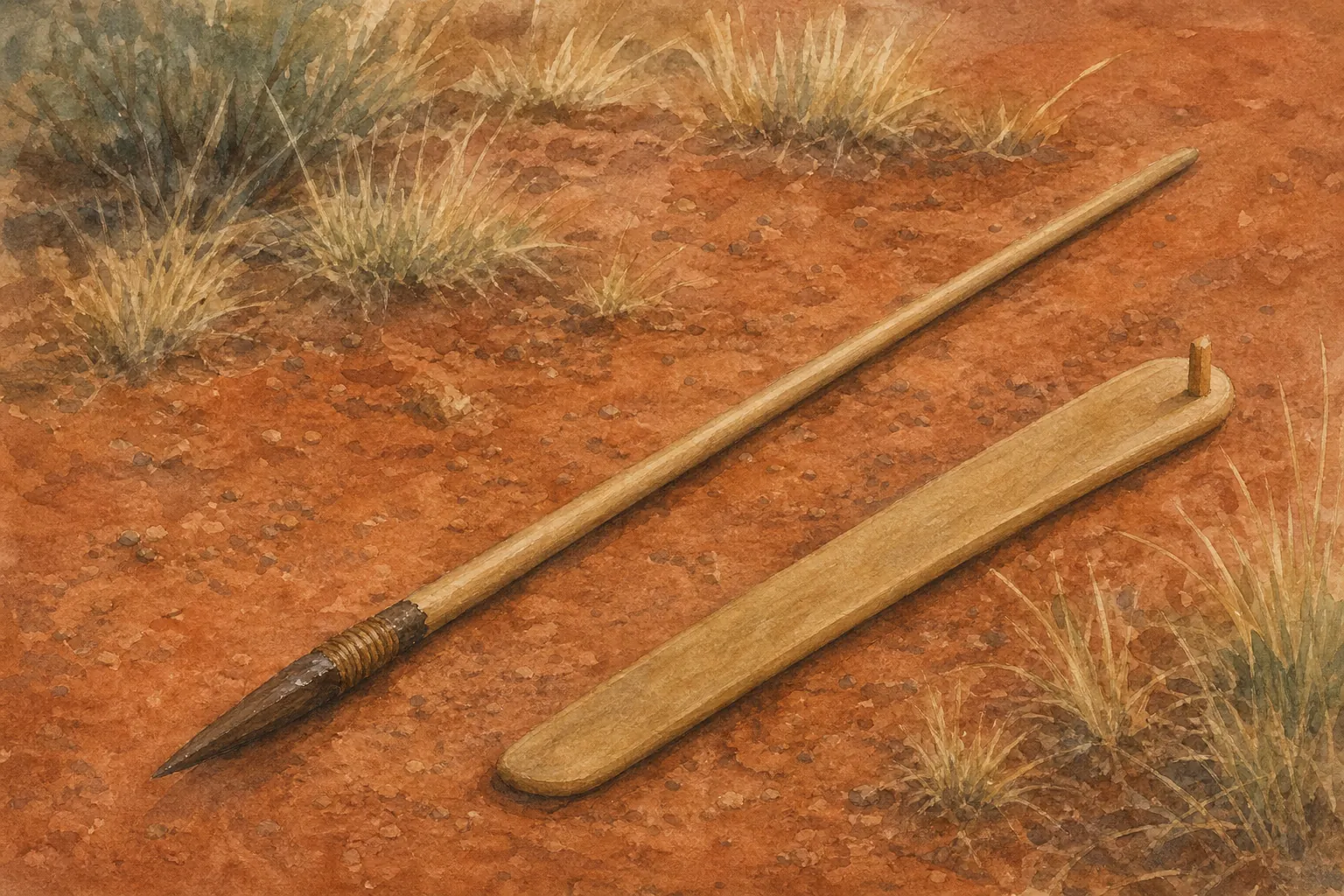
Kalka is the spear, and especially the fishing spear. Balur, Milbayarr and mirrba are the woomera, the spear-thrower whose hook, mingu, fits into the end of the spear[1]. Bloomfield River spears were built in two pieces: a light butt of grass-tree, reed or bamboo, and a hard tip of black palm (duwar), wattle or bloodwood, set with wooden or stingray barbs and sealed with tree gums[2][3]. The Bloomfield people also made a curved, moon-shaped woomera, the ballur, which was known nowhere else. It was used for spearing fish and birds at close quarters and held in a grip of its own[2][4].
Names
Kalka is 'fishing spear, also generic term for spear'[1]. Roth found the same word for spear at Princess Charlotte Bay, Cape Bedford, the Bloomfield and the middle Palmer[2]. Fishing spears are also yinba, yirrmba ('many-pronged fish spear') and jindal ('spear with three prongs')[1]. Roth's Bloomfield yirmbua, a many-pronged fish spear, is the same word as yirrmba in his 1909 spelling[2]. Barbs are jinil or manbir. A turtle-spear point is kurajan in Yalanji and biyul in Nyungkul[1]. Dara and wulburr are bamboo spear sticks, and duwar is both the black palm and a spear made from it[1].
The woomera is balur, Milbayarr or mirrba. Its hook is mingu, and its decorated butt is ngurmu[1]. Mumal is 'to throw a spear with a woomera', and damal is 'to spear'[1].
Description
Spears. Roth treated the spears of Princess Charlotte Bay, Cape Bedford, the Bloomfield and the middle Palmer as one family. Each is a light butt mortised onto a hard tip, and the end of the barb forms the very point of the spear[2]. The Bloomfield kinds he recorded, with his 1909 spellings, were[2]:
- do-war: a reed butt with a short black-palm tip, which gives the spear its name. This is duwar, the 'black palm spear' of the dictionary[1].
- wur-poi: a long grass-tree butt with a short wattle (Acacia holocarpa) tip and a wooden barb.
- yirmbua: a many-pronged fish spear of light wood, preferably grass-tree. People said it had first come from elsewhere, but it was being made on the Bloomfield before 1885.
- ta-chal and dikara: fighting spears with a short grass-tree butt and a long black-palm or bloodwood shaft, carrying one stingray barb or several set one behind the other. ku-yan: a fighting spear tipped with small quartz flakes set in gum. These are dajal, dikarra ('war spear, has a stingray barb') and kuyan ('war spear with quartz head') in the dictionary[1]. The heavy shovel-headed murrangkal of black palm is also a fighting spear[1].
Woomeras. At Cape Bedford, on the Endeavour and Bloomfield rivers and at Butcher's Hill, the ordinary spear-thrower was of ironwood. It had a long blade of even width and a short peg with a slight nick to take the spear butt. The peg was tied on with tendon through two drilled holes and covered with gum cement[2]. The handle was plain, or hafted with two pieces of baler shell (Melo) fixed with beeswax, or with a thin lath bent back on itself[2].
The ballur of the Bloomfield, and of the short coast from there south to Cape Grafton, is different. It is bent like a new moon, short, light and without a haft, and usually painted red and white at the far end[2]. The Museums Victoria example from the Bloomfield River (X 94769) is 790 mm long and 180 mm wide. It is curved, with a wooden peg bound at an acute angle and a rounded handle end. The museum notes that boomerang-shaped spear-throwers are known only from the Bloomfield area, and that Roth collected fourteen of them in 1898[4].
Where the materials come from
- Black palm (Normanbya normanbyi, Roth's Drymophloeus normanbyi): on the Bloomfield its buds and young leaf-stalks were eaten, and its timber made spears. Roth's Bloomfield name is du-ar, the dictionary's duwar[5][1].
- Bamboo and reed for light butts: dara, wulburr[1].
- Grass-tree (Xanthorrhoea) for butts and fish-spear prongs; its resin is kanunjul[2][1].
- Ironwood (Cooktown ironwood, Erythrophleum chlorostachys) for woomeras, pegs and root gum. It grows in open forest and on rainforest margins across Cape York and north-east Queensland[6].
- Woomera timbers named in the dictionary: ngadil, 'hickory, good timber for woomeras', and jinajina, the water gum, 'good timber for woomeras' in the Yalanji dialect[1]. Roth saw Butcher's Hill woomeras made of a yellow timber he called nga-til, almost certainly the same word as ngadil[2].
- Durral: a tree whose wood is used for spears[1].
- Wattle for turtle-spear points: kurrajan is 'a spear point made from wattle'[1].
- Stingray barbs, from the coast. On the middle Palmer, inland, they were traded in from the Musgrave River on the east coast and from down the Mitchell[2].
For Western Yalanji country, Roth's records from the Koko-minni of the middle Palmer, Laura and Maytown are the nearest. There, spear-throwers were of ironwood with a long Acacia peg, nicked to take the spear butt and lashed with tendon under Grevillea cement. The haft was baler shell traded from the coast or a doubled lath of wood[2]. Their fish-spear butts were of bamboo bartered from Princess Charlotte Bay, with bone barbs[2].
Uses
Fishing. Kalka is first of all a fishing spear[1]. In deep or muddy waterholes where the fish could not be seen, men struck here and there on the chance of a hit, and every now and then they succeeded[5]. Roth often watched this at Princess Charlotte Bay[2]. Muddying a shallow pool with the feet and spearing the fish as they came up was common everywhere[5]. On the lower Tully, men waded in up to the waist after eels and jabbed single-pointed spears straight down among the leaves and water-grass. Pronged spears clogged in the tussocks[5].
Birds and close work. The Bloomfield ballur was used for spearing fish or birds, especially at very close quarters[2].
Turtle. Kukuni is 'the big spear used for spearing turtle, used as a harpoon', and kurrajan is its fire-hardened wattle point[1].
Fighting. Spears were also weapons, and damaway is 'fight with spears'[1]. The war spears are listed above. The dictionary notes that the woomera also served as a shield to ward off spears[1].
How spears and woomeras were made and thrown
Making a two-piece spear (Bloomfield materials from Roth[2], methods from Roth[3]):
- Cut the parts. Take a long, light butt of grass-tree, reed or bamboo, and a hard tip of black palm, wattle or bloodwood.
- Straighten and harden. Work the wood with heat. Charring in the fire hardens a point[3]. The dictionary word balnji covers doing a job 'properly with a fire as in cooking or hardening spears over a fire'[1].
- Cut the mortise. Pick out the end of the butt with a hardened stick or bone awl. Lay red-hot cinders in the hole, blow on them, clear them out and pick again until the socket is deep enough[3].
- Fit the barb. Bind on a wooden barb so that its end forms the very point. For fighting spears, a stingray barb was used instead[2].
- Bind it. Lash the joints with twine or tendon. Biyal is sinew or string, especially wallaby-tail sinew[1].
- Seal the binding with gum. Bloomfield gums[3]:
- Grass-tree resin (kanunjul; Roth's KYE kannojó-ol). It lies in lumps among the roots and only needs heating[3][1].
- Canarium gum, from the 'brown cedar' (Roth's KYE t-chaln-ji; compare dictionary jalnji, a tree whose gum is used for making spears). Bake the dry lumps in leaves or warm them by the fire. Pound them between two greased stones until soft, then use the gum to fix haft and shaft together.
- Ironwood gum, once made on the Bloomfield. Clear the roots of a young tree. Test a root by rubbing a fire-stick on it and trying the melted gum between your teeth. If it is sticky, cut pieces off, strip the sticky covering, then roast and hammer it in turns until soft.
- Yikari: in the dictionary, beeswax hardened with ironwood root juice and used to make spears[1]. Roth gave yikari as the Bloomfield name of a traded Canarium muelleri resin[3].
- Paint it. On the Bloomfield, ochre for spear-painting was fixed with candlenut oil[3].
Making a woomera (Cape Bedford–Bloomfield–Butcher's Hill type[2]):
- Shape a long, even-width blade of ironwood, or of ngadil or jinajina[1].
- Smooth it with the rough leaves of the sandpaper fig (Ficus opposita), as was done on the Bloomfield and the Laura[3].
- Cut a short peg from Petalostigma with a slight nick in it. Lash it with tendon through two holes drilled in the blade, and cover the back with ironwood or, better, Grevillea cement[2].
- Leave the handle plain, or fix on two pieces of baler shell with beeswax[2].
Throwing (mumal):
- Fit the mingu, the hook, into the end of the spear butt[1].
- For the ordinary woomera, the blade rests between the first and second fingers. For the Bloomfield ballur, it rests in the fork between the first finger and the thumb[2].
- Throw. The woomera is 'a wooden instrument to help throw spears more powerfully'[1]. Roth describes the grips but not the rest of the throwing action, which is best learned from someone who still throws.
Safety
A spear thrown with a woomera can kill. Throw only where you can see the whole field, never toward people, dogs or a camp, and walk to collect spears only when everyone has finished throwing. Spears glance. The dictionary has a word, dalbarril, for a spear bouncing off a sea turtle's shell[1]. Barbed and stingray-tipped points tear on the way out.
Some traditional materials are hazardous. Kulbawurr, the resin gum of the cypress pine, is poisonous. It was used on spears in the old days, with an effect lasting about two hours[1]. Ironwood timber can cause dermatitis, and its splinters can cause complications[6]. Roasting and hammering gums means working close to fire and hot stones. Never carry a spear point-forward through camp.
On Country today
Under Queensland's Fisheries Act 1994, traditional fishing applies when the catch is for a personal, domestic or non-commercial communal need, follows the traditional laws and customs of the native title holders or Traditional Owners of the area, and is done by people with a connection to that land or water[7]. Section 211 of the Native Title Act 1993 gives the same protection against licence and permit requirements for native title holders' hunting and fishing[8]. Other people spearfishing must follow the ordinary fisheries rules.
Much Eastern Kuku Yalanji country, including the Daintree, Ngalba-bulal, Kalkajaka and Hope Islands national parks, is now Aboriginal land jointly managed with QPWS[9]. On Western Yalanji country the 2026 determination recognised rights to hunt, fish and gather over most of the area[10]. Visitors need the Traditional Owners' permission. Old spears and spear-throwers from the Bloomfield are held in museums, including the ballur at Museums Victoria[4].
Language
Damal 'to spear'; mungkil 'spear to kill'; [ngura-ngura ngal](word:ngura-ngura ngal) 'straighten, measure, aim'; kajal 'to tie'; janbangal 'to glue or stick something, using pitch or glue (yalanji only)'[1].
References
- Hershberger, H. D. & Hershberger, R. (1982). Kuku-Yalanji Dictionary. Work Papers of SIL-AAB, Series B, Volume 7. With Toby Bloomfield, Roy Friday, Billy Roberts, Hector and Doris Sykes, Joe Walker and others. www.sil.org/resources/archives/18038
- Roth, W. E. (1909). North Queensland Ethnography, Bulletin No. 13: Fighting weapons. Records of the Australian Museum 7(4): 189–211. — Sect. 4 (spears of Princess Charlotte Bay, Cape Bedford, Bloomfield and middle Palmer); sects. 10–11 (spear-throwers) archive.org/details/biostor-52873
- Roth, W. E. (1904). North Queensland Ethnography, Bulletin No. 7: Domestic implements, arts, and manufactures. Brisbane: Government Printer. Bloomfield River information from R. Hislop. — Sects. 2–4 (treatment and polishing of timber, morticing); sect. 13 'Gums, resins, cements' archive.org/details/northqueensland00landgoog
- Museums Victoria Collections. Item X 94769: Ballur, spearthrower, Bloomfield River, East Cape York, Queensland, c.1880. collections.museumsvictoria.com.au/items/239263
- Roth, W. E. (1901). North Queensland Ethnography, Bulletin No. 3: Food — its search, capture, and preparation. Brisbane: Government Printer. — Fish capture: muddying, spears; plant list, 'Drymophloeus normanbyi' archive.org/details/northqueensland00landgoog
- Australian Tropical Rainforest Plants (RFK8), Erythrophleum chlorostachys. CSIRO / Lucidcentral. apps.lucidcentral.org/rainforest/text/entities/Erythrophleum_chlorostachys.htm
- Business Queensland. First Nations fishing (Fisheries Act 1994). www.business.qld.gov.au/industries/farms-fishing-forestry/fisheries/first-nations
- Australian Law Reform Commission. Review of the Native Title Act 1993 (DP 82), ch. 8: Relevant provisions in the Native Title Act (s 211). www.alrc.gov.au/publication/review-of-the-native-title-act-1993-dp-82/8-the-nature-and-content-of-native-title/relevant-provisions-in-the-native-title-act/
- National Indigenous Times (1 October 2021). Daintree Rainforest handed back to Eastern Kuku Yalanji people. nit.com.au/01-10-2021/2393/daintree-rainforest-handed-back-to-eastern-kuku-yalanji-people
- National Indigenous Times (13 August 2026). Western Yalanji determination brings Cape York native title 'to the finish line'. nit.com.au/13-08-2026/25941/western-yalanji-determination-brings-cape-york-native-title-to-the-finish-line