Trees
Bloodwoods
babajaka · kawarr · kuji-kujiCorymbia clarksoniana, C. erythrophloia, C. hylandii, C. stockeri, C. terminalis and others
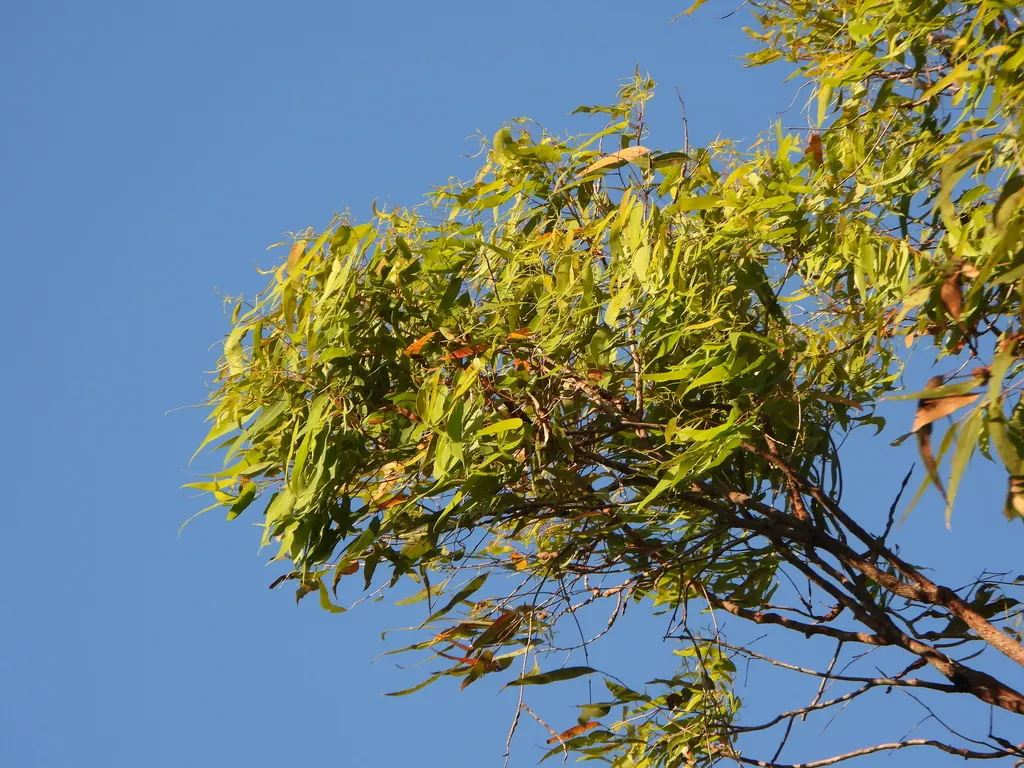
The bloodwoods are the rough-barked gums of the woodland, named for the dark red kino that bleeds from a cut, and the dictionary has three words for them: babajaka, kawarr and kuji-kuji, each 'a species of bloodwood tree'[1]. They are known by their bark, 'tessellated', broken into small squares like a crocodile's back, and by their big urn- or barrel-shaped fruit[2][3]. The old uses on record are the bark, which Roth saw made into pleated troughs at Cooktown, the boughs thrown down as a windbreak, the seed pods that Bloomfield people worked into their hair with beeswax and clay, the charcoal, the red gum as a medicine in the western and Palmer districts, and two foods Edward Palmer recorded on the Mitchell in 1883: the sweet manna that falls from the leaves after the rains, and the galls, 'Kurcha', with a grub or a bag of jelly inside[4][5][6][7][8]. The red-tailed black cockatoos that crack the fruit and the sugarbag bees in the hollows depend on the same trees[9].
Hann River Cape York
Possum People's country on the upper river and Thaypan (Kuku Thaypan) country downstream: stringybark and bloodwood woodland and a spring-fed sandy river that runs north-east from the Great Dividing Range, past the Peninsula Developmental Road, into Rinyirru (Lakefield) and the North Kennedy. Not Kuku Yalanji country: the Kuku Yalanji words on this page are the dictionary's, not the Hann's own languages. Place guide
Bloodwoods are part of the Hann's own woodland: the country along the river is 'stringybark, bloodwood, Moreton Bay ash and ironbark trees with a ground cover of coarse grasses such as speargrass'[22]. The Atlas of Living Australia holds 297 bloodwood (Corymbia) records, from 1965 to 2026, in a box of about 90 × 85 km around the middle Hann, Laura and western Rinyirru; most are Clarkson's bloodwood (106), blotchy bloodwood (52) and the Melville Island bloodwood, C. nesophila (47)[23]. Kuku Thaypan Elders read the bloodwood for fire, for possums and for gum, and their knowledge is the main published record for this country[24].
Where they grow here
In the Kuku Thaypan Elders' description, their bloodwood is 'found all over the landscape except for in the river bed areas'[24]. Bloodwood is a parent tree of two of their country types[24]:
- Mixed-tree country: bloodwood and Cooktown ironwood over cocky apple, bushman's clothes peg and cabbage palm, on 'slightly elevated light sandy soil', with kurrajong and yams beneath.
- Gum tree country: Ku garl gum with bloodwood.
Bloodwoods also stand in the stonier, shorter Debil Debil country, and the Elders warn: 'This country can trick you with timing because it has bloodwoods in it so you think ah its bloodwood country but it isn’t it is much stonier and shorter than bloodwood country'[24].
Its year here
After the wet 'large numbers of suckers always shoot up' from the bloodwood[24].
Early dry. In the Kuku Thaypan fire calendar, bloodwood flowering comes with cooler nights, heavy dews and nesting emus, and the knock-em-down rain. 'The Bloodwood Ku argnamageel flower ku enyarl also signals that the Boxwood system is ready for burning.' Mixed-tree country itself is burnt 'during the knock-em- down rain when Bloodwood species begin flowering', 'in late July early August depending on the mix of tree species present, the geographical location and the season'[24].
June–July is when the gum shows in the young leaves, the possum sign below[24]. Through the late dry the Hann runs low between its holes and the woodland dries; at Musgrave hardly any rain falls from June to September[25].
How people used it here
Gum (Kuku Thaypan). Bloodwood trees 'were utilised for sap and cut with a stone tommy hawk to gain the useful sticky substance'. Elder George Musgrave Snr, recorded in 2003: 'if you no gum they use that thing, mix em up the grass tree gum, mix em up. Turn it hard. You can tie the spear, or you can plug the, ah the, Mess Mate Bark (Stringy Bark bowl) anything leak like that, you can put that plug that on. Shut the hole up.'[24]
Reading the possums (Kuku Thaypan). 'Bloodwood tell you the fat that possum' (Musgrave). The method, as the Elders gave it[24]:
- Pick a young leaf from a bloodwood sucker, the lighter green ones.
- Break it and pull it apart.
- If gum shows between the broken halves, the possums are fat; if not, they are not. The sign is expected in June and July.
The Elders burnt bloodwood country 'to produce new shoots for possums at important times of year in their breeding cycles'[24].
Toothache (Kuku Warra, Laura). A Kuku Warra witness told the Federal Court: 'For a toothache, you get the gum or sap from the bloodwood tree'[26].
Sugarbag. Bloodwood is one of the trees the Elders list as important for native sugarbag bees; their own bloodwood has 'very poor wood quality' and is 'commonly found dead or pretty much hollowed out by termites'[24].
Nothing is published on the Possum People's use of bloodwood on the upper Hann.
On country today
The upper Hann is the Possum People's country and the middle and lower Hann are Thaypan country, both determined in November 2023[27][28]; Rinyirru's Traditional Owners are the Lama Lama and Kuku Thaypan peoples[29]. The fire signs are the Elders' knowledge. In 2007, after the Elders mentioned bloodwood flowering as a burning indicator, park staff burnt bloodwood country across Rinyirru without them, and this 'was seen as deliberately trying to take the knowledge of the Elders and implement it without them'[24]. Burn with the Traditional Owners, not from this page.
Language
Kuku Thaypan names for the bloodwood, as Standley spells them: Ku Anarmagetta, Ku arramagel, Ku argnamageel, Ku argnamagal[24]. 'Mixed bloodwood' is Ku arnagel in one passage[24]. There is no published Kuku Thaypan dictionary to settle the spelling.
Upper Mitchell Western Yalanji
Western Yalanji country west of the Great Dividing Range: dry open woodland cut by the sandy, paperbark-lined upper Mitchell River, around Karma Waters and Mount Carbine. Place guide
At Karma Waters the bloodwoods are the second family of the hills after the ironbarks: Clarkson's bloodwood is one of the three trees the Queensland Herbarium names for the woodland on these slopes, and the Atlas of Living Australia records Hyland's, red, blotchy and inland bloodwoods as well within 30 km of the homestead[16][30].
Where they grow here
The Queensland Herbarium's description of the hill woodland at Karma Waters names Clarkson's bloodwood with Molloy red box and Cullen's ironbark as the three trees of the slopes[16]. Hyland's bloodwood on the sandstone and granite ridges and blotchy bloodwood on the river levees are the other two common ones here, and the inland bloodwood reaches the upper Mitchell from the dry country[11][12][10]. Of the smooth-barked ones, Dallachy's ghost gum is the commonest tree in the Karma Waters records[30]. Grassy woodland on sand and sandy loam, the bloodwoods' country, is the country of the upper Mitchell[2][16].
On the station
Cutting bark or felling on the station is a matter for the lessee's permission[31].
On country today
The bloodwoods are the most ordinary trees on Karma Waters and the ones with the most in them: the cockatoos, the bees, the hollows, the kino and the galls. Gathering on native title country here is recognised in the Western Yalanji determinations[32].
Eastern coast Eastern Kuku Yalanji
Eastern Kuku Yalanji country: rainforest, beaches, mangroves, reef and the short steep rivers from the Daintree to the Bloomfield and the Annan.
The dictionary's three bloodwood words, babajaka, kawarr and kuji-kuji, come from the open country behind the Bloomfield, the eastern edge of the same woodland[1].
How people used it here
At Bloomfield, 'small clay balls mixed with bloodwood seed pods' were put into the hair with beeswax[6].
Everywhere
Names
babajaka, kawarr and kuji-kuji are each glossed 'species of bloodwood tree' and nothing more, so the three words are three bloodwoods that the dictionary's speakers told apart and the dictionary does not[1]. Beside them the dictionary has kayjurr 'white gum', jabarr 'baldy gum', dari 'boxwood tree, grows mainly in high places', the stringybarks marbaji and warka, and the water gums dakumbar and jinajina, the latter 'good timber for woomeras'[1]. Roth's Cooktown name for the bloodwood whose bark made troughs was jin-jil (Guugu Yimithirr); on the Palmer the Koko-minni called the inland bloodwood ga-ja, and in Pitta-Pitta, in the Boulia district far to the south-west, its gum was richindi[4][7]. Palmer's Cloncurry name for the inland bloodwood was Narm-boon-bong and on the Gilbert Kulcha; the gall was Kurcha 'on the Mitchell and Cloncurry Rivers', in languages he does not name[8].
The bloodwoods
Bloodwoods are the genus Corymbia, split from Eucalyptus in 1995, and the rough-barked ones share a look: bark 'tessellated', cracked into small plates, on the trunk and branches; leaves paler underneath; flowers in branched bunches of seven at the ends of the twigs; and big thick-walled fruit shaped like an urn or a barrel, with a winged seed[2][3]. Cut one and it bleeds red kino, the 'blood'[10].
Clarkson's bloodwood (C. clarksoniana) is the woodland's: a tree to 15 m with a lignotuber, bark 'rough throughout, tessellated, grey, grey-brown and red to orange', glossy green lance-shaped leaves 6–18 cm long, cream flowers, and fruit 'urceolate varying to barrel-shaped', 1.2–2.5 cm long. It grows 'as a component of often grassy woodlands and forests on sand and sandy loam, but also may be on rising ground in skeletal soil', from northern New South Wales to about 13° on the Peninsula; flowering is recorded in January and from March to August[2].
Red bloodwood (C. erythrophloia), 'variable-barked' or 'gum-topped bloodwood': to 15 m, with 'tessellated, red-brown, dull, grey or pink bark that is persistent on the trunk and lower branches' and sheds 'in small polygonal flakes giving the tree a mottled appearance'; it runs from Cooktown west to the Gulf and south to Hervey Bay, often with narrow-leaved ironbark[3].
Hyland's bloodwood (C. hylandii) of the sandstone and granite ridges and blotchy bloodwood (C. stockeri) of the river levees are two more; the woodland page sets them side by side[11][12].
Inland bloodwood (C. terminalis), tjuta, the bloodwood of the dry country, is a tree to 18 m 'on river flats, scree slopes and dune swales', with light brown to light grey tessellated bark and scurfy cream buds. Its flowers 'produce drops of nectar which provide a high energy food source for many desert animals including honeyeaters, insects and possums', and it carries the bush coconut, a gall made by a coccid insect that 'burrows into the bark', which 'must be broken open; the insect on the inside can be eaten, and contains a lot of moisture'[10].
The smooth ones. The same genus holds the smooth-barked gums of the flats: Dallachy's ghost gum (C. dallachiana), with 'smooth white to cream-coloured and pinkish bark that is shed in thin patches' on the grassy plains and creek levees, and the carbeens C. confertiflora and C. tessellaris with a rough grey stocking at the base and smooth limbs above[13][14][15].
Bloodwood, ironbark, box
- Bloodwood: bark in small squares, flaking, grey to red; urn-shaped fruit as big as a thumb-joint; red kino[2][10].
- Ironbark (Cullen's): bark hard, black, deeply furrowed, never flaking; small fruit[16].
- Box (Molloy red box, green-leaf box): bark fibrous and flaky in short strips, grey-brown; small cup fruit[16].
- Ghost gum and carbeen: bark smooth and white or with a rough grey stocking only at the base; these are bloodwoods too, by the fruit and the flower bunches, but no one calls them that[13][15].
- Ironwood: not a gum at all; dark, hard, rough bark, pinnate leaves and a flat pod[1].
- Among the bloodwoods, the fruit shape is the best guide: Clarkson's urn-shaped and less than twice as long as wide; Hyland's smaller; the inland bloodwood scurfy-budded[2][10].
Signs
- Red stains down the trunk where a limb has broken: kino[10].
- Chewed fruit split open under a tree is cockatoo work; eucalypt seed, 'especially the big-fruited gums and bloodwoods', is the mainstay of the red-tailed black cockatoo[9].
- Galls as big as a hen's egg on the young trees, Palmer's Kurcha, with a grub or a bag of jelly inside[8].
- A white crust on the leaves and twigs after the rains is manna, which Palmer saw gathered on the Mitchell[8].
- Bee dung at the base and a hollow note when tapped mark a sugarbag tree; big old bloodwoods with hollows are the hives[6].
- Bark scars, long and rectangular, on old trees by a camp are trough scars[4].
Where they grow
Clarkson's bloodwood on the sandy and stony slopes with the ironbark and the red box; Hyland's on the sandstone and granite ridges; the blotchy bloodwood on the river levees; the inland bloodwood on the flats toward the dry country; the ghost gum on the grassy plains and creek levees[16][11][12][10][13]. All of them are trees of grassy woodland on sand and sandy loam[2]. Where they grow in each place is set out under that place.
What the bloodwood feeds
The bloodwood is a nectar tree and a hollow tree. Its flowers feed the honeyeaters, the flying foxes and the native bees, whose sugarbag fills its hollows; its seed feeds the red-tailed black cockatoo, which can be heard cracking the fruit from a long way off; its galls feed the grub and the people who found them; and its manna, the sugary exudate that follows the rains, was food on the Mitchell[10][9][8]. The hollows that the kino and the termites make in an old bloodwood are the nest sites of the woodland: parrots, kookaburras, possums, bats, goannas[16]. Fire runs under it every few years in this country, and the tessellated bark and the lignotuber are what let it stand through the burns[17][2].
Seasons
Clarkson's bloodwood flowers from March to August and in January, so its blossom and its sugarbag run through the dry[2]. Palmer: 'After the rainy season this food is said to be abundant', of the manna[8]. Bark comes off 'at the end of the wet season when the sap is up and the bark slips'[4]. Seed falls to the cockatoos in the late dry. See the year on country.
Uses
- Bark troughs. At Cooktown the spiked pleat-type trough was made from the bark of the bloodwood (jin-jil), among other trees; see bark troughs[4].
- Windbreak. Leafy bloodwood boughs thrown down in a half circle round the sleeping place; see huts and shelters[5].
- Charcoal. Bloodwood charcoal was a body paint on the Tully and a wound dressing at Brisbane, where a washed and scraped wound 'would then just be covered up with wood-ashes or blood-wood charcoal'[7].
- Kino as medicine, elsewhere. On the Palmer the Koko-minni took the inland bloodwood's gum 'mixed with water ... for constipation'; in the Boulia, Cloncurry and Georgina districts the bloodwood gum was dusted on sores or boiled and drunk; in the desert the kino is drunk in water for diarrhoea, indigestion and chest pain. No Kuku Yalanji medicinal use of kino is on record[7][10].
- Cement. At Brisbane 'this "bloodwood" gum was warmed for use, and mixed with spittle to make it set'[4].
- Manna. On the Mitchell the sugary particles were gathered from the leaves and small branches laid on bark, 'or are scraped off with mussel-shells into a kooliman', or the crusted leaves were 'pounded together with a stone and roasted in the ashes'[8].
- Galls. The Kurcha galls on young bloodwood and messmate, 'two inches or more in diameter', with a grub or 'a small transparent bag of jelly-like substance' inside, were eaten on the Mitchell; the inland bloodwood's bush coconut is the same thing[8][10].
- Timber. The inland bloodwood's wood 'was used by indigenous peoples to make spear-throwers, digging bowls and carrying vessels'[10].
- Sugarbag from the hollows; see native bees[6].
Working the bloodwood
Manna (Palmer's Mitchell River method)[8]: after the rains, when the leaves and twigs carry a white crust, lay sheets of bark under the tree and strip the leaves onto them so the particles fall; or scrape the crust off with a mussel shell into a trough; or pound the crusted leaves with a stone and roast the mass in the ashes.
Galls: break the big gall open; eat the grub or the jelly inside[8][10].
A bark trough: the Cooktown method is on the bark troughs page; take the sheet when the sap is up after the storms[4].
Charcoal: bloodwood charcoal, cold and crushed, for paint or a dressing[7].
Finding sugarbag: in the late dry, check the bases of the old bloodwoods for bee dung and tap the trunks for hollowness; see native bees[6].
Safety
- Old bloodwoods drop limbs; never camp under a dead one[18].
- The kino medicines on record are from other districts and other languages; the Kuku Yalanji record is silent, and this page does not recommend them[7][10].
- Scarred trees are protected heritage; ask the Traditional Owners, and the landholder, before cutting bark or felling[19].
- Fire: this is a 2–5 year burn woodland, and a bloodwood crown fire in the late dry is not a cultural burn[17][20].
On Country today
The bloodwoods are the most ordinary trees of the woodland and the ones with the most in them: the cockatoos, the bees, the hollows, the kino and the galls. Which of the three dictionary words belongs to which tree is a question for Kuku Yalanji speakers; the contribution box below is for that[1]. Gathering on native title country is protected by section 211 of the Native Title Act 1993[21].
Language
babajaka, kawarr, kuji-kuji 'species of bloodwood tree'; kayjurr 'white gum'; jabarr 'baldy gum'; dari 'boxwood tree'; marbaji, warka stringybarks; jinajina 'water gum tree; good timber for woomeras'; nganyin 'sugar bag'; mandi-mandi 'honeycomb'; dabu and kuja the bees; ngalku 'bush fire'; duli 'burnt patch of grass'[1].
References
- Hershberger, H. D. & Hershberger, R. (1982). Kuku-Yalanji Dictionary. Work Papers of SIL-AAB, Series B, Volume 7. With Toby Bloomfield, Roy Friday, Billy Roberts, Hector and Doris Sykes, Joe Walker and others. www.sil.org/resources/archives/18038
- EUCLID: Eucalypts of Australia, online edition (CSIRO / Lucidcentral). Corymbia clarksoniana, Clarkson's bloodwood. apps.lucidcentral.org/euclid/text/entities/corymbia_clarksoniana.htm
- Wikipedia. Corymbia erythrophloia (red bloodwood). en.wikipedia.org/wiki/Corymbia_erythrophloia
- Roth, W. E. (1904). North Queensland Ethnography, Bulletin No. 7: Domestic implements, arts, and manufactures. Brisbane: Government Printer. — Sect. 10 'Fire-tongs' archive.org/details/northqueensland00landgoog
- Roth, W. E. (1910). North Queensland Ethnography, Bulletin No. 16: Huts and shelters. Records of the Australian Museum 8(1): 55–66. — Sect. 11, ridge-pole huts archive.org/details/records-australian-museum-8-055-066
- Anderson, C. (1996). Traditional material culture of the Kuku-Yalanji of Bloomfield River, North Queensland. Records of the South Australian Museum 29(1): 63–83. Based on fieldwork at Wujal Wujal in the late 1970s and early 1980s. — Hunting (spears, spear-throwers, harpoons); fishing (stupefacients); manufacturing (gums and resins); post-contact bush component archive.org/details/RecordsSouthAus29Sout
- Roth, W. E. (1903). North Queensland Ethnography, Bulletin No. 5: Superstition, magic, and medicine. Brisbane: Government Printer. — Medicine, 'Erythrophloeum laboucherii' (Pennefather River) archive.org/details/northqueensland00landgoog
- Palmer, E. (1883). On plants used by the natives of North Queensland, Flinders and Mitchell Rivers, for food, medicine, &c., &c. Journal and Proceedings of the Royal Society of New South Wales 17: 93–113. Palmer's Mitchell River names come from the lower and middle Mitchell, not from Kuku Yalanji speakers. archive.org/details/journalandproce16walegoog
- Wikipedia. Red-tailed black cockatoo. en.wikipedia.org/wiki/Red-tailed_black_cockatoo
- Wikipedia. Corymbia terminalis (inland bloodwood, tjuta), citing Hill & Johnson 1995 and Aboriginal-use sources. en.wikipedia.org/wiki/Corymbia_terminalis
- Wikipedia. Corymbia hylandii (Hyland's bloodwood). en.wikipedia.org/wiki/Corymbia_hylandii
- Wikipedia. Corymbia stockeri (blotchy bloodwood). en.wikipedia.org/wiki/Corymbia_stockeri
- Wikipedia. Corymbia dallachiana (Dallachy's gum). en.wikipedia.org/wiki/Corymbia_dallachiana
- Wikipedia. Corymbia confertiflora (broad-leaved carbeen). en.wikipedia.org/wiki/Corymbia_confertiflora
- Wikipedia. Corymbia tessellaris (carbeen, Moreton Bay ash). en.wikipedia.org/wiki/Corymbia_tessellaris
- Queensland Herbarium, Regional Ecosystem 9.11.26 (Einasleigh Uplands): Eucalyptus leptophleba and/or E. cullenii and/or Corymbia clarksoniana +/- E. platyphylla woodland on undulating terrain to rolling hills. Fire management guidelines. Queensland Government Regional Ecosystem Description Database. apps.des.qld.gov.au/regional-ecosystems/details/?re=9.11.26
- Queensland Parks and Wildlife Service (2013). Planned Burn Guidelines: Cape York Peninsula Bioregion of Queensland. Department of National Parks, Recreation, Sport and Racing. — 'Fire in the monsoonal tropics of the Cape York Peninsula bioregion'; ch. 1–2 season guidance (storm burns) parks.desi.qld.gov.au/__data/assets/pdf_file/0019/151480/pbg-cape-york.pdf
- Karma Waters Station. Bush Camping at Karma Waters Station (web page, accessed 5 October 2026). www.karmawatersstation.com/bush-camping.html
- Aboriginal Cultural Heritage Act 2003 (Qld), sections 23–25 (cultural heritage duty of care; harming, excavating, relocating or taking away Aboriginal cultural heritage). www.legislation.qld.gov.au/view/html/inforce/current/act-2003-079
- Queensland Fire Department. Fire permits: lighting fires in Queensland. fire.qld.gov.au/safety-education/using-fire-outdoors/lighting-fires-in-queensland
- Australian Law Reform Commission. Review of the Native Title Act 1993 (DP 82), ch. 8: Relevant provisions in the Native Title Act (s 211). www.alrc.gov.au/publication/review-of-the-native-title-act-1993-dp-82/8-the-nature-and-content-of-native-title/relevant-provisions-in-the-native-title-act/
- Wikipedia. Hann River (Queensland) (accessed 28 October 2026). en.wikipedia.org/wiki/Hann_River_(Queensland)
- Atlas of Living Australia. Occurrence records of Corymbia (297 records, 1965–2026; C. clarksoniana 106, C. stockeri 52, C. nesophila 47, C. tessellaris 21, C. confertiflora 20, C. dallachiana 16) in a box of about 90 × 85 km around the middle Hann River, Laura and western Rinyirru (lat −15.6 to −14.8, long 143.5 to 144.3), queried 28 October 2026. biocache.ala.org.au/occurrences/search?q=genus%3ACorymbia
- Standley, P.-M. (2019). The importance of campfires to effective conservation. PhD thesis, James Cook University. Records the fire and country knowledge of Kuku Thaypan Elders Dr Tommy George and Dr George Musgrave. researchonline.jcu.edu.au/64274/
- Bureau of Meteorology. Climate statistics for Australian locations: Musgrave (station 028007, 79 m), 1887–2012. www.bom.gov.au/climate/averages/tables/cw_028007.shtml
- Ross on behalf of the Cape York United #1 Claim Group v State of Queensland (No 19) (Kuku Warra determination) [2023] FCA 1314 (Federal Court of Australia, 2 November 2023). www.judgments.fedcourt.gov.au/judgments/Judgments/fca/single/2023/2023fca1314
- Ross on behalf of the Cape York United #1 Claim Group v State of Queensland (No 21) (Possum determination) [2023] FCA 1316 (Federal Court of Australia, 2 November 2023). — Determination area (upper Hann and Kennedy rivers); prescribed body corporate; affidavit evidence on hunting and fishing www.judgments.fedcourt.gov.au/judgments/Judgments/fca/single/2023/2023fca1316
- Ross on behalf of the Cape York United #1 Claim Group v State of Queensland (No 20) (Thaypan determination) [2023] FCA 1315 (Federal Court of Australia, 2 November 2023). — Determination area and waters; prescribed body corporate (Awu-Laya Indigenous Corporation); affidavit evidence on hunting www.judgments.fedcourt.gov.au/judgments/Judgments/fca/single/2023/2023fca1315
- Queensland Parks and Wildlife Service. Nature, culture and history: Rinyirru (Lakefield) National Park (CYPAL) (web page, last updated 1 July 2024; accessed 28 October 2026). parks.qld.gov.au/parks/rinyirru-lakefield/about/culture
- Atlas of Living Australia. Plant occurrence records within 30 km of the Karma Waters homestead (16.62°S, 144.60°E), queried 10 October 2026: 832 records of 266 species. biocache.ala.org.au/occurrences/search?q=kingdom:Plantae&lat=-16.62&lon=144.60&radius=30
- Karma Waters Station. About: location, native title (web page, accessed 5 October 2026). www.karmawatersstation.com/about.html
- Western Yalanji Aboriginal Corporation & CRC for Developing Northern Australia (2020). Western Yalanji Land Use and Economic Diversification Plan. CC BY 4.0. — Native Title Determinations 1–4 (pp. 13–18); ‘Fire Management and Carbon Farming’ (pp. 32–33); ‘Pastoralists’ crcna.com.au/wp-content/uploads/2024/05/westernyalanjilanduseplan_nov2020.pdf
From the community
Know this one? Add the words you use for it, what it is for, how it is done, a correction, or a photo from country. It shows here straight away with your name on it. Please keep anything restricted or sacred off the site.
Loading…