Trees
Ironwood
jujabalaErythrophleum chlorostachys (syn. E. laboucherii)
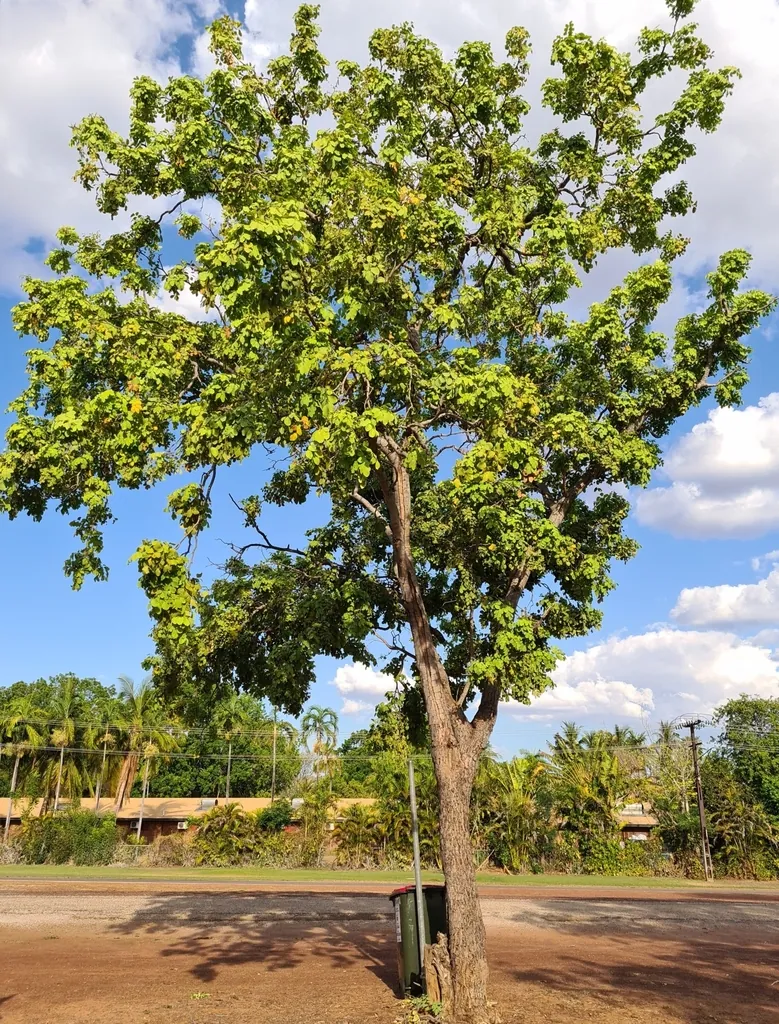
Jujabala is the 'ironwood tree'[1]. On the Bloomfield River, 'ironwood' meant the Cooktown ironwood, Erythrophleum chlorostachys, a tree of the dry open forest with extremely hard, heavy wood[2][3]. Kuku Yalanji made hunting spear-throwers and fire-hardened spear points from it, and cooked a strong cement out of the sticky covering of its roots[2][4]. That root 'juice' also hardened the beeswax called yikari[1]. Its bark and leaves were a fish poison[2], and its leaves are deadly to cattle and horses[5].
Names
Jujabala is 'ironwood tree'[1]. Its bark is also burned to control thunderstorms, the dictionary notes. Anderson's Bloomfield account names 'Cooktown ironwood' as Erythrophleum chlorostachys[2]. Roth used the older name E. laboucherii[4], which is now a synonym[6]. Several unrelated hardwoods are called 'ironwood' in English, so the botanical name matters. The match between the word and the tree rests on the ethnographers' usage and on the root gum (see Uses).
Description
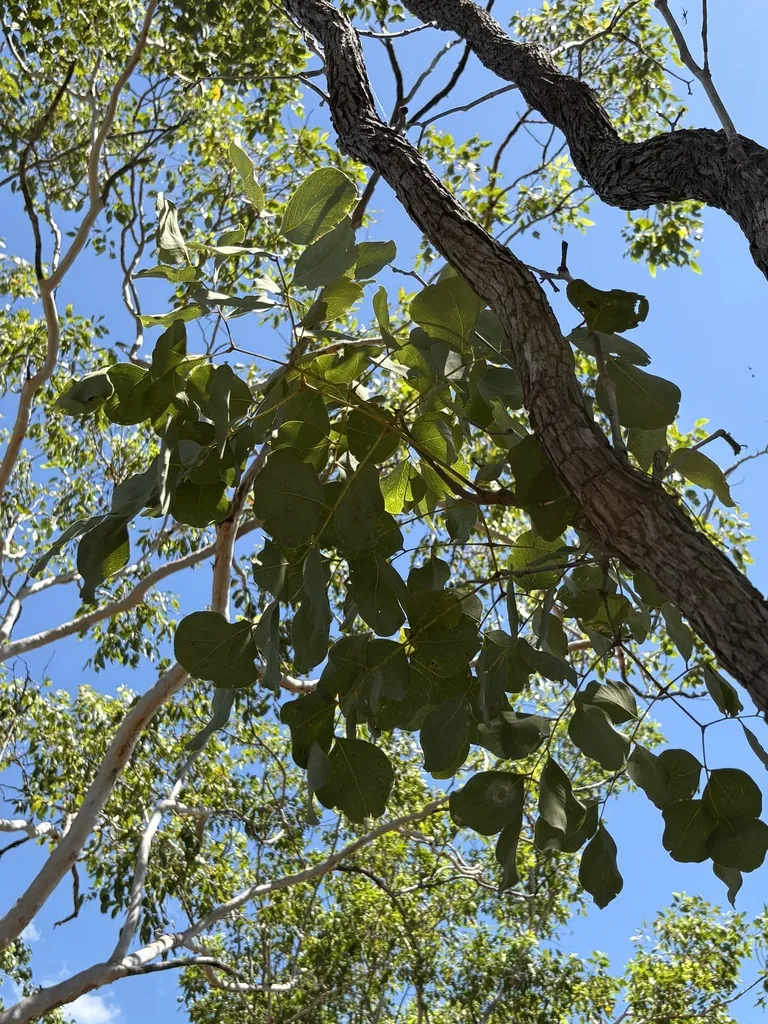
E. chlorostachys is a tree of the pea family. Its trunk is often short, and its dead bark is 'hard and horny to cut'. The wood is 'extremely hard and heavy', with a specific gravity of about 1.22, so it sinks in water[3]. Each leaf is divided into leaflets 3–5.5 cm long with lopsided bases. The small flowers grow in spikes, and the flat pods, 25–40 mm wide, hold seeds about 10 mm across[3]. The tree is semi-deciduous, shedding leaves in the dry winter, and the timber resists termites[6].
Where it grows
Cooktown ironwood grows only in Australia, from north-east Queensland across Cape York Peninsula and the Northern Territory to the Kimberley. It is mainly a tree of open forest but also grows in monsoon forest and on rainforest edges, from sea level to 500 m[3][6]. Roth saw ironwood cement in use on the Endeavour, Laura and Palmer rivers and on the Gulf coast between the Mitchell and Staaten rivers[4]. On the middle Palmer, Koko-minni people made spear-throwers and hut bark from it[7][8].
Around Karma Waters. The Atlas of Living Australia has no ironwood records within 30 km of the homestead. Within 60 km it holds 39 records of E. chlorostachys. The nearest is a Queensland WildNet record about 35 km south-west, near Nychum. There are herbarium specimens from Mount Mulligan (1936) and from Whites Creek on the Peninsula Development Road, in open forest about 43 km north (1990)[9]. So ironwood grows around the upper Mitchell but is patchy. Learn to recognise it before turning stock into a new paddock (see Safety).
Uses
Spear-throwers (Bloomfield). Hunters used a plain lath spear-thrower of E. chlorostachys, linear or oval in outline, 0.9–1 m long and 60–90 mm wide, usually without a shell grip[2]. There are many scarred trees around the Bloomfield where wood for them was cut out[2]. Roth describes the ironwood spear-thrower of Cape Bedford, the Endeavour and Bloomfield rivers and Butcher's Hill. It had a long blade of even width and a short peg of Petalostigma tied on with tendon and covered with cement[7]. See Spear and woomera.
Spear points. For wooden-pointed spears, Cooktown ironwood sometimes replaced black palm as the point and foreshaft, and was fire-hardened after sharpening. Turtle-harpoon points were usually Acacia crassicarpa but sometimes ironwood[2].
Cement (Bloomfield). The sticky covering of ironwood roots made a strong black cement[4][2]. Anderson's consultants rated it above grass-tree gum: 'readily available and of good quality'[2]. It fixed stingray barbs and spear prongs over their sinew bindings[2]. Its weakness was 'its liability to crack', and on spear-throwers a Grevillea cement was preferred where it could be had, 'as it lasts better'[4][7]. The dictionary's yikari is 'hardened beeswax, hardened with ironwood root juice. The juice is extracted by heating and is used to make spears'[1]. That joins this tree to the wax of native bees.
Fish poison. In the inland areas in the late dry, the bark and leaves were smashed together under water in drying waterholes to stun fish[2]. See fish-poison plants and fish poisoning.
Other tools. The smoothing board for spreading hot cement, used on the Bloomfield, Palmer and Mitchell rivers, was a flat piece of ironwood or similar wood[4]. Across North Queensland, women's digging sticks were cut from ironwood 'where generally available'. On the Bloomfield the digging stick was tchu-al in Roth's spelling, the dictionary's juwal[4][1]. No source here records ironwood clubs among Kuku Yalanji.
Medicine (neighbours, not Kuku Yalanji). On the Pennefather River, far to the north, the outer bark was soaked in water for some hours. The liquid was rubbed into spear wounds, or over the whole body for general sickness[10].
How it was done
Ironwood root cement, Bloomfield River. Roth's account came from R. Hislop[4], and Anderson recorded it at Wujal Wujal[2].
- Choose a tree, 'the younger the better'.
- Test first. Rub a firestick on an exposed root so that some of the sticky covering melts off. Try it between your closed teeth. If it is sticky there, the gum is good.
- Clear the soil from the underground roots and cut off pieces of a handy length.
- Strip off the sticky outer covering with a bark strip pulled steadily upwards, or scrape it off. Gather it onto the end of a stick.
- Roast it lightly over the fire.
- Pound it between two stones greased with cassowary fat so that it does not stick.
- Roast and pound again, and keep alternating until it is soft. Let it cool and harden for storage.
- To use it, warm it and spread it over the binding with a greased wooden smoothing board.
A spear-thrower blank. Cut a lath from the trunk, which leaves a scar like those still seen around the Bloomfield. Shape it to 0.9–1 m long and 60–90 mm wide[2]. Fig leaves were used to smooth the blade[7] (see Fig).
Safety
Stock poison. Cooktown ironwood is 'well known as a stock poison'. It has killed cattle, horses, sheep, donkeys, goats and camels[3]. A Northern Territory resource puts the lethal dose at less than 100 g for a horse or a cow. Poisonings usually happen in the dry season, when pasture is poor and the tree is putting out fresh shoots. The young leaves and sucker growth are the most toxic. Sick animals show severe abdominal pain, sunken eyes, laboured breathing and sometimes bloody scours, and usually die within 24–48 hours. There is no consistently successful treatment, so keep stock away from ironwood country at risky times[5].
People. The timber can cause dermatitis, and splinters can turn septic. Rainwater collected under the trees can be fouled by fallen leaves[3]. A waterhole poisoned for fish was unusable until a storm and flood renewed it[2]. Don't drink from water where bark or leaves have been pounded.
On Country today
In the late 1970s and early 1980s, Bloomfield men still covered the bindings of wire-pronged fish spears with some mix of ironwood resin, car-battery 'tar', 'Araldite' or asphalt[2]. Old ironwood trees with spear-thrower blanks cut out of them are records of past use[2]. Everyone in Queensland has a duty of care not to harm Aboriginal cultural heritage[11]. The Western Yalanji determinations recognise rights to take and use natural resources around the Palmer and Mitchell rivers[12]. Under s 211 of the Native Title Act 1993, native title holders can do so for personal, domestic and communal needs without licences[13].
Language
jujabala 'ironwood tree'; yikari 'hardened beeswax, hardened with ironwood root juice'; jila 'beeswax'; nyumbirr 'wax made by bees'; balur 'spear thrower'; juwal 'yam or digging stick'; julnji 'tar from a tree used to make spears'[1].
The sources disagree about yikari. The dictionary makes it a beeswax hardened with ironwood root juice[1]. Roth wrote that the resin of Canarium muelleri was 'known to the Bloomfield River natives as yikari' and was 'largely traded and bartered'[4]. Both records are kept here. Speakers can say whether the word covers both prepared cements. Anderson's word for the ironwood spear-thrower, milbayarr[2], is not a spear-thrower headword in the dictionary; there the spear-thrower is balur[1]. Neighbouring names: Guugu Yimithirr gam-bar, the cement named after the tree, at Cooktown; Koko-minni ariga for the tree and tchal-nga for its cement, on the middle Palmer[4].
Images
References
- Hershberger, H. D. & Hershberger, R. (1982). Kuku-Yalanji Dictionary. Work Papers of SIL-AAB, Series B, Volume 7. With Toby Bloomfield, Roy Friday, Billy Roberts, Hector and Doris Sykes, Joe Walker and others. www.sil.org/resources/archives/18038
- Anderson, C. (1996). Traditional material culture of the Kuku-Yalanji of Bloomfield River, North Queensland. Records of the South Australian Museum 29(1): 63–83. Based on fieldwork at Wujal Wujal in the late 1970s and early 1980s. — Hunting (spears, spear-throwers, harpoons); fishing (stupefacients); manufacturing (gums and resins); post-contact bush component archive.org/details/RecordsSouthAus29Sout
- Australian Tropical Rainforest Plants (RFK8), Erythrophleum chlorostachys (Cooktown ironwood). CSIRO / Lucidcentral. apps.lucidcentral.org/rainforest/text/entities/erythrophleum_chlorostachys.htm
- Roth, W. E. (1904). North Queensland Ethnography, Bulletin No. 7: Domestic implements, arts, and manufactures. Brisbane: Government Printer. — Sect. 13 cements ('Erythrophloeum laboucherii', 'Canarium muelleri'); sect. 16 smoothing-board; sect. 39 digging-sticks archive.org/details/northqueensland00landgoog
- FutureBeef (Queensland, NT and WA agriculture departments and MLA). Poisonous trees and shrubs: Cooktown ironwood. futurebeef.com.au/resources/poisonous-trees-and-shrubs/
- Wikipedia, 'Erythrophleum chlorostachys' (synonyms E. laboucheri, Laboucheria chlorostachya) (accessed 6 October 2026). en.wikipedia.org/wiki/Erythrophleum_chlorostachys
- Roth, W. E. (1909). North Queensland Ethnography, Bulletin No. 13: Fighting weapons. Records of the Australian Museum 7(4). — Sects. 10–11 spear-throwers (middle Palmer; Cape Bedford, Endeavour and Bloomfield rivers, Butcher's Hill) archive.org/details/biostor-52873
- Roth, W. E. (1910). North Queensland Ethnography, Bulletin No. 16: Huts and shelters. Records of the Australian Museum 8(1): 55–66. — Middle Palmer huts (ironwood bark) archive.org/details/records-australian-museum-8-055-066
- Atlas of Living Australia. Occurrence records of Erythrophleum within 30 km and 60 km of the Karma Waters homestead (16.618° S, 144.605° E), queried 6 October 2026 (none within 30 km; 42 within 60 km, 39 of them E. chlorostachys). biocache.ala.org.au/occurrences/search?q=genus%3AErythrophleum&lat=-16.6179&lon=144.6047&radius=60
- Roth, W. E. (1903). North Queensland Ethnography, Bulletin No. 5: Superstition, magic, and medicine. Brisbane: Government Printer. — Medicine, 'Erythrophloeum laboucherii' (Pennefather River) archive.org/details/northqueensland00landgoog
- Aboriginal Cultural Heritage Act 2003 (Qld), s 23 (cultural heritage duty of care). www.legislation.qld.gov.au/view/whole/html/inforce/current/act-2003-079
- Brady on behalf of the Western Yalanji People #4 v State of Queensland [2013] FCA 958 (Logan J, 24 September 2013), consent determinations of native title over lands in and around the Palmer and Mitchell River systems north-west of Mt Carbine. www.judgments.fedcourt.gov.au/judgments/Judgments/fca/single/2013/2013fca0958
- Australian Law Reform Commission (2014). Review of the Native Title Act 1993, Discussion Paper 82, ch. 8: Relevant provisions in the Native Title Act (s 211, preservation of native title hunting, fishing, gathering and cultural activities). www.alrc.gov.au/publication/review-of-the-native-title-act-1993-dp-82/8-the-nature-and-content-of-native-title/relevant-provisions-in-the-native-title-act/