Fish
Sleepy cod
kurrubalOxyeleotris lineolata
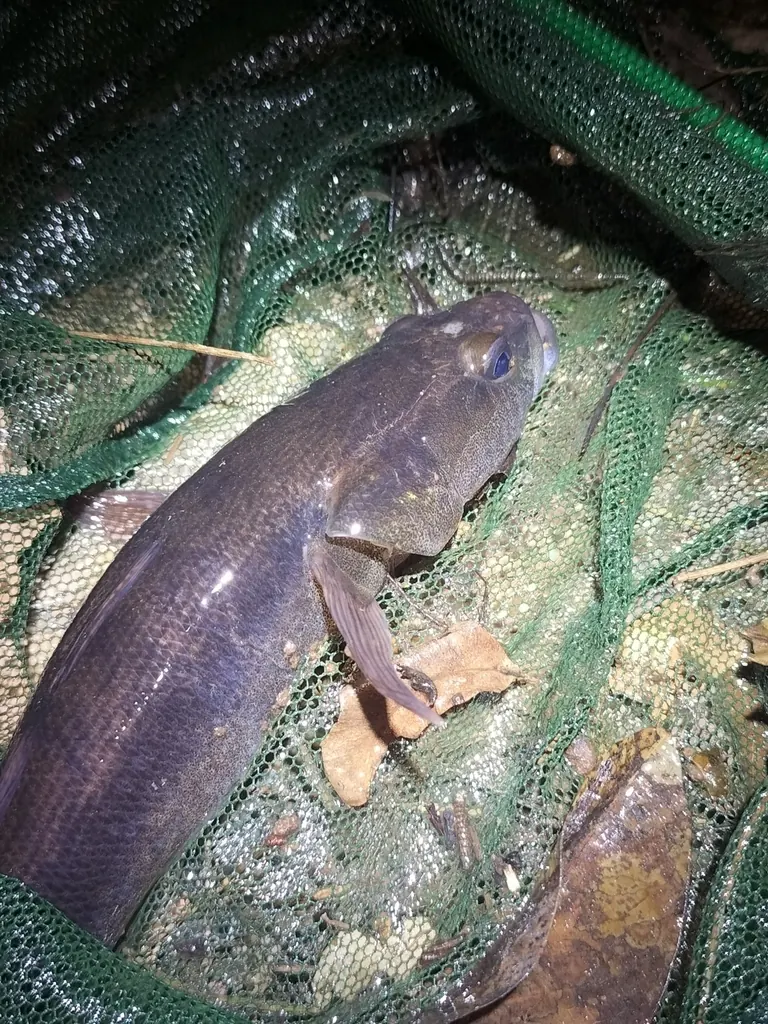
kurrubal is 'fresh water cod', and the freshwater cod of these rivers is the sleepy cod, Oxyeleotris lineolata, a thick, mottled, big-headed fish that lies on the bottom among snags and roots by day and hunts by night, and that is 'one of the most favoured freshwater fish in Australia for eating, having white, flaky flesh, low fat content, and a mild flavour'[1][2]. It is not a cod at all but a gudgeon, in the family Butidae, 'thus is unrelated to the true cods'[2]. It reaches 51 cm and 3 kg, though most are under 20 cm; it lives 'in quiet or slow-flowing water among vegetation, around log debris or beneath undercut banks'; it can breathe air; and from October to February the male guards a sheet of up to 70,000 eggs 'which look like shiny velvet' stuck to the roof of a hollow log or the underside of a ledge until they hatch[2][3][4].
Nothing is written for the Eastern coast on this page yet. What follows is true across the country.
Hann River Cape York
Possum People's country on the upper river and Thaypan (Kuku Thaypan) country downstream: stringybark and bloodwood woodland and a spring-fed sandy river that runs north-east from the Great Dividing Range, past the Peninsula Developmental Road, into Rinyirru (Lakefield) and the North Kennedy. Not Kuku Yalanji country: the Kuku Yalanji words on this page are the dictionary's, not the Hann's own languages. Place guide
The sleepy cod lives in the Hann's waters. In a survey of anglers in Lakefield National Park (now Rinyirru), downstream of the Hann, in 1986–91, the freshwater catch included 'sleepy cod (Oxyeleotris lineolatus)'[20]. The Atlas of Living Australia holds only two records in a box of about 90 × 85 km around the middle Hann, Laura and western Rinyirru, both from 1972[21]. The Hann never stops running, so its deep holes keep their water and their snags through the late dry[22].
Where it lives here
The Hann is fed by springs: water 'seeps down through the high elevation sandstone and recharges the groundwater', and the larger springs 'supply base flow to several streams including … Jungle Creek and the Hann River in the west'[23]. The gauge at Sandy Creek has not recorded a day without flow since 1968; flow is lowest from September to November[22]. So in the late dry the sleepy cod's water is a low run between deep holes, with snags and undercut banks for cover, not a cut-off pool.
How people fished here
No published record from this country names the sleepy cod. What is recorded is fishing in general:
- Possum People (upper Hann): a Possum man described 'fishing for barra, jewfish, catties and spotties'[24].
- Thaypan: 'We get wallaby, barramundi, freshwater fish and turtles and mussels'[25].
- Kuku Thaypan fish traps: Rungol (hollow logs) 'that were cut from the Ku akulumbah Messmate woodland and used as fish traps', set in a lagoon[26]. Which fish they took is not recorded.
- Kuku Warra (Laura): before fishing, 'I'll sing out to the old people and say "Hey old people, I'm coming to take some fish. I just want a little bit."', and after a good catch 'we must always leave three or four fish on the banks after we leave to show appreciation for the people of the country'[27].
Safety here
Estuarine crocodiles 'inhabit waterways and billabongs throughout Rinyirru'[28]. Night fishing at the water's edge is crocodile country; see crocodiles.
On country today
The upper Hann is the Possum People's country and the middle and lower Hann are Thaypan country; their November 2023 determinations recognise rights to 'hunt, fish and gather on the land and waters of the area'[24][25].
Upper Mitchell Western Yalanji
Western Yalanji country west of the Great Dividing Range: dry open woodland cut by the sandy, paperbark-lined upper Mitchell River, around Karma Waters and Mount Carbine. Place guide
It is recorded within 30 km of Karma Waters, and the dry-season pools with their snags and undercut banks are its country[29].
What it eats here
On the Mitchell, prawns 'featured prominently' in its diet[7].
Where it lives here
At Karma Waters the undercut banks, roots and snags of the dry-season pools are its places; the waterhole page describes the cover and the hot, low-oxygen water of the late dry that the sleepy cod's air-breathing helps it through[8][9].
Taking it here
On the Mitchell, Palmer saw the freshwater mangrove Barringtonia racemosa, 'Yakoora', cut up, hammered fine and put in the lagoons, and the coolibah's branches and leaves 'laid in water for several days to sicken the fish; it is universally used for this purpose'[30].
On country today
The sleepy cod is in the Karma Waters pools and is the fish to teach children spearing on, because it lies still and is worth eating[29][4].
Everywhere
Names
kurrubal 'fresh water cod'[1]. Nothing else in the dictionary fits the sleepy cod so well, and nothing says outright that this is the fish; the gloss is a colonist's name applied to a Kuku Yalanji word, and the identification is this page's. Other river fish words: kuyu 'fish'; kurruba 'species of freshwater fish'; bayil 'jungle perch'; dijarr a perch 'like the jungle perch, but not around here. Found at Rossville and Shipton's Flats'; julaji and kanyaji the catfish[1]. In English the fish is the sleepy cod, 'sleepy' for the way it lies, and 'cod' for its shape and its eating, though it is a gudgeon[2].
The fish
'The sleepy cod can reach a length of 51 cm, though most do not exceed 20 cm. Fish up to 3 kg have been caught by anglers. They are dark brown along the back and paler on the sides, with fuzzy dark lines running along scale rows. Juveniles have a white or cream patch running along the back and top of the head, with brown sides and a white belly'[2]. FishBase: maximum 45 cm standard length, common 20 cm; 'facultative air-breathing in the genus'[3].
'Most often found in slow flowing well vegetated areas with abundant in-stream cover, snags and submerged logs'; 'widespread from the Fitzroy River in Queensland north throughout Cape York, the Gulf of Carpentaria and west to the Ord River system'[4]. 'A sluggish bottom dwelling carnivore, feeds on other fish, insects and crustaceans'; 'generally quiet during the day it will take live food such as other fish, shrimps etc at night'[4].
Breeding. 'Spawning occurs between October and February. Female lays a roundish egg sheet, of up to 70,000 adhesive eggs. This is frequently on the underside of an overhanging rock ledge, under roots or on the roof of a hollow submerged log, usually in a shady location. The straw coloured eggs, which look like shiny velvet, are guarded and aerated by the male until after the eggs hatch in 5 to 7 days'[4][2].
'A popular angling species, although it offers little in the way of sport'[4]. 'They are one of the most favoured freshwater fish in Australia for eating'[2]. FishBase rates it 'moderate vulnerability'[3].
Sleepy cod, catfish, barramundi
- Sleepy cod: mottled brown, big flat head, rounded tail, no whiskers, lying on the bottom[2].
- Catfish: whiskers, a pointed eel-like tail, and venomous fin spines[1].
- Barramundi: silver, humped, broom-tailed, a mid-water hunter[5].
- Mouth almighty: small, barred, with two back fins and a bar through the eye, in the weed at the edge[6].
- Purple-spotted gudgeon and the small gudgeons: the same family, a hand long at most[3].
Signs
- A shape on the bottom beside a log that does not move when you look at it; the fish lies still by day[4].
- A velvet sheet of straw-coloured eggs on the roof of a hollow log or under a ledge in the shade, with a male beside it, from October[4].
- Prawn shells in the shallows at dawn: the night's hunting[7].
- A fish gulping at the surface of a hot, still pool in the late dry is using its air-breathing[3][8].
Where it lives
'Quiet or slow-flowing water among vegetation, around log debris or beneath undercut banks' in 'rivers, creeks and billabongs'[3]. The waterhole page describes the cover, and the hot, low-oxygen water of the late dry that its air-breathing helps it through[8][9].
The night shift on the bottom
The sleepy cod takes the bottom of the pool at night: prawns, cherabin, insects, small fish, among the snags, while the catfish work the open bottom and the eels the edges, and the mouth almighty ambushes in the weed[4][7]. By day it lies up, and that is when the freshwater crocodile, the darter and the cormorant find it[10][11]. Its eggs on the roof of a log are a fortnight's work for the male and food for everything that finds them; the waterhole page has the pool's whole cast.
Seasons
Spawning October to February, as the water warms past 25 °C and the first storms come; males on the nests then[4][8]. Through the dry it is in the deep cover of the pools, most active on warm nights; in the late dry, when the pools shrink and go hot and low in oxygen, the air-breathing gudgeons are among the last fish still comfortable[3][9]. See the year on country.
Uses
Taking a sleepy cod
The ways of taking river fish are on their own pages: spears, nets, traps and fences, hooks and lines and fish poisons. At Bloomfield, night fishing was 'done on the tidal estuaries from a canoe at night. One person sat at the front of the boat holding aloft a burning paperbark torch. As the fish were attracted to the light, another person would spear them'[12].
- By day, by spear: walk the bank of a clear pool and look beside the logs and under the overhangs for the mottled shape lying still; the many-pronged yirrmba is the spear for a fish that does not move[4][1].
- By night, by line: a live prawn or a piece of fish on a hook dropped beside a snag; it 'will take live food such as other fish, shrimps etc at night'[4].
- By torchlight: the Bloomfield method, a paperbark torch in the bow and a spear[12].
- In a trap: a trap or fence across a narrow in the dry[13].
- Leave the guarding males from October to February; the sheet of eggs under the log is next year's fish[4].
- Cook it on the coals or in the earth oven; the flesh is white and flaky[2].
Safety
- Crocodile water, especially at night by torchlight[14][15].
- The sleepy cod is not listed in the Queensland freshwater size and possession table; the gear rules and the general rules apply[16][17].
- Native title holders' fishing for personal, domestic or non-commercial communal needs is covered by section 211 of the Native Title Act 1993 and section 14 of the Fisheries Act 1994[18][19].
On Country today
Whether kurrubal is its name is for Kuku Yalanji speakers; the contribution box below is for that[1].
Language
kurrubal 'fresh water cod'; kuyu 'fish'; kurruba 'species of freshwater fish'; wukuju 'freshwater prawn, the big one with long legs'; yinba 'fish spear'; yirrmba 'many-pronged fish spear'; makarr 'fish net'; ngawurr-ngawun 'freshwater crocodile'[1].
References
- Hershberger, H. D. & Hershberger, R. (1982). Kuku-Yalanji Dictionary. Work Papers of SIL-AAB, Series B, Volume 7. With Toby Bloomfield, Roy Friday, Billy Roberts, Hector and Doris Sykes, Joe Walker and others. www.sil.org/resources/archives/18038
- Wikipedia. Sleepy cod (Oxyeleotris lineolata). en.wikipedia.org/wiki/Sleepy_cod
- FishBase. Oxyeleotris lineolata (Steindachner, 1867), sleepy cod: habitat, diet and spawning, citing Allen, Midgley & Allen (2002). www.fishbase.se/summary/Oxyeleotris-lineolata
- Native Fish Australia. Sleepy cod, Oxyeleotris lineolata (species page). www.nativefish.asn.au/home/page/Sleepy-Cod
- Wikipedia. Gulf saratoga (Scleropages jardinii). en.wikipedia.org/wiki/Gulf_saratoga
- Wikipedia. Mouth almighty (Glossamia aprion). en.wikipedia.org/wiki/Mouth_almighty
- Jardine, T. D., Pettit, N. E., Warfe, D. M., Pusey, B. J., Ward, D. P., Douglas, M. M., Davies, P. M. & Bunn, S. E. (2012). Consumer–resource coupling in wet–dry tropical rivers. Journal of Animal Ecology 81: 310–322. Mitchell River sites sampled in the early dry season. doi.org/10.1111/j.1365-2656.2011.01925.x
- The temperature regimes of dry-season waterholes in tropical northern Australia: potential effects on fish refugia (Flinders and Gilbert catchments). Freshwater Science. www.journals.uchicago.edu/doi/10.1086/681278
- Fish assemblage dynamics in an intermittent river of the northern Australian wet–dry tropics (Fergusson River, Daly catchment, seven-year study): contraction to a single refugial pool and the role of piscivorous fish. agris.fao.org/search/ar/records/65dea3fb4c5aef494fdcf454
- Tucker, A. D., Limpus, C. J., McCallum, H. I. & McDonald, K. R. (1996). Ontogenetic dietary partitioning by Crocodylus johnstoni during the dry season. Copeia 1996(4): 978–988. 324 crocodiles stomach-flushed over three dry seasons in Queensland. doi.org/10.2307/1447669
- Wikipedia. Australasian darter (Anhinga novaehollandiae). en.wikipedia.org/wiki/Australasian_darter
- Anderson, C. (1996). Traditional material culture of the Kuku-Yalanji of Bloomfield River, North Queensland. Records of the South Australian Museum 29(1): 63–83. Based on fieldwork at Wujal Wujal in the late 1970s and early 1980s. — Hunting (spears, spear-throwers, harpoons); fishing (stupefacients); manufacturing (gums and resins); post-contact bush component archive.org/details/RecordsSouthAus29Sout
- Roth, W. E. (1901). North Queensland Ethnography, Bulletin No. 3: Food — its search, capture, and preparation. Brisbane: Government Printer. Bloomfield River information from the Hislops. — Sect. 6 'Cooking'; plant list ('Castanospermum australe', 'Dioscorea sativa', 'Elettaria Scottiana', 'Nymphaea') archive.org/details/northqueensland00landgoog
- Queensland Government. Be Crocwise top tips; Be Crocwise in Croc Country (web pages, accessed 5 October 2026). www.qld.gov.au/environment/plants-animals/animals/living-with/crocodiles/becrocwise/be-crocwise-top-tips
- Karma Waters Station. About: location, native title (web page, accessed 5 October 2026). www.karmawatersstation.com/about.html
- Queensland Government. Size and possession limits in fresh waters (web page, last updated 27 March 2026, accessed 5 October 2026). www.qld.gov.au/recreation/activities/boating-fishing/rec-fishing/rules/limits-fresh
- Queensland Government. Fishing equipment rules: fresh waters (web page, last updated 26 March 2026, accessed 6 October 2026). www.qld.gov.au/recreation/activities/boating-fishing/rec-fishing/rules/equipment
- Australian Law Reform Commission. Review of the Native Title Act 1993 (DP 82), ch. 8: Relevant provisions in the Native Title Act (s 211). www.alrc.gov.au/publication/review-of-the-native-title-act-1993-dp-82/8-the-nature-and-content-of-native-title/relevant-provisions-in-the-native-title-act/
- Fisheries Act 1994 (Qld), current as at 27 April 2026: s 14 (defence for Aboriginal peoples and Torres Strait Islander peoples). www.legislation.qld.gov.au/view/html/inforce/current/act-1994-037
- Russell, D. J. & Hales, P. W. (1993). A survey of the Princess Charlotte Bay recreational barramundi fishery. Queensland Department of Primary Industries, QI93049. era.dpi.qld.gov.au/id/eprint/6393/1/Survey%20of%20the%20Princess%20Charlotte%20Bay%20recreational%20barramundi%20fishery_QI93049_1993_russell.pdf
- Atlas of Living Australia. Occurrence records of Oxyeleotris lineolatus, sleepy cod (2 records, both 1972), and other Oxyeleotris gudgeons (4 records) in a box of about 90 × 85 km around the middle Hann River, Laura and western Rinyirru (lat −15.6 to −14.8, long 143.5 to 144.3), queried 28 October 2026. biocache.ala.org.au/occurrences/search?q=genus:Oxyeleotris&fq=decimalLatitude:%5B-15.6%20TO%20-14.8%5D&fq=decimalLongitude:%5B143.5%20TO%20144.3%5D
- Bureau of Meteorology, Water Data Online. Station 105001B, Hann River at Sandy Creek: daily and monthly mean discharge 1968–2026 (recent data provisional), retrieved 28 October 2026. No day of zero mean flow in 20,711 days of record; mean flow highest in February–March, lowest in September–November. www.bom.gov.au/waterdata/
- Queensland Government, WetlandInfo. Normanby catchment story: physical features (springs and base flow). wetlandinfo.detsi.qld.gov.au/wetlands/ecology/processes-systems/water/catchment-stories/normanby/norm-physical.html
- Ross on behalf of the Cape York United #1 Claim Group v State of Queensland (No 21) (Possum determination) [2023] FCA 1316 (Federal Court of Australia, 2 November 2023). — Determination area (upper Hann and Kennedy rivers); prescribed body corporate; affidavit evidence on hunting and fishing www.judgments.fedcourt.gov.au/judgments/Judgments/fca/single/2023/2023fca1316
- Ross on behalf of the Cape York United #1 Claim Group v State of Queensland (No 20) (Thaypan determination) [2023] FCA 1315 (Federal Court of Australia, 2 November 2023). — Determination area and waters; prescribed body corporate (Awu-Laya Indigenous Corporation); affidavit evidence on hunting www.judgments.fedcourt.gov.au/judgments/Judgments/fca/single/2023/2023fca1315
- Standley, P.-M. (2019). The importance of campfires to effective conservation. PhD thesis, James Cook University. Records the fire and country knowledge of Kuku Thaypan Elders Dr Tommy George and Dr George Musgrave. researchonline.jcu.edu.au/64274/
- Ross on behalf of the Cape York United #1 Claim Group v State of Queensland (No 19) (Kuku Warra determination) [2023] FCA 1314 (Federal Court of Australia, 2 November 2023). www.judgments.fedcourt.gov.au/judgments/Judgments/fca/single/2023/2023fca1314
- Queensland Parks and Wildlife Service (2013). Rinyirru (Lakefield) Aggregation Management Statement 2013. parks.desi.qld.gov.au/__data/assets/pdf_file/0027/165771/rinyirru.pdf
- Atlas of Living Australia. Occurrence records within 30 km of the Karma Waters homestead (16.62°S, 144.60°E), queried 10 October 2026: river animals and waterbirds. biocache.ala.org.au/occurrences/search?q=*:*&lat=-16.62&lon=144.60&radius=30
- Palmer, E. (1883). On plants used by the natives of North Queensland, Flinders and Mitchell Rivers, for food, medicine, &c., &c. Journal and Proceedings of the Royal Society of New South Wales 17: 93–113. Palmer's Mitchell River names come from the lower and middle Mitchell, not from Kuku Yalanji speakers. archive.org/details/journalandproce16walegoog
From the community
Know this one? Add the words you use for it, what it is for, how it is done, a correction, or a photo from country. It shows here straight away with your name on it. Please keep anything restricted or sacred off the site.
Loading…