Tools & things made
Stone axes and adzes
kulbanmuku · waymbil · warrbi
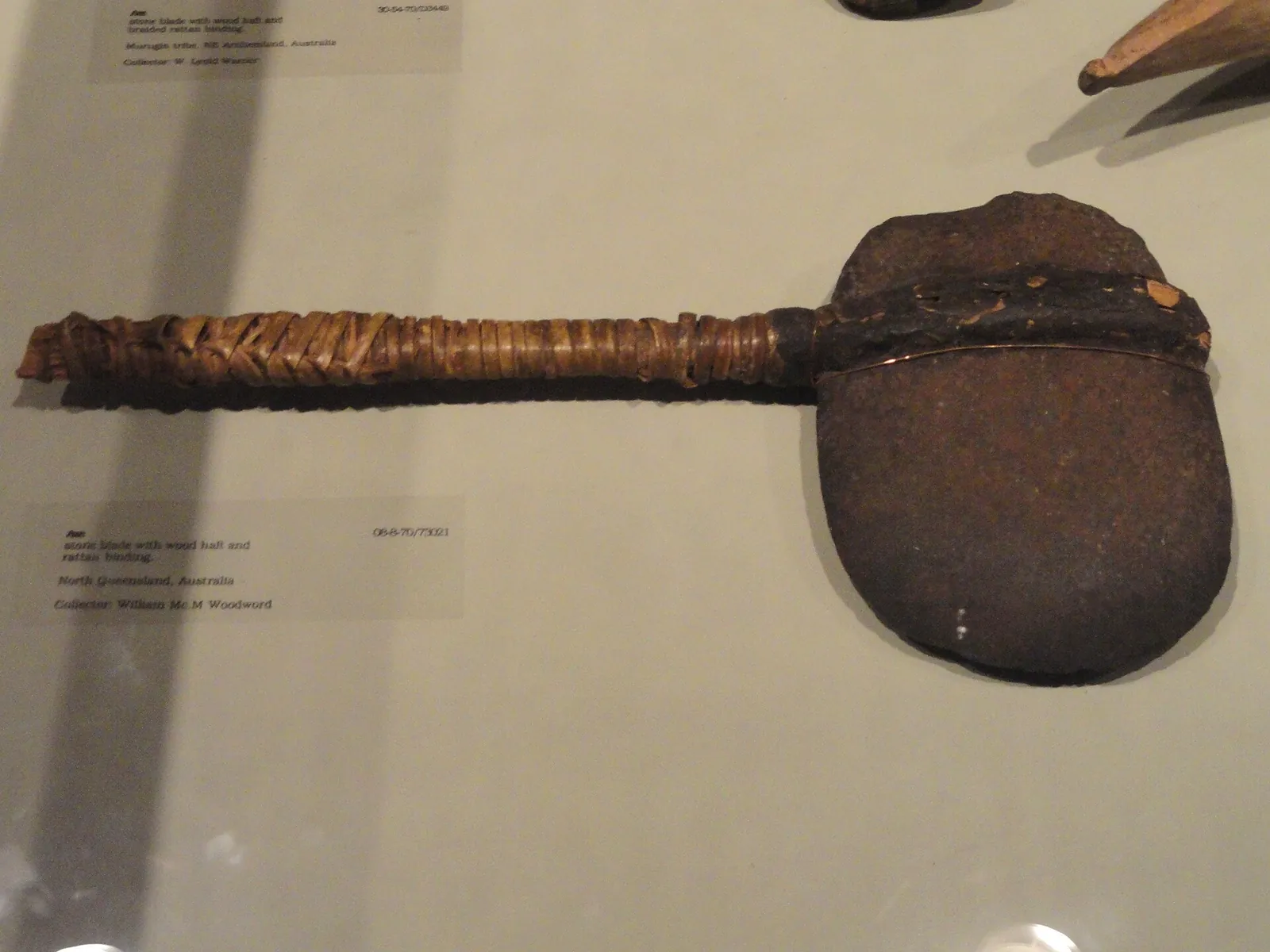

The kulbanmuku, 'axe, originally a stone axe', was the tool that opened the trees: it felled the canoe logs, cut the steps up a honey tree, chopped out the sugarbag and the grubs, and took the bark sheets for troughs and huts[1][2]. The head was a ground-edged stone, a celt in Roth's word, and across Queensland the same head served as axe, adze or wedge depending on how it was held and hafted[3]. On the Bloomfield the head was tied into a handle of big lawyer cane with bark fibre or wallaby sinew and cemented with beeswax mixed with brown-cedar resin; Kuku Yalanji men told Anderson such an axe could fell softwoods up to a metre through and hardwoods to about 40 cm[2]. Steel axes were the most valued trade goods of the early station days, and men worked for settlers to get them[2]. How the stone head itself was shaped and ground is on the stone page; this page is the tool, its handle, its cement and its work.
Hann River Cape York
Possum People's country on the upper river and Thaypan (Kuku Thaypan) country downstream: stringybark and bloodwood woodland and a spring-fed sandy river that runs north-east from the Great Dividing Range, past the Peninsula Developmental Road, into Rinyirru (Lakefield) and the North Kennedy. Not Kuku Yalanji country: the Kuku Yalanji words on this page are the dictionary's, not the Hann's own languages. Place guide
Stone axes were the tools of this country too, and their marks are still on its trees. Kuku Thaypan Elders read the old sugarbag cuts by the tool that made them: the stone tommyhawk, the horseshoe axe of the gold-rush years and the steel axe[8]. One of the Possum People's clans of the upper Hann is the Tomahawk clan[9]; what that name holds belongs to its people.
Axe marks on the trees here
From the Kuku Thaypan Elders' field work with Standley[8]:
- Stone tommyhawk: 'Arrlonomen or stone tommyhawk scars tend to be more rounded in the center and then wider to the surface of the tree, this indicates wedging the timber rather than just a straight cut through the wood.' 'Most stone axe holes have a smaller entrance cause the aim is to just make a hole to get in. Steel axe scars cannot make small holes like this.'
- Horseshoe axe: 'During the gold rush to the region there was an increase in horses and a subsequent increase in horseshoes. These were utilised by the local Indigenous people, they were sharpened and fashioned into an axe and used to harvest Sugarbag.'
- Steel axe: 'The entry hole is long and even from the surface to the inside, because it takes the shape of the steel axe head'.
A scarred tree is cultural heritage: look, and leave it[4].
How the people of this country used them
Sugarbag, with care. The cut was made just below the nest and kept small, and the hole was sealed again with wax and grass so the bees would stay. Dr Tommy George: 'If the axe mark is big and a lot taken bees will go nest somewhere else'[8]. See native bees.
Gum. 'Bloodwood trees were utilised for sap and cut with a stone tommy hawk to gain the useful sticky substance'[8]. A Kuku Warra man described getting grass-tree resin: 'You take the root of the tree, cut it with a tomahawk, scrape the dirt off, heat the root on hot coals, and the resin or sap comes out'[10]. See grass tree.
The stone hammer. A stone hafted 'on identical lines as a celt when used for an axe' was used 'for tapping on the bark when the sheet is being removed' and 'for breaking open some of the harder nuts, e.g., pandanus'. Roth 'found the implement in use throughout the Princess Charlotte Bay hinterland, in 1898, and again on the Palmer' the next year[3].
Steel comes in trade. By about 1900, 'the Koko-rarmul of the Morehead River give the Koko-warra (whose "country" extends along the course of the Normanby and Deighton Rivers) reed-spears, iron-scraps, European tomahawks, etc.'[5].
On country today
Stone axe heads, grinding grooves and scarred trees on the Hann are protected under the Aboriginal Cultural Heritage Act 2003[4]. In Rinyirru the rule is 'Do not collect souvenirs or interfere with cultural sites'[11].
Language
Kuku Thaypan: Arrlonomen 'stone tommyhawk'[8]. Roth's names for a stone celt around Princess Charlotte Bay, in his spelling: Koko-rarmul ngo-mun, Koko-warra ai-mu-an; and for the stone hammer, Koko-warra ambianga[3]. None of these are Kuku Yalanji words.
Upper Mitchell Western Yalanji
Western Yalanji country west of the Great Dividing Range: dry open woodland cut by the sandy, paperbark-lined upper Mitchell River, around Karma Waters and Mount Carbine. Place guide
On the upper Mitchell the raw material is in the river: the bed is full of water-worn pebbles of the ridges' hard rock, the kind of stone Roth says most axe heads began as[12][3].
Where the stone comes from here
At Karma Waters the ridges are Hodgkinson Formation greywacke, siltstone and slate, and the river's bed is full of water-worn pebbles of it, the raw material Roth says most heads began as[12][13][3].
Eastern coast Eastern Kuku Yalanji
Eastern Kuku Yalanji country: rainforest, beaches, mangroves, reef and the short steep rivers from the Daintree to the Bloomfield and the Annan.
On the Bloomfield the stone axe was hafted in big lawyer cane, and Kuku Yalanji men told Anderson what it could fell and how it opened the honey trees[2].
The Bloomfield axe
The Bloomfield axe. Anderson's informants described it: 'The celts were tied onto a handle made of a portion of large lawyer cane and secured there by bark fibre or wallaby sinew and a gum mixture of beeswax mixed with resin from Canarium australasicum', the brown cedar[2]. With hardwoods a downward chopping stroke was used rather than a horizontal one[2]. The men carried their axes in belts of wallaby sinew or plaited hair[2].
Signs here
- Steps cut up a trunk, one each side, to reach a bee hive; Anderson noted these 'on many trees in the Bloomfield area in the late 1970s'[2].
- Felled honey trees: 'It is surprising to see how hard the Bloomfield blacks work in cutting down a big tree to get a hive', Le Souef wrote in 1894[2].
- An old axe-head in an oven: around the Annan and Endeavour rivers discarded heads were used as oven stones, which is why so few were left by 1900[14].
Everywhere
Names
The dictionary has three words: kulbanmuku 'axe, originally a stone axe'; waymbil 'axe'; and warrbi, which is both 'axe' and a 'house made of grass, beehive house'[1]. For the head, Roth's list of local names for a stone celt gives, for the Bloomfield (KYE), jangkawabi, built on jangka 'stone'[3][1]. For the cement, Roth recorded the Bloomfield gum t-chaln-ji 'used for fixing together the haft and shaft of spears, and in the old days (R. Hislop) was employed for fixing the stone-celt into its handle'; the dictionary's jalnji is a poison-nut tree whose gum 'is not poisonous, used for making spears', and yikari is 'hardened beeswax, hardened with ironwood root juice', the spear and axe cement[3][1]. The verbs: nyandal 'to chop', nyurrbal 'to grind, sharpen'; jalngkun 'sharp', dudu 'blunt'; and kadil, the 'sharp sound or crashing sound, as of an axe cutting wood, or a tree falling'[1].
What it is
The head. Roth, who had examined hundreds, argued that sorting stone celts into 'axes, adzes, wedges, scrapers' was mostly a European habit: 'the same celt may be used both as an axe or adze', the wedge-shaped celt of the Batavia and Pennefather rivers 'was used both as an axe, e.g., for cutting into trees, and as an adze, e.g., for hollowing out', the Bloomfield people 'undoubtedly used their axes as wedges', and Aboriginal evidence agreed that these were tools, not fighting weapons[3]. Most heads were made from water-worn pebbles chosen for being close to the shape already, so that only the edge had to be ground; others were broken from rock in place by fire or flaking. The Queensland rocks that made celts include diorite, basalt, argillite and serpentine[3]. Two local types stood out to him: a large, oval, slab-like, double-edged head with a groove round its middle, almost peculiar to the Herberton ranges, and a small, square, wedge-shaped celt peculiar to the Peninsula[3].
The handle. Across the far north and west the handle was a lath of wood bent double at its middle, the stone fixed in the bend with twine and beeswax or cement, and the two limbs bound together just below the stone and again at the grip. On Cape York the binding went only next to the stone, so the limbs crossed and gripped the head tighter, like a pair of pincers, when the diverging ends were squeezed[3]. There is no evidence that a Queensland celt was ever set in the fork of a stick, and some were used in the hand with no handle at all, as Cook saw on the Endeavour River[3].
Axe, adze, wedge or hammer?
- Axe: the edge in line with the handle, swung to cut across the grain[3].
- Adze: the same head turned so the edge is across the handle, pulled towards the body to hollow and shave; the canoe tool[3][2].
- Wedge: the head used alone, driven into a split; Roth says the Bloomfield people used their axes this way[3].
- Hammer-stone: unground, used for roughing out other stones and for pounding; see stone[3].
- Grooved head: a groove right round a wedge-shaped head means a handle, and probably use as both axe and adze by re-setting it[3].
- A big butt: a head whose back end is much bigger than its edge was probably used unhafted, because a handle would let it slip backwards under a heavy blow[3].
Signs
- Bark scars from troughs, canoes and hut sheets; see bark troughs[3].
- Grinding grooves on sandstone near water where edges were ground; see stone[3].
- A ground-edged stone on the surface of a camp or an old oven is an artefact and is protected; leave it where it lies[4].
- The sound: kadil, the crack of an axe in wood or a tree coming down[1].
Where the stone and the handle come from
Hard fine-grained stone for the head: diorite, basalt, argillite, serpentine[3]. Good heads also travelled: Bulletin 14 records stone and other goods passing hand to hand along trade routes across the Peninsula[5].
For the handle, big lawyer cane (mawar, 'the vine of the lawyer cane') in the rainforest country of the Bloomfield; a bent wooden lath in the open country[2][3][1]. For the binding, bark fibre or wallaby tail sinew (biyal)[2][1]. For the cement, beeswax from the native bees, brown-cedar resin, and the ironwood root juice that hardens yikari; see beeswax and gums and ironwood[2][1].
What the axe did in the country
The axe sits at the start of most of the chains in this guide. It felled the candlenut, red cedar and cotton tree for canoes, whose insides were then burnt out and scraped with adzes[2]. It opened the trees for sugarbag: 'Hafted stone axes were used to obtain both the grubs and the bee hives', the nest hole enlarged with the axe, steps cut up the trunk, or the whole tree brought down[2]. It split the rotten logs for grubs[2]. It cut the bark sheets for troughs and huts[2][3]. It broke the bones of a crocodile before cooking[2]. It also marks the woodland: a stand of old bloodwoods with cut steps and bark scars is a place that was lived in, and the hollows the cockatoos nest in are often the hollows the honey came from[2].
In the other direction, the axe depended on the country: on the right stone, on lawyer cane, on wallaby sinew, on beeswax from a healthy bee population and on brown-cedar resin, the trade in which Roth recorded[2][3]. When steel came it displaced the stone head but not the handle-maker's and the honey-hunter's knowledge; men 'undertook any amount of work for a European settler in return for these tools'[2].
Seasons
The axe's busiest season was the dry, when sugarbag was hunted and the tree bases were checked and tapped for hollowness in the late dry; canoe and bark work came after the first storms when the sap had risen[2]. See the year on country.
Uses
- Felling trees for canoes; hollowing them as an adze[2].
- Opening and felling honey trees; cutting steps to climb them[2].
- Splitting rotten logs for grubs[2].
- Cutting bark for troughs, huts and canoes[2][3].
- Splitting wood, as a wedge[3].
- Butchering large game: the Bloomfield crocodile 'bashed with an axe to break the bones' before it went on the fire[2].
- Not fighting: Roth's Aboriginal informants were clear the celt was a tool[3].
Hafting a Bloomfield axe
The head's own making (choosing the pebble, roughing out, grinding the edge) is on the stone page. To make it a tool[2][3]:
- Cut a length of big lawyer cane long enough to bend double round the head with two limbs for a grip[2].
- Bend it round the head so the stone sits in the bend, edge outwards[2][3].
- Bind the two limbs together close below the stone with bark-fibre twine or wallaby tail sinew; in the north-and-west style, bind again at the grip; in the Cape York style, bind only next to the stone so the crossed limbs grip the head like pincers when squeezed[2][3].
- Cement it. Heat beeswax, mix it with brown-cedar resin (or use yikari, beeswax hardened with ironwood root juice), and work the warm cement round the head and over the binding; let it set hard[2][1].
- Use it right. Downward chopping strokes on hardwood, not horizontal ones; softwoods to about a metre through, hardwoods to about 40 cm[2].
- To adze, re-set the same head across the handle and pull the strokes towards you on charred timber[3].
- Keep the edge by grinding on sandstone with water (nyurrbal)[3][1].
Safety
- A stone head in a cane haft can loosen; check the cement before a heavy stroke and keep the stroke downward and away from the legs[2].
- Felling: a honey tree felled with an axe or a chainsaw comes down with the bees still in it; sugarbag bees do not sting, but hornets and paper wasps share hollows[2].
- Stone artefacts, scarred trees and grinding grooves are protected under the Aboriginal Cultural Heritage Act 2003; do not collect, move or sell them[4].
On Country today
By 1904 Roth called the making of a celt 'a lost art in Queensland', and by the 1970s Bloomfield bush camps ran on steel axes, which were already the prized tools of the 1890s[3][2]. The knowledge that survives is the hafting, the cement and the work: where the honey trees are, which bark peels, how a log is hollowed. Old stone heads turn up on creek banks and old camps; they are cultural heritage, and under the duty of care in the Aboriginal Cultural Heritage Act 2003 they stay where they are[4]. Native title holders' gathering rights under section 211 of the Native Title Act 1993 cover taking timber and bark for personal and communal use[6][7].
Language
kulbanmuku 'axe, originally a stone axe'; waymbil 'axe'; warrbi 'axe; house made of grass'; jangka 'stone'; jundi 'pumice stone, carborundum stone'; nyandal 'to chop'; nyurrbal 'to grind, sharpen'; jalngkun 'sharp'; dudu 'blunt'; kadil 'sharp sound, as of an axe cutting wood'; yikari 'hardened beeswax'; jalnji the gum tree 'used for making spears'; mawar 'the vine of the lawyer cane'; biyal 'sinew'[1].
References
- Hershberger, H. D. & Hershberger, R. (1982). Kuku-Yalanji Dictionary. Work Papers of SIL-AAB, Series B, Volume 7. With Toby Bloomfield, Roy Friday, Billy Roberts, Hector and Doris Sykes, Joe Walker and others. www.sil.org/resources/archives/18038
- Anderson, C. (1996). Traditional material culture of the Kuku-Yalanji of Bloomfield River, North Queensland. Records of the South Australian Museum 29(1): 63–83. Based on fieldwork at Wujal Wujal in the late 1970s and early 1980s. — Hunting (spears, spear-throwers, harpoons); fishing (stupefacients); manufacturing (gums and resins); post-contact bush component archive.org/details/RecordsSouthAus29Sout
- Roth, W. E. (1904). North Queensland Ethnography, Bulletin No. 7: Domestic implements, arts, and manufactures. Brisbane: Government Printer. — Sect. 10 'Fire-tongs' archive.org/details/northqueensland00landgoog
- Aboriginal Cultural Heritage Act 2003 (Qld), sections 23–25 (cultural heritage duty of care; harming, excavating, relocating or taking away Aboriginal cultural heritage). www.legislation.qld.gov.au/view/html/inforce/current/act-2003-079
- Roth, W. E. (1910). North Queensland Ethnography, Bulletin No. 14: Transport and Trade. Records of the Australian Museum 8(1). — Sects. 14–15, dug-out canoes from the Flinders Group to Cape Grafton archive.org/details/biostor-52863
- Australian Law Reform Commission. Review of the Native Title Act 1993 (DP 82), ch. 8: Relevant provisions in the Native Title Act (s 211). www.alrc.gov.au/publication/review-of-the-native-title-act-1993-dp-82/8-the-nature-and-content-of-native-title/relevant-provisions-in-the-native-title-act/
- Western Yalanji Aboriginal Corporation & CRC for Developing Northern Australia (2020). Western Yalanji Land Use and Economic Diversification Plan. CC BY 4.0. — Native Title Determinations 1–4 (pp. 13–18); ‘Fire Management and Carbon Farming’ (pp. 32–33); ‘Pastoralists’ crcna.com.au/wp-content/uploads/2024/05/westernyalanjilanduseplan_nov2020.pdf
- Standley, P.-M. (2019). The importance of campfires to effective conservation. PhD thesis, James Cook University. Records the fire and country knowledge of Kuku Thaypan Elders Dr Tommy George and Dr George Musgrave. researchonline.jcu.edu.au/64274/
- Ross on behalf of the Cape York United #1 Claim Group v State of Queensland (No 21) (Possum determination) [2023] FCA 1316 (Federal Court of Australia, 2 November 2023). — Determination area (upper Hann and Kennedy rivers); prescribed body corporate; affidavit evidence on hunting and fishing www.judgments.fedcourt.gov.au/judgments/Judgments/fca/single/2023/2023fca1316
- Ross on behalf of the Cape York United #1 Claim Group v State of Queensland (No 19) (Kuku Warra determination) [2023] FCA 1314 (Federal Court of Australia, 2 November 2023). www.judgments.fedcourt.gov.au/judgments/Judgments/fca/single/2023/2023fca1314
- Queensland Parks and Wildlife Service. About Rinyirru (Lakefield) National Park (CYPAL): park features and looking after the park (web page, last updated 1 July 2024; accessed 28 October 2026). parks.qld.gov.au/parks/rinyirru-lakefield/about
- Cheng, Y. et al. (2017). Geology and mineralization of the Mt Carbine tungsten deposit, northern Queensland. EGRU Contribution 69, James Cook University. researchonline.jcu.edu.au/54656/
- Karma Waters Station. About: location, native title (web page, accessed 5 October 2026). www.karmawatersstation.com/about.html
- Roth, W. E. (1901). North Queensland Ethnography, Bulletin No. 3: Food — its search, capture, and preparation. Brisbane: Government Printer. Bloomfield River information from the Hislops. — Sect. 6 'Cooking'; plant list ('Castanospermum australe', 'Dioscorea sativa', 'Elettaria Scottiana', 'Nymphaea') archive.org/details/northqueensland00landgoog
From the community
Know this one? Add the words you use for it, what it is for, how it is done, a correction, or a photo from country. It shows here straight away with your name on it. Please keep anything restricted or sacred off the site.
Loading…