Birds
Ducks and geese
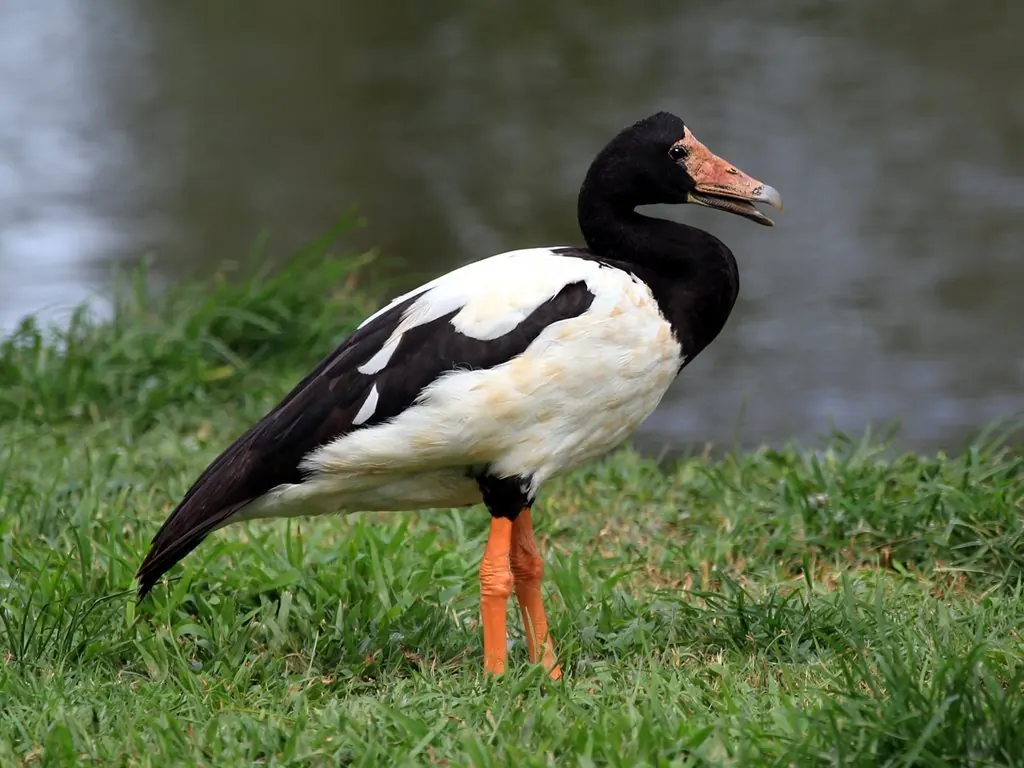
nili-nili is a duck and jamarbina a goose, and the dictionary stops there, which leaves the rest to sort out by eye[1]. The Pacific black duck is the duck of every pool; the hardhead dives, the grey teal dabbles, the green pygmy goose sits among the lily pads, the plumed whistling ducks stand in whistling mobs on the bank, the wood ducks graze the grass like small geese, the pink-eared duck strains the plankton of the drying pans with its spoon bill, the radjah shelduck works the paperbark swamps, and the magpie goose, the big black-and-white goose of the floodplain, comes through in the dry[2][3][4][5][6][7][8][9]. Roth's ducks were 'stalked and speared', the hunter gliding through the water with a collar of grass round his head 'like a tussock of grass floating down the stream', or knocked over 'with long thin switches ... both by day and by moonlight', or noosed from a feather-quill on a stick, or, near the Laura and at Cape Bedford, 'caught by silently diving under them in the water and pulling them down'[10]. The eggs were taken in the nesting season, which in the north is mostly the wet, in hollows and on the ground[10][2].
Nothing is written for the Eastern coast on this page yet. What follows is true across the country.
Hann River Cape York
Possum People's country on the upper river and Thaypan (Kuku Thaypan) country downstream: stringybark and bloodwood woodland and a spring-fed sandy river that runs north-east from the Great Dividing Range, past the Peninsula Developmental Road, into Rinyirru (Lakefield) and the North Kennedy. Not Kuku Yalanji country: the Kuku Yalanji words on this page are the dictionary's, not the Hann's own languages. Place guide
The Hann runs into some of the best waterbird country in Cape York. Rinyirru's waterbirds include 'brolgas, sarus cranes, black-necked storks, magpie geese'[22], and the Atlas of Living Australia holds 2,257 duck records and 428 magpie goose records, from 1948 to 2026, in a box of about 90 × 85 km around the middle Hann, Laura and western Rinyirru[23]. One of the Thaypan clans is the Goose clan[24].
Which ones live here
The commonest here is the green pygmy goose (643 records), then the radjah shelduck (465), the plumed whistling duck (390), the Pacific black duck (297) and the wandering whistling duck (252). The grey teal (77) and the hardhead (69) are fewer. The spotted whistling duck (Dendrocygna guttata, 49 records, 2003–2025) is here too. The wood duck (2), the pink-eared duck (3) and the cotton pygmy goose (4) are rare[23]. The box takes in the big lagoons of Rinyirru as well as the Hann, so read it as 'these birds live in this country', not as a map.
Their year here
In the wet, December to March, the rivers flood onto the plains, and 'animals disperse far and wide as food and water is plentiful'. By October the land is 'brown and parched'[22], and the birds crowd back onto the lagoons and the permanent holes; the Hann itself keeps running right through the dry[25]. The Kuku Thaypan Elders watch for 'flocks of Magpie Geese during migration and throughout the year' as a sign that country is healthy[26].
How the people of this country took them
Princess Charlotte Bay hinterland, the Palmer and the Laura (Roth, c. 1900). The grass-collar stalk with the pronged spear, and the dive under a sitting duck 'in the neighbourhood of the Laura', set out in the general sections above, are records from this country and the next river south[10]. Children at Princess Charlotte Bay and on the middle Palmer made a string figure called 'Duck in flight'[27].
Kuku Thaypan Elders (Standley 2019). When the Elders were young, 'bird numbers and diversity was higher across the entire system' of their wetlands, magpie geese, black ducks and Burdekin ducks among them. Today they read the birds as a sign: 'look, the feathers on that geese, dirty, something not right'. What they want is to 'fence the water hole off to keep pigs and cattle out'[26].
The Goose clan. 'The Goose Language (Alwangara) was once spoken by one or more clans whose estate was primarily the Morehead River drainage. The descendants of the Goose clan now consider themselves and are considered by others to be part of the Kuku Thaypan named group'[26]. The goose's stories belong to its people: ask them, not this page.
On country today
The middle and lower Hann are in the Thaypan native title determination of November 2023, held by the Awu-Laya Indigenous Corporation[24]. Downstream, Rinyirru's Traditional Owners are the Lama Lama and Kuku Thaypan peoples, and the park is jointly managed[22]. The Elders measure success by the 'return of magpie geese and pelican numbers' with clean feathers[26].
Language
Kuku Thaypan (Awu Alaya) names recorded by Standley: Nhye Wann magpie goose, Nhye rou Pacific black duck, Nhye woongara Burdekin duck (the radjah shelduck), and chiyen pygmy goose[26].
Upper Mitchell Western Yalanji
Western Yalanji country west of the Great Dividing Range: dry open woodland cut by the sandy, paperbark-lined upper Mitchell River, around Karma Waters and Mount Carbine. Place guide
Eleven kinds of duck and goose use the Karma Waters pools, and the black duck, hardhead and green pygmy goose are on them most days of the dry[28].
Which ones live here
Within 30 km of the Karma Waters homestead the Atlas has the Pacific black duck (30 records), hardhead (26), green pygmy goose (22), grey teal (15), wood duck (8), plumed whistling duck (8), pink-eared duck (6), cotton pygmy goose (5), radjah shelduck (4), magpie goose (3) and wandering whistling duck (2)[28]. The magpie goose comes through in the dry.
Where they are here
The long pools of the Mitchell and the lagoons and swamps off it; the station's river camps are beside them[29]. The Western Yalanji of the Mitchell lagoons may well have more duck words than the dictionary; the contribution box on this page is for them.
On country today
Hunting by native title holders for personal, domestic or non-commercial communal needs is recognised in the Western Yalanji determinations[30].
Everywhere
Names
nili-nili 'duck'; jamarbina 'goose'[1]. The dictionary's speakers were coastal and rainforest people, and the duck words are few; other Yalanji speakers may well have more, and the contribution box on this page is for them. The birds of the same water with their own words: dulku 'white crane', biluwarra 'spoon bill bird', birmba 'straw-necked ibis', kalmbangarr 'black diver bird', kulbal 'brolga', on the water birds and cranes pages[1].
The ducks and geese
Pacific black duck (Anas superciliosa). 'A dark body, and a paler head with a dark crown and facial stripes. In flight, it shows a green speculum and pale underwing ... The size range is 54–61 cm'. 'This sociable duck is found in a variety of wetland habitats ... It feeds by upending'. 'The nest is usually placed in a hole in a tree, but sometimes an old nest of a corvid is used and occasionally the nest will be placed on the ground. The clutch of 8–10 pale cream eggs is incubated only by the female. The eggs hatch after 26–32 days'[2].
Hardhead (Aythya australis). 'Smaller than most ducks, with body length typically between 42–59 cm', 'a fairly uniform chocolate-brown above, with rufous flanks and white undersides'; the male has a white eye. 'Hardheads feed by diving deeply, often staying submerged for as long as a minute at a time. They slip under the water with barely a ripple ... They eat a broad range of small aquatic creatures, and supplement this with water weeds.' 'Moderately nomadic in normal years, but disperse widely in times of drought'[3].
Grey teal (Anas gracilis), 'a dabbling duck found in open wetlands', small and mottled grey-brown with a pale throat; it 'nests near its favoured freshwater lakes and marshes, usually on the ground, but also in tree holes'[11].
Green pygmy goose (Nettapus pulchellus). 'Ranging from 30 to 36 cm in length, the green pygmy goose is one of the smallest species of duck ... The breeding male has a predominantly dark green back and neck, and a dark gray crown. The cheeks are white, and the underparts are pale grey and white scalloped'; 'the green pygmy goose nests in tree hollows. Eight to twelve eggs are laid and the incubation period is 26 days'. It lives on the lily lagoons[4]. The cotton pygmy goose (N. coromandelianus), is smaller still, 'the smallest waterfowl on earth, at as little as 160 g and 26 cm', white-faced, feeding 'mainly at the surface of the water'[12].
Plumed whistling duck (Dendrocygna eytoni), 'also called the grass whistling duck'. 'Measuring 42–60 cm and weighing around one kilogram, it is a long-necked duck with brown upperparts, paler underparts and a white rump. The chest is a chestnut colour with thin black bars, while long black-margined plumes arise from its flanks. Its bill and legs are a pinkish red'; 'the call is a characteristic whistle'. The wandering whistling duck is its darker relative that swims more[5].
Wood duck (Chenonetta jubata). 'This 45–51 cm duck looks like a small goose, and mostly feeds by grazing in flocks. The male is grey with a dark brown head, mottled breast ... The female has white stripes above and below the eye'; it nests in hollows[6].
Pink-eared duck (Malacorhynchus membranaceus). 'A large spatulate bill ... Its brown back and crown, black and white barred sides and black eye patches on its otherwise white face make this bird unmistakable'. 'They are dependent on plankton, as well as crustaceans, mollusks and insects. Their bill is well designed for straining minute organisms'; 'nesting is stimulated by the drying and filling of pools'[7].
Radjah shelduck (Radjah radjah). 'Both the male and female of the species are mostly white, with dark wing-tips and a distinctive "collar" of dark feathers'; 'the species prefers the salty waters of mangrove flats and paperbark tree swamps, but will visit all manner of brackish and freshwater swamps, lagoons, lakes'; it eats 'mollusks, aquatic or other insects, worms, aquatic weeds' and nests 'often in the hollow limb' of a tree[8].
Magpie goose (Anseranas semipalmata), the goose of the north. 'Black-and-white plumage in both sexes, with a long neck and legs and a long hooked bill. The males are 75–90 cm in length and weigh 2.76 kg on average ... Their voice is a loud resonant honking.' 'Found in a variety of open wetland areas such as floodplains and swamps, where they wade and swim. They eat mostly vegetation such as dry grass blades, grass seeds, spike rush bulbs and wild rice'. 'Colonial breeders ... gregarious outside of the breeding season when they can form large and noisy flocks of up to a few thousand individuals. Magpie geese nest on the ground or in trees'. In western Arnhem Land 'it became an important food item with the formation of wetlands about 1500 years ago, and is depicted in rock art from this period'[9].
Roth's methods, 1901 (each from the district he names). 'The natives of the upper Georgina and in the Boulia District noose ducks with a long slender stick, to the extremity of which a feather-quill with slip-noose is attached. The hunter, well concealed with bushes tied round his head and face, waits patiently in the water for his prey, which, paddling along the water, soon comes into suitable position for the loop to be slipped over its neck.' 'In the hinterland of Princess Charlotte Bay, on the Palmer River, etc., ducks, geese, and similar game are all stalked and speared, usually with the ordinary simple-point spear if on land, but commonly with a pronged one if on water. In either case, the aboriginal covers his head with a bundle of long grass, tied about near to its extremities into something like a horse-collar, the ends falling over onto the back of the wearer's shoulders ... holding with one hand a bunch of leafy switches in front, and with the other his wommera spear, as he glides forward in the water after the unsuspecting birds. Viewed from the front, the individual so concealed looks for all the world like a tussock of grass floating down the stream, so slow and silent are all his movements. If duck are being hunted out on the plains, the black does not trouble about holding the leafy screen in front of him, but stalks his prey more or less on all fours, under cover of any intervening bushes. On the Pennefather, Embley, Tully, etc., Rivers, ducks and geese may be knocked over with long thin switches both by day and by moonlight. The Pennefather natives, in addition, will build special bush-shelters in the lagoons, and hiding under cover will wait there for hours for a favourable strike with their spears. In the neighbourhood of the Laura, also at Cape Bedford and elsewhere, ducks can be caught by silently diving under them in the water and pulling them down'[10]. Murrell, near Bowen, saw birds caught 'with snares, merely loose knots, which are placed in the thick grass and reeds in the swamps, and as the birds pass through in quest of food, especially at night time, the prey is caught'[10].
Telling the ducks
- Black duck: dark, with two black stripes on a pale face; upends; the common one[2].
- Hardhead: chocolate brown, a white eye on the male, slips under and stays down; never upends[3].
- Grey teal: small, pale-throated, in mobs on open water[11].
- Pygmy geese: tiny, green-backed or white-faced, perched on the lily pads[4][12].
- Plumed whistling duck: upright, long-necked, with plumes along the flanks, in whistling crowds on the bank by day[5].
- Wood duck: a small grey goose grazing on the grass, the male with a dark mane[6].
- Pink-eared duck: zebra sides, a black eye patch, a spoon of a bill[7].
- Radjah shelduck: white with a dark collar, in the paperbarks[8].
- Magpie goose: big, black and white, a knob on the head, honking, half-webbed feet that perch in trees[9].
- Cormorants and the darter sit low and dive; they are not ducks[13].
Signs
- Whistling from the bank: plumed whistling ducks[5].
- Honking overhead in lines in the dry: magpie geese on the move[9].
- A duck gone under without a ripple and up a minute later: a hardhead[3].
- Down and eggshell at a hollow above the water in the wet[2].
- Grazed grass by the pool in the morning: wood ducks[6].
- Birds strung along a drying pan with their bills in the scum: pink-eared ducks[7].
Where they are
Long river pools and the lagoons and swamps off them; the lily lagoons for the pygmy geese; the paperbark swamps for the shelduck; the drying pans for the pink-eared duck; the grass by the water for the wood duck and the whistlers; the floodplain for the magpie goose[4][8][7][6][9]. The waterhole page has the pools' year.
The duck's lagoon
The ducks eat the seed of the grass and the sedges, the weed, the lily seed, the insects and shrimps of the shallows, each in its own way, dabbling, diving, grazing, straining; the magpie goose digs the spike-rush bulbs and the cranes dig beside it[2][3][7][9][14]. They are hunted by the sea eagle and the kites, by the freshwater crocodile, by the goanna at the nest, and by people[15][10]. Their nesting hollows are the same old bloodwoods and paperbarks that the possums and parrots use, which is one more reason to leave the hollow trees standing[2][16].
Seasons
Nesting with the rains, in hollows and reeds, eggs 'in the nesting season' being Roth's season for taking them; the ducks concentrate on the shrinking pools through the dry, and the pink-eared ducks and magpie geese come and go with the filling and drying of the pans[10][7][9]. The late dry, when every duck on the river is on the last pools, is the easy time for the hunter and the hard time for the duck[17]. See the year on country.
Uses
Taking ducks the old way
From Roth[10]:
- The grass hood: tie a bundle of long grass round the head like a horse-collar, the ends over the shoulders; in the water, hold leafy switches in front with one hand and the woomera spear in the other, and move so slowly that you are a floating tussock[10].
- Use the pronged spear on the water, the plain point on land; on the plain, crawl under bushes[10].
- By moonlight, ducks roosting on the bank can be knocked over with long thin switches[10].
- The noose: a feather-quill slip-noose on a long slender stick, slipped over the neck of a duck paddling past the hidden hunter[10].
- The dive: swim under a sitting duck and pull it down by the legs, the Laura and Cape Bedford way[10].
- A hide in the lagoon: a bush shelter in the water, and hours of waiting[10].
- Cook on the coals or in the earth oven; pluck first[18].
Safety
- Native birds are protected wildlife in Queensland under the Nature Conservation Act 1992; native title holders hunting for personal, domestic or non-commercial communal needs are covered by section 211 of the Native Title Act 1993[19][20]. The wood duck is a declared game bird in some states but not in Queensland, where no recreational duck season exists[6][19].
- Wading a lagoon under a grass hood is wading a crocodile's lagoon; the old method belongs to pools you know, in daylight, with a watcher[21].
- Lead shot is banned for waterfowl across Australia; the old methods never had the problem.
On Country today
The dictionary's two words are a start; the names in each language of the country for the whistler, the diver and the big goose are for the contribution box below[1]. See each place below for who lives where.
Language
nili-nili 'duck'; jamarbina 'goose'; kalmbangarr 'black diver bird'; dikal 'bird'; bana 'water'; yarru 'deep water hole'; makarr 'fish net'; yirrmba 'many-pronged fish spear'[1].
References
- Hershberger, H. D. & Hershberger, R. (1982). Kuku-Yalanji Dictionary. Work Papers of SIL-AAB, Series B, Volume 7. With Toby Bloomfield, Roy Friday, Billy Roberts, Hector and Doris Sykes, Joe Walker and others. www.sil.org/resources/archives/18038
- Wikipedia. Pacific black duck (Anas superciliosa). en.wikipedia.org/wiki/Pacific_black_duck
- Wikipedia. Hardhead (Aythya australis). en.wikipedia.org/wiki/Hardhead
- Wikipedia. Green pygmy goose (Nettapus pulchellus). en.wikipedia.org/wiki/Green_pygmy_goose
- Wikipedia. Plumed whistling duck (Dendrocygna eytoni). en.wikipedia.org/wiki/Plumed_whistling_duck
- Wikipedia. Australian wood duck (Chenonetta jubata). en.wikipedia.org/wiki/Australian_wood_duck
- Wikipedia. Pink-eared duck (Malacorhynchus membranaceus). en.wikipedia.org/wiki/Pink-eared_duck
- Wikipedia. Radjah shelduck (Radjah radjah). en.wikipedia.org/wiki/Radjah_shelduck
- Wikipedia. Magpie goose: habitat and diet. en.wikipedia.org/wiki/Magpie_goose
- Roth, W. E. (1901). North Queensland Ethnography, Bulletin No. 3: Food — its search, capture, and preparation. Brisbane: Government Printer. Bloomfield River information from the Hislops. — Sect. 6 'Cooking'; plant list ('Castanospermum australe', 'Dioscorea sativa', 'Elettaria Scottiana', 'Nymphaea') archive.org/details/northqueensland00landgoog
- Wikipedia. Grey teal (Anas gracilis). en.wikipedia.org/wiki/Grey_teal
- Wikipedia. Cotton pygmy goose (Nettapus coromandelianus). en.wikipedia.org/wiki/Cotton_pygmy_goose
- Wikipedia. Australasian darter (Anhinga novaehollandiae). en.wikipedia.org/wiki/Australasian_darter
- Wikipedia. Brolga (Antigone rubicunda). en.wikipedia.org/wiki/Brolga
- Wikipedia. Wedge-tailed eagle. en.wikipedia.org/wiki/Wedge-tailed_eagle
- Queensland Herbarium, Regional Ecosystem 9.11.26 (Einasleigh Uplands): Eucalyptus leptophleba and/or E. cullenii and/or Corymbia clarksoniana +/- E. platyphylla woodland on undulating terrain to rolling hills. Fire management guidelines. Queensland Government Regional Ecosystem Description Database. apps.des.qld.gov.au/regional-ecosystems/details/?re=9.11.26
- Stewart-Koster, B., O'Mara, K., et al. (2021). Critical water needs to sustain freshwater ecosystems and aquatic biodiversity in Queensland's Mitchell River. Griffith University / NESP Northern Australia Environmental Resources Hub. era.dpi.qld.gov.au/id/eprint/8432/1/Critical-water-needs-for-the-Mitchell-River-final-report.pdf
- Anderson, C. (1996). Traditional material culture of the Kuku-Yalanji of Bloomfield River, North Queensland. Records of the South Australian Museum 29(1): 63–83. Based on fieldwork at Wujal Wujal in the late 1970s and early 1980s. — Hunting (spears, spear-throwers, harpoons); fishing (stupefacients); manufacturing (gums and resins); post-contact bush component archive.org/details/RecordsSouthAus29Sout
- Queensland Government, State of the Environment. Nature Conservation Act 1992. www.stateoftheenvironment.des.qld.gov.au/biodiversity/management-responses/legislation/nature-conservation-act-1992
- Australian Law Reform Commission. Review of the Native Title Act 1993 (DP 82), ch. 8: Relevant provisions in the Native Title Act (s 211). www.alrc.gov.au/publication/review-of-the-native-title-act-1993-dp-82/8-the-nature-and-content-of-native-title/relevant-provisions-in-the-native-title-act/
- Queensland Government. Be Crocwise top tips; Be Crocwise in Croc Country (web pages, accessed 5 October 2026). www.qld.gov.au/environment/plants-animals/animals/living-with/crocodiles/becrocwise/be-crocwise-top-tips
- Queensland Parks and Wildlife Service. Nature, culture and history: Rinyirru (Lakefield) National Park (CYPAL) (web page, last updated 1 July 2024; accessed 28 October 2026). parks.qld.gov.au/parks/rinyirru-lakefield/about/culture
- Atlas of Living Australia. Duck and goose occurrence records in a box of about 90 × 85 km around the middle Hann River, Laura and western Rinyirru (lat −15.6 to −14.8, long 143.5 to 144.3), queried 28 October 2026: Anatidae 2,257 records (1948–2026) — Nettapus pulchellus 643, Radjah radjah 465, Dendrocygna eytoni 390, Anas superciliosa 297, D. arcuata 252, A. gracilis 77, Aythya australis 69, D. guttata 49 (2003–2025), N. coromandelianus 4, Malacorhynchus membranaceus 3, Chenonetta jubata 2; Anseranas semipalmata 428 (1948–2026). biocache.ala.org.au/occurrences/search?q=family%3AAnatidae
- Ross on behalf of the Cape York United #1 Claim Group v State of Queensland (No 20) (Thaypan determination) [2023] FCA 1315 (Federal Court of Australia, 2 November 2023). — Determination area and waters; prescribed body corporate (Awu-Laya Indigenous Corporation); affidavit evidence on hunting www.judgments.fedcourt.gov.au/judgments/Judgments/fca/single/2023/2023fca1315
- Bureau of Meteorology, Water Data Online. Station 105001B, Hann River at Sandy Creek: daily and monthly mean discharge 1968–2026 (recent data provisional), retrieved 28 October 2026. No day of zero mean flow in 20,711 days of record; mean flow highest in February–March, lowest in September–November. www.bom.gov.au/waterdata/
- Standley, P.-M. (2019). The importance of campfires to effective conservation. PhD thesis, James Cook University. Records the fire and country knowledge of Kuku Thaypan Elders Dr Tommy George and Dr George Musgrave. — p. 12 (Goose Language, after the 1996 Lakefield land claim report); p. 294 (birds of the wetlands, with Awu Alaya names); p. 308 (pygmy goose); p. 345 (dirty feathers); pp. 419 and 447 (the Elders' indicators) researchonline.jcu.edu.au/64274/
- Roth, W. E. (1902). North Queensland Ethnography, Bulletin No. 4: Games, sports and amusements. Brisbane: Government Printer. — String figures, 'Duck in flight' (Princess Charlotte Bay; middle Palmer River) archive.org/details/northqueensland00landgoog
- Atlas of Living Australia. Bird (Aves) occurrence records within 30 km of the Karma Waters homestead (16.62° S, 144.60° E), species counts (accessed 10 October 2026). biocache.ala.org.au/occurrences/search?q=*:*&lat=-16.62&lon=144.60&radius=30&fq=class:Aves
- Karma Waters Station. Bush Camping at Karma Waters Station (web page, accessed 5 October 2026). www.karmawatersstation.com/bush-camping.html
- Western Yalanji Aboriginal Corporation & CRC for Developing Northern Australia (2020). Western Yalanji Land Use and Economic Diversification Plan. CC BY 4.0. — Native Title Determinations 1–4 (pp. 13–18); ‘Fire Management and Carbon Farming’ (pp. 32–33); ‘Pastoralists’ crcna.com.au/wp-content/uploads/2024/05/westernyalanjilanduseplan_nov2020.pdf
From the community
Know this one? Add the words you use for it, what it is for, how it is done, a correction, or a photo from country. It shows here straight away with your name on it. Please keep anything restricted or sacred off the site.
Loading…