Skills & methods
Fishing nets
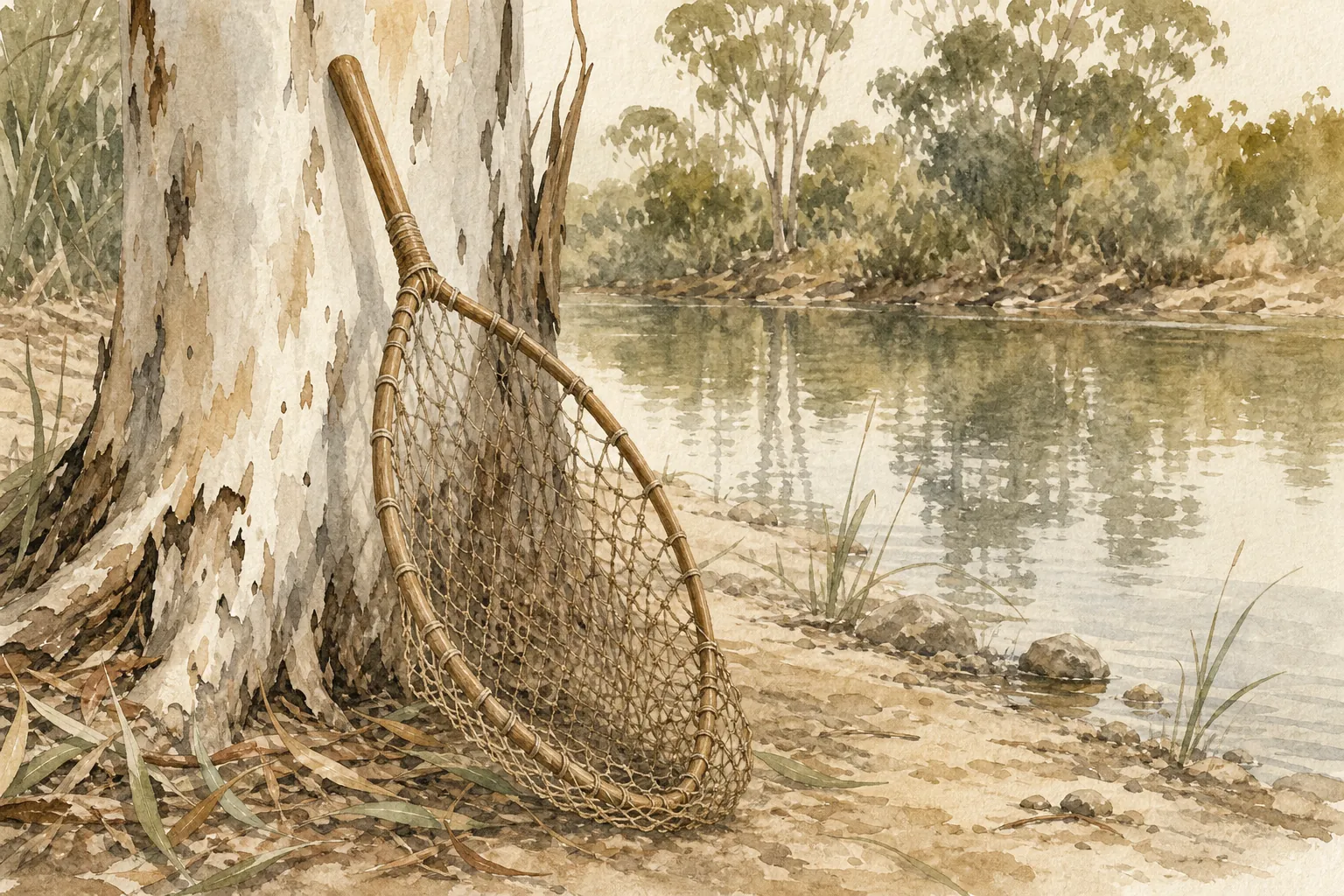
A makarr is a fish net[1]. The dictionary records nets made of warrur bark, 'dragged through the water in the dry season when the water goes down'[1]. Roth, writing in 1901, thought fish-nets were not used on the Bloomfield, the Endeavour or at Cape Bedford[2]. Yet he collected a two-person oval-frame net on the Bloomfield in 1898, a type made around the Laura[3]. Bloomfield people also got fishing nets in trade from the Laura[4]. Inland, on the Palmer and at the Laura, nets on oval frames of lawyer cane were swept through the water by two people while others drove the fish towards them[2].
Names
Makarr is 'fish net'. Warrur is 'tree bark which can be used as vine. It was used to make fishnets, which were dragged through the water in the dry season when the water goes down.' Ngunyin means a dilly bag, 'the tree bark used to make into strips and weave fishing nets and dilly bags', a spider web, and the placenta[1].
Roth's Bloomfield vocabulary fills in the fibre. Khan's catalogue of his collection records that the Bloomfield people called their netted string bags ngon-yan. The string, spun from the bark of the fig tree, was called warur or tchul-bal (Roth's spellings)[3]. Anderson likewise describes the men's bag, the ngunyin, as made of Ficus fibre twine[5]. So the warrur of the nets is probably fig-bark string; see fig.
At Cooktown, Roth was told that the Guugu Yimithirr word for a net was magar, 'i.e. a cobweb'[2]. That sounds close to Kuku Yalanji makarr, and the Kuku Yalanji ngunyin also joins net-bark and spider web.
Description
Two records that disagree. Roth wrote in 1901 that 'fish-nets are not employed at Cape Bedford, on the Bloomfield, or on the Endeavour River'. He added that the nearest people who used them were at the Laura, Princess Charlotte Bay and Cape Grafton[2]. Anderson's account of Bloomfield fishing likewise lists spears, lines and poisons, not nets[5]. Yet:
- Roth collected a non-folding oval-frame fishing net on the Bloomfield in 1898 (Australian Museum E.14959). It is 137 × 45 cm, woven in loose hour-glass looping with loops 9 cm long; the frame is missing. The museum's 1905 register says 'made at the Laura or Deighton'[3].
- Roth recorded that Bloomfield and Endeavour River people took red ochre, white clay and grass-tree spears up towards the Laura. In return they received melo shells, shell necklaces, stingray spears and fishing-nets[4][5].
- The 1982 dictionary has makarr and the warrur nets dragged in the dry season[1].
Nets were known and used, even if, in Roth's day, many were traded in rather than made on the coast.
Kinds of net in the region[2]:
- Non-folding oval-frame nets, with mesh in hour-glass looping, are found only on Cape York Peninsula: on the Morehead, Musgrave, Normanby, Laura, Palmer, Embley, Pennefather and Batavia Rivers. The Koko-yellanji (Roth's spelling) of the Laura called this net jikan-ikan.
- Folding 'purse' nets on oval frames, with European-style netting-stitch mesh, run from Princess Charlotte Bay south to Hinchinbrook Island and west to the Gulf. They fold shut like a purse when a fish is in. On the lower Tully the net is called mokaro.
- Scoops: on the lower Tully, women dipped their everyday lawyer-cane dilly-bags into the stream to catch fry swimming upstream in floods. Men scooped prawns at the river mouth in long split-cane baskets. See dilly bags and cherabin.
Where and when
The dictionary places warrur netting in the dry season, 'when the water goes down'[1]. As the creeks shrink, the fish are crowded into shallow pools where a net can sweep them. On the lower Tully, folding nets were also set in narrow channels in flood time[2].
The upper Mitchell. The nearest recorded nets are the two-person nets of the Palmer River and the Laura[2]. Only about 4% of the Mitchell catchment's rain falls between May and October[6], so the late dry is when its side creeks and lagoons shrink to pools.
What they caught
Roth names few species. Folding nets set with wings in flood time on the Tully were 'especially for "rock cod"', and the tiny fry scooped in dilly-bags were wrapped in wild-ginger leaves and baked[2]. A dry-season sweep of a waterhole on the Mitchell would take fish such as black bream, catfish and cherabin.
How nets were made and used
- Strip the bark: at Bloomfield, fig bark (warur). On the Palmer, the string was made from the wattle Acacia leptocarpa[2]. Further north it came from Acacia latifolia or the cabbage-tree palm.
- For Acacia latifolia, soak the inner bark all morning, when it turns red. Then dry it in the sun and split it into shreds.
- Roll each shred forwards on your outer thigh to make a strand. Fold it in two and roll it under pressure, forwards and then sharply back, so the two halves twist into two-ply twine. Join new shreds as you go. See string and twine.
- Start with one straight base strand. On the Bloomfield bags it was tied between two sticks set in the ground.
- Work one continuous strand in hour-glass (double-loop) looping along it, row after row. For a net the looping is kept very loose. On the Bloomfield net the loops are 9 cm long.
The frame (Princess Charlotte Bay hinterland)[2]:
- Make an oval of lawyer cane in two or three pieces, firmly lashed together. It is usually about 2½ feet wide and 5 feet long (about 75 cm × 1.5 m), often bigger.
- Lash the net to it.
Fishing with a two-person net (Palmer River and Princess Charlotte Bay)[2]:
- Two people carry the net upright through the water.
- Friends walk ahead as beaters, driving the fish towards it.
- Lift the net as soon as a fish is in.
A folding net on the lower Tully (Mallanpara country)[2]: fix the net open between two stakes in a narrow channel, where the current holds it open. When the beaters drive a fish close, the person watching from the bank or a snag dives in and shuts it.
The dictionary records that warrur nets were dragged, but not how many people pulled them or how the catch was landed[1].
Safety
A net that snags underwater can trap a swimmer, so keep a knife handy and never tie a net to yourself. Shrinking dry-season waterholes are where crocodiles shelter too; see freshwater crocodile.
On Country today
Recreational rules (Queensland fresh waters). The only nets allowed are scoop or dip nets, no bigger than 1 m in any dimension, with a handle up to 2.5 m long and mesh no bigger than 25 mm, plus landing nets for line-caught fish. Cast nets, seine nets, bait nets and drum nets are banned in fresh waters[8]. A traditional oval-frame net, at 1.5 m long, is too big to count as a scoop net.
Aboriginal tradition and native title. Queensland's Fisheries Act 1994 gives an Aboriginal person acting under Aboriginal tradition a defence for fishing with recreational gear, or with traditional fish traps of stone or organic material[9][10]. A traditional drag net is neither. Section 211 of the Native Title Act 1993 lifts licence and permit requirements for native title holders fishing for personal, domestic or non-commercial communal needs[11]. Western Yalanji native title includes rights to fish[12]. How s 211 meets an outright gear ban has not been settled in the sources found, so native title holders should ask their prescribed body corporate. Everyone else should ask the Traditional Owners, and the station at Karma Waters.
Language
Karra 'rope, cord, string'; ngurran 'rope, also dilly bag made from rope'; murnil 'twist, stir'; kajal 'to tie'; marral 'dry'; kuyu 'fish'[1].
References
- Hershberger, H. D. & Hershberger, R. (1982). Kuku-Yalanji Dictionary. Work Papers of SIL-AAB, Series B, Volume 7. With Toby Bloomfield, Roy Friday, Billy Roberts, Hector and Doris Sykes, Joe Walker and others. www.sil.org/resources/archives/18038
- Roth, W. E. (1901). North Queensland Ethnography, Bulletin No. 3: Food — its search, capture, and preparation. Brisbane: Government Printer. — Sect. 15 'Fish' (h) baskets and cages, (i) fish-nets archive.org/details/northqueensland00landgoog
- Khan, K. (1993). Catalogue of the Roth Collection of Aboriginal artefacts from north Queensland. Volume 1: Items collected from Archer River, Atherton, Bathurst Head, Bloomfield River and Butcher's Hill, 1897–1901. Technical Reports of the Australian Museum 10: 1–205. — Bloomfield River: 'Woven bag' E.14833; 'Non-folding oval frame fishing net' E.14959 doi.org/10.3853/j.1031-8062.10.1993.69
- Roth, W. E. (1910). North Queensland Ethnography, Bulletin No. 14: Transport and trade. Records of the Australian Museum 8(1). — Sect. 1, trade and barter (Bloomfield and Endeavour River people with the Koko-warra) archive.org/details/biostor-52863
- Anderson, C. (1996). Traditional material culture of the Kuku-Yalanji of Bloomfield River, North Queensland. Records of the South Australian Museum 29(1): 63–83. Based on fieldwork at Wujal Wujal in the late 1970s and early 1980s. — Subsistence activities: fishing; dilly-bags; trade archive.org/details/RecordsSouthAus29Sout
- Stewart-Koster, B., O'Mara, K., et al. (2021). Critical water needs to sustain freshwater ecosystems and aquatic biodiversity in Queensland's Mitchell River. Griffith University / NESP Northern Australia Environmental Resources Hub. era.dpi.qld.gov.au/id/eprint/8432/1/Critical-water-needs-for-the-Mitchell-River-final-report.pdf
- Roth, W. E. (1901). North Queensland Ethnography, Bulletin No. 1: String, and other forms of strand: basketry-, woven bag-, and net-work. Brisbane: Government Printer. — Sect. 7, manufacture of fibre-twine; sect. 22, 'hour-glass' mesh archive.org/details/northqueensland00landgoog
- Queensland Government. Fishing equipment rules: fresh waters (web page, last updated 26 March 2026, accessed 6 October 2026). www.qld.gov.au/recreation/activities/boating-fishing/rec-fishing/rules/equipment
- Fisheries Act 1994 (Qld), current as at 27 April 2026: s 14 (defence for Aboriginal peoples and Torres Strait Islander peoples). www.legislation.qld.gov.au/view/html/inforce/current/act-1994-037
- Fisheries (General) Regulation 2019 (Qld), current as at 1 July 2026: s 7 (recreational fishing apparatus) and s 21 (prescribed fishing apparatus for s 14 of the Act: fish trap). www.legislation.qld.gov.au/view/html/inforce/current/sl-2019-0179
- Australian Law Reform Commission. Review of the Native Title Act 1993 (DP 82), ch. 8: Relevant provisions in the Native Title Act (s 211). www.alrc.gov.au/publication/review-of-the-native-title-act-1993-dp-82/8-the-nature-and-content-of-native-title/relevant-provisions-in-the-native-title-act/
- Brady on behalf of the Western Yalanji People #4 v State of Queensland [2013] FCA 958 (Federal Court of Australia, 24 September 2013). www.judgments.fedcourt.gov.au/judgments/Judgments/fca/single/2013/2013fca0958