Skills & methods
Games, toys and string figures
kinkay 'play' and ngujuri 'to play', nguju and kuya 'fun', nguju-wuri-y 'to fool around, play about, dance in a funny/playful way', nguku maniway 'playing together', baki 'toy', yajarril 'to laugh', mala-kural 'good diver' and biray 'grey March fly', the name of a children's game, are the dictionary's words for this page[1]. Roth's 1902 bulletin on games 'from the Bloomfield (particulars of which have been forwarded to me by Miss Violet Hislop)' and from R. Hislop at the same place, and Anderson's 1996 summary, give the Kuku Yalanji games by name: 'swinging on the lawyer-cane', diving and bubble-blowing, jumping into the water 'from the greatest height', the 'March-fly' chasing game, 'string games, using fibre and human hair twines', 'toy canoes', toy boomerangs 'made from pandanus leaves', and the rolling-disc spear game played 'on a cleared space, about 12 to 16 yards long, down more or less of a slope' with a ball 'cut out from the top of a "zamia" tree'[2][3]. String figures, 'cratch-cradle', are 'met everywhere throughout North Queensland', played 'for hours at a time' by 'adult women and young children, of both sexes'; Roth drew figures from the lower Palmer River, Atherton, Cape Bedford and Cape Grafton, and 'some of the figures are extremely complicated', 'passing through at least 8 or 9 stages before completion'[2]. Add the Palmer River's own games, the Koko-minni wrestling called 'donaman' and the hide-and-seek 'koabangan' played with a goanna claw, and the toy boomerang, which 'on the (middle) Palmer River, about latitude 16 degrees — the most northerly limit at which the boomerang has so far been met with — is employed merely as a toy'[2]. This page is the games as things to make and play on country now, at Karma Waters or anywhere: the string, the lawyer cane, the zamia disc, the grass-blade shooter, the toy spear; the ceremonial side that Roth sometimes brushed, the bullroarer and the didgeridoo taught at initiation, is left out of it on purpose[2][3].
Hann River Cape York
Possum People's country on the upper river and Thaypan (Kuku Thaypan) country downstream: stringybark and bloodwood woodland and a spring-fed sandy river that runs north-east from the Great Dividing Range, past the Peninsula Developmental Road, into Rinyirru (Lakefield) and the North Kennedy. Not Kuku Yalanji country: the Kuku Yalanji words on this page are the dictionary's, not the Hann's own languages. Place guide
No games are published from the Hann River itself. The nearest records are Roth's, made around 1898–1900 among the Koko-warra, Koko-rarmul and Koko-lama-lama of Princess Charlotte Bay, the bay the Laura Basin drains to, and on the upper Normanby next door[2][7]. The upper Hann is the Possum People's country and the middle and lower Hann are Thaypan country; their own games are theirs to tell[8][9].
Games recorded nearest the Hann
Crocodile. The 'crocodile' game was 'a favourite one amongst the Princess Charlotte Bay blacks, where the surface bubbles, as the native dives along, is intended to imitate the reptile's tracks'[2]. On the upper Normanby the lads had 'a kangaroo and a crocodile game': in the first a boy 'will hop about here and there, after the manner of the marsupial in question, dodging as he goes the toy-spears which are being thrown at him'; in the second 'he will swim on the surface like the saurian he is supposed to represent, and expose himself to similar treatment'[2].
Iguanas. On the upper Normanby one boy 'will half-lie on the ground and dig his fore-arm, up to and including the elbow, into the sand. Here and there he will stick out a finger', and the others try to hit it with a stick[2].
Playing house. 'On the upper Normanby, the youngsters pretending to be married will build an impromptu hut and sit contentedly within its shade'[2].
Swinging and shooting. Roth noticed 'a similar thing' to the Bloomfield's lawyer-cane swinging 'along the Morehead River at the back of Princess Charlotte Bay', and a way 'of shooting wooden splinters is recorded from the Upper Normanby, in the middle eighties'[2].
Games that teach the hunt
Kuku Thaypan Elders recorded that 'games were also made that increased capacities to be better hunters such as the throwing of the bushman's clothes peg, Grevillia glauca seed', which 'can be attached to a throwing stick and be sent hurtling off into the distance for a long way. This technique although a game for young children is a method used to hunt birds on the wing'[10]. In Kuku Thaypan the tree is Ku andeal, one of the 'mixed trees on higher elevation light sandy soils'[10].
String figures from Princess Charlotte Bay
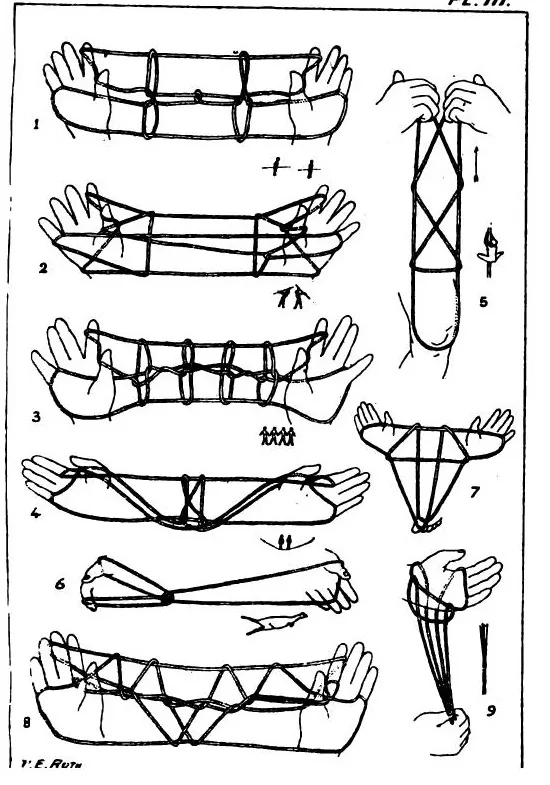
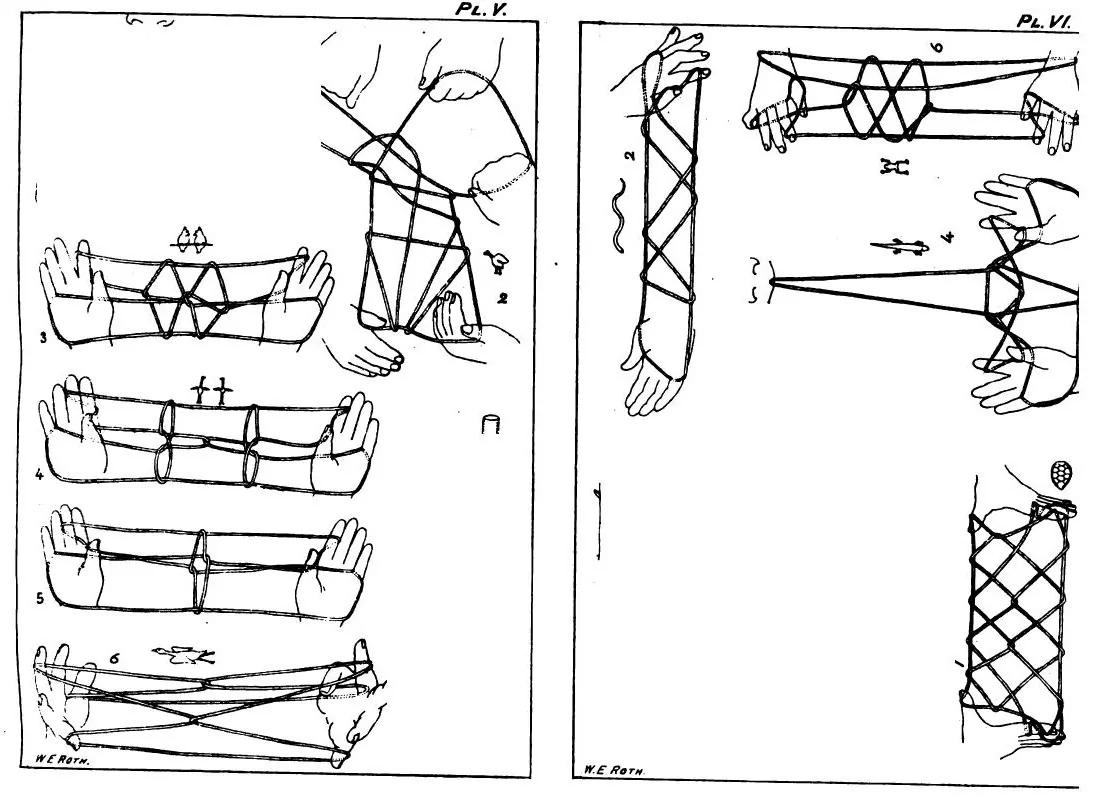
Roth gives the Koko-lama-lama name for string figures as yirma and the Koko-warra name as andai-ibi, in his spelling[2]. The figures he drew from Princess Charlotte Bay include a kangaroo, a pouch 'indicative of a kangaroo', an emu, a duck in flight, a 'bird's nest, in the bottom of a hollow stump' and a 'dilly bag with handle'. The plates are in the bulletin; the endless string above is how to start[2].
Water play on the Hann
Not in the Hann's deep holes. Both crocodiles live in this river system, and the park's rule holds on the river too: 'Never swim in water where crocodiles may live, even if there is no warning sign present'[11]. The water games on this page are for safe, checked water only; the crocodiles page has the Hann in full.
Upper Mitchell Western Yalanji
Western Yalanji country west of the Great Dividing Range: dry open woodland cut by the sandy, paperbark-lined upper Mitchell River, around Karma Waters and Mount Carbine. Place guide
Western Yalanji country around Karma Waters sits beside the middle Palmer, whose Koko-minni games are the closest record, and at about latitude 16 degrees, the boomerang's northern limit, where Roth found it 'employed merely as a toy'[2][12].
Signs here
A boomerang found on the Palmer side of the country is as likely a toy as a weapon, since there it 'is employed merely as a toy'[2].
Where the games are played here
At Karma Waters the waterhole is a fenced river pool in the dry, with the freshwater crocodile rule that goes with it, and never the lower tidal river[13][4]. On the Mitchell the swing is a rope on a river gum.
The games of the Palmer
Roth's Koko-minni, 'the (middle) Palmer River' people, were the Western Yalanji's neighbours and kin, and their games are the closest record to Karma Waters[2]. 'Wrestling has since been met with on the Palmer (KMI, donaman)'; 'bending forwards, the challenger will grip his adversary with both hands round the loins where he interlocks his fingers so as to maintain a very firm hold: the latter, with arms raised, remains passive, and in this position is lifted from off the ground on to which he is next thrown. Honours are divided so long as he touches ground with his feet'; 'there is no mutual clutching, or both combatants falling: strictly speaking, it is a throwing, rather than a wrestling, match. Only males engage in this sport: as soon as one proves himself victorious, another challenges him'[2]. 'Another hide-and-seek game played by the Kokominni boys is the koabangan. While all sit round in a circle with heads low and hands over their faces, an iguana-claw is hidden in the fork of a neighbouring tree: upon a signal being given, they will jump up and commence looking for it'[2]. The goanna page has the claw.
The toy boomerang. 'While the fighting Boomerang may be employed as a toy, the implement is often constructed solely and especially for purposes of sport and amusement'; 'on the (middle) Palmer River, about latitude 16 degrees — the most northerly limit at which the boomerang has so far been met with — it is employed merely as a toy. The toy-boomerang is thrown only by men and boys, and its throwing is the only indigenous North Queensland game wherein any real attempt is made to see who is the "best" man so to speak, but even then no so-called "prize" is awarded'[2]. 'When thus made as a toy, and compared with a fighting boomerang, it is lighter and smaller'; 'the boomerang is said to be right or left handed not because it is necessarily thrown with the one or other hand, but because it circles to the right or left side of the thrower', and 'until its manufacture is completed, and it has been tried by experience, the blacks have told me that they cannot determine with any degree of assurance which of the two varieties it will prove to be'[2]. Karma Waters sits at that same latitude, 16 degrees south; it is boomerang country only as play[2][12].
The water season here
Water games are the dry season's, when the pools are clear and low and the river is safe to be in; the wet river is for nobody[13].
On country today
At Karma Waters the station's rule on dogs is on the cattle page[14]. Which figures the Western Yalanji women made, what the Mitchell's children called the games, and what a Karma Waters sports day looks like are for the contribution box below.
Eastern coast Eastern Kuku Yalanji
Eastern Kuku Yalanji country: rainforest, beaches, mangroves, reef and the short steep rivers from the Daintree to the Bloomfield and the Annan.
The Bloomfield is the best-recorded games country in this guide: Roth's 1902 bulletin drew on Violet Hislop and R. Hislop there, and Anderson's 1996 summary on what Kuku Yalanji people at the Bloomfield told him[2][3].
The Bloomfield games
In the water. 'Bathing is, of course, always indulged in at any convenient creek or waterhole, and in its wake comes splashing, diving, catching, etc. One will dive either to elude being caught himself, or the better to enable him to catch others, any convenient rocks or water-bushes being utilised for purposes of eluding pursuit'[2]. 'Along the Bloomfield, among what may be called such aquatic sports, is one in which the individual will, with a long breath, dive under water, and, as he swims along, blow bubbles up onto the surface; others will try and excel him'; 'the Bloomfield aboriginals will also often see who can jump into the water from the greatest height, this being always done with the feet foremost (R. Hislop)'[2]. Anderson: 'young men held diving competitions from tree branches into the water and also held wrestling matches'[3].
On the cane. 'At the Bloomfield, swinging on the lawyer-cane (Calamus) is a common pastime. The hanging creeper is cut from 2½ to 3 feet from the ground, and the children jump and run at it, or else get others to swing them: they hold on with the hands above and feet below, the knees being extended outwards (R. Hislop)'[2]. The lawyer cane is the rainforest's.
March fly. 'Very small children at the Bloomfield play "March-fly" as follows: Shutting his (or her) eyes, the one who takes the part of the fly runs about trying to catch someone. As soon as successful, he makes an unpleasant noise (imitative of the insect's buzz) in the ear of the child caught and also gives it a pinch (indicative of the sting)'[2]. The insect page has the real fly.
Toys of the Bloomfield
Toy canoes 'were made from bark and palm leaves' at the Bloomfield, the canoe in small[3]. At the Bloomfield the toy boomerangs were 'made from pandanus leaves'[3].
The Bloomfield wheel
Anderson: 'a small wheel (made of a log of softwood or the top of a zamia tree) was covered on the sides by red clay and beeswax and then decorated with parrot, pigeon or cockatoo feathers. This wheel was then rolled down a hill and spears were thrown at it. Men used normal spears and boys used toy spears made from dry grasstree stems'[3].
Everywhere
Names
kinkay 'play (yalanji)' and ngujuri 'to play (yalanji) (nyungkul - kinkay)'[1]. nguju 'fun'; ngujungu 'for fun or in fun, pretend'; nguju-wuri-y 'to fool around, play about, dance in a funny/playful way'; nguku maniway 'playing together'; kuya 'fun'; kuya-bungal 'make fun of, tease in fun, make a joke'[1]. yajarril 'to laugh'; janjarriji-y 'to laugh at someone in a friendly way'; judal 'tricking, pretending'[1]. baki 'toy; toys with wheels. English loan word from buggy'[1]. karra 'rope, cord, string'[1]. maraji and mariji-y 'swim'; janjil 'wash, bathe, swim'; mala-kural 'good diver'; ngalu-ngalu 'refreshed, as after a swim'[1]. jalamal 'jump, hop, skip'; kala-jalamal 'jump over'; wayi-janay 'jumping around because he's happy; good dancer'; juru-kulbaway 'walk single file'[1]. biray 'grey March fly', kamay 'yellow March fly', waja 'march fly': Anderson writes that 'young boys and girls played a game called birray, or "March fly"'[1][3]. kunbu 'a big day, celebration, as a dance, race meeting or corraborree'; wulngku 'song'; mala-burri 'good singer'; wuri 'to dance, swing; to gamble'[1].
Roth's spellings for the Bloomfield are not the dictionary's: his 'tchugari', the small one-piece spear of the disc game, and 'teripa', the bullroarer, are given here as he wrote them and not as headwords[2]. The Koko-minni words 'donaman' and 'koabangan' are the middle Palmer's, in Roth's spelling[2].
The games Roth recorded
Mimicry. 'The mimicking, by means of attitudes and movements, of various animals, birds, etc., forms an important item in the diversions with which the aboriginals will everywhere amuse themselves in their leisure hours. Emus and kangaroos can be very well imitated', the emu with 'the mimic's one arm and hand' for 'the bird's neck and head' and 'a bunch of feathers held in the other hand, to indicate the tail'[2]. At Cape Bedford '"Shark" is played by little children': 'the two arms are twisted one over the other' 'and represent a shark's movements in the water', and 'a boy (or girl) rushes about with her limbs in this position, trying to catch whom she can'[2].
Tracks in the sand. 'Next to "cratch-cradle" the most general perhaps of all this particular group of imitative games is the drawing of different animal- and bird-tracks, etc., in the smoothed sand, by means of the fingers, finger-nails, palms, small sticks, etc.'; 'even in the delineation of such apparently simple things as an animal's track, a good deal of art and ingenuity is brought into execution'[2]. It is the tracks page as a game, and the way children learned the prints.
Dolls and playing house. 'Playing at "Houses," "Grown-ups," "Marriage" etc., is in one form or another as common among black children as it is among white ones'; at Cape Bedford 'the small girls often play at the preparation and cooking of yams and other vegetables, mimicking in the process all the actions of their elders', 'forked sticks similarly constitute girls' dolls', and elsewhere 'the parents generally make miniature dilly-bags for their children to carry these dolls in'[2]. 'Plait-work is met with as a pastime among the boys at Cape Bedford', 'in a form imitative of the handles of the dillybags met with further north'[2].
Pets. 'Only in the case of the dingo does true domestication and training take place. The pups are caught young, brought into camp, and tied up by the leg until such time as they become reconciled to their surroundings. Sometimes a boy (on the Bloomfield) but more usually a gin is placed in charge of these animals', and 'the aboriginals appear to be very fond of their dogs, share their food with them, often speak to them as if they were intelligent beings'[2]. The dingo page has the rest.
Games and the things that are not games
Roth himself drew a line and sometimes crossed it. Of the 'Moon' game of Cape Bedford and the Bloomfield he wrote 'I admit having my doubts as to the propriety of doing so, the general run of the thing looking suspiciously like a remnant of some ordeal or ceremonial'; of wrestling, that it 'might be originally derived from ceremonial'; and of the bullroarer and the Bloomfield's yiki-yiki, that they are 'taught at the initiation performances'[2]. Anderson repeats that 'instruction in how to play the pipe was given to young men during initiation, but the instrument could be openly played in public'[3]. Those things, and the games Roth records that act out spirit beings, are not on this page; they belong to the families and the old people, and if any of them is to be written down it is for them to say[2].
What is here is the open play: water, string, sand, toys, mimicry of animals, chasing, throwing. Roth's own test is a fair one: a game 'played in public, and before women', by children, with laughter, is a game[2].
Signs
A rope on a river gum over a pool, a worn bank where children jump, a smoothed patch of sand with prints drawn in it, a cleared strip on a slope with spear holes in it, a loop of string in a pocket: the signs of play are small and everywhere[2]. The old zamia-disc ground would have been a strip 'about 12 to 16 yards long' on a slope near camp; nothing of it survives on the ground, but the trees do, since the zamia is still 'cut out from the top' for the ball[2].
Where the games are played
The waterhole is the first playground: the dive, the bubble race, the jump from the branch, the catching game among 'any convenient rocks or water-bushes'[2]. The camp is the second: string figures by the fire, 'for hours at a time'; dolls; the sand drawing; the guess game, 'another good pastime indulged in by young and old at Cape Bedford', in which 'one of the party may perhaps notice a new flower just in blossom, a bird half hidden in a bush, a tussock of grass uprooted, etc., and taking care to look in quite a contrary direction' 'will say, "What am I thinking of?"' and 'they all try to guess, one after the other, and great laughter is aroused when the right thing is mentioned'[2]. The camps page has the camp itself.
The slope and the open ground are the third: the rolling disc, the toy spears, the toy boomerang, the throwing sticks, the wrestling ring, 'a cleared circular space, about 8 yards in diameter'[2].
Hunting games
Cape Bedford's hunting games are the Koko-yimidir's, not Yalanji, but they show the pattern: the 'Honey-game', 'imitative of the search for honey', in which stacked hands 'represent the trunk of a tree' and 'each hand is now in turn knocked off from above down with a side-cut — the tree is being felled'; 'Catching Cockatoos', where the hands 'represent cockatoos sitting one above the other on a branch of tree' and 'the one free hand in the group of players now makes a dart at the topmost fore-finger'; the 'Duck game', in which a child with 'a long stick' plays 'a man catching duck by means of a slip-noose attached to the end of a long slender switch', and 'the other children pass round and round, bobbing underneath the stick in Indian file, when, all of a sudden, down it comes just in front of one who will thus be considered "caught"'; and 'Tortoise', where a boy 'holds out back' a short stick 'after the manner of a wommera' and his mate 'slowly raises his hands so as to get his fore-fingers on either side of the forehead' as 'the animal with flappers rising to the water-surface in answer to the "call"'[2]. Every one of them is a hunting lesson in play.
Seasons
String and sand are all year; the toy spears are made when the grass is tall and dry, from 'light thin withes or else from grasses, reeds, and rushes, e.g., Andropogon schoenanthus, Imperata sp.', the lemon grass and the blady grass[2]. The grass-blade shooter wants a fresh green blade of blady grass, so it is a wet-season and early-dry toy[2]. The zamia disc is cut when a zamia is being taken for food anyway[2][3].
Uses
Every game is a school. The sand drawing teaches tracks; the honey, cockatoo, duck and tortoise games teach the hunt; the toy spear and woomera teach the throw, 'held at their lighter ends, and thrown either with the hand' 'or with the toy wommera'; the disc game teaches the moving target, with 'spears used for this special purpose' that 'are small, made in one piece, thrown with the hand'; the diving and the bubble race teach the breath that takes turtles and mussels from the bottom; the string figures teach the fingers that make nets and dilly bags[2]. 'In those districts where shields are employed by the adults, these may be imitated on smaller scale, and often with similar ornamentation, out of convenient pieces of bark'[2].
The grass-blade shooter was a hunting tool as well: 'boys, both old and young, are very expert with this toy in the way of killing such birds as small wrens, etc. On one occasion, at the Tully, I saw a boy shooting these grass-petioles at, and hitting, some weaver-birds' nests quite over 100 feet from the ground'[2].
String is the most useful toy on earth: an endless loop of karra in the pocket is a game, a measuring line, a snare, a lashing[1][2].
Making and playing
An endless string. Take about a metre and a half to two metres of twine, the string page's two-ply if you have made it, or any cord, and join the ends with a small firm knot; 'with any fair length of twine, adult women and young children, of both sexes, will often amuse themselves for hours at a time. It is thus used in the form of an endless string to play the game known to us Europeans as "cratch-cradle"'[2]. Roth's figures are drawn 'only' as 'the finished article', and 'during the progress of manufacture such an one requires not only the hands, but even the mouth, knees, etc., to make the different loops, twists, and turns'; 'certain of the figures may be made with two endless strings', and 'to complete others again, it may be necessary to have one or even two assistants'[2]. The figures he recorded nearest Kuku Yalanji country include 'two women fighting with sticks' from the '(lower) Palmer River', 'two boys carrying spears' from Atherton, and 'four boys walking in a row, holding each other's hands' from Cape Grafton; the plates are in the bulletin, and the figures themselves live in the hands of whoever still makes them[2]. To start any of them: the loop over both hands behind the thumbs and little fingers, the far string picked up with the index fingers, and from there every figure is a sequence of picking up and dropping; the old people's sequences are for the contribution box below.
The grass-blade shooter. 'A piece of "bladey" grass (e.g., Imperata arundinacea) is pulled, cut to a suitable length, and split from below up, on either side of the petiole, to a convenient length'; 'the cut extremity of the grass is held loosely and horizontally between the lips, while the split ends of the leaf are bent over a stick (grasped with the right) and held in the left hand. If the stick be now driven sharply forwards, the petiole is shot away, leaving the two halves of the blade behind in the left hand. Sometimes the stick is replaced by the fore-finger of the right hand'[2]. The blady grass page has the plant.
A toy spear and woomera. 'Toy spears are thus made from light thin withes or else from grasses, reeds, and rushes', 'held at their lighter ends'; 'the toy wommera can be manufactured from a rush by splitting its end, removing the pith from one of the split halves, and tying the cortex in a loop round the other: the loop retains the reed-spear in position'[2]. The grown-up version is on the spear page.
The rolling disc. Clear 'a cleared space, about 12 to 16 yards long, down more or less of a slope'; 'at the top end of this slope one of the men will, with his spear, start rolling a ball cut out from the top of a "zamia" (Cycas) tree: as it rolls on and on with ever-increasing momentum, his friends lining the cleared pathway will try and job it with their spears'[2]. 'At Butcher's Hill and elsewhere the cycad disc may be replaced by a circular piece of bark'; so can a slice of a soft log[2]. The zamia, the red ochre, the beeswax and the grass tree are all on their own pages.
Toy throwing sticks, from the west: 'a thin rounded straight stick' 'with an elongately-knobbed extremity', '12 to 20 inches in length', 'thrown from a distance of 2 or 3 yards up and against the fringe of some overhanging bushes or leafy branches', from which 'the stick shoots through the air, knob foremost, and with greater impetus'[2].
A spinning top from the coast: 'the mamandur of Cape Bedford is made by passing a small wooden splinter through a more or less flattened and circular plate of bees'-wax and spinning it like an English boy would a "tee-to-tum"', and 'this method of spinning is adopted with the calyx-cups' of the mangrove apple and other plants[2].
The water games need no making: a branch over a deep pool for the jump, feet first always; the bubble race from one bank to the other; the catching game around a snag[2].
Safety
Water. Jump 'feet foremost', as the Bloomfield did, and only into a pool someone has checked for depth and snags that day; a river pool changes every wet[2]. No swimming in the lower tidal river or any water with a saltwater crocodile sign, and the Crocwise rules at every pool; the freshwater crocodile bites a hand that grabs it in a snag[4][5]. Someone watches the small ones from the bank, always.
Spears and sticks. Toy spears are held 'differently to the fighting weapon' and thrown at the disc, never at a person; the disc game has the throwers on one side of the strip[2]. The grass-blade shooter is for targets, not faces.
String. A loop of string is a toy, not a necklace: nothing around a small child's neck.
The sun and the ground. Play in the shade in the hot season; the bites-and-stings page has the ants, the March flies and the ticks that come with sitting on the ground[6].
On Country today
Roth wrote of 'games introduced of late years by missionaries, settlers, and others', and the dictionary's baki, 'toys with wheels. English loan word from buggy', and kunbu, 'a big day, celebration, as a dance, race meeting or corraborree', record the same thing: football, the races, the rodeo and the station sports day are country games now[2][1]. The old ones are not gone: string figures, the swimming games and the sand drawing need nothing bought, and the disc game needs a slope, a zamia and a few hours[2].
Language
kinkay 'play'; ngujuri 'to play'; nguju 'fun'; kuya 'fun'; ngujungu 'for fun, pretend'; nguju-wuri-y 'fool around'; nguku maniway 'playing together'; kuya-bungal 'make fun of'; judal 'tricking, pretending'; yajarril 'laugh'; janjarriji-y 'laugh at in a friendly way'; baki 'toy'; karra 'string'; maraji 'swim'; janjil 'bathe, swim'; mala-kural 'good diver'; ngalu-ngalu 'refreshed, as after a swim'; jalamal 'jump'; kala-jalamal 'jump over'; wayi-janay 'jumping around because he's happy'; juru-kulbaway 'walk single file'; biray 'grey March fly'; kamay 'yellow March fly'; waja 'march fly'; kunbu 'big day'; wulngku 'song'; mala-burri 'good singer'[1].
Images
References
- Hershberger, H. D. & Hershberger, R. (1982). Kuku-Yalanji Dictionary. Work Papers of SIL-AAB, Series B, Volume 7. With Toby Bloomfield, Roy Friday, Billy Roberts, Hector and Doris Sykes, Joe Walker and others. www.sil.org/resources/archives/18038
- Roth, W. E. (1902). North Queensland Ethnography, Bulletin No. 4: Games, sports and amusements. Brisbane: Government Printer. — Sect. 4 'Realistic games (animals)' archive.org/details/northqueensland00landgoog
- Anderson, C. (1996). Traditional material culture of the Kuku-Yalanji of Bloomfield River, North Queensland. Records of the South Australian Museum 29(1): 63–83. Based on fieldwork at Wujal Wujal in the late 1970s and early 1980s. — Hunting (spears, spear-throwers, harpoons); fishing (stupefacients); manufacturing (gums and resins); post-contact bush component archive.org/details/RecordsSouthAus29Sout
- Queensland Government. Be Crocwise top tips; Be Crocwise in Croc Country (web pages, accessed 5 October 2026). www.qld.gov.au/environment/plants-animals/animals/living-with/crocodiles/becrocwise/be-crocwise-top-tips
- Queensland Department of Environment, Science and Innovation. Crocodile biology and ecology (web page, last reviewed 15 June 2023; Wayback Machine copy). environment.des.qld.gov.au/wildlife/animals/living-with/crocodiles/about-crocodiles
- healthdirect Australia. Insect bites and stings (accessed 10 October 2026). www.healthdirect.gov.au/insect-bites-and-stings
- Queensland Parks and Wildlife Service. Nature, culture and history: Rinyirru (Lakefield) National Park (CYPAL) (web page, last updated 1 July 2024; accessed 28 October 2026). parks.qld.gov.au/parks/rinyirru-lakefield/about/culture
- Ross on behalf of the Cape York United #1 Claim Group v State of Queensland (No 21) (Possum determination) [2023] FCA 1316 (Federal Court of Australia, 2 November 2023). — Determination area (upper Hann and Kennedy rivers); prescribed body corporate; affidavit evidence on hunting and fishing www.judgments.fedcourt.gov.au/judgments/Judgments/fca/single/2023/2023fca1316
- Ross on behalf of the Cape York United #1 Claim Group v State of Queensland (No 20) (Thaypan determination) [2023] FCA 1315 (Federal Court of Australia, 2 November 2023). — Determination area and waters; prescribed body corporate (Awu-Laya Indigenous Corporation); affidavit evidence on hunting www.judgments.fedcourt.gov.au/judgments/Judgments/fca/single/2023/2023fca1315
- Standley, P.-M. (2019). The importance of campfires to effective conservation. PhD thesis, James Cook University. Records the fire and country knowledge of Kuku Thaypan Elders Dr Tommy George and Dr George Musgrave. researchonline.jcu.edu.au/64274/
- Queensland Parks and Wildlife Service. Visiting Rinyirru (Lakefield) National Park (CYPAL) safely (web page, last updated 1 June 2025; accessed 28 October 2026). parks.qld.gov.au/parks/rinyirru-lakefield/visiting-safely
- Karma Waters Station. About: location, native title (web page, accessed 5 October 2026). www.karmawatersstation.com/about.html
- Karma Waters Station. Bush Camping at Karma Waters Station (web page, accessed 5 October 2026). www.karmawatersstation.com/bush-camping.html
- Karma Waters Station. Induction, waiver and indemnity form (updated 9 June 2023). www.karmawatersstation.com/uploads/3/1/9/2/31929385/induction_waiver_and_indemnity.pdf
From the community
Know this one? Add the words you use for it, what it is for, how it is done, a correction, or a photo from country. It shows here straight away with your name on it. Please keep anything restricted or sacred off the site.
Loading…