Spears & weapons
Shields, swords, clubs and boomerangs
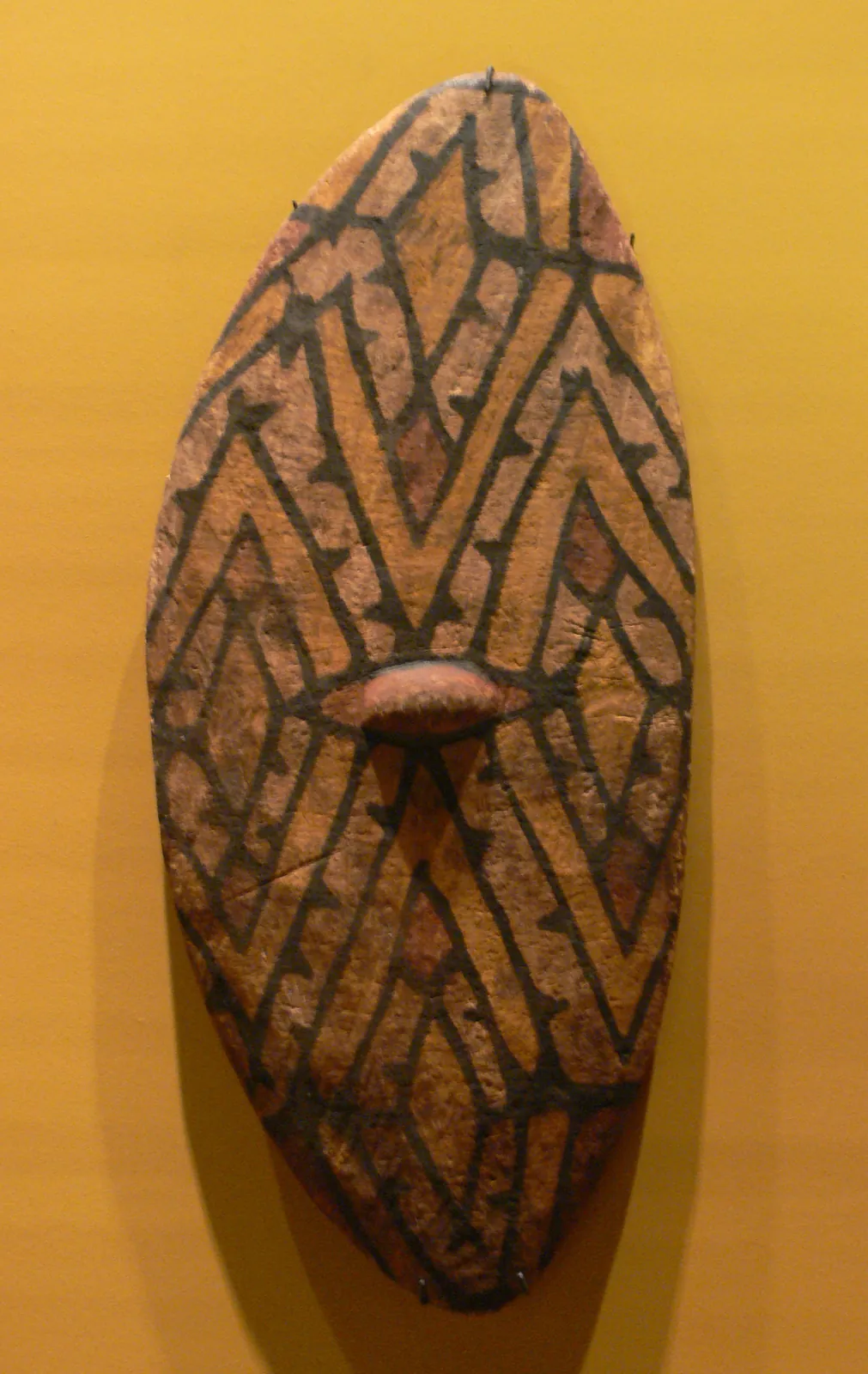

kunjuri is the shield, wakay the 'wooden sword. The Port Douglas and rain forest people used them', mirru the 'club, nullanulla', nala-nala the 'waddy club', and wangal the boomerang[1]. Roth mapped the shield in 1909. The big painted rainforest shields of the wet tropics were cut from the plank buttress of a fig and worked with fire and stone, from below Cardwell north to the Bloomfield; a split-timber shield came up the Gulf side as far as the Mitchell; and in between, 'throughout the Peninsula no indigenous shield is to be met, the place of the weapon being taken by the broad-bladed spear-thrower'[2]. The single-handed sword was a rainforest weapon too, 'met with in the Cardwell and Bloomfield Districts'[2]. Each place above has its own record.
Hann River Cape York
Possum People's country on the upper river and Thaypan (Kuku Thaypan) country downstream: stringybark and bloodwood woodland and a spring-fed sandy river that runs north-east from the Great Dividing Range, past the Peninsula Developmental Road, into Rinyirru (Lakefield) and the North Kennedy. Not Kuku Yalanji country: the Kuku Yalanji words on this page are the dictionary's, not the Hann's own languages. Place guide
No shield was made in the Hann's country. Roth, 1909: 'Throughout the Peninsula no indigenous shield is to be met, the place of the weapon being taken by the broad-bladed spear-thrower, which, in the hands of a skilful fighter, can brush to the right or the left, as the case may be, any spear that may be thrown at him'[2]. Boomerangs too, 'north of the Palmer River, they may be said to be absent in the Peninsula'[2]. What Roth recorded around Princess Charlotte Bay was the ironwood spear-thrower, the club, the fighting pole and a spear made with bamboo from the Hann.
The weapons here
Roth's records from Princess Charlotte Bay and its hinterland, about 1900, in his spellings[2]:
- Spear-thrower, the shield's stand-in. 'At Princess Charlotte Bay the wommera is made of iron-wood. The blade is longer than at Cape Bedford, etc., wide at the centre, narrower at the handle.' Koko-rarmul bo-un, Koko-warra alvau-ul. See spear and woomera.
- Club. The plain nulla-nulla, a type 'common throughout the whole of North Queensland'; Koko-rarmul kunbai-il, Koko-warra pa-ul.
- Fighting pole. On the middle Palmer the men's fighting pole was made of box-wood; 'at Princess Charlotte Bay the implement ... is somewhat shorter'.
- The Hann's bamboo. 'The Princess Charlotte Bay Natives have a special spear made with a proximal bamboo portion, and a distal Acacia one; local names, KRA. andarma, KWA. bar-nga; the bamboo is obtained from the Hann and Kennedy Rivers, and forms a staple barter, e.g., to the Koko-minni of the Middle Palmer River.'
How people used them here
The Kuku Thaypan Elders spoke of the many uses of fire, 'for cooking and for warfare', and of fire for 'tool and weaponry production'[10]. Roth recorded a Koko-rarmul story of how the bamboo came to the Hann[11]. The stories, and the law of fighting, belong to their custodians and are not retold here.
On country today
The upper Hann is the Possum People's country and the middle and lower Hann are Thaypan country, under native title determinations of November 2023[12][13]. Old weapons and the places they were made are their cultural heritage.
Upper Mitchell Western Yalanji
Western Yalanji country west of the Great Dividing Range: dry open woodland cut by the sandy, paperbark-lined upper Mitchell River, around Karma Waters and Mount Carbine. Place guide
On the Mitchell it was different: 'throughout the Peninsula no indigenous shield is to be met, the place of the weapon being taken by the broad-bladed spear-thrower, which, in the hands of a skilful fighter, can brush to the right or the left, as the case may be, any spear that may be thrown at him. On the Gulf Coast-line, the northernmost limit of the shield would appear to be the Mitchell River, where the weapon is more or less identical with the Normanton and North-West District pattern, in that it is made from a split timber and subsequently trimmed down into shape'[2].
The shield here
The Mitchell River shield. 'Throughout the Peninsula no indigenous shield is to be met, the place of the weapon being taken by the broad-bladed spear-thrower ... On the Gulf Coast-line, the northernmost limit of the shield would appear to be the Mitchell River, where the weapon is more or less identical with the Normanton and North-West District pattern, in that it is made from a split timber and subsequently trimmed down into shape ... The Normanton District shields are usually decorated with red and white bands.' Roth's example 'measures three feet three and a half inches in length by one foot in width. It is a large and proportionately very elongate oval shield ... concavo-convex, convex externally ... Both surfaces are raddled, the outer decorated with three pipeclay and four dark-red narrow transverse bands at the centre, with a pipeclay panel occupying the whole of each apex. The handle or holdfast, on the inside, is of the ordinary pattern'[2]. Which of the two the Western Yalanji of the upper Mitchell carried, the rainforest plank from the east or the split-timber oval from the Gulf, the sources used here do not say.
A weapon's country here
Karma Waters sits where Roth's three zones meet: the rainforest plank shield to the east, the Gulf split-timber shield down the Mitchell, and the broad woomera of the Peninsula to the north[2].
On country today
The Karma Waters ridges are not fig country. Whether the Western Yalanji carried the Gulf shield or the woomera is for the old people and the contribution box below.
Eastern coast Eastern Kuku Yalanji
Eastern Kuku Yalanji country: rainforest, beaches, mangroves, reef and the short steep rivers from the Daintree to the Bloomfield and the Annan.
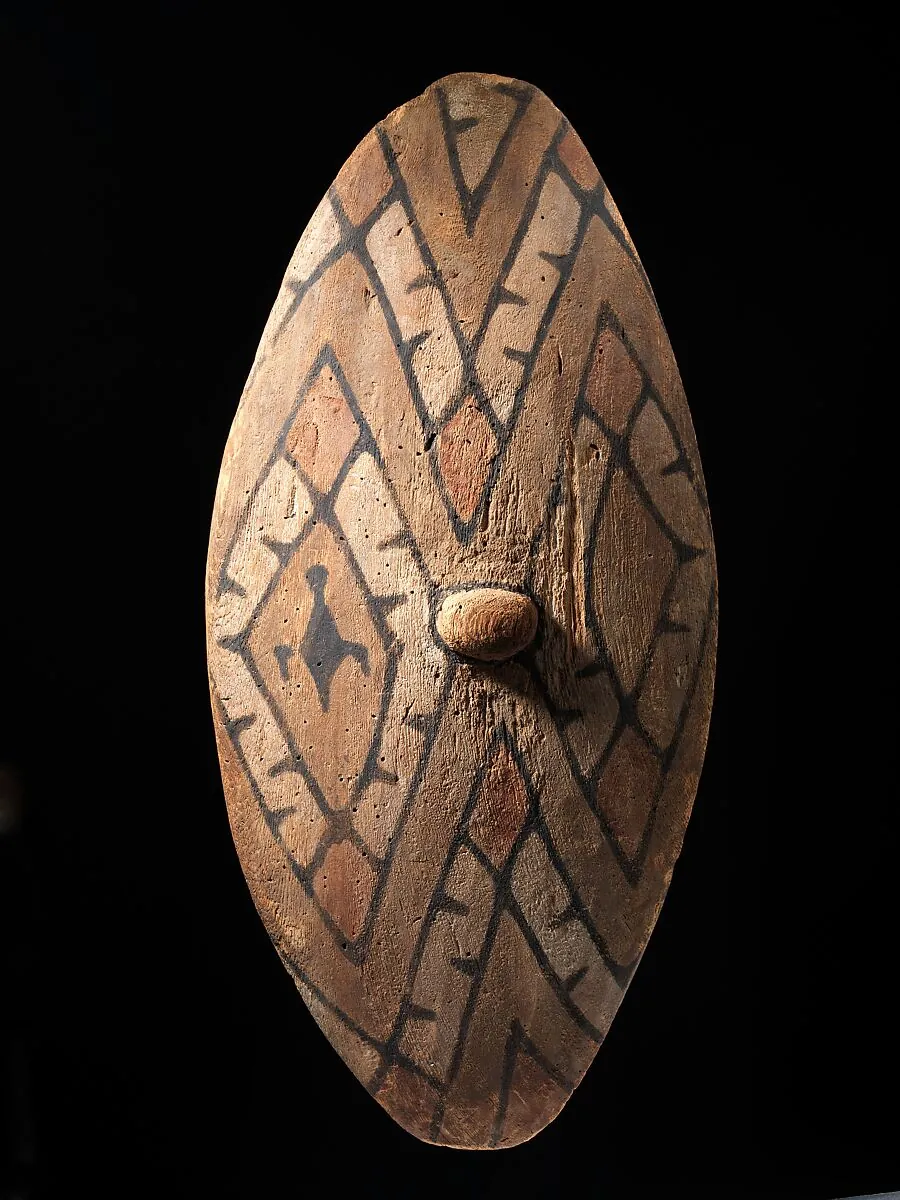
Roth, 1909: 'The Bloomfield weapon was somewhat more oblong and rectangular as compared with that of the Tully, and usually larger, such dimensions as three and a half by one and a half feet being not uncommon; it is, however, fast falling into disuse, and even so late as 1898 was only being occasionally manufactured by some of the very old men. The Bloomfield Natives called it kún-juri, and used to paint it with varying designs'[2]. The single-handed sword, 'from four and a half to five feet in length, and always used with the one hand stretched over the shoulder, the weapon hanging behind the back, and brought forward from above down with a more or less sudden jerk', 'used to be manufactured on the Bloomfield River, but now (1898) only occasionally by the old men', and 'the swords were sometimes used as fighting sticks', 'the shields were given to individuals for blocking spears during the formal trial'[2][6].
The shield and sword here
Then the Bloomfield: 'somewhat more oblong and rectangular as compared with that of the Tully, and usually larger, such dimensions as three and a half by one and a half feet being not uncommon; it is, however, fast falling into disuse, and even so late as 1898 was only being occasionally manufactured by some of the very old men. The Bloomfield Natives called it kún-juri, and used to paint it with varying designs. Although no shields are found on the Endeavour River and at Cape Bedford at the present day, the local Koko-yimidir Blacks speak of them as gorndor-e. Indeed, so far as the eastern coast-line is concerned, the Endeavour River must be regarded as the northerly limit of the weapon'[2]. Anderson: 'a shield collected by Roth is in the Australian Museum. Le Souef also describes a shield 3'8" (110 cm) long by 1'4" (40 cm) wide. Neither source gives any information on methods of manufacture or the woods used at Bloomfield'[6][8].
The sword. Roth: 'This weapon used to be manufactured on the Bloomfield River, but now (1898) only occasionally by the old men'[2]. Anderson: 'this was from 3'3" to 5' (108 cm – 150 cm) long and about 6" (16 cm) wide ... Although older Kuku-Yalanji in the late 1970s knew of these two items and knew that they had been used at Bloomfield, no one had ever made one or seen one for at least 60 years. The swords were sometimes used as fighting sticks during the ritual head-hitting; the shields were given to individuals for blocking spears during the formal trial. There are two swords from Bloomfield in the Australian Museum collection'[6][8].
Fighting sticks. Anderson: at Bloomfield 'two disputing individuals taking turns to hit each other on the head with sticks' was one of the recognised forms of conflict; 'men used fighting sticks and women used their yam sticks. A fighting stick from Bloomfield River is in the Australian Museum collection', and 'there are several eyewitness accounts of women fighting using yam sticks'[6][8].
How people used them here
The trial. Anderson: 'physical conflict at Bloomfield took a number of forms including: (i) generalised fights of one group against another, often in the form of an ambush; (ii) two groups "squaring off" against each other in a formal fight; (iii) two disputing individuals taking turns to hit each other on the head with sticks; (iv) a formal "trial by spear" of one individual against a group with a grievance against him. With the first two forms, fighting spears and the curved woomeras were used ... In the "trial" the defendant was given the longer, straight spear thrower and he was allowed to block or deflect the spears thrown at him', which is the dictionary's nganya-burra and the mirrba given to the guilty man[6][1].
On country today
No one at Bloomfield had made or seen a shield or sword 'for at least 60 years' by the 1970s[6].
Everywhere
Names
kunjuri 'shield', Roth's kún-juri. wakay 'wooden sword. The Port Douglas and rain forest people used them'; Roth wrote that 'the Koko-yellanji Natives here call it worran', a word not in the dictionary. mirru 'club, nullanulla'; nala-nala 'waddy club'. wangal 'boomerang'. balur 'spear thrower' and mirrba, 'a wooden instrument to help throw spears more powerfully. This was used as an instrument of defence. After being found guilty, a man used to be given a woomera with which to ward off the spears thrown'[1][2]. The fighting words: kuyan 'war spear with quartz head', dajal 'fighting spear', murrangkal 'fighting spear (shovelhead), made from black palm', dikarra 'war spear, has a stingray barb', mabarr 'war', damaway 'fight with spears', nganya-burra 'old time aboriginal trial. The one on trial has spears thrown at him. If he is able to dodge them, he goes free'[1]. In English, 'waddy comes from the Darug people of Port Jackson, Sydney' and 'nulla-nulla' and 'boomerang' are from the same region[3][4].
The weapons and how they were made
The rainforest shield. Roth's account of the Tully shield is the making of the whole type: 'the shield or pi-kan is made from Ficus ... It is cut from the tree on similar lines as the boomerang. A curved incision is made in the flange both above and below, and the spur next chipped about half-way through on either side along the lines required, and the piece then hammered or pushed out. Such shields are therefore not exactly oval, their shape on one edge depending upon the greater or less concavity of the flange. After this piece has been removed it is chipped away on both surfaces, except at the centres, which remain ... To the central boss on the front of the shield nothing more is done for the present, though it may subsequently be shaved down a little; into the projection at its future back, however, two longitudinal holes are chipped, these being united below by hot cinders, together constitute a handle at the end of the process. The weapon is then lightened ... then rubbed down with pumice stone, etc., and finally painted. In the designs of the patterns so depicted there is no meaning or interpretation ... as a rule, one man copies another's'. 'This manufacture of a shield from the flange of a tree extends southwards to below Cardwell, and northwards to the Bloomfield River, and is met with along the mountain ranges of the hinterland, e.g., Atherton'[2].
The sword. 'Single-handed swords are met with in the Cardwell and Bloomfield Districts. On the Lower Tully River this weapon, the barkur, is made from Myrtus exaltata ... Such a tree of about six inches in diameter is cut off at the butt and felled, the length required removed, and then split down the centre. A slab can then be taken from either half, and chipped to shape. The shape of weapon thus follows the shape of the tree, straight or bent; the straighter it is the more preferable it would appear to be. To make the handle a cut is made into either side of the slab, which is then split; fibre twine is finally wound round the handle and covered with beeswax. One edge is as a rule sharper than the other, but both edges can be used for cutting ... It is from four and a half to five feet in length, and always used with the one hand stretched over the shoulder, the weapon hanging behind the back, and brought forward from above down with a more or less sudden jerk; well directed, a blow from it can split a man's skull'[2].
Clubs. 'A waddy is a heavy pointed club constructed of carved hardwood timber'; 'waddies were used in hand-to-hand combat and were capable of splitting a shield. They could also kill or stun a prey. They could be used as projectiles or to make fire and make ochre. The waddies were sometimes used to punish those who broke Aboriginal law'[3].
Boomerangs. 'Various forms of boomerang-like designs were traditionally and in some cases are still used by some groups of Aboriginal Australians for hunting'; 'boomerangs were, historically, used as hunting weapons, percussive musical instruments, battle clubs, fire-starters, decoys for hunting waterfowl'; but 'the returning boomerang was unknown to Aboriginal peoples in most of the Northern Territory, all of Tasmania, half of South Australia and the northern parts of Queensland'[4]. The dictionary has wangal, and the cockatoo and pigeon pages have Roth's western hunters throwing a light boomerang into the flocks; at Bloomfield the children's 'boomerangs' were 'made from pandanus leaves', and the boomerang-shaped thing Roth collected there fourteen of was the spear-thrower[1][5][6][7].
Telling the types
- Rainforest shield: a big flat plank with a boss and a cut-in handle at the back, painted; the Bloomfield ones oblong, the Tully ones oval[2].
- Gulf shield: a narrow elongate oval of split wood, concave inside, red and white bands[2].
- Sword: a long flat slab, one edge sharper, a twine-and-beeswax grip[2].
- Nulla-nulla / waddy: a heavy pointed hardwood club[3].
- Fighting stick and yam stick: see digging sticks[6].
- Spear-thrower as shield: the broad-bladed woomera of the Peninsula; see spear and woomera[2].
Signs
Where the wood came from
The rainforest shield from the plank buttresses of the scrub figs and their like, on the Bloomfield and the ranges; the sword from a straight scrub tree 'about six inches in diameter'; the Gulf shield from split timber; the clubs and fighting sticks from the hard woods of the woodland, the ironwood and the wattles[2][3].
A weapon's country
Roth's map of the shield is a map of the trees: the plank shield stops where the rainforest's buttressed figs stop, at the Bloomfield and the Endeavour, and the split-timber shield comes up the Gulf side to the Mitchell; between them, on the Peninsula, the broad woomera did the shield's work[2].
Seasons
The fights and the trials Anderson describes were held when the groups came together, at the big gatherings of the dry; the wood for a shield was cut when the figs were not in sap[6][2]. See the year on country.
Uses
- The shield to block spears, 'given to individuals for blocking spears during the formal trial', and in the group fights[6].
- The sword as a two-edged striking weapon and 'as fighting sticks'[2][6].
- The club in hand-to-hand fighting, for finishing game, as a throwing stick and for law[3].
- The boomerang thrown into bird flocks in the west; the spear-thrower as both weapon and shield here[5][2].
- Today: the shield and sword as the Kuku Yalanji's own art object, painted 'with varying designs' that Roth could find no meaning in and that the makers copied and improved from one another[2].
Making a rainforest shield, after Roth
This is Roth's Tully method, the same craft the Bloomfield shield came from[2]:
- Find a fig or similar scrub tree with a plank buttress, and mark on it the outline of the shield, about a metre by half a metre for the Bloomfield shape.
- Cut a curved incision across the flange above and below, chip the spur 'about half-way through on either side along the lines required', and hammer or push the slab out of the tree[2].
- Thin the slab on both faces with the stone adze, leaving a boss in the centre of the front and a block at the centre of the back; see axes and adzes[2].
- Make the handle: chip two holes lengthwise into the back block and burn them through to each other with hot cinders[2].
- Lighten and smooth the shield, rubbing it down with pumice or sandstone; see stone[2].
- Paint it with the ochres, pipeclay and charcoal in your own design; see red ochre[2][6].
A sword: fell a straight tree six inches through, split it down the centre, take a slab from one half and chip it to shape; cut into both sides at the handle end and split the grip, bind it with twine and cover the binding with beeswax[2].
Safety and respect
- These are weapons; a sword blow 'can split a man's skull'[2].
- The painted designs were each maker's own, and the old fights and trials belong to the old law; this page records the craft, not the practice[2][6].
- Native plants are protected; taking a slab from a living fig is a big cut, and a dead fall or a station tree is the modern source[9].
On Country today
The museum pieces and Roth's pages are the pattern for anyone who wants to make a shield or sword again[6][2]. What each people carried is under each place above.
Language
kunjuri 'shield'; wakay 'wooden sword'; mirru 'club, nullanulla'; nala-nala 'waddy club'; wangal 'boomerang'; balur 'spear thrower'; mirrba the defensive woomera; kuyan 'war spear with quartz head'; dajal 'fighting spear'; mabarr 'war'; damaway 'fight with spears'; nganya-burra 'old time aboriginal trial'; juwal 'yam or digging stick'[1].
Images

References
- Hershberger, H. D. & Hershberger, R. (1982). Kuku-Yalanji Dictionary. Work Papers of SIL-AAB, Series B, Volume 7. With Toby Bloomfield, Roy Friday, Billy Roberts, Hector and Doris Sykes, Joe Walker and others. www.sil.org/resources/archives/18038
- Roth, W. E. (1909). North Queensland Ethnography, Bulletin No. 13: Fighting weapons. Records of the Australian Museum 7(4). — Sect. 4 (Princess Charlotte Bay bamboo spear); sect. 12 (Princess Charlotte Bay spear-thrower); sect. 15 (boomerangs); sect. 21 (shields: Peninsula and North-West); sect. 26 (nulla-nulla) and sect. 30 (fighting pole) archive.org/details/biostor-52873
- Wikipedia. Waddy (nulla-nulla). en.wikipedia.org/wiki/Waddy
- Wikipedia. Boomerang. en.wikipedia.org/wiki/Boomerang
- Roth, W. E. (1901). North Queensland Ethnography, Bulletin No. 3: Food — its search, capture, and preparation. Brisbane: Government Printer. Bloomfield River information from the Hislops. — Sect. 6 'Cooking'; plant list ('Castanospermum australe', 'Dioscorea sativa', 'Elettaria Scottiana', 'Nymphaea') archive.org/details/northqueensland00landgoog
- Anderson, C. (1996). Traditional material culture of the Kuku-Yalanji of Bloomfield River, North Queensland. Records of the South Australian Museum 29(1): 63–83. Based on fieldwork at Wujal Wujal in the late 1970s and early 1980s. — Hunting (spears, spear-throwers, harpoons); fishing (stupefacients); manufacturing (gums and resins); post-contact bush component archive.org/details/RecordsSouthAus29Sout
- Museums Victoria Collections. Item X 94769: Ballur, spearthrower, Bloomfield River, East Cape York, Queensland, c.1880. collections.museumsvictoria.com.au/items/239263
- Khan, K. (1993). Catalogue of the Roth Collection of Aboriginal artefacts from north Queensland. Volume 1: Items collected from Archer River, Atherton, Bathurst Head, Bloomfield River and Butcher's Hill, 1897–1901. Technical Reports of the Australian Museum 10: 1–205. — Bloomfield River: 'Woven bag' E.14833; 'Non-folding oval frame fishing net' E.14959 doi.org/10.3853/j.1031-8062.10.1993.69
- Queensland Government, State of the Environment. Nature Conservation Act 1992. www.stateoftheenvironment.des.qld.gov.au/biodiversity/management-responses/legislation/nature-conservation-act-1992
- Standley, P.-M. (2019). The importance of campfires to effective conservation. PhD thesis, James Cook University. Records the fire and country knowledge of Kuku Thaypan Elders Dr Tommy George and Dr George Musgrave. — The many uses of fire, including 'tool and weaponry production' and warfare (p. 15) researchonline.jcu.edu.au/64274/
- Roth, W. E. (1903). North Queensland Ethnography, Bulletin No. 5: Superstition, magic, and medicine. Brisbane: Government Printer. — Sect. 28: how the bamboo came to the Hann River (Koko-rarmul) archive.org/details/northqueensland00landgoog
- Ross on behalf of the Cape York United #1 Claim Group v State of Queensland (No 21) (Possum determination) [2023] FCA 1316 (Federal Court of Australia, 2 November 2023). — Determination area (upper Hann and Kennedy rivers); prescribed body corporate; affidavit evidence on hunting and fishing www.judgments.fedcourt.gov.au/judgments/Judgments/fca/single/2023/2023fca1316
- Ross on behalf of the Cape York United #1 Claim Group v State of Queensland (No 20) (Thaypan determination) [2023] FCA 1315 (Federal Court of Australia, 2 November 2023). — Determination area and waters; prescribed body corporate (Awu-Laya Indigenous Corporation); affidavit evidence on hunting www.judgments.fedcourt.gov.au/judgments/Judgments/fca/single/2023/2023fca1315
From the community
Know this one? Add the words you use for it, what it is for, how it is done, a correction, or a photo from country. It shows here straight away with your name on it. Please keep anything restricted or sacred off the site.
Loading…