Plants, vines & grasses
Grass tree
nganjirr · kanunjulXanthorrhoea johnsonii (and other Xanthorrhoea species)
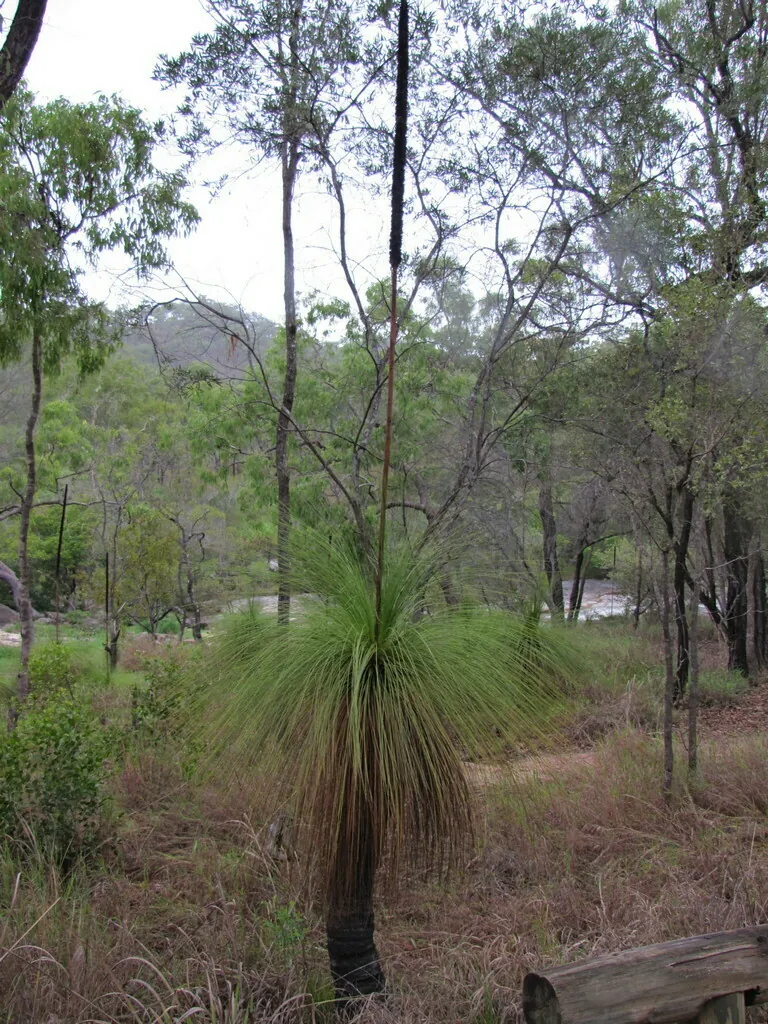
The grass tree, nganjirr[1], is the tufted, black-trunked plant of the dry open forest, Xanthorrhoea. Its resin, kanunjul, was 'used to make pitch to seal spear bindings'[1]. Kuku Yalanji at Bloomfield also used the light flower stalks as spear shafts and fire-drills. They ate the young leaf bases and shoots, and traded grass-tree spears inland[2][3][4][5]. Anderson's Bloomfield consultants rated grass-tree gum below other cements[6]. Near Karma Waters, herbarium and Atlas records place Xanthorrhoea johnsonii on Mount Mulligan and around Mount Carbine[7].
Names
Nganjirr is the 'grass tree' and kanunjul is its resin[1]. Roth's Bloomfield records match both words. In his food-plant list the grass tree is ngang-ir on the Bloomfield[2]. In his list of cements its gum is tun-ja or kannojo-ol among the Kuku Yalanji[3]. On the Bloomfield, Roth added, chakki was the term for any gum[3]. The dictionary also lists burning grass tree or its pitch to send thunder away; that belongs to its keepers and is not described here[1].
Description
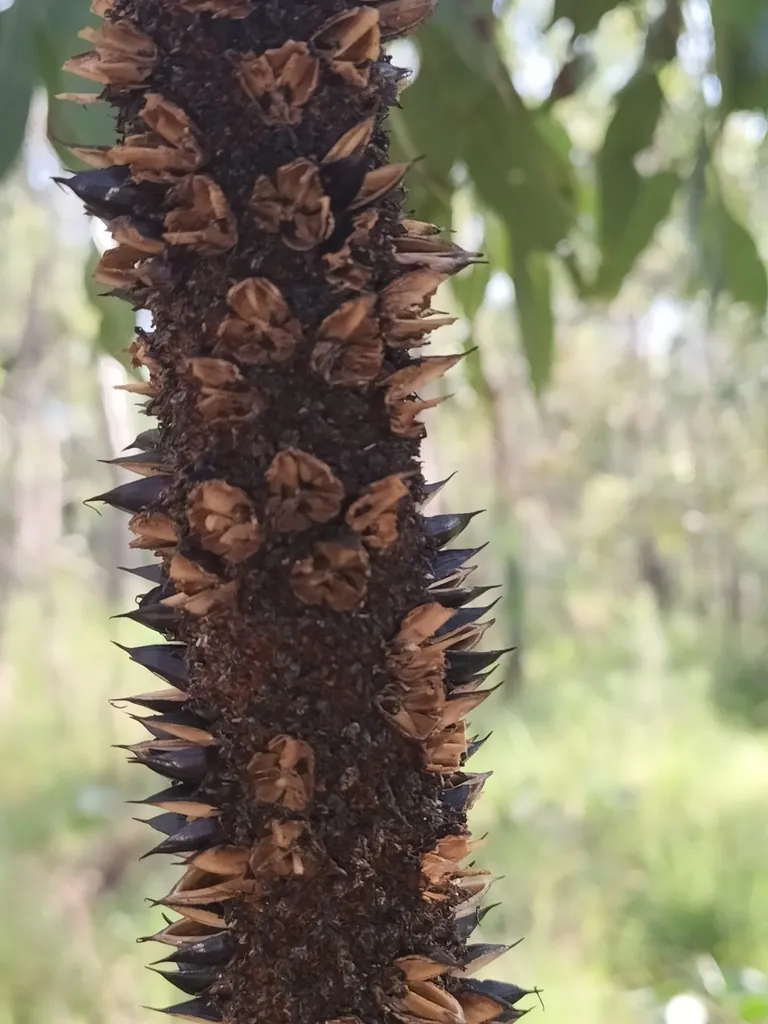
Xanthorrhoea johnsonii has a single trunk up to about 5 m tall, often blackened by fire. A clump of grass-like leaves sits on top. The leaves are rigid and grey-green, up to 1 m long and diamond-shaped in cross-section, and they arch over with age[8]. The flowers are small and white to cream, packed on a narrow cylindrical spike 20–120 cm long. The spike stands on a stalk 75–190 cm long. Black seeds form in spiky capsules on the spike[8]. The long, straight, light flower stalk is the part used for spear shafts and fire-drills. The resin is found in lumps among the roots[3].
Where it grows
X. johnsonii grows in drier coastal, inland and range country in Queensland and New South Wales, usually as an understorey plant in open forest[8]. It is a plant of the dry country, not the rainforest.
Around Karma Waters. The Atlas of Living Australia has no grass-tree records within 30 km of the homestead. Within 60 km it has 23, and 21 of them are X. johnsonii. The nearest are herbarium specimens from Mount Mulligan, about 38 km south-east. They were collected in 1984–85 on a scree slope below the cliffs and near the summit dam. There are also 2024 photographs from just east of Mount Carbine, about 60 km east, and a 2010 specimen from Mount Windsor National Park[7]. So on the upper Mitchell, look for grass trees on the stony ranges and rocky slopes rather than on the river flats. They are worth reporting to the Atlas if you find them closer in.
Seasons
X. johnsonii flowers from August to October[8], in the late dry. Fire often blackens the trunks[8]. Resin can be dug from among the roots at any time[3]. The young leaf bases and shoots that Roth recorded as food[2] are best looked for when the plant is putting on new growth.
Uses
Pitch (Bloomfield). Kanunjul, the resin, was made into pitch to seal the bindings on spears[1]. Roth wrote that the gum, 'found as it is in lumps in amongst the roots, only requires heating before use'[3]. Anderson lists grass-tree resin (Xanthorrhoea johnsonii) alongside resins from brown cedar (Canarium australasicum) and ironwood for fixing stingray barbs and multiple prongs, which were first bound on with wallaby sinew[6]. But his Bloomfield consultants also said that grass-tree and Grevillea gums did not have 'very good bonding qualities'. Ironwood root gum was easy to get and of good quality, so it was preferred[6]. Both records stand: grass-tree pitch was used, but it was not the best glue on the Bloomfield.
Spear shafts (Bloomfield). The light flower stalks made the butt ends of spears:
- the Bloomfield many-pronged fish spear, yirmbua in Roth's spelling (the dictionary's yirrmba), was made of light wood, 'preferably' grass tree[4];
- the spear Roth wrote as wur-poi had a long grass-tree butt and a short Acacia holocarpa foreshaft with a wooden barb[4].
Anderson's table of Bloomfield spears also lists grass-tree butts joined to black palm or Acacia points[6]. Bloomfield and Endeavour River people carried grass-tree spears inland toward the Laura River as trade goods[5]. More on spears is in Spear and woomera.
Fire. Across North Queensland, grass tree was 'the most common of all' timbers for the twirled fire-drill wherever it grew[3].
Food. On the Bloomfield and among neighbouring peoples, 'the bases of the young leaves are eaten raw; also the extremities of the young shoots'[2]. A grub, kuru, is 'found in dry grass tree'[1]; compare witchetty grubs.
How it was done
- Clear the soil from around the base of a grass tree and look for lumps of resin among the roots.
- Gather the lumps and knock off the dirt.
- Warm them by the fire until soft. Roth records no other ingredient for grass-tree gum. For brown-cedar and ironwood gum, Bloomfield people pounded the warm gum between two stones greased with fat to stop it sticking. No source says whether grass-tree gum was treated the same way.
- Bind the barb or prongs onto the spear with sinew or twine.
- Press the soft pitch over the binding. Smooth it with a smoothing board, a flat palm-sized piece of hard wood greased with sweat from the forehead. Roth recorded these boards on the Bloomfield, Palmer and Mitchell rivers.
- Let it cool and set hard. Gentle heat softens it again for repairs.
A grass-tree spear butt, Bloomfield River[4]:
- Choose a long, straight, dry flower stalk.
- Join it to a hardwood foreshaft, such as Acacia, with a mortice.
- Bind the join with sinew or twine and seal it with pitch.
Safety
Hot resin sticks to skin and burns, so handle it with a stick or a greased board, as the old people did[3][6]. Grass trees grow slowly: a seedling takes 3–7 years to reach flowering size[8]. Take resin from among the roots without killing the plant, and leave the flower stalks of young plants. Don't confuse grass-tree pitch with kulbawurr, 'the resin gum of the cypress pine which is poisonous'. It too 'was used on spears in the old days', and 'the effect lasts about two hours'[1]. Roth recorded a cement called kalbuwur from the head of the Daintree, and a chemist found that its resin behaved 'in every way like a Red Grass-tree Resin'[3].
On Country today
In the late 1970s and early 1980s, Bloomfield fishing spears still had their prong bindings covered with ironwood resin, car-battery 'tar', 'Araldite' or asphalt[6]. Store-bought glues had begun to take the place of tree gums. The Western Yalanji determinations recognise native title rights to take and use natural resources on the land around the Palmer and Mitchell rivers[9]. Under s 211 of the Native Title Act 1993, native title holders can gather for personal, domestic and communal needs without the licences other people need[10]. Visitors need Traditional Owners' permission to dig resin or cut flower stalks.
Language
nganjirr 'grass tree'; kanunjul 'resin of grass tree'; julnji 'tar from a tree used to make spears'; janbangal 'to glue or stick something, using pitch or glue (yalanji only)'; kulbawurr 'the resin gum of the cypress pine'; kuru 'grub found in dry grass tree'; yirrmba 'many-pronged fish spear'[1]. In Roth's spellings the Kuku Yalanji grass-tree plant is ngang-ir, its gum tun-ja or kannojo-ol, and gum in general on the Bloomfield chakki. Guugu Yimithirr at Cooktown and Cape Bedford called the grass tree and its gum pungga[2][3].
Images
References
- Hershberger, H. D. & Hershberger, R. (1982). Kuku-Yalanji Dictionary. Work Papers of SIL-AAB, Series B, Volume 7. With Toby Bloomfield, Roy Friday, Billy Roberts, Hector and Doris Sykes, Joe Walker and others. www.sil.org/resources/archives/18038
- Roth, W. E. (1901). North Queensland Ethnography, Bulletin No. 3: Food — its search, capture, and preparation. Brisbane: Government Printer. Bloomfield River information from R. Hislop. — Plant list, 'Xanthorrhoea arborea' archive.org/details/northqueensland00landgoog
- Roth, W. E. (1904). North Queensland Ethnography, Bulletin No. 7: Domestic implements, arts, and manufactures. Brisbane: Government Printer. — Sect. 5 fire-sticks ('Xanthorrhoea arborea'); sect. 13 cements ('Xanthorrhoea arborea', 'Kalbuwur', 'Canarium australasicum'); sect. 16 smoothing-board archive.org/details/northqueensland00landgoog
- Roth, W. E. (1909). North Queensland Ethnography, Bulletin No. 13: Fighting weapons. Records of the Australian Museum 7(4). — Compound spears: Bloomfield 'yirmbua' and 'wur-poi' archive.org/details/biostor-52873
- Roth, W. E. (1910). North Queensland Ethnography, Bulletin No. 14: Transport and trade. Records of the Australian Museum. — Trade: Endeavour and Bloomfield River people supplying the Koko-warra with grass-tree spears archive.org/details/biostor-52863
- Anderson, C. (1996). Traditional material culture of the Kuku-Yalanji of Bloomfield River, North Queensland. Records of the South Australian Museum 29(1): 63–83. Based on fieldwork at Wujal Wujal in the late 1970s and early 1980s. — Table 1 (Kuku-Yalanji spears); hunting (spear resins); manufacturing (gums and resins); post-contact fishing spears archive.org/details/RecordsSouthAus29Sout
- Atlas of Living Australia. Occurrence records of the genus Xanthorrhoea within 30 km and 60 km of the Karma Waters homestead (16.618° S, 144.605° E), queried 6 October 2026 (none within 30 km; 23 within 60 km, 21 of them X. johnsonii, including Mt Mulligan specimens, J. R. Clarkson 1984–85). biocache.ala.org.au/occurrences/search?q=genus%3AXanthorrhoea&lat=-16.6179&lon=144.6047&radius=60
- Native Plants Queensland, Townsville Branch. Native plants of the Townsville region: Xanthorrhoea johnsonii (grass-tree). www.npqtownsville.org.au/native-plants-of-the-townsville-region/xanthorrhoea-johnsonii/
- Brady on behalf of the Western Yalanji People #4 v State of Queensland [2013] FCA 958 (Logan J, 24 September 2013), consent determinations of native title over lands in and around the Palmer and Mitchell River systems north-west of Mt Carbine. www.judgments.fedcourt.gov.au/judgments/Judgments/fca/single/2013/2013fca0958
- Australian Law Reform Commission (2014). Review of the Native Title Act 1993, Discussion Paper 82, ch. 8: Relevant provisions in the Native Title Act (s 211, preservation of native title hunting, fishing, gathering and cultural activities). www.alrc.gov.au/publication/review-of-the-native-title-act-1993-dp-82/8-the-nature-and-content-of-native-title/relevant-provisions-in-the-native-title-act/