Fish
Barramundi
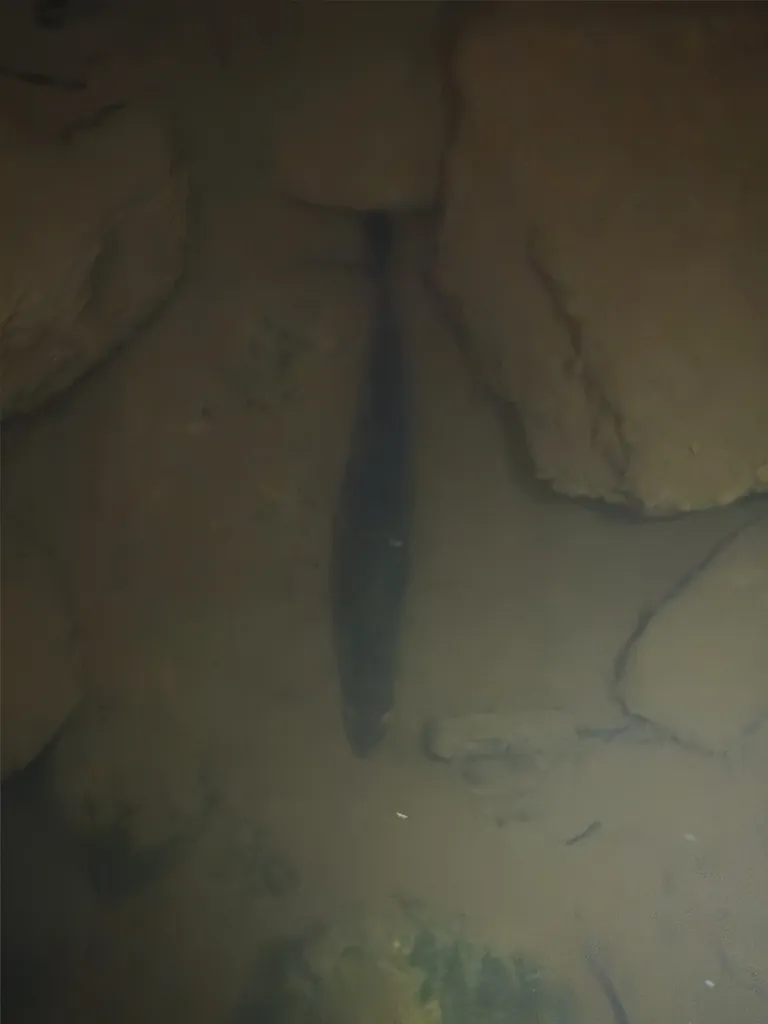
Barramundi (Lates calcarifer) has three names in the Kuku Yalanji dictionary: judi, murrabal and kudi, which belong to different dialects[1]. It is a big silver fish of the estuaries, mangroves and rivers, and the young fish run far up into fresh water[2]. Kuku Yalanji fishermen took fish with spears, including the many-pronged yirrmba, and with plant poisons, hook and line, bark nets and earth-oven cooking[1][3][4]. Barramundi also live in the Mitchell River system on Western Yalanji country, where wet-season floods carry them up into fresh water[5]. The Gulf of Carpentaria closed season, which covers the Mitchell, runs from 7 October to 31 January[6].
Names
The dictionary has three words for barramundi[1]:
- judi, marked as the Yalanji dialect word, with murrabal given as the Nyungkul equivalent;
- murrabal, also marked Yalanji, but with kudi given as the Nyungkul equivalent;
- kudi, 'barramundi', with no dialect marked.
The two cross-references do not agree, so the dictionary cannot settle which dialect owns murrabal. Speakers of Yalanji and Kuku Nyungkal are the right people to sort it out. Fish in general is kuyu, and a good fisherman is mala-kuyu[1].
A note for the Mitchell. The English word 'barramundi' is also one of the common names of the Gulf saratoga (Scleropages jardinii), a quite different fish that lives through most of the Gulf of Carpentaria drainage and across northern Queensland[7]. When a Western Yalanji speaker gives you a word for 'barramundi', check which fish they mean.
Description
A long, powerful fish, silver to greenish-grey or greyish-blue, with a distinctly concave head profile, a pointed snout, a big mouth, brown to dark grey fins and a pale belly. Its eye glows bright red in torchlight at night[2]. Barramundi commonly reach 150 cm and can reach 200 cm. They eat mainly fish and crustaceans; the young also eat insects[2].
Barramundi change sex. Most start life as males and turn into females at 3–5 years old, so small fish are almost all males and the very big fish are all females[2]. That is why the law protects the biggest fish.
Where it lives
Barramundi live in coastal and estuarine waters, often around mangroves, in clear or muddy water. Some run far upstream and some spend their whole lives in fresh water; juveniles live in the upper reaches of rivers around undercut banks, sunken logs and overhanging plants[2]. On Eastern Kuku Yalanji country, look for them in the estuaries, mangrove creeks and lower rivers from the Daintree to the Bloomfield and Annan.
Western Yalanji country. Barramundi are part of the Mitchell River system. Griffith University's study of the Mitchell found that barramundi which move into fresh water in the wet season grow faster than those that stay on the coast, and that big wet years produce more and bigger barramundi[5]. How far up the river they reach in a given year depends on the floods and on natural barriers; the study names the Mitchell Falls as a natural barrier to fish moving upstream[5]. Ask the Traditional Owners where barramundi are found near you.
Seasons
Barramundi migrate from fresh water down to shallow estuarine mudflats to spawn between September and March, with peaks in November–December and February–March[2]. In the Gulf of Carpentaria they spawn over spring and summer, October to March[5]. The wet-season floods are when barramundi push upstream into fresh water[5].
The dictionary records the dry-season fishing time: bark nets were 'dragged through the water in the dry season when the water goes down'[1]. Across North Queensland, Roth recorded that fish could be hunted at any time of year, and that the bush fences and stone dams were built for the falling water after floods[3].
Uses
Barramundi is a prized food fish. The Kuku Yalanji fishing kit, as recorded in the dictionary and by Roth, includes[1][4]:
- Spears: kalka (fishing spear, and the general word for spear), yinba (fish spear), yirrmba (many-pronged fish spear) and jindal (spear with three prongs). Roth recorded kalka as the general word for spear on the Bloomfield, and gave the Bloomfield name for the many-pronged fish spear as yirmbua (his 1909 spelling).
- Nets: makarr (fish net), woven from strips of ngunyin bark or from warrur bark.
- Hook and line: badur, as in ngayu badurriji bundanday 'I'm fishing (sitting with hook and line)'. Bait is mandurr.
- Fish poison: the sap of the miyil tree, 'used to blind fish'.
Food rules. On the lower Tully River (far to the south, not Kuku Yalanji country) barramundi was one of the sea foods forbidden to young people before initiation[8]. The dictionary records no barramundi rule for Kuku Yalanji.
How it was caught and cooked
Spearing (Bloomfield River)[4]:
- The many-pronged fish spear had (usually) four prongs morticed into the shaft, each with a wooden barb.
- On the Bloomfield it was made of a light wood, preferably grass-tree. Roth was told it was first brought in from outside, but it had been made locally since before 1885.
Roth adds how such spears were used further north, around Princess Charlotte Bay: thrown at a fish in sight, or, in a muddy water-hole, here and there at random on the chance of a hit[4]. On the lower Tully River men crept up on barramundi lying among the snags, or dived, and struck them from the side or from underneath[3].
Muddying the water, which Roth found everywhere he went[3]:
- Stir up a small, shallow pool with your feet.
- Spear or club the fish as they rise to the surface.
Fish poison (Bloomfield River)[3]:
- Hammer bark of Barringtonia racemosa between stones until it is spongy.
- Take it into the water and rub it there with your hands.
- The fish are stupefied in about a quarter of an hour and can be picked up.
A second Bloomfield poison: tie fruit of Diospyros hebecarpa (Roth's Koko-yellanji name ngam-boi) into long bundles, warm each bundle over a fire, then squash it in the water[3]. The dictionary's miyil sap was smashed under water the same way, with the person wrapping it in grass to keep the sap off their skin and eyes[1].
Nets. Roth wrote that around 1900 fish-nets were not used at Cape Bedford, on the Bloomfield or on the Endeavour River[3]. The dictionary, from later Bloomfield speakers, records makarr 'fish net' and bark nets 'dragged through the water in the dry season when the water goes down'[1]. Inland, Roth found that the Koko-yellanji people of the Laura used an oval-framed net they called jikan-ikan (his 1901 spelling). Nets of that kind, framed in lawyer cane, were carried upright through the water by two people while friends in front drove the fish towards them[3].
Killing the catch. A common North Queensland way to kill a fish was to bite it deeply just behind the head, so it could not flip back into the water once thrown on the bank[3].
Cooking. Small fish are simply roasted on the coals, dindal 'to roast on coals'[1]. Roth found shrimps, and on the Tully small fish, wrapped in wild-ginger leaves for baking[3]. His account of the earth oven (kurrma) at Cape Bedford and on the Bloomfield, written for meat, goes like this[3]:
- Heat a number of stones well in a fire, then rake out the stones and ashes and quickly dig a hole where the fire was.
- Line the bottom with leaves of the wild gingers.
- Lay in the food and pack the hot stones and ashes around it.
- Cover with more leaves or tea-tree bark, then a layer of earth and stones, and leave it to bake.
Safety
Barramundi water is crocodile water. Queensland's Crocwise advice for fishing is[9]:
- Stand back from the water's edge, never on logs or branches over the water, and keep something solid like an esky between you and the water.
- If your lure snags, cut the line. Don't wade in after it.
- Never clean fish or throw scraps at the water's edge or a boat ramp.
- Take extra care at night, dusk and dawn.
The plant poisons described above are poisons. Miyil sap can blind[1]. They are recorded here as history, not as a method to use.
On Country today
Recreational rules (Queensland). Barramundi must be between 58 and 120 cm, with a limit of 5 per person, or 10 per boat with two or more people aboard[10]. Closed seasons protect spawning fish. In Gulf of Carpentaria fresh waters, which include the Mitchell River system, the season is closed from 7 October to 31 January. In all other Queensland fresh waters it is closed from 1 November to 31 January. A few listed dams are exempt, and during a closed season you cannot target barramundi even for catch-and-release[6].
Native title. Eastern Kuku Yalanji native title was recognised in August 2026 over about 217,884 ha, from the Annan River to the Daintree River[11], and Western Yalanji native title over 170,827 ha two days later; the Western Yalanji rights include fishing[12]. Under section 211 of the Native Title Act 1993, native title holders fishing for personal, domestic or non-commercial communal needs do not need the licences and permits other people need[13]. Visitors need the Traditional Owners' permission to fish on their country.
Language
kuyu 'fish'; mala-kuyu 'good fisherman'; damal 'to spear'; mumal 'to throw a spear with a woomera'; mandurr 'bait (any kind)'; wuwu-damaji 'to go back all the time to the same place, as a good place to fish'[1].
References
- Hershberger, H. D. & Hershberger, R. (1982). Kuku-Yalanji Dictionary. Work Papers of SIL-AAB, Series B, Volume 7. With Toby Bloomfield, Roy Friday, Billy Roberts, Hector and Doris Sykes, Joe Walker and others. www.sil.org/resources/archives/18038
- Gomon, M. F. & Bray, D. J. (2025). Barramundi, Lates calcarifer. Fishes of Australia (Museums Victoria), accessed 5 October 2026. fishesofaustralia.net.au/home/species/4643
- Roth, W. E. (1901). North Queensland Ethnography, Bulletin No. 3: Food — its search, capture, and preparation. Brisbane: Government Printer. Bloomfield River information from R. Hislop. — Sect. 6 'Cooking'; sect. 15 'Fish' (a)–(n), incl. fish-poisons and fish-nets archive.org/details/northqueensland00landgoog
- Roth, W. E. (1909). North Queensland Ethnography, Bulletin No. 13: Fighting Weapons. Records of the Australian Museum 7(4). — Sect. 4, Princess Charlotte Bay, Cape Bedford, Bloomfield and Middle Palmer spears archive.org/details/biostor-52873
- Stewart-Koster, B., O'Mara, K., et al. (2021). Critical water needs to sustain freshwater ecosystems and aquatic biodiversity in Queensland's Mitchell River. Griffith University / NESP Northern Australia Environmental Resources Hub. era.dpi.qld.gov.au/id/eprint/8432/1/Critical-water-needs-for-the-Mitchell-River-final-report.pdf
- Queensland Department of Primary Industries. Closed seasons in fresh waters: barramundi (web page, accessed 5 October 2026). www.dpi.qld.gov.au/business-priorities/fisheries/closures/fresh/seasons
- Wikipedia. Scleropages jardinii (Gulf saratoga), accessed 5 October 2026; distribution after Gomon (2011), Fishes of Australia. en.wikipedia.org/wiki/Scleropages_jardinii
- Roth, W. E. (1908). North Queensland Ethnography, Bulletin No. 11: Miscellaneous Papers (tabu and other restrictions). Records of the Australian Museum 7(2). — Sect. 5, food restrictions on the young archive.org/details/biostor-52896
- Queensland Government. Be Crocwise top tips (web page, accessed 5 October 2026). www.qld.gov.au/environment/plants-animals/animals/living-with/crocodiles/becrocwise/be-crocwise-top-tips
- Queensland Government. Size and possession limits in tidal waters and in fresh waters: barramundi (web pages, accessed 5 October 2026). www.qld.gov.au/recreation/activities/boating-fishing/rec-fishing/rules/limits-tidal
- National Indigenous Times (12 August 2026). 'More than 100 ancestral lines united in Eastern Kuku Yalanji native title determination.' nit.com.au/12-08-2026/25896/more-than-100-ancestral-lines-united-in-eastern-kuku-yalanji-native-title-determination
- National Indigenous Times (13 August 2026). 'Western Yalanji determination brings Cape York native title to the finish line.' nit.com.au/13-08-2026/25941/western-yalanji-determination-brings-cape-york-native-title-to-the-finish-line
- Native Title Act 1993 (Cth), section 211: preservation of certain native title rights and interests (hunting, fishing and gathering for personal, domestic or non-commercial communal needs). www.legislation.gov.au/C2004A04665/latest/text