Birds
Scrub hen
jarrukaMegapodius reinwardt
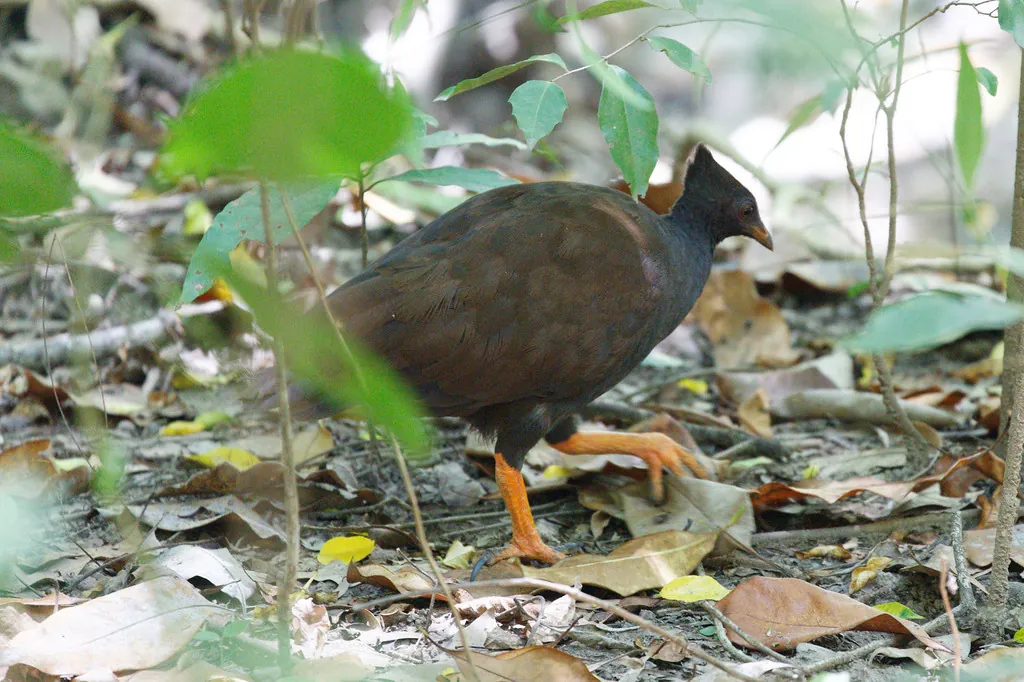
Jarruka, the scrub hen or orange-footed scrubfowl (Megapodius reinwardt), is a hen-sized ground bird with big orange feet that builds huge mounds of earth and leaves to hatch its eggs[1]. In Kuku Yalanji the one word covers the bird, its eggs and its nest[2]. That shows how much the eggs mattered. The dictionary records two flowering signs for egg time. When the cotton tree, wawuburra, blooms with big red flowers, 'it signals the start of the scrub hen egg season'. The flowering of the flame tree, ngakun, 'signals the time when the scrub hen eggs are in season'[2]. The Queensland Parks and Wildlife Service adds a third sign: when mat grass is in flower, it is time to collect jarruka eggs[3].
Names
The dictionary gives jarruka 'scrub hen, jungle fowl'. A second entry adds that jarruka is 'also used to refer to the eggs and/or nest of scrub hen'[2]. Its example sentence, spelled jaruka, is about collecting: Jana jaruka diburr wubul manin 'They got lots of scrub hen eggs'[2]. Kuku Yalanji's northern neighbours at Cape Bedford had a related word. Roth's 1901 list gives du-ka 'scrub-hen'[4].
Description
A medium-sized ground bird, 42–47 cm long and about 900 g, with a small crest at the back of the head and strong orange legs and feet[1]. It feeds by raking the ground with those feet for seeds, berries and roots, and sometimes eats snails and beetles[1]. It is noisy, with 'a variety of chuckles and screams'[1]. In Daintree National Park it is commonly seen scratching for food on the forest floor[3].
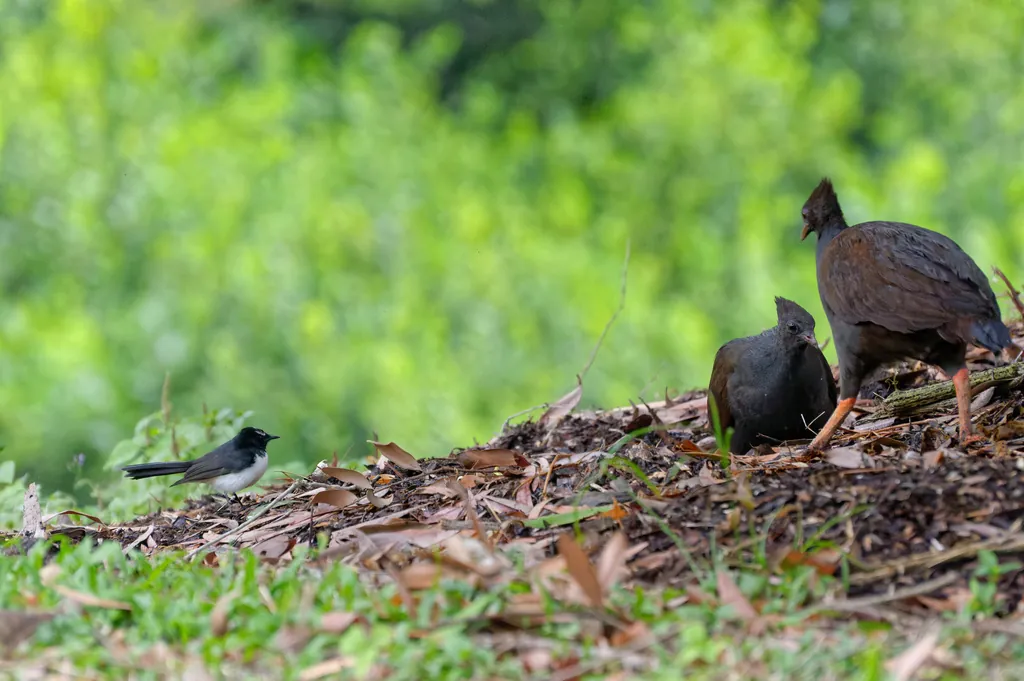
Like the scrub turkey, it does not sit on its eggs. It builds a mound of earth and rotting plant material, often several metres across and more than a metre high, and lets the heat of the mound incubate them[1]. A pair uses the same mound for many years, and sometimes shares it with other scrubfowl[1].
Where it lives
In Australia the scrubfowl lives in the far north of the Northern Territory, the top half of Cape York, and coastal Far North and North Queensland south to Yeppoon[1]. It likes rainforest with a closed, shady canopy, vine thickets, the dense parts of eucalypt forest, and swamps. It builds its mounds in shade, and also on sand above the high-tide mark[1]. On Eastern Kuku Yalanji country it is common in the rainforest of Daintree National Park[3].
Western Yalanji country. The scrubfowl is a bird of the wet coast. A search of the Atlas of Living Australia found plenty of records in the rainforest around and east of Mt Carbine, but none from the dry Mitchell River country to the west[5]. In Western Yalanji country, the mound-builder you are more likely to meet is the scrub turkey (diwan).
Seasons
Scrubfowl breed from about July to March, laying eggs one at a time into the mound[1]. Kuku Yalanji people knew the egg time by what was flowering[2]:
- Wawuburra, the cotton tree: 'When it blooms (big red flowers) it signals the start of the scrub hen egg season'[2]. Wawuburra was also one of the canoe trees[2].
- Ngakun, the flame tree: 'The flowering of this tree signals the time when the scrub hen eggs are in season'[2]. (Ngakun is also the name of a yam.)
- Mat grass: 'when [mat grass] is in flower, it is time to collect jarruka … eggs'[3].
When the big red cotton-tree flowers show, it is time to head for the mounds.
Uses
Eggs. Scrubfowl eggs were the main prize. The dictionary's own example is about bringing back 'lots of scrub hen eggs'[2]. A mound is used for many years[1], so a family that knew where the mounds were could come back to them season after season. Eggs went into the general class minya 'meat, eggs (protein food)'[2].
The bird. The bird was caught too. Roth's rainforest records from the Tully River describe the same lawyer-cane traps being used 'for both' the scrub turkey and the scrubfowl (Megapodius)[6].
How it was gathered, caught and cooked
Collecting eggs. The sources give the timing very precisely: the cotton tree, the flame tree and mat grass[2][3]. They do not give a published step-by-step Kuku Yalanji account of opening a mound. What they do record is this:
- Watch for the signs. The red flowers of wawuburra mark the start of the egg season, and ngakun flowering marks the time the eggs are in[2].
- Go to the known mounds. They are big, and a pair keeps using the same mound for years[1].
- Dig in by hand through the soil and rotting litter. The eggs are laid singly inside the mound and warmed by its heat[1].
- Collect the eggs (mujal 'collect, gather') and carry them home[2].
Trapping the bird. On the Tully River, south of Kuku Yalanji country, Roth saw lawyer-cane traps used for scrubfowl as well as turkeys. The trap was a tunnel of cane hoops with 'wings' of brush or cane that steered the bird inside, and it took about half a day to set up. The hunter crouched behind the wings under leaves and bushes. Unlike with the turkey, he did not call to the scrubfowl[6].
Cooking. Meat was roasted on and in hot ashes, or baked in the Bloomfield stone earth oven (kurrma). For the oven, heat stones in a fire, dig a hole where it stood, line it with ginger leaves, pack in the food with the hot stones and ashes, and cover with leaves or tea-tree bark and then earth[6][2].
Safety
Scrubfowl are harmless to people. Mounds sit in shady rainforest and on beach scrub, so watch where you put your hands when digging into leaf litter. Eggs from a mound can be at different stages, because the birds lay one egg at a time over a long season[1]. Cook eggs and meat through.
On Country today
The scrubfowl is a protected native animal under Queensland's Nature Conservation Act 1992, and anyone else needs a licence or permit to take it or its eggs[7]. Much of its country, the Daintree and the coast north to the Bloomfield, is now Eastern Kuku Yalanji land. In 2021 the Daintree, Ngalba Bulal, Kalkajaka and Hope Islands national parks were handed back, to be jointly managed with the Queensland Government until Traditional Owners take over sole management[8]. The 2007 Eastern Kuku Yalanji native title determination recognises rights to hunt animals and gather, but not for trade or commerce[9]. Section 211 of the Native Title Act 1993 protects native title holders hunting and gathering for personal, domestic or non-commercial communal needs[10]. The right to give permission to come onto country belongs to the Traditional Owners[9]. Visitors must ask them first.
Language
jarruka 'scrub hen; its eggs and nest'; diburr 'egg'; yijirr 'shell of egg'; birukay 'yolk'; jamal 'white of egg'; mujal 'collect, gather'; wawuburra 'cottontree'; ngakun 'flame tree'[2].
Images
References
- Birds in Backyards (BirdLife Australia). Orange-footed Scrubfowl, Megapodius reinwardt. www.birdsinbackyards.net/species/Megapodius-reinwardt
- Hershberger, H. D. & Hershberger, R. (1982). Kuku-Yalanji Dictionary. Work Papers of SIL-AAB, Series B, Volume 7. With Toby Bloomfield, Roy Friday, Billy Roberts, Hector and Doris Sykes, Joe Walker and others. www.sil.org/resources/archives/18038
- Queensland Parks and Wildlife Service. Nature, culture and history — Daintree National Park (CYPAL). parks.qld.gov.au/parks/daintree/about/culture
- Roth, W. E. (1901). North Queensland Ethnography, Bulletin No. 2: The structure of the Koko-Yimidir language. Brisbane: Government Printer. — Vocabulary, '(5) Birds' archive.org/details/northqueensland00landgoog
- Atlas of Living Australia. Occurrence records for Megapodius around Mt Carbine and in the Mitchell River country to its west, queried 5 October 2026. biocache.ala.org.au/occurrences/search?q=Megapodius
- Roth, W. E. (1901). North Queensland Ethnography, Bulletin No. 3: Food — its search, capture, and preparation. Brisbane: Government Printer. Bloomfield River information from K. and R. Hislop. — Sect. 6 'Cooking', sect. 25 'Scrub turkeys, scrub hens, &c.' archive.org/details/northqueensland00landgoog
- Queensland Government, State of the Environment. Nature Conservation Act 1992. www.stateoftheenvironment.des.qld.gov.au/biodiversity/management-responses/legislation/nature-conservation-act-1992
- Australian Geographic (29 September 2021). Daintree handed back to Traditional Owners. www.australiangeographic.com.au/news/2021/09/daintree-handed-back-to-traditional-owners/
- Walker on behalf of the Eastern Kuku Yalanji People v State of Queensland [2007] FCA 1907 (Federal Court of Australia, 9 December 2007). www.judgments.fedcourt.gov.au/judgments/Judgments/fca/single/2007/2007fca1907
- Australian Law Reform Commission. Review of the Native Title Act 1993 (DP 82), ch. 8: Relevant provisions in the Native Title Act (s 211). www.alrc.gov.au/publication/review-of-the-native-title-act-1993-dp-82/8-the-nature-and-content-of-native-title/relevant-provisions-in-the-native-title-act/