Shellfish & crustaceans
Mud crab
kijuScylla serrata
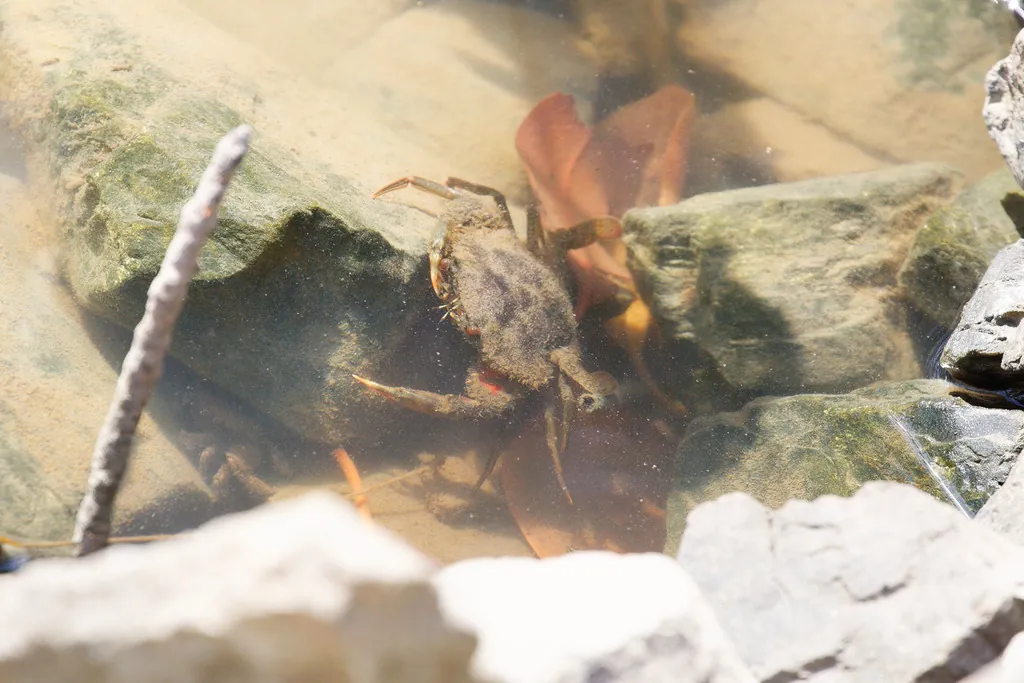
Kiju is the Kuku Yalanji word for the mud crab[1], the big, heavy-clawed crab of the mangroves (Scylla serrata)[2]. Eastern Kuku Yalanji Traditional Owners name kiju among the important food animals that breed in their mangrove and mudflat country[3]. Kuku Yalanji families still hunt crabs on the low-tide flats and mangroves of their coast, as at Cooya Beach north of Port Douglas[4]. Crabbing ground is also crocodile, stingray and stonefish ground, so go at the right tide and watch where you put your feet[5][6].
Names
The dictionary gives kiju 'mudcrab'[1], and the Eastern Kuku Yalanji sea country plan uses the same word[3]. Other crabs on the same coast have their own names: karruku 'ghost crab, fiddler crab', ngalngal 'sand crab', wuli-wuli 'soldier crab' and wurru-bulan 'small crab found on reef'[1].
Description
The giant mud crab, also called the green mud crab, is an armour-plated crab with massive, bone-crunching claws, which it holds out in front of itself like shears[2]. In warm northern waters, where it grows fast and stays active all year, it can weigh nearly 3 kg and measure almost 30 cm across the shell. A young crab only 8 cm across can already bite with a force of up to 40 kg[2]. Mud crabs live 3–4 years. As they grow they moult, swapping the old shell for a soft new one that hardens over a few days[2].
Where it lives
Giant mud crabs live in mangroves, mudflats and estuaries, coming out of their muddy holes and hides as the tide ebbs and flows to forage for shellfish, other crabs and carrion[2]. In Australia they range from Exmouth Gulf in Western Australia across the north and down the east coast into southern New South Wales[2].
On Eastern Kuku Yalanji country, the mangrove and mudflat areas are 'very important breeding areas' for fish and for kiju, saltwater mussels and a worm that lives in dead mangrove trunks[3]. The flats, mangroves and tidal lagoons at Cooya Beach are traditional Kuku Yalanji fishing grounds[4].
Western Yalanji country. Mud crabs are animals of the tidal mangroves[2], so they are not found on the upper Mitchell around Mount Carbine. On the Gulf side you would have to go down to the Mitchell's mangrove estuaries.
Seasons and tides
In the warm north mud crabs stay active all year[2]. What matters more is the tide. Crabbing is done at ngajal, low tide, when the flats are exposed[1][4]. Watch for balar, high tide, coming back in[1].
Crabs are most vulnerable while their new shell is soft after a moult, and that is also when females are most often mated. Egg-bearing females can carry up to five million eggs, and some travel 100 km or more out to sea to release them[2].
Just north of Kuku Yalanji country, at Cape Bedford, Roth was told that crabs are only good when caught at the full moon[7]. He did not record the same belief on the Bloomfield.
Uses
Kiju is food, and a favourite one. The Traditional Owners' plan lists it with the oysters, pipis, razor shells and periwinkles of the rocks and beaches as important coastal foods[3]. At Cooya Beach, Kuku Yalanji families still hunt, cook and share crabs together and pass the skills down the generations[4].
Roth found that in many North Queensland districts crabs were hunted mainly by women and young people[7]. Crabs were also handy as bait: on the Tully River small crabs were sometimes tied on as fish bait[7].
How kiju are caught and cooked
Neither Roth nor the dictionary describes a Bloomfield crabbing method step by step. The steps below follow how Kuku Yalanji families hunt today at Cooya Beach, plus what the records say about carrying and cooking.
- Go at low tide (ngajal), when the flats and mangrove edges are uncovered[1][4].
- Walk the mudflats, tidal lagoons and mangrove edges. Mud crabs come out of their muddy holes and hides as the tide moves[2].
- Take a spear. At Cooya Beach Kuku Yalanji hunters walk the flats with light bamboo spears and spear crabs and fish at low tide[4].
- Mind the claws. Even a young crab 8 cm across can bite with a force of up to 40 kg[2].
- Check it is legal to keep. Under Queensland rules only males measuring at least 15 cm across the shell may be kept[8].
- Carry them so they don't fight. Around Brisbane (far to the south) Roth recorded crabs carried in a dilly bag with leafy mangrove twigs, which were believed to stop them nipping each other[9].
- Cook. In North Queensland most shellfish were roasted in the ashes, and shrimps and prawns were baked wrapped in wild-ginger leaves or tea-tree bark[7]. The everyday cooking words are dindal 'to roast on coals' and kurrma 'earth oven'[1]. At Cooya Beach the day's crab is cooked up at home and shared with damper[4].
Safety
Crocodiles. Mangrove creeks and mudflats are bilngkumu country. Don't wade into creeks or channels, stay back from deep edges, take extra care at dusk, dawn and night, and stay away from crocodile slides and tracks[5]. Eastern Kuku Yalanji Traditional Owners report that saltwater crocodiles are increasing and becoming more dangerous, especially in the Bloomfield River[3].
Stingrays and stonefish. Stonefish look like rocks and lie among rocks or in mud or sand, along the coast and in some fresh waters. The spines on their backs carry a dangerous venom[6]. Stingrays (yawu)[1] carry a barbed spine. To protect yourself[6]:
- Enter the water slowly and shuffle your feet, which gives stingrays time to swim away.
- Don't touch sea creatures.
- For a stonefish or stinging-fish injury: call 000 and soak the wound in hot water, no hotter than can easily be tolerated, to ease the pain.
Mud and tide. The dictionary has words for a hazard every crabber knows: kurndal 'sink in mud or water' and yurru-janjil 'suck down, as in quicksand or mud'[1]. Know when the tide turns, and don't get cut off on the far side of a channel.
The crab itself. The claws can break a finger[2].
On Country today
Queensland rules. Mud crabs must measure at least 15 cm. The limit is 7 per person, or 14 per boat with two or more people aboard. No female mud crabs may be taken, and you cannot keep a crab with its shell missing, or claws without the rest of the crab. Waters closed to crabbing also apply[8].
Native title and sea country. Eastern Kuku Yalanji native title was recognised in August 2026 over about 217,884 ha from the Annan River to the Daintree River, including Cow Bay, Thornton Beach and Cape Tribulation[10]. Under section 211 of the Native Title Act 1993, native title holders may fish and gather on their country for personal, domestic and non-commercial communal needs without the licences others need[11], and the Marine Park's zoning plan recognises this right in the Great Barrier Reef Marine Park[12]. Everyone else needs the Traditional Owners' permission. One good way to learn crabbing on country is with a Kuku Yalanji–run tour such as the one at Cooya Beach[4].
Language
ngajal 'low tide'; balar 'high tide'; mangkurru 'mangrove (English loan word)'; kambal-kambal 'mud'; juwarru 'mud oyster', which clings to rock and mangroves; mandurr 'bait (any kind)'[1].
References
- Hershberger, H. D. & Hershberger, R. (1982). Kuku-Yalanji Dictionary. Work Papers of SIL-AAB, Series B, Volume 7. With Toby Bloomfield, Roy Friday, Billy Roberts, Hector and Doris Sykes, Joe Walker and others. www.sil.org/resources/archives/18038
- Australian Geographic (October 2024). 'March of the mud crabs.' www.australiangeographic.com.au/nature-wildlife/2024/10/march-of-the-mud-crabs/
- Yalanjiwarra People & Jabalbina Yalanji Aboriginal Corporation (2016). Nganjinanga Bubu, Nganjinanga Jalun, Nganjinanga Bama Plan: Our Land, Our Sea, Our People Plan 2016–2021. Eastern Kuku Yalanji Indigenous Protected Area Management Plan, Stage 3. Mossman: Jabalbina. — Section 4, 'Our Yalmba and Jalun (Coast and Sea Country)' www.wettropicsplan.org.au/wp-content/uploads/2019/09/Eastern-Kuku-Yalanji-Indgenous-Protected-Area-Management-Plan-Stage-3-Yalanjiwarra-Land-and-Sea-Country.pdf
- Tourism Port Douglas Daintree. 'In the footsteps of Walkers' (Kuku Yalanji Cultural Habitat Tours, Cooya Beach), accessed 5 October 2026. tourismportdouglas.com.au/in-the-footsteps-of-walkers
- Queensland Government. Be Crocwise top tips (web page, accessed 5 October 2026). www.qld.gov.au/environment/plants-animals/animals/living-with/crocodiles/becrocwise/be-crocwise-top-tips
- healthdirect Australia. Sea creature bites and stings (web page, accessed 5 October 2026). www.healthdirect.gov.au/sea-creature-stings
- Roth, W. E. (1901). North Queensland Ethnography, Bulletin No. 3: Food — its search, capture, and preparation. Brisbane: Government Printer. Bloomfield River information from R. Hislop. — Sect. 13 'Crustaceans'; sect. 14 'Molluscs'; sect. 6 'Cooking' archive.org/details/northqueensland00landgoog
- Queensland Government. Size and possession limits in tidal waters: crabs (web page, accessed 5 October 2026). www.qld.gov.au/recreation/activities/boating-fishing/rec-fishing/rules/limits-tidal
- Roth, W. E. (1904). North Queensland Ethnography, Bulletin No. 7: Domestic Implements, Arts, and Manufactures. Brisbane: Government Printer. — Sect. 54, dilly-bags (Brisbane note on carrying crabs) archive.org/details/northqueensland00landgoog
- National Indigenous Times (12 August 2026). 'More than 100 ancestral lines united in Eastern Kuku Yalanji native title determination.' nit.com.au/12-08-2026/25896/more-than-100-ancestral-lines-united-in-eastern-kuku-yalanji-native-title-determination
- Native Title Act 1993 (Cth), section 211: preservation of certain native title rights and interests (hunting, fishing and gathering for personal, domestic or non-commercial communal needs). www.legislation.gov.au/C2004A04665/latest/text
- Great Barrier Reef Marine Park Authority. Traditional use of the Marine Park; Traditional Use of Marine Resources Agreements (web pages, accessed 5 October 2026). www2.gbrmpa.gov.au/learn/traditional-owners/traditional-use-marine-resources-agreements