Trees
River red gum
kayjurr · bajar · jabarr · jinajina · dakumbarEucalyptus camaldulensis
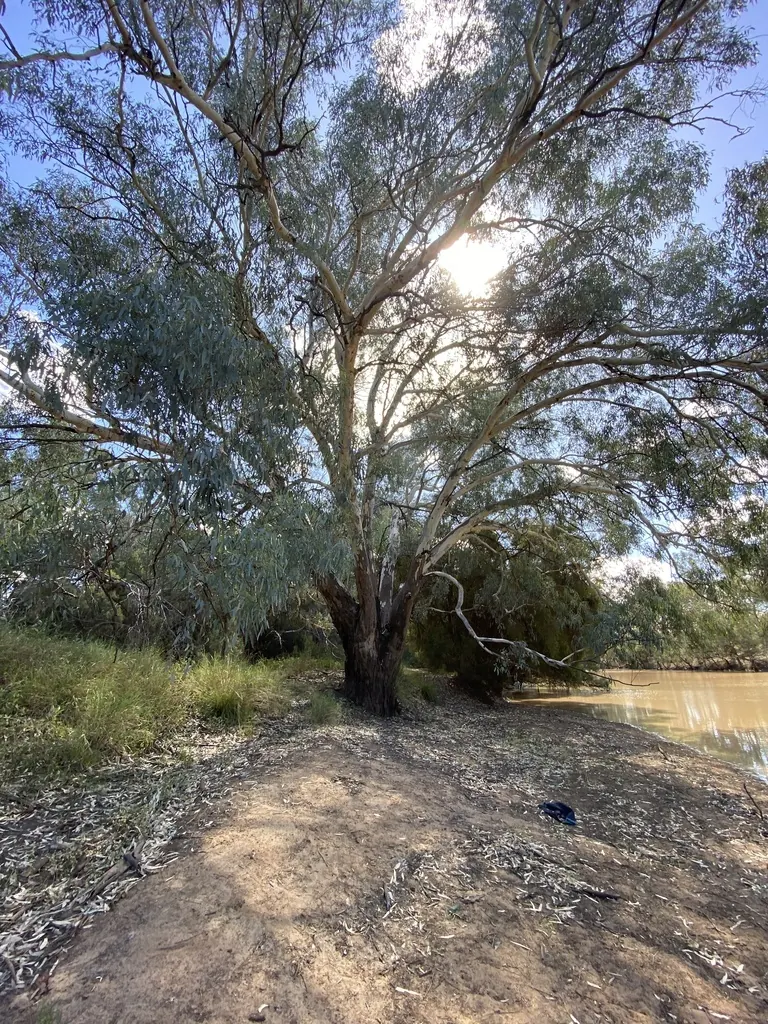
The big smooth-barked gum of the inland river banks is the river red gum, and the dictionary's words for the smooth gums are kayjurr 'white gum', bajar 'species of white gum', jabarr 'baldy gum tree', and jinajina (Nyungkul dakumbar) 'water gum tree; this tree is good timber for woomeras'[1]. It is 'a tree with smooth white or cream-coloured bark, lance-shaped or curved adult leaves, flower buds in groups of seven or nine, white flowers and hemispherical fruit with the valves extending beyond the rim. A familiar and iconic tree, it is seen along many watercourses across inland Australia, providing shade in the extreme temperatures'[2]. 'Eucalyptus camaldulensis has the widest natural distribution of any eucalyptus species. It is commonly found along waterways and there are only a few locations where the species is found away from a watercourse', which makes it the surest sign of water in dry country[2]. It is the river's shade, honey, hollows and firewood, and its one famous danger: 'the limbs of river red gums, sometimes whole trees, often fall without warning so that camping or picnicking near them is dangerous'[2].
Nothing is written for the Eastern coast on this page yet. What follows is true across the country.
Hann River Cape York
Possum People's country on the upper river and Thaypan (Kuku Thaypan) country downstream: stringybark and bloodwood woodland and a spring-fed sandy river that runs north-east from the Great Dividing Range, past the Peninsula Developmental Road, into Rinyirru (Lakefield) and the North Kennedy. Not Kuku Yalanji country: the Kuku Yalanji words on this page are the dictionary's, not the Hann's own languages. Place guide
River red gums stand along the big streams of the Hann country. The Atlas of Living Australia holds 46 river red gum records, from 1973 to 2010, in a box of about 90 × 85 km around the middle Hann, Laura and western Rinyirru[8], and the Queensland Herbarium's paperbark fringe of this country's major streams carries 'Eucalyptus tereticornis (blue gum) or E. camaldulensis (river red gum)' over the silver-crowned paperbarks[9]. The Kuku Thaypan Elders know the gums of the lagoons, river banks and plains as Ku garl, gum tree country, with its own time to burn[10].
Names here
In Kuku Thaypan, ku begins the name of every tree[10]. Ku garl (also written Ku agawl and Ku awgarl) is 'Gum Tree', Eucalyptus sp., and Standley names the gums of Ku garl country as E. tereticornis and E. tessellaris[10]. Whether the Elders count the river red gum among them, the thesis does not say. The Kuku Yalanji words above are not this country's.
Where it grows here
Ku garl country is 'around lagoon systems, riverine woodland and open eucalypt grassy woodlands on plains. Water settles in these systems from the wet season and they have hard brown dark soil'. The Elders group its gum communities 'according to where this system occurs in the landscape, for example on open plains, surrounding lagoons or on river banks'[10].
The Herbarium's river fringe (regional ecosystem 3.3.10a) is the river-bank kind: paperbarks with blue gum or river red gum, a sub-canopy that often holds the cluster fig, and a ground layer 'generally very sparse and regularly swept clear by floods'[9].
Its year here
The Hann floods in the wet, highest in February–March, and runs very low but never stops in September–November[11]; the river red gum depends on just such flooding to recharge the ground it lives on[2].
In the Elders' fire calendar, 'Ku agawl Gum flowering' is one of the signs for the early-dry burns[10]. Gum country 'is ready for burning when the Ku akalmba Messmate is flowering. By this time of the year the gum tree communities have flowered and produced fruit. Gum tree community is one of the first systems to burn, the darker the soil the earlier the burn, lighter soils are burnt later.' The weather sign is 'the last of the light squally showers and the SE knock em down rain', 'when Eriachne sp is setting seed and bark has shed'. Gum country left unburnt for years needs a hotter fire than it otherwise would[10].
What it gives here
The Elders list Ku garl among the trees important for the native sugarbag bees[10], and sugarbag is Arear in Kuku Thaypan[10]. See native bees. Nothing else is published on how the people of the Hann used the river red gum; for the rest, see Uses above.
On country today
The upper Hann is the Possum People's country and the middle and lower Hann are Thaypan country, under native title determinations of November 2023[12][13]. Downstream, Rinyirru (Lakefield) National Park is jointly managed by the Rinyirru Aboriginal Corporation and the Queensland Government[14]. Native title holders may take timber and other resources for personal, domestic and non-commercial communal needs without the licences others need[15]; anyone else should ask before cutting. Camp clear of big gums: their limbs fall without warning[2].
Upper Mitchell Western Yalanji
Western Yalanji country west of the Great Dividing Range: dry open woodland cut by the sandy, paperbark-lined upper Mitchell River, around Karma Waters and Mount Carbine. Place guide
At Karma Waters it is the sixth most-recorded plant within 30 km, with twenty-two records, and the Queensland Herbarium maps it with the Leichhardt tree and the paperbarks in the fringing woodland of the river's channels and levees[16][17].
Where it grows here
On the Mitchell and its creeks it grows in the Herbarium's 'Melaleuca fringing woodland on channels and levees' with the Leichhardt tree[17].
On country today
The red gums are the Karma Waters river camps' shade and their hazard; the campground rules and the induction say where to camp[18][17].
Everywhere
Names
The dictionary classes the eucalypts by their bark, as the botanists do, and the smooth ones are the 'white' and 'baldy' gums: kayjurr 'white gum', bajar 'species of white gum', jabarr 'baldy gum tree'. Its 'water gum tree' is jinajina in Yalanji, 'this tree is good timber for woomeras', and dakumbar in Nyungkul[1]. On the coast where the dictionary was made there are several smooth gums and a water gum, so which word belongs to the river red gum of the inland rivers is not recorded; the woodland page puts kayjurr and jabarr with the gums as a class. nyumbil 'coolibah tree (messmate)' is the dictionary's word for the other flood-country gum, and wankar, 'a tree which grows along the water and has red flowers', fits the weeping bottlebrush of the same banks[1]. The river red gum's Northern Territory Aboriginal names are listed on its Wikipedia page[2].
Description
'Eucalyptus camaldulensis is a tree that typically grows to a height of 20 metres but sometimes to 45 metres and often does not develop a lignotuber. The bark is smooth white or cream-coloured with patches of yellow, pink or brown. There are often loose, rough slabs of bark near the base. The juvenile leaves are lance-shaped, 80–180 mm long and 13–25 mm wide. Adult leaves are lance-shaped to curved, the same dull green or greyish green colour on both sides, 50–300 mm long and 7–32 mm wide'. 'The flower buds are arranged in groups of seven, nine or sometimes eleven', 'with a prominently beaked operculum'. 'Flowering mainly occurs in summer and the flowers are white. The fruit is a woody, hemispherical capsule 2–5 mm long and 4–10 mm wide ... with the valves raised above the rim.' 'The plant's flowers bloom for a long time throughout the year'[2].
Water and flood. 'The species can be found along the banks of watercourses, as well as the floodplains of those watercourses. Due to the proximity to these watercourses, river red gum is subject to regular flooding in its natural habitat. River red gum prefers soils with clay content. The trees not only rely on rainfall but also on regular flooding, since flooding recharges the sub-soil with water.' 'The dry river beds of central Australia have sufficient underground water flow to sustain the trees'[2].
What it gives the river. 'The association of the river red gum with water makes the tree a natural habitat choice, indeed sometimes the only choice in drier areas, for other species. The trees provide a breeding habitat for fish during the flooding season, which also benefits aquatic bird life that depend on fish as a food source during their own breeding season.' 'River red gums contribute to the provision of nutrients and energy for other species through leaf and insect fall. This is especially important to the ecology in areas of low nutrients. The tree's preferred habitat of floodplains and watercourses also gives it the role of flood mitigator, which slows silt runoff'[2].
Kino. The dark red gum that bleeds from a wound in the bark is a kino, and 'Australian, Botany Bay, or Eucalyptus kino from Eucalyptus siderophloia and Eucalyptus camaldulensis, were imported into the United States' as a drug; 'the drug was frequently used in diarrhoea' and as a gargle, until better medicines replaced it[3]. See beeswax and gums and bush medicine.
Telling it from the other gums
- River red gum: smooth white bark with coloured patches, rough slabs only at the butt, on the river bank; small fruit with the valves sticking out[2].
- Dallachy's gum and the other smooth gums of the hills: on the ridges, not the bank; see woodland.
- Carbeen / Moreton Bay ash (bajar in the woodland page's reading): tessellated bark on the bottom metres, then abruptly smooth[1].
- Paperbark: papery layers, bottlebrush flowers.
- Leichhardt tree: big glossy leaves, round fruit, bare in the dry.
- Ironbark and bloodwood: rough bark the whole way up.
Signs
- A line of white gums across dry country is a creek, and water under the sand[2].
- Blossom in summer roaring with bees by day and flying foxes by night[2][4].
- Hollows with a parrot's head in them, and the cockatoos' chewed entrances; see cockatoos and parrots.
- Red kino running from a wound[3].
- Fresh-dropped limbs on the sand under a tree: the tree's warning[2].
- Flood debris lodged in the forks shows the last wet's height.
Where it grows
The bank and floodplain of rivers and creeks, over bare sand and leaf litter: 'there are only a few locations where the species is found away from a watercourse'[2].
The river's tree
Everything in the waterhole runs partly on the red gum: its leaf and insect fall feed the pool's bottom, its flood-time roots are 'a breeding habitat for fish', its shade keeps the pool cool, its blossom feeds the native bees, the lorikeets and the flying foxes, its hollows house the possums, the parrots, the ducks and the kookaburras, and its fallen limbs are the snags the barramundi and sleepy cod lie under[2][4][5]. The rosellas eat its seed[6]. It needs the flood as much as the fish do: 'infrequent flooding ... provides inadequate water to recharge the floodplain subsoils that river red gums depend on. This will result in stunted tree growth, death of existing trees'[2].
Seasons
Flowers 'mainly ... in summer' and on and off through the year; seed shed 'mostly in spring and summer', some 'carried by the wind and water'; the flood in the wet recharges the ground it lives on[2]. See the year on country.
Uses
- Finding water: the tree is the sign; see finding water[2].
- Shade for the camp, with the limb warning below[2].
- Woomera timber, if the dictionary's water gum is this tree: 'this tree is good timber for woomeras'[1]. See spear and woomera.
- Honey: a summer blossom tree for the sugarbag[2].
- Kino as a gum and, historically, a medicine[3].
- Firewood: dense, slow, hot coals; the earth oven's wood on the river.
Camping under red gums
- Look up before you camp: dead limbs, a split fork, a hollow trunk, a tree stressed by drought; 'the limbs of river red gums, sometimes whole trees, often fall without warning'[2].
- Camp outside the drip line of the biggest trees, in the open or under the paperbarks, and never in a wind.
- Take firewood from the ground, not the tree; the dropped limbs are already seasoned.
- Follow the gums to water across dry country: where the line of white trunks goes, the creek goes, and a soak is under the sand at the bend; see finding water[2].
- Leave the hollow trees; they are the river's nests.
Safety
On Country today
Each place below says whose country the red gums stand on and where to camp. Which of the dictionary's gum words is this tree is for the contribution box below[1].
Language
kayjurr, bajar 'white gum'; jabarr 'baldy gum'; jinajina, dakumbar 'water gum tree'; nyumbil 'coolibah'; wankar 'a tree which grows along the water and has red flowers'; kingal 'river oak, she oak'; yikin 'bank of river'; wawubaja 'river'[1].
References
- Hershberger, H. D. & Hershberger, R. (1982). Kuku-Yalanji Dictionary. Work Papers of SIL-AAB, Series B, Volume 7. With Toby Bloomfield, Roy Friday, Billy Roberts, Hector and Doris Sykes, Joe Walker and others. www.sil.org/resources/archives/18038
- Wikipedia. Eucalyptus camaldulensis (river red gum). en.wikipedia.org/wiki/Eucalyptus_camaldulensis
- Wikipedia. Kino (botany): Eucalyptus kino and its former medicinal use. en.wikipedia.org/wiki/Kino_(botany)
- Wikipedia. Little red flying fox. en.wikipedia.org/wiki/Little_red_flying_fox
- Wikipedia. Common brushtail possum (Trichosurus vulpecula), including the northern subspecies' decline (von Takach et al. 2020). en.wikipedia.org/wiki/Common_brushtail_possum
- Wikipedia. Pale-headed rosella. en.wikipedia.org/wiki/Pale-headed_rosella
- Queensland Government. Be Crocwise top tips; Be Crocwise in Croc Country (web pages, accessed 5 October 2026). www.qld.gov.au/environment/plants-animals/animals/living-with/crocodiles/becrocwise/be-crocwise-top-tips
- Atlas of Living Australia. Occurrence records of Eucalyptus camaldulensis in a box of about 90 × 85 km around the middle Hann River, Laura and western Rinyirru (lat −15.6 to −14.8, long 143.5 to 144.3), queried 28 October 2026: 46 records (1973–2010), almost all herbarium specimens. biocache.ala.org.au/occurrences/search?q=species%3A%22Eucalyptus%20camaldulensis%22
- Queensland Herbarium. Regional ecosystem descriptions, Cape York Peninsula bioregion: 3.3.10a (Melaleuca fluviatilis fringing woodland), 3.3.24 (Eucalyptus leptophleba woodland on riverine levees, Laura area), 3.10.6 and 3.10.10 (Darwin stringybark woodland on sandstone), 3.3.66 (lakes and lagoons). apps.des.qld.gov.au/regional-ecosystems/
- Standley, P.-M. (2019). The importance of campfires to effective conservation. PhD thesis, James Cook University. Records the fire and country knowledge of Kuku Thaypan Elders Dr Tommy George and Dr George Musgrave. — Kuku Thaypan prefix ku (p. 297); Ku garl among trees important for sugarbag bees (Table 8.11, p. 361); Arear, sugarbag (p. 100); fire-calendar indicators (p. 383); Ku garl gum tree country (pp. 441–446) researchonline.jcu.edu.au/64274/
- Bureau of Meteorology, Water Data Online. Station 105001B, Hann River at Sandy Creek: daily and monthly mean discharge 1968–2026 (recent data provisional), retrieved 28 October 2026. No day of zero mean flow in 20,711 days of record; mean flow highest in February–March, lowest in September–November. www.bom.gov.au/waterdata/
- Ross on behalf of the Cape York United #1 Claim Group v State of Queensland (No 21) (Possum determination) [2023] FCA 1316 (Federal Court of Australia, 2 November 2023). — Determination area (upper Hann and Kennedy rivers); prescribed body corporate; affidavit evidence on hunting and fishing www.judgments.fedcourt.gov.au/judgments/Judgments/fca/single/2023/2023fca1316
- Ross on behalf of the Cape York United #1 Claim Group v State of Queensland (No 20) (Thaypan determination) [2023] FCA 1315 (Federal Court of Australia, 2 November 2023). — Determination area and waters; prescribed body corporate (Awu-Laya Indigenous Corporation); affidavit evidence on hunting www.judgments.fedcourt.gov.au/judgments/Judgments/fca/single/2023/2023fca1315
- Queensland Parks and Wildlife Service. Nature, culture and history: Rinyirru (Lakefield) National Park (CYPAL) (web page, last updated 1 July 2024; accessed 28 October 2026). parks.qld.gov.au/parks/rinyirru-lakefield/about/culture
- Native Title Act 1993 (Cth), section 211: preservation of certain native title rights and interests (hunting, fishing and gathering for personal, domestic or non-commercial communal needs). www.legislation.gov.au/C2004A04665/latest/text
- Atlas of Living Australia. Plant occurrence records within 30 km of the Karma Waters homestead (16.62°S, 144.60°E), queried 10 October 2026: 832 records of 266 species. biocache.ala.org.au/occurrences/search?q=kingdom:Plantae&lat=-16.62&lon=144.60&radius=30
- Queensland Herbarium, Regional Ecosystem 9.3.14 (Einasleigh Uplands): Melaleuca fringing woodland on channels and levees. Fire management guidelines. Queensland Government Regional Ecosystem Description Database. apps.des.qld.gov.au/regional-ecosystems/details/?re=9.3.14
- Karma Waters Station. Bush Camping at Karma Waters Station (web page, accessed 5 October 2026). www.karmawatersstation.com/bush-camping.html
From the community
Know this one? Add the words you use for it, what it is for, how it is done, a correction, or a photo from country. It shows here straight away with your name on it. Please keep anything restricted or sacred off the site.
Loading…