Trees
Brown cedar (jalnji)
jalnjiCanarium australasicum
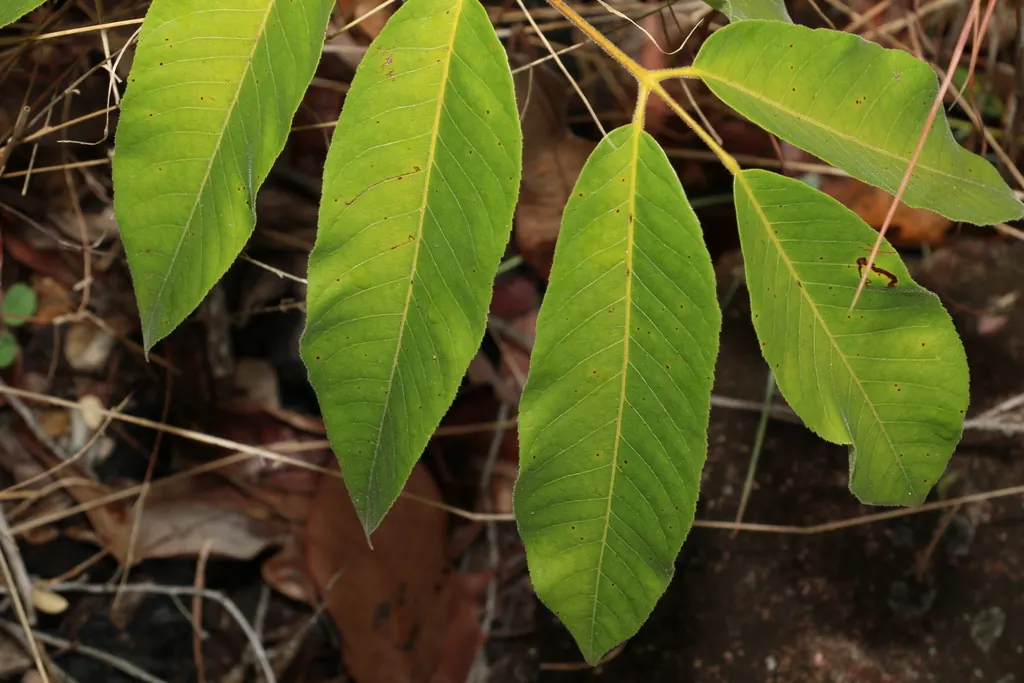
jalnji is a tree whose 'gum from this tree is not poisonous, used for making spears', and Roth's Bloomfield name for the brown-cedar gum, t-chaln-ji, is the same word: this is Canarium australasicum, the brown cedar, brown cudgerie or mango bark, the rainforest tree whose dry lumps of gum, baked and pounded, were the cement of the Bloomfield spear and axe[1][2][3]. Its bark 'exudes a strong mango odour' when cut, its flowers are dark red to maroon, and its fruit small[4]. Anderson: the stone axe head was set in its lawyer-cane handle with 'a gum mixture of beeswax mixed with resin from Canarium australasicum', the stingray barbs on the spears with the same resin, and the harpoon point with 'a ring-plug of gum (usually Canarium australasicum)'; and its wood, like the blind-your-eye mangrove's, 'produces a smoke which is said by Kuku-Yalanji to produce blindness'[3]. At Cape Bedford the tree was also a canoe timber[5]. The gums themselves are on the beeswax and gums page.
Hann River Cape York
Possum People's country on the upper river and Thaypan (Kuku Thaypan) country downstream: stringybark and bloodwood woodland and a spring-fed sandy river that runs north-east from the Great Dividing Range, past the Peninsula Developmental Road, into Rinyirru (Lakefield) and the North Kennedy. Not Kuku Yalanji country: the Kuku Yalanji words on this page are the dictionary's, not the Hann's own languages. Place guide
Brown cedar does not grow on the Hann River. The Atlas of Living Australia has no record of Canarium australasicum in a box of about 90 × 85 km around the middle Hann, Laura and western Rinyirru; the only Canarium there is a different tree, C. australianum (18 records, 1970–2020), and no source says its gum was used[6]. The cements of this country were the ironwood and the grass tree[2][7].
Where it grows here
It doesn't. The brown cedar is a rainforest tree[4], and the Hann is stringybark and bloodwood woodland with a paperbark fringe on the river[8]. The trees that gave gum here are in the Atlas: ironwood, Erythrophleum chlorostachys, 50 records (1970–2026), and the grass tree Xanthorrhoea johnsonii, 14 records (1968–2024), in the same box[6].
The gums people used here
Ironwood gum. Roth saw ironwood cement 'in use among the natives of the Endeavour, Laura, and Palmer Rivers, along the Princess Charlotte Bay coast line' about 1900; he noted its 'liability to crack'[2]. See ironwood.
Grass-tree resin (Kuku Warra, Laura). A Kuku Warra man from Laura told the Federal Court in 2023: 'At the bottom of the black boy tree, you get a resin right down near the root. You take the root of the tree, cut it with a tomahawk, scrape the dirt off, heat the root on hot coals, and the resin or sap comes out of the root. You can mould the sap to bind things together'[7]. Kuku Warra country is around Laura, and it shares the land between the North Kennedy and the Hann with the Thaypan under a customary agreement[7].
Sap, resin and fire (Kuku Thaypan). The Kuku Thaypan Elders who worked with Standley taught that in their fire knowledge 'weaponry and crafts are intimately tied to fire. Materials used in the creation of weapons require sap and resin and fire is used to stimulate the production of both in species that are utilised for this purpose'[9]. Scarred trees on their country record this: 'Scars can be from harvesting sugarbag (native honey) or resin or for use in tools, weaponry or craft'[9].
On country today
The upper Hann is the Possum People's country and the middle and lower Hann are Thaypan country, both determined in November 2023[10][11]. Scarred trees are part of that country's record; leave them alone[9].
Upper Mitchell Western Yalanji
Western Yalanji country west of the Great Dividing Range: dry open woodland cut by the sandy, paperbark-lined upper Mitchell River, around Karma Waters and Mount Carbine. Place guide
Brown cedar is a long way from Karma Waters on the upper Mitchell; this page is here because the words, the trade and the tools reach inland.
Where it grows here
Not at Karma Waters, whose cements are the grass tree, the ironwood and the spinifex[2].
Eastern coast Eastern Kuku Yalanji
Eastern Kuku Yalanji country: rainforest, beaches, mangroves, reef and the short steep rivers from the Daintree to the Bloomfield and the Annan.
This is a tree of the sea country of the Eastern Kuku Yalanji, the Bloomfield and Daintree coast, where its gum was the cement of the spear and the axe[3].
Where it grows here
The lowland rainforest of the Bloomfield and Daintree[4][2].
On country today
The tree is in the Bloomfield scrubs and its gum still sets a spear; the Eastern Kuku Yalanji country where it grows was handed back to its Traditional Owners in 2021[12][3].
Everywhere
Names
jalnji 'species of poison nut tree; gum from this tree is not poisonous, used for making spears'[1]. Roth: the brown-cedar gum 'is used for fixing together the haft and shaft of spears, and in the old days (R. Hislop) was employed for fixing the stone-celt into its handle. KYE Bld. t-chaln-ji. Though the tree is not growing in the immediate vicinity of Cooktown and Cape Bedford, the local (KYI) blacks know the gum as kun-dar', and at Cape Bedford the tree itself, as a canoe timber, was gundar[2][5]. The related yikari is the traded resin of Canarium muelleri, a different tree; the dictionary's cedars milbanku and mirrbangku are the 'pencil cedar' with a sweet date-shaped fruit, and the red cedar is marrakan[2][1].
The tree and the gum
'Brown cudgerie; carrotwood; mango bark; mango carrotwood; parsnip wood': 'freshly cut bark exudes a strong mango odour and a small amount of clear or slightly milky exudate'; the leaves are compound, sometimes reduced on big trees to one leaflet; the flowers 'dark red to maroon' with yellow or orange anthers; the fruits 'about 8–9 mm long'[4].
The gum. Roth: 'the dry lumps of gum are gathered off the tree ... and are either wrapped in leaves and baked, or just warmed before a fire, and then pounded between two stones till pliable and soft enough for use'[2]. Anderson: 'the celts were tied onto a handle made of a portion of large lawyer cane and secured there by bark fibre or wallaby sinew and a gum mixture of beeswax mixed with resin from Canarium australasicum'; the stingray barbs and prongs 'were held in place by wallaby sinew and resins made from Canarium australasicum, E. chlorostachys or grasstree'; the harpoon point 'was stuffed into the hollowed-out end of the handle and kept there by a ring-plug of gum (usually Canarium australasicum)'[3]. 'Gums and resins were an important resource ... I have noted the use of Canarium australasicum gum for fixing spear points and axe hafts. C. muelleri resin, and the gum from a forest Casuarina species, Xanthorrhoea johnsonii and Grevillea striata were also widely used'[3].
The wood. 'Some wood was very dangerous to use as firewood. For instance, a mangrove species, Excoecaria agallocha, produces a smoke which is said by Kuku-Yalanji to produce blindness. This is also true of the "brown cedar", Canarium australasicum'[3]. At Cape Bedford the dug-out canoes were made of 'Canarium australasicum (KYI gundar), and Gmelina'[5].
Brown cedar, red cedar, pencil cedar
- Brown cedar (jalnji): mango smell from the cut bark, maroon flowers, gum lumps on the trunk; the cement tree[4][2].
- Red cedar (marrakan): the canoe and timber tree, pinnate leaves, red wood, no mango smell[1].
- Pencil cedar (milbanku, mirrbangku): 'the fruit is the shape of a date and very sweet'[1].
- Canarium muelleri: the big-teared resin tree of yikari[2].
Signs
Where it grows
A tree of lowland rainforest[4]. It is not found everywhere Kuku Yalanji is spoken: it was not growing near Cooktown, where the gum was known by name but had to be traded in[2]. See each place above for where it grows and where it does not.
The cement tree
Brown-cedar gum is the thing that holds the Bloomfield toolkit together: barb to spear, stone to axe haft, point to harpoon, with beeswax and sinew; its wood made the Cape Bedford canoe; and its smoke was the one thing a Bloomfield cook would not have at the fire[3][5]. Gum-cements were among the Bloomfield's trade exports[5].
Seasons
Gum lumps are gathered when found and kept, since the cement 'only requires heat to soften it again'; spear and axe work followed the materials, after the storms[2][3]. See the year on country.
Uses
Preparing the gum
- Gather the dry lumps of gum from the trunk.
- Wrap them in leaves and bake them in the ashes, or warm them before the fire.
- Pound between two stones until soft; at Cooktown the stones were greased with an oily nut so the gum did not stick[2].
- For an axe, mix with beeswax; work it hot round the binding and let it set[3].
- Never burn the wood at the cooking fire[3].
The whole cement kit is on the beeswax and gums page.
Safety
On Country today
Whether jalnji is this tree exactly is for the people who gather its gum; the contribution box below is for that[1].
Language
jalnji the spear-gum tree; yikari the traded resin; milbanku, mirrbangku 'pencil cedar'[1].
References
- Hershberger, H. D. & Hershberger, R. (1982). Kuku-Yalanji Dictionary. Work Papers of SIL-AAB, Series B, Volume 7. With Toby Bloomfield, Roy Friday, Billy Roberts, Hector and Doris Sykes, Joe Walker and others. www.sil.org/resources/archives/18038
- Roth, W. E. (1904). North Queensland Ethnography, Bulletin No. 7: Domestic implements, arts, and manufactures. Brisbane: Government Printer. — Sect. 10 'Fire-tongs'; sect. 9 'Cements' (ironwood gum in use on the Endeavour, Laura and Palmer rivers and the Princess Charlotte Bay coast) archive.org/details/northqueensland00landgoog
- Anderson, C. (1996). Traditional material culture of the Kuku-Yalanji of Bloomfield River, North Queensland. Records of the South Australian Museum 29(1): 63–83. Based on fieldwork at Wujal Wujal in the late 1970s and early 1980s. — Hunting (spears, spear-throwers, harpoons); fishing (stupefacients); manufacturing (gums and resins); post-contact bush component archive.org/details/RecordsSouthAus29Sout
- Australian Tropical Rainforest Plants (RFK8), Canarium australasicum (brown cudgerie, mango bark, carrotwood). CSIRO / Lucidcentral. apps.lucidcentral.org/rainforest/text/entities/canarium_australasicum.htm
- Roth, W. E. (1910). North Queensland Ethnography, Bulletin No. 14: Transport and Trade. Records of the Australian Museum 8(1). — Sects. 14–15, dug-out canoes from the Flinders Group to Cape Grafton archive.org/details/biostor-52863
- Atlas of Living Australia. Occurrence records of Canarium australasicum (none), Canarium australianum (18 records, 1970–2020), Erythrophleum chlorostachys (50 records, 1970–2026) and Xanthorrhoea johnsonii (14 records, 1968–2024) in a box of about 90 × 85 km around the middle Hann River, Laura and western Rinyirru (lat −15.6 to −14.8, long 143.5 to 144.3), queried 28 October 2026. biocache.ala.org.au/occurrences/search?q=genus:Canarium&fq=decimalLatitude:%5B-15.6%20TO%20-14.8%5D&fq=decimalLongitude:%5B143.5%20TO%20144.3%5D
- Ross on behalf of the Cape York United #1 Claim Group v State of Queensland (No 19) (Kuku Warra determination) [2023] FCA 1314 (Federal Court of Australia, 2 November 2023). www.judgments.fedcourt.gov.au/judgments/Judgments/fca/single/2023/2023fca1314
- Wikipedia. Hann River (Queensland) (accessed 28 October 2026). en.wikipedia.org/wiki/Hann_River_(Queensland)
- Standley, P.-M. (2019). The importance of campfires to effective conservation. PhD thesis, James Cook University. Records the fire and country knowledge of Kuku Thaypan Elders Dr Tommy George and Dr George Musgrave. researchonline.jcu.edu.au/64274/
- Ross on behalf of the Cape York United #1 Claim Group v State of Queensland (No 21) (Possum determination) [2023] FCA 1316 (Federal Court of Australia, 2 November 2023). — Determination area (upper Hann and Kennedy rivers); prescribed body corporate; affidavit evidence on hunting and fishing www.judgments.fedcourt.gov.au/judgments/Judgments/fca/single/2023/2023fca1316
- Ross on behalf of the Cape York United #1 Claim Group v State of Queensland (No 20) (Thaypan determination) [2023] FCA 1315 (Federal Court of Australia, 2 November 2023). — Determination area and waters; prescribed body corporate (Awu-Laya Indigenous Corporation); affidavit evidence on hunting www.judgments.fedcourt.gov.au/judgments/Judgments/fca/single/2023/2023fca1315
- Australian Geographic (29 September 2021). Daintree handed back to Traditional Owners. www.australiangeographic.com.au/news/2021/09/daintree-handed-back-to-traditional-owners/
From the community
Know this one? Add the words you use for it, what it is for, how it is done, a correction, or a photo from country. It shows here straight away with your name on it. Please keep anything restricted or sacred off the site.
Loading…