Trees
Wattles and grevilleas
yalngkal · yarun · yumba · kurrajanAcacia guymeri, A. holosericea, A. leptostachya and the other wattles; Grevillea parallela, G. glauca, G. pteridifolia
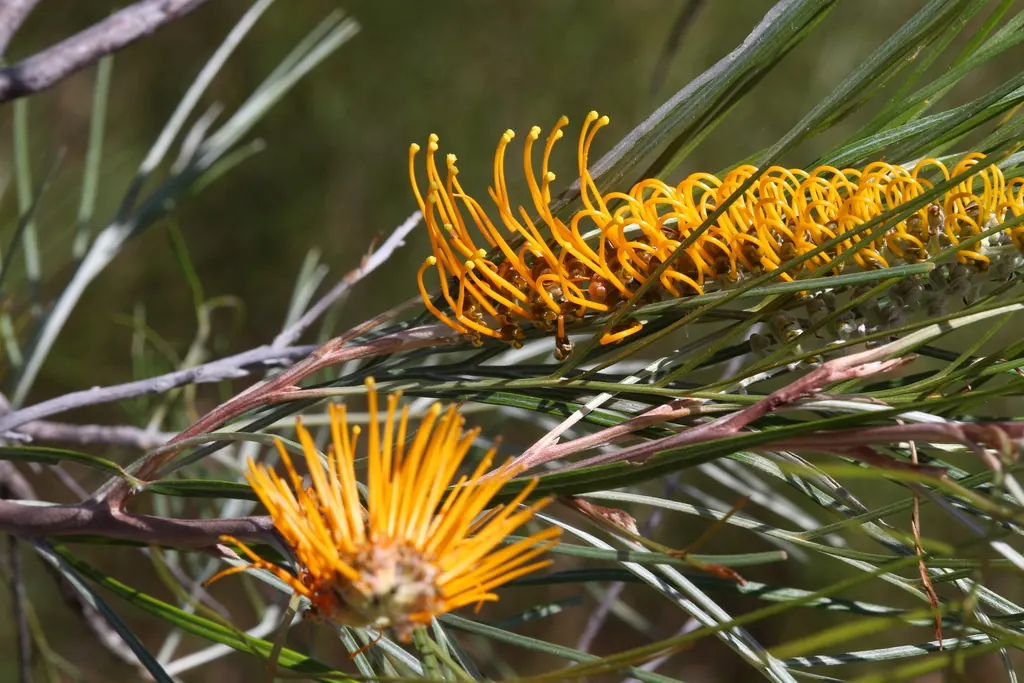
yalngkal is the 'white wattle', yarun the 'black wattle (yellow flower)' and yumba a 'species of wattle'; kurrajan is 'a spear point made from wattle and used for turtle spearing. It was put in the fire until it was hard enough to pierce through a turtle shell', and the water of cooked wattle bark is the dictionary's cure for the poison nut's burn[1]. The wattles are the understorey of the open woodland: among them Acacia guymeri, 'an open, single stemmed or multistemmed shrub with smooth, silver-grey bark' that is 'near threatened' in Queensland, the silky candelabra wattle with its 'tightly and sometimes irregularly coiled pods', and the Townsville wattle with 'spikes of golden yellow flowers' in August and September[2][3][4]. Wattle was the hard wood of the kit: Anderson's table of Kuku Yalanji spears has 'wood (Acacia sp)' for the heads of the fighting and fishing spears, the harpoon point was 'a sharpened and fire-hardened point some 10 cm–15 cm long made from Acacia crassicarpa', and the candelabra wattle was a fish poison[5][3]. Wattle seed is the other thing: 'wattleseeds were a relatively recent addition to Aboriginal Australian diets with specialized seed grinders first dated to 1000 years ago. Many species require pre-treatment of seeds through parching at high temperatures, soaking, or cracking'[6]. The grevilleas beside them, the silver oak, bushman's clothes peg and the golden grevillea, gave the gum that cemented spear heads and axe hafts and the charcoal for paint, and give the honeyeaters and the bees their flowers from the dry season on[5][7][8].
Hann River Cape York
Possum People's country on the upper river and Thaypan (Kuku Thaypan) country downstream: stringybark and bloodwood woodland and a spring-fed sandy river that runs north-east from the Great Dividing Range, past the Peninsula Developmental Road, into Rinyirru (Lakefield) and the North Kennedy. Not Kuku Yalanji country: the Kuku Yalanji words on this page are the dictionary's, not the Hann's own languages. Place guide
Wattles and grevilleas fill the Hann's woodland. The Atlas of Living Australia holds 332 wattle (Acacia) records, from 1930 to 2026, and 54 grevillea records, from 1962 to 2020, in a box of about 90 × 85 km around the middle Hann, Laura and western Rinyirru[16]. Kuku Thaypan Elders name several wattles and the bushman's clothes peg, and wattle country is one of their nine country types[17].
Where they grow here
The commonest wattles in the Atlas box are A. auriculiformis (42 records), A. leptocarpa (37), the northern lancewood A. torulosa (34), A. crassicarpa (31), A. rothii (30), A. hammondii (28) and the candelabra wattle (26); the grevilleas are the bushman's clothes peg G. glauca (20), the golden grevillea (12) and the silver oak (11)[16].
In the Kuku Thaypan Elders' account[17]:
- Wattle country is 'Wattle/Lancewood country, Ku nbae Red inside wattle, Ku toeadoo yellow-flowered wattle on lower elevation ridges, red soil reddish sandy soils', often rocky or stony, with sparser grass than other country.
- Ku Nbae (Acacia rothii) 'is found in most parts of the country and is most common in the sandridge areas', 'commonly found in large numbers like forests'.
- Ku Toada, the golden wattle, 'is found in most parts of Kuku-Thaypan country'.
- Ku Andeal, the bushman's clothes peg, 'is located all over the country', in the mixed-tree country with bloodwood and Cooktown ironwood and in the stony Debil Debil country.
Their year here
In the wet the Kuku Thaypan calendar has 'Flowers on Gravellia, Calitrix, large leaf wattles'; as the wetlands begin drying out, 'Ku taeru Ku enyarl Wattle Flower begin flowering'[17]. The golden wattle, Ku Toada, flowers June–August[17]. Wattle flowering is 'an indicator for timing of when fish, turtle and goanna are fat'[17].
Fire. Wattle country is burnt late, after the storms return: 'It is required that there is an increase in intermittent monsoonal storms before burns are implemented in this system, but not until after a least a foot of rain has fallen otherwise the grass will not recover well'[17]. At Musgrave the rain comes back in November (59 mm on average) and December (182 mm)[18]. Burnt hot, this country 'will lose its grass understorey and thickening of Acacia sp. will occur'[17].
How people used them here
Kuku Thaypan (Elders' knowledge, recorded by Standley)[17]:
- 'Wattle timber was used to make fighting sticks and other weapons'; Ku Nbae 'has special craft uses and medical uses for tribal combat purposes'.
- 'The Lancewood and wattle roots provide a good source of fiber for witchetty grubs and a good food source for people': the grubs are dug from the lancewood base. See witchetty grub.
- Wattles and Ku Andeal are among the trees the Elders list as important for native sugarbag bees.
- Ku Andeal 'is used for food and cooking purposes, it is used for medical uses, it is also used for hunting uses and learning techniques'. Its seed 'not only has a delicious edible kernel but can be attached to a throwing stick and be sent hurtling off into the distance', a children's game that trains hunters. The tree also has uses that belong to certain clan members; those are not for this page.
Princess Charlotte Bay and the Palmer (Roth, c. 1900, his words):
- In the hinterland of Princess Charlotte Bay the big oval scoop nets, worked by two boys in the water with 'beaters' in front, were woven of twine 'obtained either from the Acacia latifolia or Livistona australis'; on the Palmer the same kind of net was made of Acacia leptocarpa string[19].
- Acacia latifolia fibre was used for fishing nets on the Musgrave and elsewhere. To make it, 'the inner bark, after removal, is soaked in water all the morning, during which process it becomes red: it is subsequently dried in the sun before being split into shreds'[20].
Nothing is published on the Possum People's use of wattles on the upper Hann.
Take care here
The Elders' warning: 'Red Wattle timber is toxic and if you get a splinter it will get infected really quickly'[17].
On country today
The upper Hann is the Possum People's country and the middle and lower Hann are Thaypan country, both determined in November 2023[21][22]. The wattle fire signs and the clan uses are the Elders' knowledge; ask the Traditional Owners.
Language
Kuku Thaypan, as Standley spells it: Ku Toada or Ku toeadoo golden (yellow-flowered) wattle; Ku Nbae or Ku mbae red (red inside) wattle, Acacia rothii; Ku taeru, listed with them among the wattle trees; Ku Andeal bushman's clothes peg, Grevillea glauca, also called beefwood or walnut tree[17].
Upper Mitchell Western Yalanji
Western Yalanji country west of the Great Dividing Range: dry open woodland cut by the sandy, paperbark-lined upper Mitchell River, around Karma Waters and Mount Carbine. Place guide
The wattles are the understorey of the Karma Waters woodland: twenty-one kinds within 30 km, headed by Acacia guymeri with twenty-six records, then the candelabra wattle with seven and the Townsville wattle with six[23].
Where they grow here
Beside these the Atlas list has A. ammitia, A. chisholmii, A. humifusa, A. julifera, A. simsii, A. flavescens, A. disparrima, A. multisiliqua, A. victoriae and more, and two Vachellia. Of the grevilleas it has the silver oak with thirteen records, the bushman's clothes peg with nine and the golden grevillea with two; the silver oak and clothes peg are among the woodland's commonest small trees[23].
On country today
The wattles and grevilleas are under every ironbark on Karma Waters, and the golden grevillea's orange flowers are the dry season's colour on the ridges[23][8]. Gathering for personal use on native title country here is covered by the Western Yalanji determinations[24].
Eastern coast Eastern Kuku Yalanji
Eastern Kuku Yalanji country: rainforest, beaches, mangroves, reef and the short steep rivers from the Daintree to the Bloomfield and the Annan.
Anderson's record of Kuku Yalanji material culture on the Bloomfield River is the fullest account of what wattles and grevilleas were for[5].
How people used them here
Anderson's table of Kuku Yalanji spears gives 'wood (Acacia sp)' as the material of the heads of the yirrmba fishing spear, the dikarra and kuyan fighting spears and the dajal; the turtle harpoon's point was 'a sharpened and fire-hardened point some 10 cm–15 cm long made from Acacia crassicarpa or sometimes Erythrophloeum'; and 'Acacia holocarpa' made the distal tips of other spears; see spear and woomera[5]. Meat went into the earth oven 'with Eucalyptus, Acacia or wild ginger leaves for' flavour[5]. For the grevilleas, Anderson lists 'Grevillea striata' gum among the resins 'widely used' for 'fixing spear points and axe hafts', and 'Grevillea charcoal' with the ochres and kaolin as 'the major sources of paint'[5].
Everywhere
Names
yalngkal 'white wattle'; yarun 'black wattle (yellow flower)' and 'black wattle tree and its yellow flower'; yumba 'species of wattle; wattle tree'. kurrajan 'a spear point made from wattle and used for turtle spearing. It was put in the fire until it was hard enough to pierce through a turtle shell' (the Nyungkul point is biyul). jinjay 'poison nut tree ... the bark and sap are poisonous, but water from cooked wattle tree bark will cure the poisoned skin'[1]. 'Wattle' is the colonists' word, from the wattle-and-daub huts they built of acacia saplings; which wattle is yalngkal and which yarun is not recorded. The golden grevillea carries its own Aboriginal names from the west and north, 'manbulu, yawuny and tjummula'[8].
The wattles and grevilleas
Acacia guymeri. 'An open, single or multistemmed shrub that typically grows to a height of 1–2.5 m and has smooth, silver-grey bark. Its branchlets are red-brown or yellowish red, resinous and covered with minute scales. The phyllodes are linear ... 80–160 mm long, 1–2 mm wide'; 'the flowers are pale yellow or golden yellow and borne in spikes 9–13 mm long. Flowering has been recorded in January'; 'this species of wattle grows in poor soil on rocky ridges and in disturbed areas and in Eucalyptus woodland from west of Cooktown in the north extending down the western edge of the Great Dividing Range to near Mount Surprise'; 'listed as "near threatened" under the Queensland Government Nature Conservation Act 1992'[2].
Candelabra wattle, soapbush, silver wattle (A. holosericea). 'A shrub or tree that typically grows to 3–8 m high ... and has branchlets and young shoots covered with silvery, silky hairs'; phyllodes 'obliquely narrowly elliptic, 100–200 mm long, 20–50 mm wide and usually covered with silky hairs'; 'the flowers are golden yellow and borne in rod-like spikes'; 'the pods are tightly and somewhat irregularly coiled ... remaining as entangled clumps after the seeds have been released. The seeds are oblong, 3.5 mm long, shiny dark brown with a bright yellow aril'; 'found in and around ephemeral watercourses growing in gravelly sand or loamy soils'[3]. The fish-poison plants page has its use, and 'soapbush' is the other: the crushed phyllodes lather.
Townsville wattle, slender wattle (A. leptostachya). 'A shrub or tree that typically grows to a height of 0.5–6 m'; 'the flowers are golden yellow and borne in two spikes 20–40 mm long'; 'flowering occurs in August and September'; 'grows in deep sand on sandstone or granite in eucalypt woodland, open forest or Triodia hummock grassland'[4].
The grevilleas. The woodland page describes the silver oak (Grevillea parallela), 'to 15 m with dark furrowed bark and hanging strap leaves', and bushman's clothes peg (G. glauca), 'spindly, hairy-leaved, with cylinders of flowers'[9][10]. The golden grevillea (G. pteridifolia): 'a shrub or tree that typically grows to a height of 2–14 m'; leaves 'usually pinnatisect with 13 to 29 linear ... lobes'; 'the flowers are greyish-green to silvery on the outside, the inside and the style bright orange-yellow or reddish'; 'flowering occurs in most months with a peak from May to September'; 'plants from Queensland are non-lignotuberous shrubs to small trees with smooth bark'; it was 'first collected by Europeans from the vicinity of the Endeavour River' by Banks and Solander in 1770[8]. Grevilleas generally are 'commonly known as spider flowers', 'the fruit a follicle that splits down one side only, releasing one or two seeds'[11].
What they were for. Roth's spear-throwers were lashed 'with tendon under Grevillea cement'[7]. The Kuku Yalanji record of wattle spear heads, harpoon points and grevillea gum comes from the Bloomfield; see that place. Wattle seed: 'wattleseeds were a relatively recent addition to Aboriginal Australian diets with specialized seed grinders first dated to 1000 years ago. Many species require pre-treatment of seeds through parching at high temperatures, soaking, or cracking using seed grinders. Following the colonization of Australia, consumption of wattleseed decreased but was not eliminated', and 'acacia seed flour has recently gained popularity in Australia due to its high nutritional content, hardiness, and low toxicity'[6].
Telling the wattles and grevilleas
- A. guymeri: needle-thin phyllodes, silver-grey smooth bark, resinous red twigs, on the stony ridges[2].
- Candelabra wattle: broad silky-silver phyllodes, rod flowers, coiled tangled pods, by the creeks[3].
- Townsville wattle: narrow phyllodes with many fine veins, paired golden spikes in August, on deep sand[4].
- Silver oak: a tree with hanging strap leaves and furrowed bark[9].
- Bushman's clothes peg: broad hairy leaves and a woody fruit split like a peg[10].
- Golden grevillea: fern-like divided leaves, silky beneath, and orange toothbrush flowers[8].
- Not a wattle: the kurrajong and cotton tree have lobed leaves; the ironwood is a legume too but a big dark tree with poisonous leaves.
Signs
- Yellow blossom on the ridges in the dry: the wattles, and the honeyeaters and bees in them[4].
- Orange toothbrush flowers from May: the golden grevillea, with the lorikeets and honeyeaters on it[8][12].
- Coiled pods in tangles on the ground under a silver shrub: the candelabra wattle's seed[3].
- Gum beads on a grevillea's trunk: the cement[5].
- Wattles dead after a hot fire on the stony ironbark ridges: that woodland is burnt only every 10–50 years because 'its wattles do not survive frequent or hot fire'[13].
Where they grow
A. guymeri 'in poor soil on rocky ridges'; the candelabra wattle 'in and around ephemeral watercourses'; the Townsville wattle 'in deep sand on sandstone or granite'; the grevilleas through the open woodland[2][3][4].
The understorey
The wattles and grevilleas are the woodland's second storey and its blossom between the gums' flowerings: the wattles' pollen for the native bees, the grevilleas' nectar for the honeyeaters, lorikeets and flying foxes, the wattle seed for the parrots, 'seeds of eucalyptus, acacia', and the ants that carry the seeds' yellow arils away and plant them[3][12]. The wattles fix nitrogen in the poor stony soil, which is part of why the woodland grows at all, and their death in a hot fire is the Herbarium's reason for burning the stony ridges rarely[13].
Seasons
The Townsville wattle flowers in August and September, A. guymeri in January, the golden grevillea 'with a peak from May to September'; the wattle seed ripens in the late dry and the build-up; the spear-wood is cut any time[4][2][8]. See the year on country.
Uses
- Spear heads, barbs and harpoon points, fire-hardened: kurrajan[1][5].
- Fish poison: the candelabra wattle; see fish poisoning[3].
- Seed flour from the wattles that bear it, parched, cracked and ground; see wild rice and grass seed[6].
- Bark water for skin poisoned by the poison nut's sap; see bush medicine[1].
- Leaves in the earth oven with the meat[5].
- Gum: wattle gum to eat and to glue; grevillea gum as cement for spear heads and axe hafts; see beeswax and gums[5][7].
- Grevillea charcoal for paint, with the ochres[5].
- Soap: the candelabra wattle's phyllodes, the 'soapbush'[3].
A fire-hardened wattle point, and wattle seed
- Choose a straight wattle branch of dense wood about a thumb thick, and cut and shave a point 10–15 cm long, as Anderson's harpoon points were[5].
- Harden it in the fire: hold the point in the hot ashes, turning it, until it is charred brown and hard, not burnt; 'it was put in the fire until it was hard enough to pierce through a turtle shell'[1].
- Fix it with gum and twine; see spear and woomera and beeswax and gums[7].
- Seed: gather the pods when they split, parch the seed on a hot flat stone or in a bark dish of coals, winnow, crack and grind on the stone; 'many species require pre-treatment of seeds through parching at high temperatures, soaking, or cracking'[6].
- Know your wattle: not every acacia's seed is food, the candelabra wattle is a fish poison, and the bark-water remedy is the dictionary's, not a tested one[3][1].
Safety
- The candelabra wattle is a fish poison; keep it out of the drinking water[3].
- A. guymeri is near threatened; take spear wood from the common wattles[2].
- Native plants are protected; native title holders gathering for personal, domestic or non-commercial communal needs don't need the permits others need[14][15].
- A fire-hardened point is a weapon; see spear and woomera.
On Country today
The golden grevillea's orange flowers are the dry season's colour on the ridges[8]. Which wattle is yalngkal and which yarun is for the contribution box below[1].
Language
yalngkal 'white wattle'; yarun 'black wattle (yellow flower)'; yumba 'wattle tree'; kurrajan fire-hardened wattle spear point; jinjay 'poison nut tree'; juku 'tree, wood'; baya 'fire, firewood'; jila 'beeswax'[1].
References
- Hershberger, H. D. & Hershberger, R. (1982). Kuku-Yalanji Dictionary. Work Papers of SIL-AAB, Series B, Volume 7. With Toby Bloomfield, Roy Friday, Billy Roberts, Hector and Doris Sykes, Joe Walker and others. www.sil.org/resources/archives/18038
- Wikipedia. Acacia guymeri. en.wikipedia.org/wiki/Acacia_guymeri
- Wikipedia. Acacia holosericea (candelabra wattle). en.wikipedia.org/wiki/Acacia_holosericea
- Wikipedia. Acacia leptostachya (Townsville wattle). en.wikipedia.org/wiki/Acacia_leptostachya
- Anderson, C. (1996). Traditional material culture of the Kuku-Yalanji of Bloomfield River, North Queensland. Records of the South Australian Museum 29(1): 63–83. Based on fieldwork at Wujal Wujal in the late 1970s and early 1980s. — Hunting (spears, spear-throwers, harpoons); fishing (stupefacients); manufacturing (gums and resins); post-contact bush component archive.org/details/RecordsSouthAus29Sout
- Wikipedia. Wattleseed. en.wikipedia.org/wiki/Wattleseed
- Roth, W. E. (1909). North Queensland Ethnography, Bulletin No. 13: Fighting weapons. Records of the Australian Museum 7(4). — Sects. 10–11 spear-throwers (middle Palmer; Cape Bedford, Endeavour and Bloomfield rivers, Butcher's Hill) archive.org/details/biostor-52873
- Wikipedia. Grevillea pteridifolia (golden grevillea). en.wikipedia.org/wiki/Grevillea_pteridifolia
- Wikipedia. Grevillea parallela (silver oak). en.wikipedia.org/wiki/Grevillea_parallela
- Wikipedia. Grevillea glauca (bushman's clothes peg). en.wikipedia.org/wiki/Grevillea_glauca
- Wikipedia. Grevillea. en.wikipedia.org/wiki/Grevillea
- Wikipedia. Blue-faced honeyeater. en.wikipedia.org/wiki/Blue-faced_honeyeater
- Queensland Herbarium, Regional Ecosystem 9.11.1 (Einasleigh Uplands): Eucalyptus melanophloia low woodland on skeletal soils on metamorphic hills; fire management guidelines. apps.des.qld.gov.au/regional-ecosystems/details/?re=9.11.1
- Queensland Government, State of the Environment. Nature Conservation Act 1992. www.stateoftheenvironment.des.qld.gov.au/biodiversity/management-responses/legislation/nature-conservation-act-1992
- Australian Law Reform Commission. Review of the Native Title Act 1993 (DP 82), ch. 8: Relevant provisions in the Native Title Act (s 211). www.alrc.gov.au/publication/review-of-the-native-title-act-1993-dp-82/8-the-nature-and-content-of-native-title/relevant-provisions-in-the-native-title-act/
- Atlas of Living Australia. Occurrence records of Acacia (332 records, 1930–2026) and Grevillea (54 records, 1962–2020) in a box of about 90 × 85 km around the middle Hann River, Laura and western Rinyirru (lat −15.6 to −14.8, long 143.5 to 144.3), queried 28 October 2026. biocache.ala.org.au/occurrences/search?q=genus%3AAcacia
- Standley, P.-M. (2019). The importance of campfires to effective conservation. PhD thesis, James Cook University. Records the fire and country knowledge of Kuku Thaypan Elders Dr Tommy George and Dr George Musgrave. researchonline.jcu.edu.au/64274/
- Bureau of Meteorology. Climate statistics for Australian locations: Musgrave (station 028007, 79 m), 1887–2012. www.bom.gov.au/climate/averages/tables/cw_028007.shtml
- Roth, W. E. (1901). North Queensland Ethnography, Bulletin No. 3: Food — its search, capture, and preparation. Brisbane: Government Printer. — Fish-nets (hinterland of Princess Charlotte Bay; Palmer River) archive.org/details/northqueensland00landgoog
- Roth, W. E. (1901). North Queensland Ethnography, Bulletin No. 1: String, and other forms of strand: basketry-, woven bag-, and net-work. Brisbane: Government Printer. — Plants used for fibre, 'Acacia latifolia'; sect. 7, manufacture of fibre-twine archive.org/details/northqueensland00landgoog
- Ross on behalf of the Cape York United #1 Claim Group v State of Queensland (No 21) (Possum determination) [2023] FCA 1316 (Federal Court of Australia, 2 November 2023). — Determination area (upper Hann and Kennedy rivers); prescribed body corporate; affidavit evidence on hunting and fishing www.judgments.fedcourt.gov.au/judgments/Judgments/fca/single/2023/2023fca1316
- Ross on behalf of the Cape York United #1 Claim Group v State of Queensland (No 20) (Thaypan determination) [2023] FCA 1315 (Federal Court of Australia, 2 November 2023). — Determination area and waters; prescribed body corporate (Awu-Laya Indigenous Corporation); affidavit evidence on hunting www.judgments.fedcourt.gov.au/judgments/Judgments/fca/single/2023/2023fca1315
- Atlas of Living Australia. Plant occurrence records within 30 km of the Karma Waters homestead (16.62°S, 144.60°E), queried 10 October 2026: 832 records of 266 species. biocache.ala.org.au/occurrences/search?q=kingdom:Plantae&lat=-16.62&lon=144.60&radius=30
- Western Yalanji Aboriginal Corporation & CRC for Developing Northern Australia (2020). Western Yalanji Land Use and Economic Diversification Plan. CC BY 4.0. — Native Title Determinations 1–4 (pp. 13–18); ‘Fire Management and Carbon Farming’ (pp. 32–33); ‘Pastoralists’ crcna.com.au/wp-content/uploads/2024/05/westernyalanjilanduseplan_nov2020.pdf
From the community
Know this one? Add the words you use for it, what it is for, how it is done, a correction, or a photo from country. It shows here straight away with your name on it. Please keep anything restricted or sacred off the site.
Loading…