Fish
Black bream (sooty grunter)
barrbalHephaestus fuliginosus
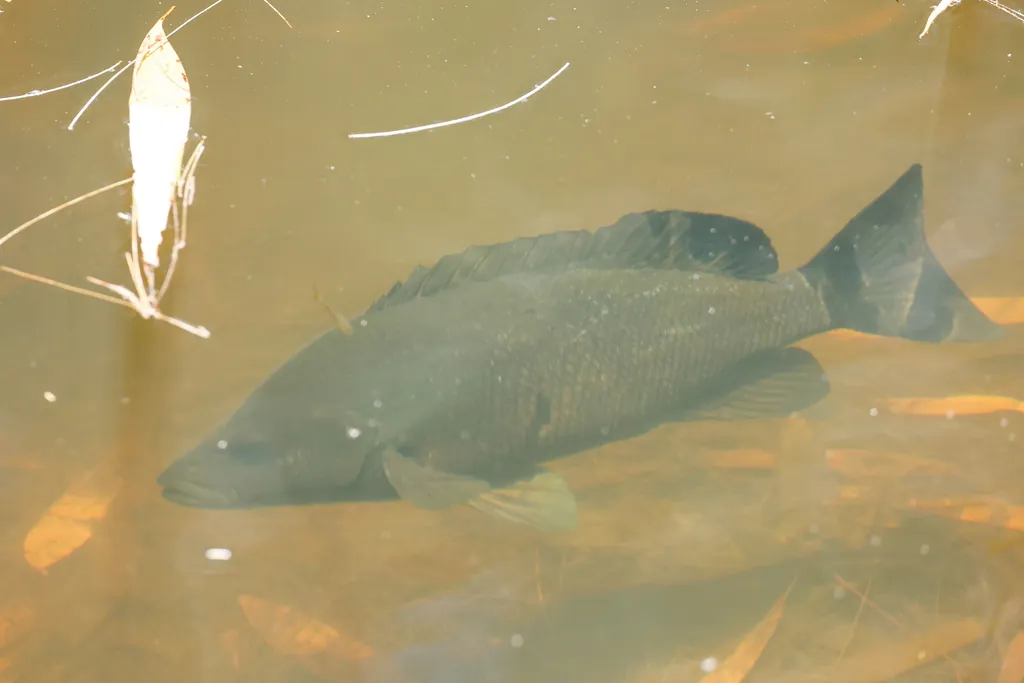
Barrbal is the Kuku Yalanji dictionary word for 'black bream'[1]. In the fresh water of north Queensland, black bream is the sooty grunter (Hephaestus fuliginosus), a thick-lipped, sooty-black fish of rocky pools and snags[2][3]. It is the black bream that Karma Waters Station shows off from its stretch of the Mitchell River[4]. Kuku Yalanji people fished the freshwater creeks with bark lines and lawyer-cane thorn hooks, speared in clear water and used plant poisons in the late dry season[5]. Their inland neighbours on the Palmer used bone-barbed hooks and two-person nets[6]. In Queensland today a sooty grunter must be at least 28 cm, and there is a combined limit of 10 grunter[7].
Names
The dictionary gives barrbal 'black bream'[1]. It does not say whether the fish lives in fresh or salt water, so the English name has to be read the way north Queenslanders use it.
Why this page treats barrbal as the sooty grunter. In north Queensland fresh water, 'black bream' is the usual name for Hephaestus fuliginosus[2][3]. Roth used the name the same way in 1901, for a big fish that lay with barramundi among the snags of the lower Tully River[6]. On the Mitchell at Karma Waters the black bream is this fish[4].
The Bloomfield doubt. The dictionary was made with Bloomfield River speakers[1], and the Bloomfield estuaries also hold the pikey bream (Acanthopagrus pacificus), a true sea bream. The Atlas of Living Australia has records of pikey bream, sooty grunter and khaki grunter within 25 km of the Bloomfield River mouth[8]. Anderson lists 'various species of bream' among the fish taken with hook and line on the Bloomfield coast[5]. If an elder from Wujal Wujal uses barrbal for the estuary bream, that is their word to settle.
Grunters. Two more dictionary words, jarbir and kurriyala, are both glossed 'species of fish, grunter'[1]. Kurriyala is also the word for the carpet snake. Several fish called grunter live around Bloomfield, among them the silver, khaki, crescent and sooty grunters[8]. Which fish each word names is not recorded. Bloomfield fishermen used a small grunter as bait[5].
Description
A deep-bodied, thick-lipped fish, brownish-grey to sooty black with darker scale margins. Some have golden blotches on the sides[2]. Most are about 25 cm and 400 g, but they can reach 54 cm and 6.2 kg[2][3]. Sooty grunter eat almost anything: shrimp, worms, insects, frogs, algae, plant roots and palm berries[3]. They are tough fish that put up with clear or muddy water, still or flowing, and a wide range of temperatures[2].
Where it lives
Sooty grunter live in freshwater streams from Cape Hillsborough north along the Queensland east coast, through Cape York and the Gulf of Carpentaria rivers, and west to the Daly River in the Northern Territory[3]. They like flowing water over rock, and lurk around rocks, sunken logs and in pools below waterfalls[2].
Karma Waters and the upper Mitchell. The Atlas of Living Australia holds sooty grunter records from the upper Mitchell country dated 2008 to 2026, including one about 25 km east-south-east of the Karma Waters homestead. It also has records of a close relative, the coal grunter (Hephaestus carbo), near Mount Carbine[8]. The station's own camping page features the black bream of its river[4]. Fish the rocky runs, the heads of pools and the snags.
Seasons
Sooty grunter spawn in summer, as the rivers rise with the monsoon, sometimes in groups[2]. Spawning starts once the water is warmer than 25 °C, and schools of up to 50 fish have been seen spawning together in water less than half a metre deep[3].
The dry season was the main freshwater fishing time. The dictionary's bark nets were 'dragged through the water in the dry season when the water goes down'[1]. Inland at Bloomfield, fish poisons were a late-dry method, used when the smaller creeks broke up into separate waterholes[5]. Roth found bush fences built only in flood time, to catch the bigger fish going back downstream[6].
Uses
Barrbal is a food fish. Anglers rate the sooty grunter 'fair to good eating, with a slightly weedy flavour'[3]. The Kuku Yalanji freshwater kit, recorded by Anderson at Bloomfield[5], was:
- Lines of Sterculia quadrifolia bark with hooks made from lawyer-cane thorns, used in freshwater creeks and waterholes for turtle, eelfish, catfish and perch. Bait was grubs, small freshwater prawns or small frogs. Line fishing was mostly women's work.
- Spears, which worked only in fairly clear water, thrown with the balur, a short spear thrower made for fishing.
- Plant poisons in the late dry season.
The dictionary adds badur 'hook and line', mandurr 'bait (any kind)', makarr 'fish net' and miyil, a tree whose sap was 'used to blind fish'[1].
How it was caught and cooked
Hook and line in fresh water (Bloomfield Kuku Yalanji)[5]:
- Twist a line from the bark of Sterculia quadrifolia.
- Make the hook from a lawyer-cane thorn.
- Bait it with a grub, a small freshwater prawn or a small frog.
- Hold the line in the hand, or tie it to a stick pushed into the bank.
The Palmer River hook (Koko-minni). The hook had a wooden shank with a bone barb of kangaroo bone or a catfish spine[6].
Spearing among the snags (lower Tully River, Mallanpara country). For barramundi and black bream lying among the snags, men crept up very quietly, or dived, and struck the fish from the side or from underneath[6]. In deep or muddy waterholes, where the fish can't be seen, men struck here and there on the chance of a hit[6].
Two-person nets (Palmer and Laura). On the Palmer the net was made of Acacia leptocarpa string on a large oval frame[6]:
- Two people carry the framed net upright through the water.
- Friends in front act as beaters and drive the fish towards it.
- The net is lifted as soon as a fish is in.
Roth recorded that the Koko-yellanji of the Laura called this net jikan-ikan (his 1901 spelling).
Grass fence (the Peninsula generally). In a shallow waterhole, the women of the camp lined up side by side across the hole. They moved forward on hands and knees, pushing thick bundles of grass and leafy boughs ahead of them, and drove the fish onto the bank[6].
Fish poison (late dry, inland Bloomfield)[5]:
- Choose a waterhole that has been cut off as the creek dries.
- Smash Erythrophleum chlorostachys bark and leaves under water, or swirl a grass sponge holding mashed Barringtonia seed or stem.
- Collect the stunned fish as they float up. Divers kept their eyes shut tight and did not swim through the poison.
- The hole could not be used again until a storm and flood renewed the water.
On the middle Palmer the Koko-minni threw in the bark of Adenanthera abrosperma, or leaves of Careya or Eucalyptus resinifera, leaving the leaves for one to three days. Edward Palmer recorded Barringtonia racemosa and Luffa used on the Mitchell River[6].
Killing and cooking. Kill a fish by biting deeply just behind the head, so it can't flip back into the water[6]. Roast it on the coals (dindal)[1], or bake it in the earth oven (kurrma) lined with wild-ginger leaves[6].
Safety
The Mitchell at Karma Waters is freshwater crocodile water[4]. Freshies are usually shy, but a big one can give a serious bite[9]. Saltwater crocodiles do travel, so follow the Crocwise fishing rules: stand back from the edge, cut a snagged line rather than wading in, and never clean fish at the water's edge[10].
The fish poisons above are real poisons. Miyil sap can blind[1]. They are recorded here as history, not as methods to use.
On Country today
Recreational rules (Queensland fresh water). A sooty grunter must be at least 28 cm. There is a combined limit of 10 for Gulf, khaki, lake and sooty grunter[7]. In fresh water you may use up to 6 lines, each with one hook or lure, and up to 4 traps of the permitted kinds. You may not use a spear or spear gun, a cast net or a seine net[11]. If you're fishing the Mitchell in October, remember that barramundi are closed in Gulf fresh waters from 7 October to 31 January, and you can't target them even for catch-and-release[12].
Native title. The 2013 Western Yalanji determinations recognise rights to hunt, fish and gather on the land and waters for personal, domestic and non-commercial communal purposes[13]. A further Western Yalanji determination followed in August 2026[14]. Under section 211 of the Native Title Act 1993, native title holders fishing for those needs do not need the licences and permits other people need[15]. Karma Waters' agreement with the Western Yalanji Traditional Owners was the first on pastoral land in Australia[16]. Guests should follow the station's induction and rules, and ask Traditional Owners before fishing elsewhere on their country.
At Karma Waters. Karma Waters Station falls under the earlier 1998 Western Yalanji or 'Sunset' Peoples v Pedersen consent determination, the first consent determination of native title over a pastoral property in Australia[17][18]. See the Karma Waters guide for what it covers, and ask the Traditional Owners and the station before hunting, fishing or gathering.
Language
kuyu 'fish'; mala-kuyu 'good fisherman'; badur 'hook and line'; mandurr 'bait (any kind)'; mungkil 'spear to kill', as in Bula minya wali-yindu walu-yindu kalkabu mungkin 'They speared lots of different kinds of fish'; yijirr 'fish scales'; jijirr 'red bream'[1].
Images
References
- Hershberger, H. D. & Hershberger, R. (1982). Kuku-Yalanji Dictionary. Work Papers of SIL-AAB, Series B, Volume 7. With Toby Bloomfield, Roy Friday, Billy Roberts, Hector and Doris Sykes, Joe Walker and others. www.sil.org/resources/archives/18038
- Wikipedia. Sooty grunter, Hephaestus fuliginosus (accessed 5 October 2026). en.wikipedia.org/wiki/Sooty_grunter
- Native Fish Australia. Sooty Grunter, Hephaestus fuliginosus (web page, accessed 5 October 2026). nativefish.asn.au/home/page/Sooty-Grunter
- Karma Waters Station. Bush camping (web page, accessed 5 October 2026). www.karmawatersstation.com/bush-camping.html
- Anderson, C. (1996). Traditional material culture of the Kuku-Yalanji of Bloomfield River, North Queensland. Records of the South Australian Museum 29(1): 63–83. — 'Kuku-Yalanji subsistence activities and material culture': fishing (spears, hook and line, plant stupefacients) hdl.handle.net/2440/13994
- Roth, W. E. (1901). North Queensland Ethnography, Bulletin No. 3: Food — its search, capture, and preparation. Brisbane: Government Printer. Bloomfield River information from R. Hislop. — Sect. 5 (killing fish); sect. 6 'Cooking'; sect. 15 'Fish' (c) fish-poisons, (f) hooks, (i) nets, (k) bush fences, (l) grass fences, (n) spears archive.org/details/northqueensland00landgoog
- Queensland Government. Size and possession limits in fresh waters: grunters (web page, accessed 5 October 2026). www.qld.gov.au/recreation/activities/boating-fishing/rec-fishing/rules/limits-fresh
- Atlas of Living Australia. Occurrence records for Hephaestus fuliginosus and H. carbo in the upper Mitchell River area (lat −17.0 to −15.8, long 144.3 to 145.12) and within 30 km of Karma Waters homestead (16.62° S, 144.60° E); and for Acanthopagrus, Hephaestus, Pomadasys and other Terapontidae within 25 km of the Bloomfield River mouth (15.93° S, 145.33° E). Queried 5 October 2026. biocache.ala.org.au/occurrences/search?q=taxon_name%3A%22Hephaestus%20fuliginosus%22
- Australian Museum. Freshwater Crocodile, Crocodylus johnstoni (web page, accessed 5 October 2026). australian.museum/learn/animals/reptiles/freshwater-crocodile/
- Queensland Government. Be Crocwise top tips (web page, accessed 5 October 2026). www.qld.gov.au/environment/plants-animals/animals/living-with/crocodiles/becrocwise/be-crocwise-top-tips
- Queensland Government. Fishing gear: fresh waters (web page, accessed 5 October 2026). www.qld.gov.au/recreation/activities/boating-fishing/rec-fishing/rules/equipment
- Queensland Department of Primary Industries. Closed seasons in fresh waters: barramundi (web page, accessed 5 October 2026). www.dpi.qld.gov.au/business-priorities/fisheries/closures/fresh/seasons
- Brady on behalf of the Western Yalanji People #4 v State of Queensland [2013] FCA 958 (Federal Court of Australia, 24 September 2013). www.judgments.fedcourt.gov.au/judgments/Judgments/fca/single/2013/2013fca0958
- National Indigenous Times (13 August 2026). 'Western Yalanji determination brings Cape York native title to the finish line.' nit.com.au/13-08-2026/25941/western-yalanji-determination-brings-cape-york-native-title-to-the-finish-line
- Australian Law Reform Commission. Review of the Native Title Act 1993 (DP 82), ch. 8: Relevant provisions in the Native Title Act (s 211). www.alrc.gov.au/publication/review-of-the-native-title-act-1993-dp-82/8-the-nature-and-content-of-native-title/relevant-provisions-in-the-native-title-act/
- Karma Waters Station. About (web page, accessed 5 October 2026). www.karmawatersstation.com/about.html
- Western Yalanji Aboriginal Corporation & CRC for Developing Northern Australia (2020). Western Yalanji Land Use and Economic Diversification Plan. CC BY 4.0. — Western Yalanji story; historical timeline (Table 1); Native Title Determinations 1–4; ILUAs (Table 4); pastoral stations (Table 5); heritage sites crcna.com.au/wp-content/uploads/2024/05/westernyalanjilanduseplan_nov2020.pdf
- Karma Waters Station. About: location, native title (web page, accessed 5 October 2026). www.karmawatersstation.com/about.html