Trees
Pandanus
jajikalPandanus spiralis (as identified by Anderson 1996); the beach pandan is Pandanus tectorius
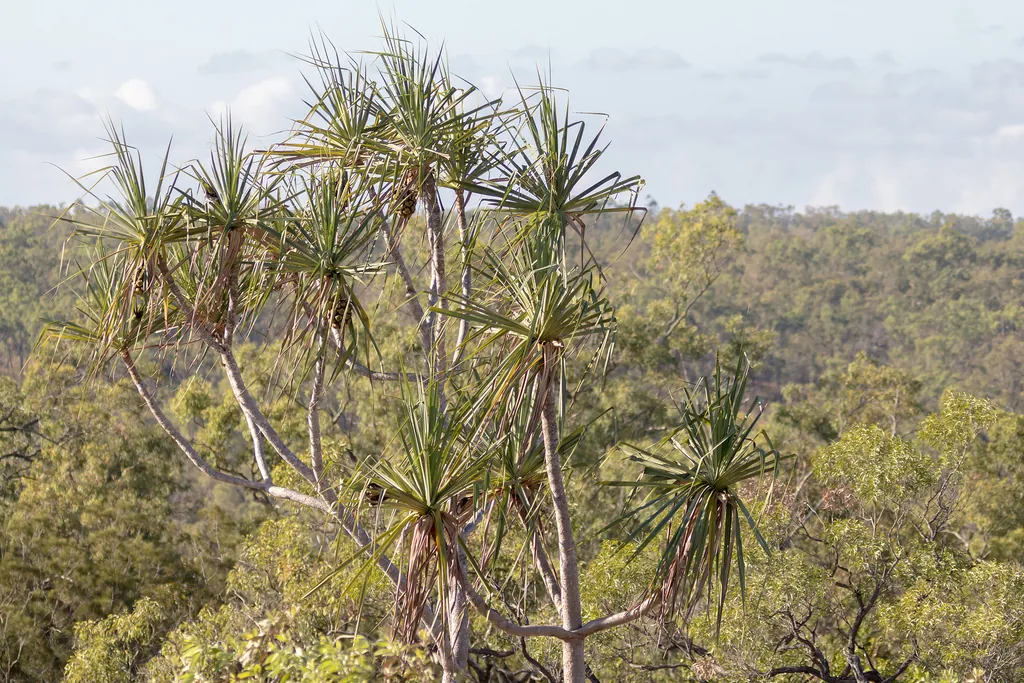
Jajikal is the pandanus or screw palm[1], the spiky, prop-rooted tree of the beaches and creek banks. Its name is written into the country: the lower camp at Ayton, 'where there are lots of pandanus trees', is called Jajikal, and the dictionary also gives Jajikal for the north side of the Bloomfield River mouth[1]. At Bloomfield the fruit was baked in the ashes and the hard shell broken to get at the seeds[2]. Roth recorded that ripe fruit was sucked, while fruit not fully ripe had to be roasted first because raw it was too 'hot'[3]. The leaves were split for armlets, plaited work and toys[4][2].
Names
The dictionary gives jajikal, 'pandanus tree (screw palm)' and 'pandanus palm'[1]. It records the word as a place name too: the 'name of lower (bottom) camp in Ayton where there are lots of pandanus trees', and the 'north side of Bloomfield River mouth'[1]. Anderson's table of Bloomfield nut foods lists jajikal as Pandanus spiralis[2].
Roth's 1901 list gives a different Bloomfield word, jillenji, for the pandanus fruit, and na-rarl from the Koko-yellanji at Butcher's Hill[3]. Neither matches jajikal, and jillenji looks more like the dictionary's jilanji, an edible fig. Whether Roth's informant mixed them up, or used a word for the fruit alone, is a question for Elders.
Description
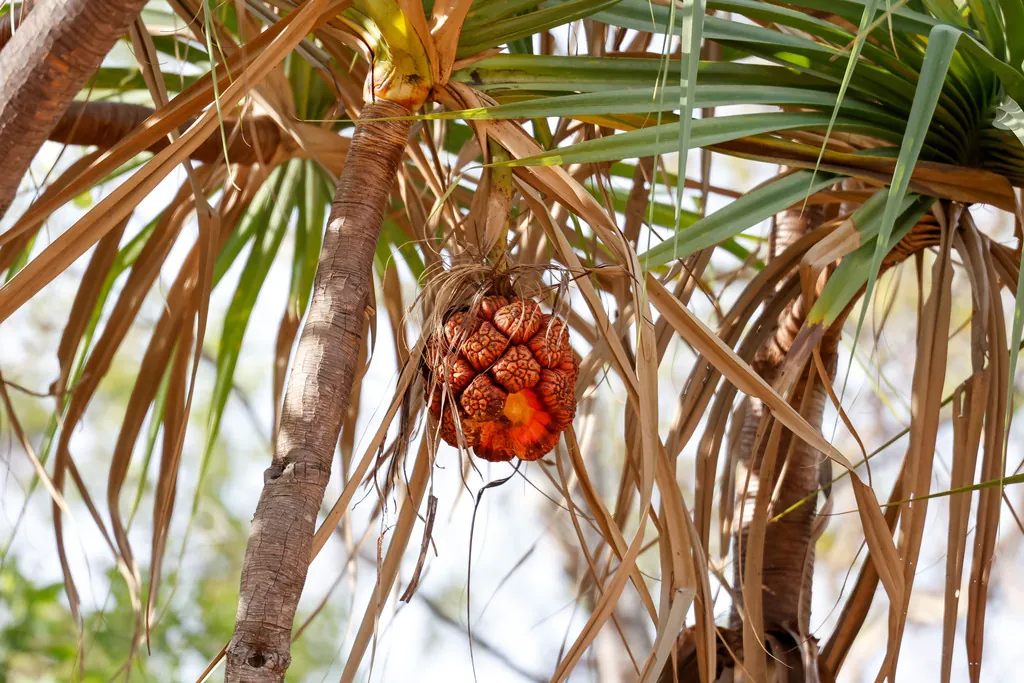
The beach pandan (Pandanus tectorius) grows to about 12 m, with a branched trunk studded with spiny, wart-like knobs and stilt-like prop roots up to 1 m long, themselves armed with short sharp points[5]. The long, strap-like leaves are up to 1.7 m long and 5–10 cm wide; the margins carry spines from just above the base to the tip[5]. The fruit is a big yellow or orange head, about 12–18 cm long, built from many hard, wedge-shaped segments, each about 4–5 cm long[5].
Where it grows
The beach pandan grows from sea level to 300 m in littoral rainforest, on sand dunes and coastal sandy country and in vine forest, from Cape York to central New South Wales[5]. On Eastern Kuku Yalanji country that is the beach country of Ayton, the Bloomfield mouth and the coves where people kept their permanent camps[2].
Pandanus also lines inland creeks and rivers, and it is part of Western Yalanji country. The Queensland WildNet database records Pandanus spiralis at Mount Carbine[6]; Roth recorded a Koko-yellanji name for pandanus at Butcher's Hill, inland[3]; and Edward Palmer, quoted by Roth, reported pandanus fruit as a food on the Mitchell and Palmer Rivers[3].
Uses
Food. At Bloomfield, jajikal fruit was baked in the ashes and the shell broken first to get at the seeds; unlike many nuts it needed no pounding or leaching[2]. Roth's general entry for pandanus, which carries the Bloomfield name, says the fruit is sucked, the shell broken and the seed eaten, and that the roasted fruit can be soaked to make a sweet drink[3].
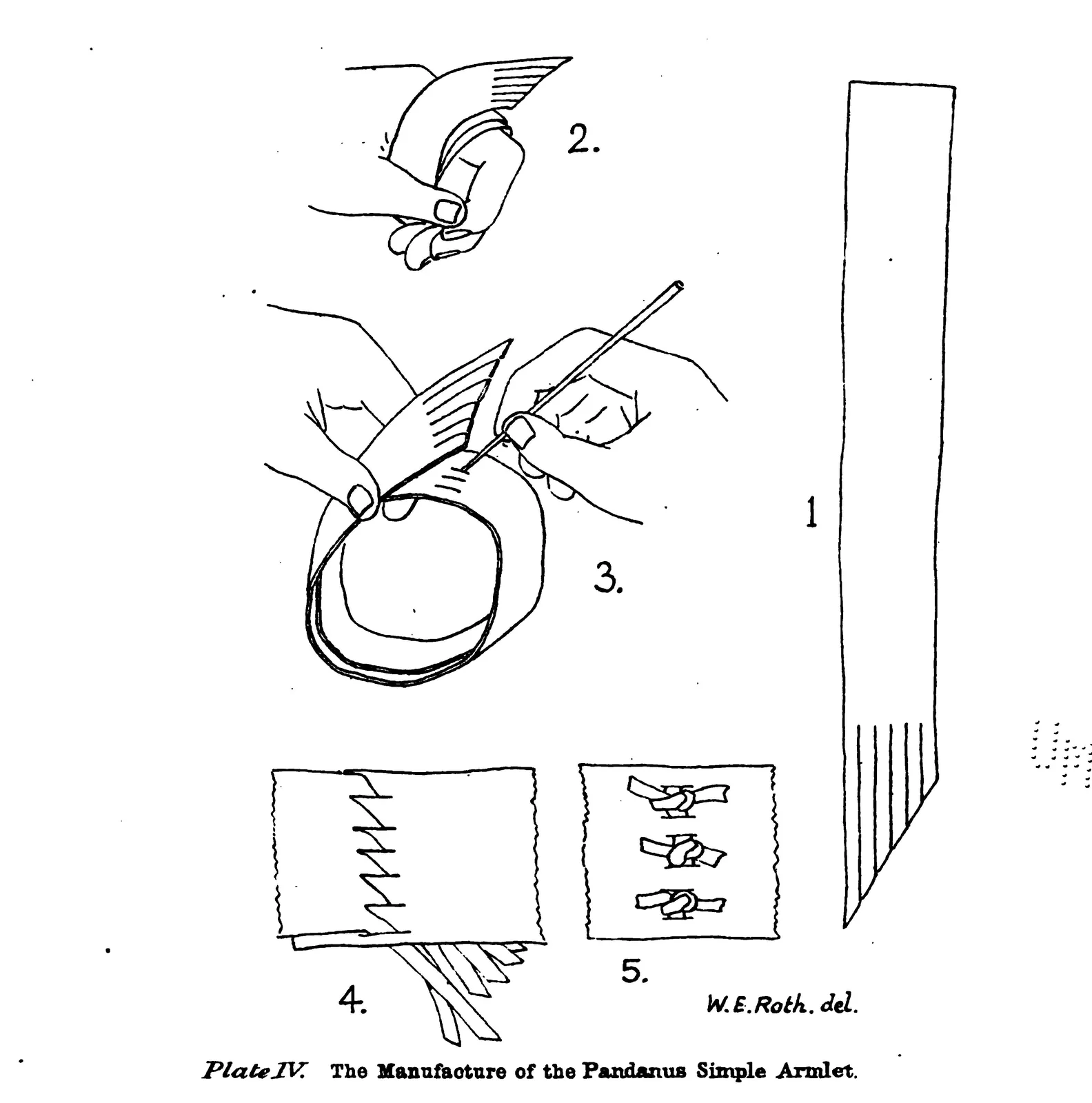
Leaves. Across North Queensland, Roth found pandanus leaves split for armlets (plain or plaited), plait-work, dilly-bag handles and sieve-bags, and used to smooth the gum-cement on spear barbs at Cooktown[4]. The pandanus-strip armlet was worn as far south on the east coast as the Bloomfield River[7], and Anderson confirms that Bloomfield people wore pandanus-leaf armlets[2]. Children made small toy boomerangs from pandanus leaves[2], and pandanus leaves made the little trough that fed water into the zamia flour during leaching[2].
Building. North of the Palmer River, Roth saw huts built on a ridge-pole held up by forked uprights, 'very commonly of Pandanus, the dichotomous growth of which lends itself admirably for the purpose'[8].
How it was prepared
Eating the fruit — from Roth's pandanus entry[3] and Anderson's Bloomfield table[2]:
- Collect the fruit segments from a ripe yellow-orange head.
- If the fruit is very ripe, suck the soft base of each segment raw.
- If it is not fully ripe, roast or bake the segments in the ashes first. Raw, unripe fruit is too 'hot' to suck.
- For a sweet drink, soak the roasted segments in water. The water becomes sweet and is drunk.
- Break the hard shell and eat the seeds inside. In the Princess Charlotte Bay hinterland and on the Palmer River, Roth saw a hafted stone hammer used to break open hard nuts such as pandanus[9].
Making a simple leaf armlet — Roth's description from Cape Bedford and the Palmer district[4]:
- Cut a strip of pandanus leaf, square at one end and tapering obliquely to a narrow end at the other.
- Split the narrow end into four, six or more tags, all to the same depth.
- Roll the square end around the hand two or three times and slip the coil off, holding it between thumb and forefinger.
- With a sharpened stick, pierce small holes through the layers, one for each tag.
- Pull each tag through its hole, knot the tags underneath in pairs, and trim the ends.
Roth adds that people sometimes just tied the ends instead[7].
Safety
Pandanus is well armed: the leaf margins carry sharp spines, and even the prop roots are studded with short sharp points[5]. Handle the leaves with care. Fruit that is not fully ripe is too 'hot' to suck raw, which is why it was roasted first[3]. The seed cases are very hard and were broken with stones[9].
On Country today
Pandanus is not listed as threatened; as native plants the pandanus species here are 'least concern' wildlife under Queensland's Nature Conservation Act[10].
Much of Eastern Kuku Yalanji country is now Aboriginal land. On 29 September 2021 more than 160,000 ha, taking in the Daintree, Ngalba-bulal, Kalkajaka and Hope Islands national parks between Mossman and Cooktown, was handed back to the Eastern Kuku Yalanji people, to be jointly managed with the Queensland Government through the Queensland Parks and Wildlife Service[11]. Under section 211 of the Native Title Act 1993, native title holders do not need a licence or permit to hunt, fish or gather for their personal, domestic or non-commercial communal needs[12]. Everyone else needs the Traditional Owners' permission to take anything from country, and park rules apply.
Language
Related words: jalngkal 'to remove a hard or tough covering, e.g. a coconut'; dalkil 'to crack a nut'; jangka 'stone'; dindal 'to roast on coals'; munja-l 'to gather, collect (e.g. nuts, plant food)'[1].
Images
References
- Hershberger, H. D. & Hershberger, R. (1982). Kuku-Yalanji Dictionary. Work Papers of SIL-AAB, Series B, Volume 7. With Toby Bloomfield, Roy Friday, Billy Roberts, Hector and Doris Sykes, Joe Walker and others. www.sil.org/resources/archives/18038
- Anderson, C. (1996). Traditional material culture of the Kuku-Yalanji of Bloomfield River, North Queensland. Records of the South Australian Museum 29(1): 63–83. — Table 2, nut species eaten at Bloomfield; 'Preparation of cycad nuts'; games; decoration hdl.handle.net/2440/13994
- Roth, W. E. (1901). North Queensland Ethnography, Bulletin No. 3: Food — its search, capture, and preparation. Brisbane: Government Printer. Bloomfield River information from R. Hislop. — Plant list, 'Pandanus aquaticus' and 'Pandanus sp.' archive.org/details/northqueensland00landgoog
- Roth, W. E. (1901). North Queensland Ethnography, Bulletin No. 1: String, and other forms of strand; basketry-, woven bag-, and net-work. Brisbane: Government Printer. — Sect. 8(e), splitting; plant list, 'Pandanus sp.' archive.org/details/northqueensland00landgoog
- Australian Tropical Rainforest Plants (RFK8), Pandanus tectorius. CSIRO / Lucidcentral. apps.lucidcentral.org/rainforest/text/entities/Pandanus_tectorius.htm
- Queensland WildNet record, Pandanus spiralis, Mount Carbine. Atlas of Living Australia. biocache.ala.org.au/occurrences/0411b128-09fc-43ad-8487-dc4e8205f819
- Roth, W. E. (1910). North Queensland Ethnography, Bulletin No. 15: Decoration, deformation, and clothing. Records of the Australian Museum 8(1). — Pandanus-strip armlet archive.org/details/biostor-52864
- Roth, W. E. (1910). North Queensland Ethnography, Bulletin No. 16: Huts and shelters. Records of the Australian Museum 8(1): 55–66. — Sect. 11, ridge-pole huts archive.org/details/records-australian-museum-8-055-066
- Roth, W. E. (1904). North Queensland Ethnography, Bulletin No. 7: Domestic implements, arts, and manufactures. Brisbane: Government Printer. Bloomfield River information from R. Hislop. — Sect. 37, stone hammers archive.org/details/northqueensland00landgoog
- Nature Conservation (Plants) Regulation 2020 (Qld), current as at 22 May 2026. — Sch. 1 pt 2 div 7 s 25 (least concern wildlife); sch. 2 (special least concern plants) www.legislation.qld.gov.au/view/pdf/inforce/current/sl-2020-0137
- Australian Geographic (September 2021). Daintree handed back to Traditional Owners. www.australiangeographic.com.au/news/2021/09/daintree-handed-back-to-traditional-owners/
- Australian Law Reform Commission. Review of the Native Title Act 1993 (DP 82), ch. 8: Relevant provisions in the Native Title Act (s 211). www.alrc.gov.au/publication/review-of-the-native-title-act-1993-dp-82/8-the-nature-and-content-of-native-title/relevant-provisions-in-the-native-title-act/