Trees
Candlenut
bilarAleurites moluccanus
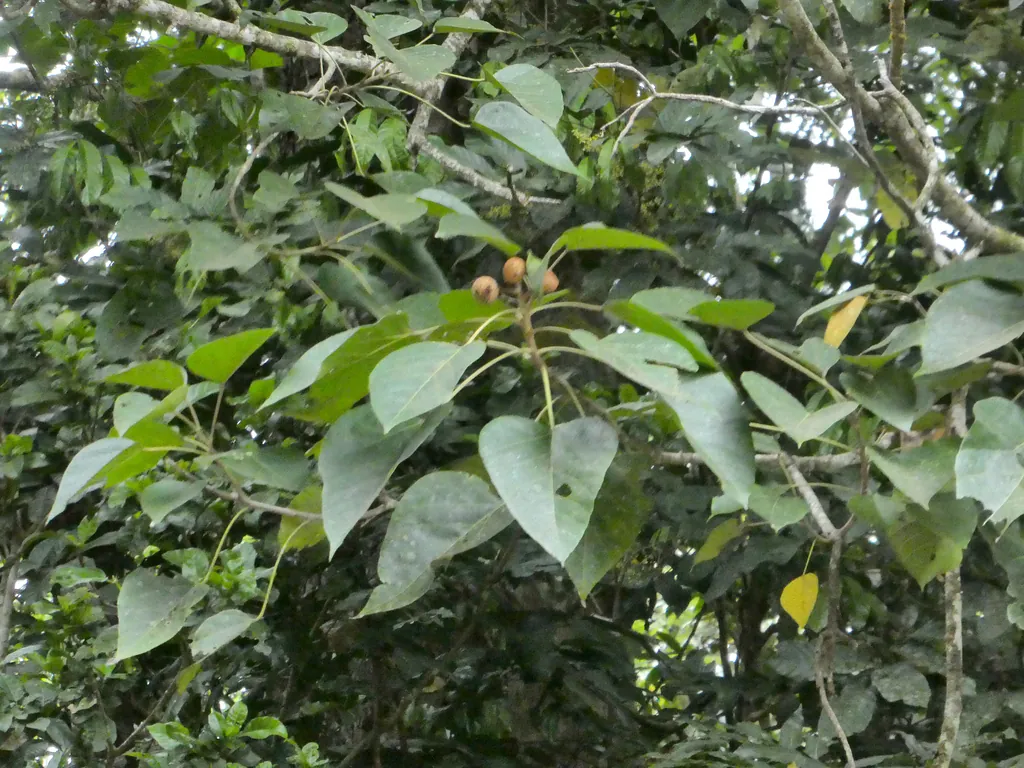
Bilar, the candlenut (Aleurites moluccanus), is a rainforest tree with hard, round nuts that are 'edible after roasting'[1]. It was the most highly prized of the Bloomfield nuts: eaten on its own, and added to wallaby while it cooked for the flavour[2]. The nut was roasted in a slow fire until it cracked[3]. Its oil fixed the ochre on painted spears[4], its trunk was hollowed into outrigger canoes[2], and the big grubs in candlenut wood were a favourite food[2]. Raw, the nuts are strongly purgative[5].
Names
The dictionary gives bilar: 'candle nut tree. The nuts are edible after roasting'[1]. Roth's 1901 Bloomfield River list gives billar for Aleurites moluccana — the same word in his spelling[3]. At Cooktown, in Guugu Yimithirr country, he recorded tarkal[3]. Anderson also lists bilar, Aleurites moluccana, among the nut foods of Bloomfield[2].
Description
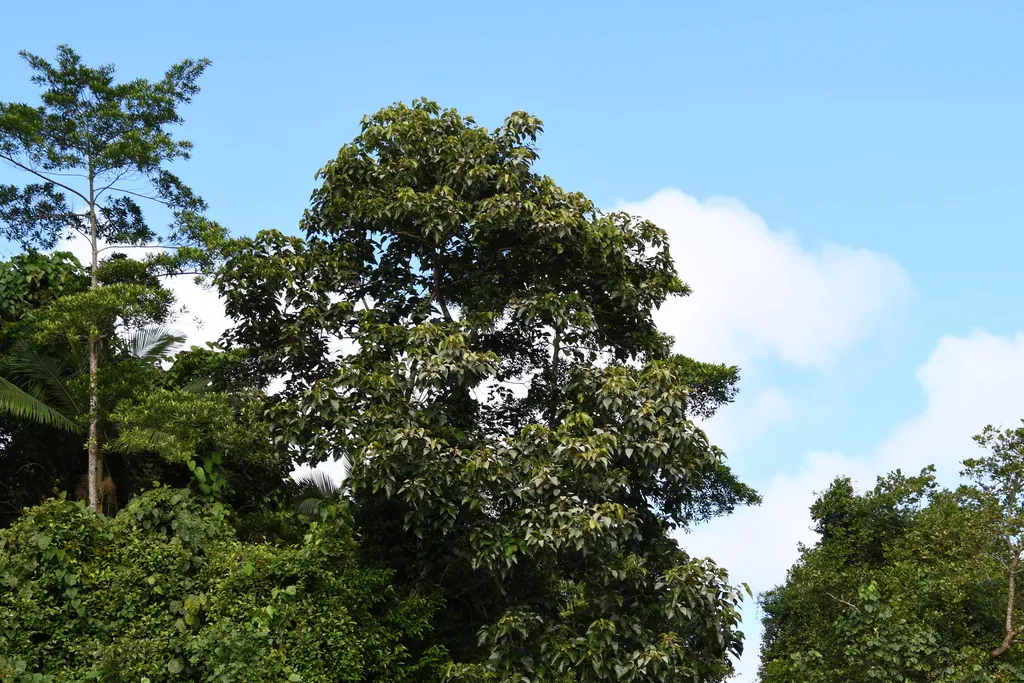
A rainforest tree whose bark, on old trees, breaks into large plates. The leaves are 7–20 cm long and 4–13 cm wide, with one or two raised green or almost black glands on the upper side of the leaf stalk, and a covering of brown star-shaped hairs or scales underneath[5]. Young plants have deeply lobed leaves[5]. The flowers are small, 5–9 mm across. The fruit is round, about 4–6 cm across and usually two-lobed, and holds hard, round seeds about 2 cm across — the nuts. Rats commonly gnaw them[5].
Where it grows
In Australia the candlenut grows in Cape York Peninsula and north-east Queensland, from near sea level to 800 m, 'mostly north of the Daintree River', with one isolated population on the central Queensland coast[5]. That puts the heart of its Australian range on Eastern Kuku Yalanji country, in the rainforest between the Daintree and the Bloomfield.
On Western Yalanji country it is a tree of the rainforest patches on the ranges, not the dry open woodland. One rainforest on the Mount Windsor Tableland, north of Mount Carbine, is even recorded by botanists as 'Candlenut Scrub'[6].
Uses
Food. Anderson calls the candlenut 'the most highly desired' of the Bloomfield nuts. It was roasted on the fire, needed no leaching, and was eaten on its own or added to wallaby carcasses to flavour them as they cooked[2]. Like the other Bloomfield nuts it could be stored for up to two months, which helped in the wet season[2].
Grubs. The big grubs that live in rotten or fallen candlenut trees were relished as food[2].
Oil for paint. On the Bloomfield River the nut 'provides the "oil" used in fixing the ochre for spear-painting'[4], and Anderson lists candlenut oil as the fixer for ochre[2].
Canoes. Anderson names Aleurites, red cedar and a cotton tree as the favourite timbers for the dug-out hull of Bloomfield outrigger canoes[2]. The dictionary agrees, noting under wawuburra (cotton tree) that 'canoes were made out of these and the candlenut tree, bilar'[1].
Elsewhere. At Atherton (not Kuku Yalanji country), Roth watched a man score a sheet of fig bark for a bark blanket with the sharp edge of a broken candlenut shell[7].
How it was prepared
- Gather the fallen fruit: round, 4–6 cm across, each with one or two hard nuts inside[5].
- Roast the fruit in a slow fire.
- When the nut cracks, it is fit to eat. Break it open (the verb is dalkil, 'to crack a nut') and eat the kernel.
- No pounding, sifting or leaching is needed for this nut[2].
Flavouring meat. Add roasted candlenuts to a wallaby as it cooks[2].
Fixing paint. The oily nut was used to fix ochre on spears[4]. The sources do not describe how the oil was worked into the ochre. Kuku Yalanji words for the materials are wuba and murbuy 'red ochre', makirr 'yellow ochre', and julngkal 'to rub or paint on'[1].
Canoes. Bloomfield dug-outs were cut down with stone axes, burnt out and scraped clean with adzes, and fitted with a single outrigger lashed on with lawyer vine[2]. The full method is under red cedar.
Safety
'The seeds of most species of Aleurites contain poisonous compounds', and candlenuts are 'strongly purging if eaten raw'[5]. The dictionary's rule is the one to follow: the nuts are edible after roasting[1]. Roast them until the shell cracks, as Roth describes[3].
On Country today
The candlenut is not listed as threatened; as a native plant it is 'least concern' wildlife under Queensland's Nature Conservation Act[8].
Much of Eastern Kuku Yalanji country is now Aboriginal land. On 29 September 2021 more than 160,000 ha, taking in the Daintree, Ngalba-bulal, Kalkajaka and Hope Islands national parks between Mossman and Cooktown, was handed back to the Eastern Kuku Yalanji people, to be jointly managed with the Queensland Government through the Queensland Parks and Wildlife Service[9]. Under section 211 of the Native Title Act 1993, native title holders do not need a licence or permit to hunt, fish or gather for their personal, domestic or non-commercial communal needs[10]. Everyone else needs the Traditional Owners' permission to take anything from country, and park rules apply.
Language
Related words: dalkil 'to crack a nut'; munja-l 'to gather, collect (e.g. nuts, plant food)'; wuba 'red ochre'; julngkal 'to rub or paint on'; wawuburra 'cottontree', the other canoe tree; and kaljan 'outrigger canoe'[1].
Images
References
- Hershberger, H. D. & Hershberger, R. (1982). Kuku-Yalanji Dictionary. Work Papers of SIL-AAB, Series B, Volume 7. With Toby Bloomfield, Roy Friday, Billy Roberts, Hector and Doris Sykes, Joe Walker and others. www.sil.org/resources/archives/18038
- Anderson, C. (1996). Traditional material culture of the Kuku-Yalanji of Bloomfield River, North Queensland. Records of the South Australian Museum 29(1): 63–83. — Table 2, nut species eaten at Bloomfield; 'Preparation of other nut species'; watercraft; tree grubs; manufacturing hdl.handle.net/2440/13994
- Roth, W. E. (1901). North Queensland Ethnography, Bulletin No. 3: Food — its search, capture, and preparation. Brisbane: Government Printer. Bloomfield River information from R. Hislop. — Plant list, 'Aleurites moluccana' archive.org/details/northqueensland00landgoog
- Roth, W. E. (1904). North Queensland Ethnography, Bulletin No. 7: Domestic implements, arts, and manufactures. Brisbane: Government Printer. Bloomfield River information from R. Hislop. — Sect. 13, gums, resins and cements, 'Aleurites moluccana' archive.org/details/northqueensland00landgoog
- Australian Tropical Rainforest Plants (RFK8), Aleurites moluccanus. CSIRO / Lucidcentral. apps.lucidcentral.org/rainforest/text/entities/aleurites_moluccanus.htm
- Queensland Herbarium (BRI) specimen AQ0604886, Aleurites moluccanus, collected 1997, 'Candlenut Scrub, State Forest 144 Mt Windsor Tableland'. Atlas of Living Australia. biocache.ala.org.au/occurrences/8c665a85-d27e-4e6c-80bf-000855f65011
- Roth, W. E. (1910). North Queensland Ethnography, Bulletin No. 15: Decoration, deformation, and clothing. Records of the Australian Museum 8(1). — Sect. 56, bark blankets (Atherton) archive.org/details/biostor-52864
- Nature Conservation (Plants) Regulation 2020 (Qld), current as at 22 May 2026. — Sch. 1 pt 2 div 7 s 25 (least concern wildlife); sch. 2 (special least concern plants) www.legislation.qld.gov.au/view/pdf/inforce/current/sl-2020-0137
- Australian Geographic (September 2021). Daintree handed back to Traditional Owners. www.australiangeographic.com.au/news/2021/09/daintree-handed-back-to-traditional-owners/
- Australian Law Reform Commission. Review of the Native Title Act 1993 (DP 82), ch. 8: Relevant provisions in the Native Title Act (s 211). www.alrc.gov.au/publication/review-of-the-native-title-act-1993-dp-82/8-the-nature-and-content-of-native-title/relevant-provisions-in-the-native-title-act/