Trees
Black palm
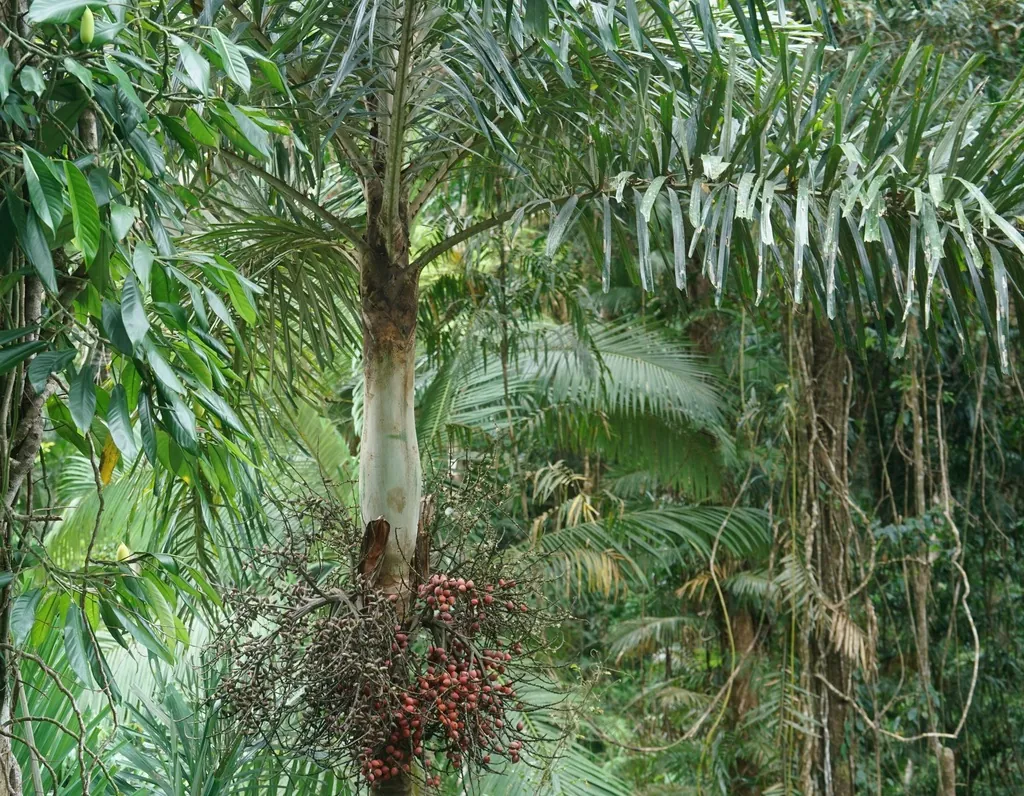
Duwar is the black palm (Normanbya normanbyi), and also the spear made from it[1]. This tall, slender rainforest palm grows only in a small stretch of the Wet Tropics, from south of Cooktown to near Mossman, which is Eastern Kuku Yalanji country[2]. Its trunk gives a very hard, dark timber for spear points and shafts. Its leaf bases give the fibre for kakan, 'the green upper part of the black palm tree from which the dilly bag is made'[1]. Roth recorded both uses on the Bloomfield River around 1900[3][4], and Kuku Yalanji weavers still make black-palm dilly bags today[5].
Names
The dictionary gives duwar for both 'black palm' and 'black palm spear'[1]. Roth wrote the Bloomfield name as du-ar and the Cape Bedford (Guugu Yimithirr) name as do-war, beside the scientific name of this palm[3]. Kakan is the green upper part of the palm from which the dilly bag is made[1]. The dictionary's one-word English gloss for kakan, 'mangrove', does not match its own definition and looks like an error. Roth heard the same word on the Bloomfield in 1904. He wrote that baskets or sieve-bags made from this palm 'are known as karkan, the name of the plant itself'[4].
Other words grew from the palm. Murrangkal is a 'fighting spear (shovelhead), made from black palm'[1]. At Cape Bedford, Roth recorded mu-rong-al as a kind of spear 'so called from the timber' of the black palm[6]. Balji is a 'ladie's dilly bag, made from grass or black palm'[1].
Description
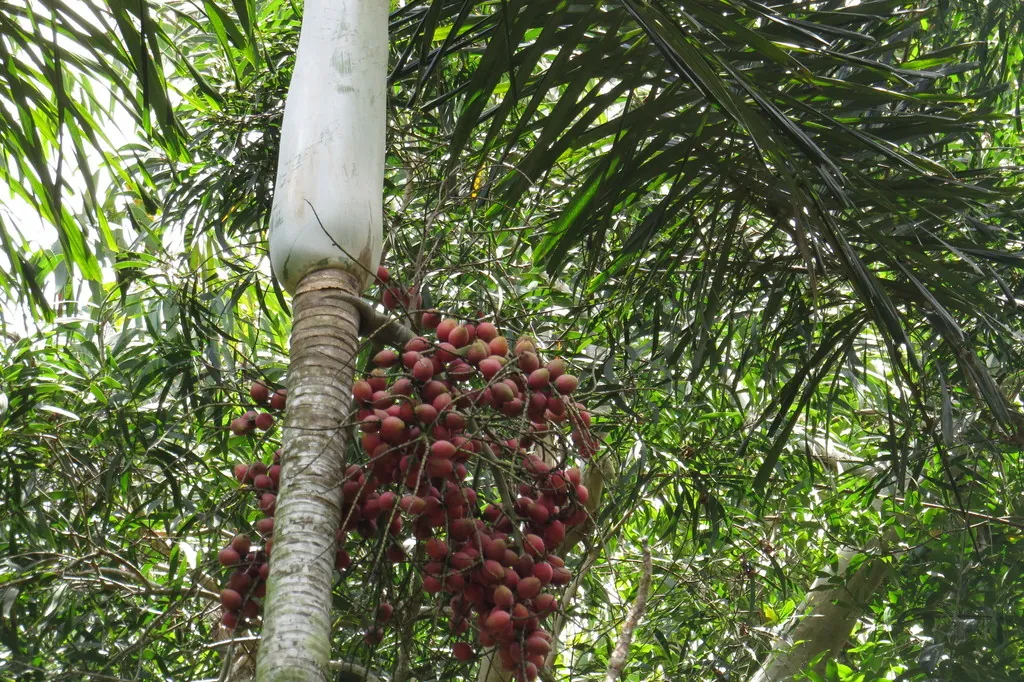
A single-stemmed palm up to 30 m tall. The trunk is smooth, slender and closely ringed, and becomes almost black with age[2]. The arching leaves are about 2.5 m long, with 75–95 leaflets on each side. Each leaflet is split to the base into 7–11 narrow segments[2]. The segments are dark green above, silvery beneath and cut off square at the tip like a fishtail, which gives the crown a bushy look like a foxtail palm[7]. The flower spike, up to 90 cm long, hangs from the trunk just below the leaves. The egg-shaped fruits are 35–50 mm long with a short beak, and ripen pink to red-brown. Each holds one large seed with an orange-red coat[2].
Where it grows
Black palm grows in rainforest and vine forest from near sea level to 700 m. It is found only in North East Queensland, from south of Cooktown to near Mossman[2]. More exactly, its range runs from just south of Rossville to just south of the Daintree River[7]. That is the rainforest heart of Eastern Kuku Yalanji country, the Daintree, Cape Tribulation and Bloomfield. Kuku Yalanji weaver Delissa Walker gathers it in the Daintree rainforest around Cow Bay[5].
Western Yalanji country. The palm does not grow in the dry open woodland of the Mitchell and Palmer rivers[2]. Its products did travel, though. The Bloomfield people traded dilly-bags and spears with their neighbours[8], and black-palm spear wood was bartered from the McIvor River as far as Princess Charlotte Bay[9].
Uses
Spears. Black palm was the spear wood of the Bloomfield. Anderson lists twelve Kuku Yalanji spear types, and black palm (N. normanbyi) is part of almost all of them, either as the handle or as the hardwood point and fore-shaft[10]. Roth described the do-war spear as a long reed shaft with a short black-palm end that 'gives the particular name to the spear', with the 'same name and weapon on the Bloomfield River'[9]. The Bloomfield stingray-barbed spears ta-chal and dikara (the dictionary's dajal 'fighting spear' and dikarra 'war spear, has a stingray barb') had a short grass-tree butt and a long black-palm or bloodwood shaft[9][1]. The hard timber was also split for clapsticks, nulla nullas and digging sticks[7].
Dilly bags and sieve-bags. On the Bloomfield, sieve-bags were made from fibre strands pulled from the leaf bases of the black palm[11]. These palm-fibre bags were one of the three main kinds of Kuku Yalanji bag. Women used them to leach cycad flour and to mash and strain the poisonous hairy yam, and to carry 'anything (including infants)'. A woman's palm-fibre bag was her own and was not lent to others[10]. Fibre from the crownshaft was also used as string to tie spear heads to shafts, and in fish traps and cradles[7].
Food. On the Bloomfield, 'the buds and young leaf-stalks are eaten'[3].
Troughs. When better bark was not to hand, dry sheets of black-palm bark could be folded into a temporary trough[10].
For animals. Cassowaries eat the fruit whole and spread the seed in their droppings[7].
How it was made
A black-palm sieve-bag or dilly bag (kakan, balji), from Roth's Bloomfield notes and his account of the basket weave[11][4][10]:
- Take the green upper part of the palm, where the leaf stalks clasp the stem[1].
- Pull the fibre strands out of the leaf bases one at a time.
- Clean each strand by drawing it between the thumb-nail and finger-nail.
- Lay out several straight strands as the frame (the 'basal strands' or warp). On the Bloomfield these were tied together into a bundle to start the base.
- Take two long working strands and twist them around each frame strand in turn, so that they make a chain. Go around row after row, adding frame strands as the bag widens (Roth's 'chain-twist').
- Finish the rim. The common methods were searing the ends in the ashes or over-casting them with another strand[11].
Louisa Smith was photographed making a balji this way with black palm fibre at Wujal Wujal in 1982[10].
A black-palm spear point[10][9][4]:
- Split a length of the hard trunk lengthways[7].
- Shape and sharpen the point and fore-shaft, then harden it in the fire. The dictionary's balnji means doing something properly with a fire, 'as in cooking or hardening spears over a fire'[1].
- Fit the black-palm piece into the long shaft (reed, bamboo or grass-tree).
- Bind the joint, and any stingray barbs or extra prongs, with wallaby sinew.
- Seal the binding with hot resin. Use brown cedar (Canarium) gum, Cooktown ironwood root gum or grass-tree resin (kanunjul). Smooth it with a small greased wooden board. Roth saw this tool in use on the Bloomfield[4].
- Spear handles were usually painted with red and white stripes[10].
Safety
Black palm is single-stemmed[2], so cutting out the bud for food or the crown for fibre ends that palm. The species is listed as Vulnerable by the IUCN because of land clearing, though Queensland rates it Least Concern[7]. Take only what is needed, with the right people's permission. Leave the fallen fruit for the cassowaries, which spread its seed[7]. Fire-hardened black-palm spears are real weapons and should be handled as such[10].
On Country today
Almost the whole range of the black palm lies inside the Wet Tropics World Heritage Area[7]. Much of it is now Eastern Kuku Yalanji land. The Daintree, Ngalba-bulal, Kalkajaka and Hope Islands national parks were handed back on 29 September 2021 and are jointly managed with the Queensland Government[12]. Some privately owned lowland rainforest still has an uncertain future[7]. Native title holders may gather for personal, domestic and communal needs without permits under s 211 of the Native Title Act 1993[13]. Visitors need Traditional Owners' permission to cut or collect, and park rules apply.
The weaving lives on. Delissa Walker learnt traditional kakan basket weaving from her grandmother, Ngadijina Wilma Walker. She is one of very few weavers still using black palm. Her Kakan (dilly bag) works of black palm and lawyer cane (2017) are held by Cairns Art Gallery[5].
Language
duwar 'black palm; black palm spear'; kakan black palm top for dilly bags; balji woman's dilly bag; ngunyin 'dilly bag'; murrangkal shovel-headed fighting spear of black palm; dajal 'fighting spear'; dikarra stingray-barbed war spear; kalka 'fishing spear, also generic term for spear'; kanunjul grass-tree resin 'used to make pitch to seal spear bindings'[1].
Images
References
- Hershberger, H. D. & Hershberger, R. (1982). Kuku-Yalanji Dictionary. Work Papers of SIL-AAB, Series B, Volume 7. With Toby Bloomfield, Roy Friday, Billy Roberts, Hector and Doris Sykes, Joe Walker and others. www.sil.org/resources/archives/18038
- Australian Tropical Rainforest Plants (RFK8), Normanbya normanbyi. CSIRO / Lucidcentral. apps.lucidcentral.org/rainforest/text/entities/Normanbya_normanbyi.htm
- Roth, W. E. (1901). North Queensland Ethnography, Bulletin No. 3: Food — its search, capture, and preparation. Brisbane: Government Printer. Bloomfield River information from R. Hislop. — Plant list, 'Drymophloeus Normanbyi' archive.org/details/northqueensland00landgoog
- Roth, W. E. (1904). North Queensland Ethnography, Bulletin No. 7: Domestic implements, arts, and manufactures. Brisbane: Government Printer. — Sect. 16 smoothing-board; sect. 53 Dilly-bags, baskets (Bloomfield) archive.org/details/northqueensland00landgoog
- Cairns Art Gallery, Artist showcase: Delissa Walker (Kuku Yalanji), Kakan (dilly bag), 2017, black palm and lawyer cane. www.cairnsartgallery.com.au/art-artists/artist-showcase/delissa-walker
- Roth, W. E. (1901). North Queensland Ethnography, Bulletin No. 2: The structure of the Koko-Yimidir language. Brisbane: Government Printer. — Vocabulary, 'mu-rong-al' archive.org/details/northqueensland00landgoog
- Wikipedia, 'Normanbya' (citing Cooper & Cooper 2004, Fruits of the Australian Tropical Rainforest; Roberts, Fisher & Gibson 1995, A Guide to Traditional Aboriginal Rainforest Plant Use, Bamanga Bubu Ngadimunku, Mossman; IUCN Red List; Queensland Government). en.wikipedia.org/wiki/Normanbya
- Roth, W. E. (1910). North Queensland Ethnography, Bulletin No. 14: Transport and trade. Records of the Australian Museum 8(1). — Sect. 1, Trade and barter on the Bloomfield River archive.org/details/biostor-52863
- Roth, W. E. (1909). North Queensland Ethnography, Bulletin No. 13: Fighting weapons. Records of the Australian Museum 7(4). — Sect. 4, spears of Princess Charlotte Bay, Cape Bedford, Bloomfield and Middle Palmer archive.org/details/biostor-52873
- Anderson, C. (1996). Traditional material culture of the Kuku-Yalanji of Bloomfield River, North Queensland. Records of the South Australian Museum 29(1): 63–83. Based on fieldwork at Wujal Wujal in the late 1970s and early 1980s. — Table 1 (Kuku-Yalanji spears); dilly-bags and yam preparation, pp. 73–76 archive.org/details/RecordsSouthAus29Sout
- Roth, W. E. (1901). North Queensland Ethnography, Bulletin No. 1: String, and other forms of strand: basketry-, woven bag-, and net-work. Brisbane: Government Printer. — Sect. 6, Bloomfield sieve-bags; plant list 'Drymophloeus Normanbyi'; sect. 29 chain-twist archive.org/details/northqueensland00landgoog
- Queensland Government (29 September 2021). Ministerial media statement: Daintree, Ngalba-bulal, Kalkajaka and Hope Islands National Parks returned to Eastern Kuku Yalanji Traditional Owners as Cape York Peninsula Aboriginal Land, to be jointly managed. statements.qld.gov.au/statements/93360
- Australian Law Reform Commission (2014). Review of the Native Title Act 1993, Discussion Paper 82, ch. 8: Relevant provisions in the Native Title Act (s 211, preservation of native title hunting, fishing, gathering and cultural activities). www.alrc.gov.au/publication/review-of-the-native-title-act-1993-dp-82/8-the-nature-and-content-of-native-title/relevant-provisions-in-the-native-title-act/