Reptiles
Saltwater crocodile
bilngkumuCrocodylus porosus
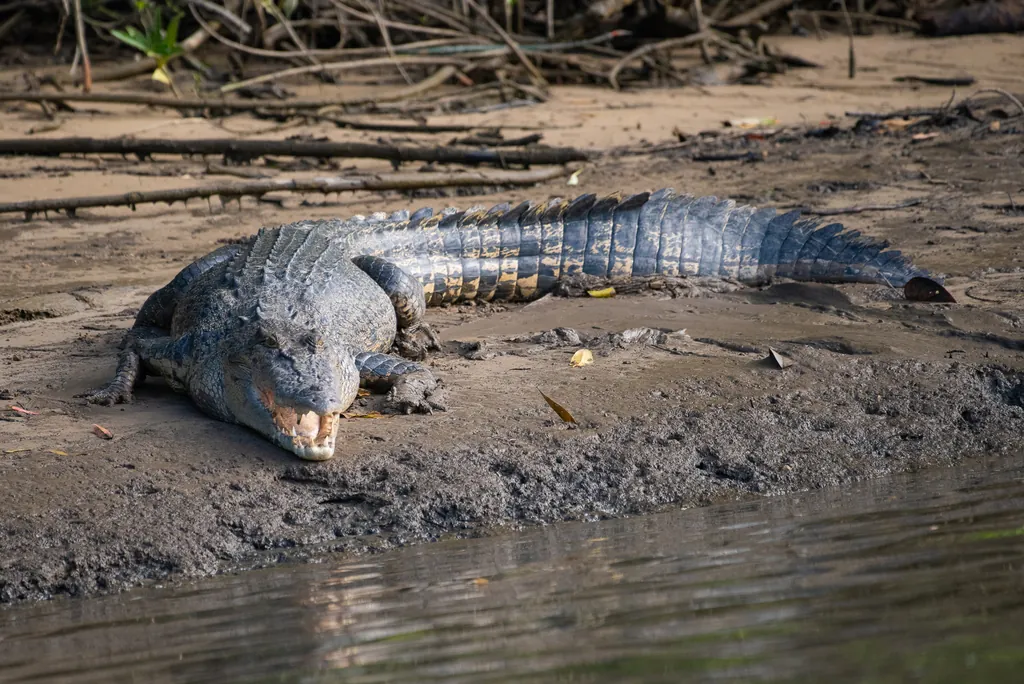
Bilngkumu is the Kuku Yalanji word for the saltwater (estuarine) crocodile, Crocodylus porosus[1]. It is the biggest and most dangerous animal on country: it lives in the sea, the mangroves and the tidal rivers, and it travels up into fresh water. Eastern Kuku Yalanji Traditional Owners describe bilngkumu as important story animals and part of their culture, and say there are now too many of them where people live, especially in the Bloomfield River[2]. Its smaller inland relative, the freshwater crocodile, is ngawurr-ngawun[1]. Anyone on country should know the Crocwise rules: keep out of the water, stay more than 5 metres from the edge, and keep something solid between you and the water[3].
Names
The Kuku Yalanji dictionary gives bilngkumu for the saltwater crocodile[1], and the Eastern Kuku Yalanji sea country plan uses the same word for the estuarine crocodile[2]. The freshwater crocodile has its own name, ngawurr-ngawun, a doubled-up form[1]. The dictionary also records kurrujuwa, a 'sentry bird which warns of crocodiles along the banks of the river'[1]: a reminder that people read the birds as well as the water. The dictionary notes other crocodile-related entries that belong to stories held by Traditional Owners; those are for them to tell.
Description
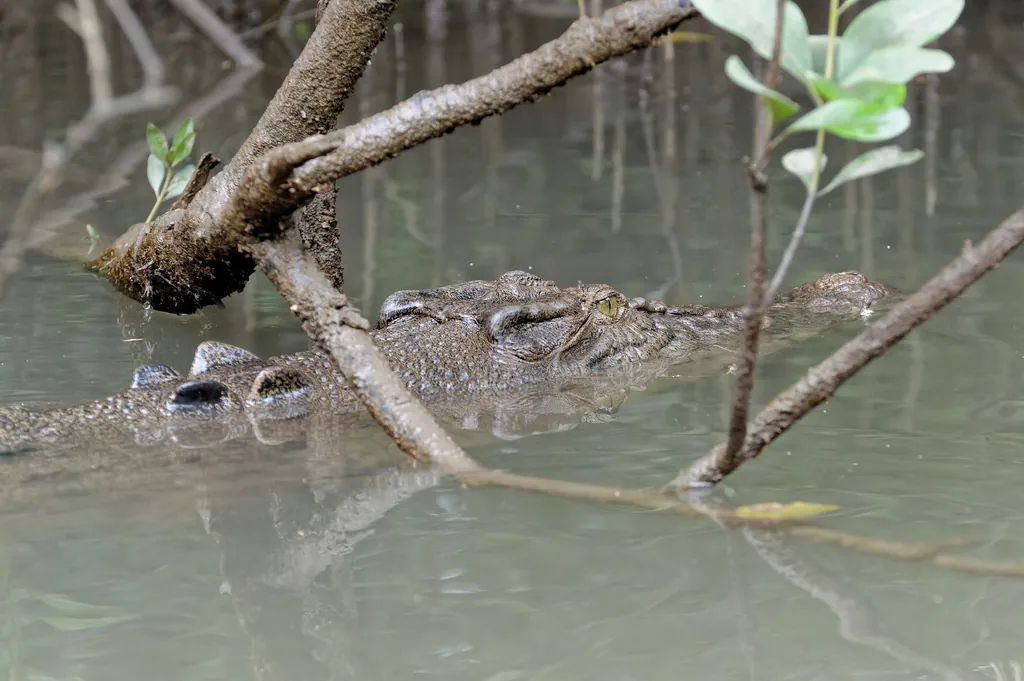
A massive, armoured reptile with a long, toothed snout, eyes and nostrils on top of the head, bony plates set in the skin, a long muscular tail and short legs with webbed, clawed feet. The saltwater crocodile has a broad, heavy snout, less than twice as long as the head is wide[4]. Adults are usually 3–5 m long, and males grow much bigger than females; the largest reliably measured animal was over 6 m[4].
Telling the two crocodiles apart. Ngawurr-ngawun, the freshwater crocodile, is slender-snouted and much smaller and lighter, grey to tan-brown with dark patches, and its fine sharp teeth show even when its mouth is shut[5]. If the snout is broad and heavy, treat it as a saltie. If you are not sure, treat it as a saltie.
Where it lives
Saltwater crocodiles live in rivers, estuaries, creeks, swamps, lagoons and billabongs, and handle anything from fresh water to full sea water[4]. Queensland's crocodile country starts near Gladstone and runs north to Torres Strait and right around Cape York Peninsula into the Gulf of Carpentaria; estuarine crocodiles can be found in any waterway and in the sea in this area, and they can travel hundreds of kilometres[3]. On Eastern Kuku Yalanji country that means the beaches, the mangroves and the rivers from the Daintree to the Bloomfield and the Annan. The Traditional Owners' plan singles out the Bloomfield River, where crocodile numbers are building up and the animals are becoming more dangerous[2].
How far inland? Their upstream movement is limited mainly by steep, rapidly rising ground; the Australian Museum says that in north-eastern Queensland they do not occur above about 250 m[4], and Queensland's crocodile habitat model sets the inland limit at the 200 m contour, with about 90% of the population living below 20 m above sea level[6].
Western Yalanji country. The Mitchell River rises on the tableland west of Kuranda, at about 376 m, and runs some 750 km north-west to the Gulf of Carpentaria[7]. The lower Mitchell and the Gulf coast are saltwater crocodile country[3]. Up around Mount Carbine and Karma Waters the crocodile you will usually meet is ngawurr-ngawun: the Atlas of Living Australia holds many freshwater crocodile records along the upper Mitchell and its tributaries, and only a handful of unverified 'saltwater crocodile' reports from the same stretch[8]. Freshwater crocodiles use rivers, creeks, pools, billabongs and swamps, gather in the bigger, deeper pools as the water drops in the dry season, and may shelter in burrows among the roots of bank-side trees[5]. Because salties do travel, never assume a deep, dark pool is saltie-free.
Seasons
Saltwater crocodiles court and mate in the build-up to the wet season. Females build a mound nest of scraped-up vegetation and earth, up to 2.5 m long and 80 cm high, usually within about 20 m of permanent water, and nest through the wet, from about late October to May or June. The mother guards the nest and carries the hatchlings to the water[4]. This is the most dangerous time to be poking around creek banks and swamp edges.
Freshwater crocodiles work to a different clock: in the Northern Territory they mate at the start of the dry and lay their eggs in sandbanks in August and September, usually within 10 m of the water[5]. Roth noted that across North Queensland crocodile eggs, like turtle and bird eggs, were eaten 'whenever found'[9].
Uses
Crocodile was food, and its eggs were taken whenever they were found[9]. For Eastern Kuku Yalanji people bilngkumu is above all a story animal, part of the culture and the law of the waterways[2]. The dictionary does not record a Bloomfield crocodile-hunting method, and Roth gives none for the Bloomfield either, so the methods below come from neighbouring peoples and are labelled as such.
How crocodiles were hunted (historical record)
These are records of what Roth was told around 1900. They are not instructions. Saltwater crocodiles are protected and lethal, and any hunting today is a matter for native title holders under their own law.
Across North Queensland Roth recorded[9]:
- Crocodiles were usually speared, and the favourite target was just behind the front leg.
- Big animals were mostly taken when stranded in small water-holes after a flood, by throwing dozens of spears into them.
At Cape Bedford (Guugu Yimithirr country, just north of Kuku Yalanji country) a few old men would dive into a water-hole and tackle a true saltwater crocodile by hand[9].
On the lower Tully River (far to the south, Mallanpara country) Roth described two set methods[9]:
- Noose, in non-tidal water. Men drove the crocodile into a deep pool, where it crouched against the bank. One man dived and slipped a lawyer-cane noose (the kambai) over its head from its free side.
- The noose knot was hammered beforehand so it could not slip, and the first 3–4 m of cane were twisted into a spiral for spring. Two canes might be joined to make more than 15 m of line.
- The diver signalled with a quick shake of the cane; nine or ten men then hauled the crocodile onto the bank and killed it with heavy sticks.
- Fence and screen, in tidal creeks. A fence of stakes 3–3.5 m long was driven into the mud across the creek about 30 cm apart, leaving a gap about 2 m wide in the middle.
- When a crocodile was known to have gone upstream through the gap, the gap was closed with a rolled cane screen (the niakai), tied to the stakes and pinned below with a forked stick.
- The hunters waited for the tide to fall, then killed the trapped animal with spears and sticks.
On the upper Leichhardt and lower Palmer rivers Roth heard of freshwater crocodiles caught by hand: the hunter got on its back, held the jaws shut, wrapped a leg around the tail and dragged it to the bank[9].
Safety
Bilngkumu can kill you. Queensland's Be Crocwise rules are simple[3]:
- Keep out of the water in croc country, even for a moment and even in the shallows. No sign does not mean no crocodile.
- Stay more than 5 m back from the water's edge, and further where a crocodile could reach you.
- Keep something solid, such as an esky or a rock, between you and the water when you have to be near it. Don't crouch at the edge, and don't keep going back to the same spot.
- Take extra care at night, dusk and dawn, and all year round.
- Put food scraps, fish frames and bait in the bin, never at the water's edge or a boat ramp. Keep children and dogs back from the edge.
- Stay away from crocodile nests, traps, tracks and slide marks.
Eastern Kuku Yalanji Traditional Owners add a local rule: don't butcher turtles in the Bloomfield River estuary. People cutting up ngawiya there are attracting bilngkumu; it is against their lore and makes the river more dangerous for everybody[2].
Ngawurr-ngawun, the freshwater crocodile, is usually shy and quick to flee, but swimmers can be bitten if they bump into one underwater[5]. On the upper Mitchell, still don't swim where you can't see the bottom.
On Country today
The estuarine crocodile is protected in Queensland and listed as vulnerable under the Nature Conservation Act 1992; it is also protected under Commonwealth law and the CITES convention. Queensland manages problem crocodiles under the Nature Conservation (Estuarine Crocodile) Conservation Plan 2018, which also makes feeding and disturbing crocodiles offences[10].
In August 2026 the Federal Court recognised Eastern Kuku Yalanji native title over about 217,884 ha from the Annan River to the Daintree River, including the Bloomfield and Daintree river systems[11], and two days later Western Yalanji native title over 170,827 ha[12]. Under section 211 of the Native Title Act 1993, native title holders may hunt, fish and gather on their country for personal, domestic and non-commercial communal needs without the licences other people need[13]. Everyone else needs the Traditional Owners' permission to go onto their country.
Language
Useful words near crocodile water: maraji 'swim'; kalkil 'salty water, as in the sea or in a tidal river'; wawubaja 'river'; yilki 'creek'; yikin 'bank or river'[1].
Images
References
- Hershberger, H. D. & Hershberger, R. (1982). Kuku-Yalanji Dictionary. Work Papers of SIL-AAB, Series B, Volume 7. With Toby Bloomfield, Roy Friday, Billy Roberts, Hector and Doris Sykes, Joe Walker and others. www.sil.org/resources/archives/18038
- Yalanjiwarra People & Jabalbina Yalanji Aboriginal Corporation (2016). Nganjinanga Bubu, Nganjinanga Jalun, Nganjinanga Bama Plan: Our Land, Our Sea, Our People Plan 2016–2021. Eastern Kuku Yalanji Indigenous Protected Area Management Plan, Stage 3. Mossman: Jabalbina. — Sections 4 (values: waterways) and 7 (threats) www.wettropicsplan.org.au/wp-content/uploads/2019/09/Eastern-Kuku-Yalanji-Indgenous-Protected-Area-Management-Plan-Stage-3-Yalanjiwarra-Land-and-Sea-Country.pdf
- Queensland Government. Be Crocwise top tips; Be Crocwise in Croc Country (web pages, accessed 5 October 2026). www.qld.gov.au/environment/plants-animals/animals/living-with/crocodiles/becrocwise/be-crocwise-top-tips
- Australian Museum. Estuarine Crocodile, Crocodylus porosus (web page, accessed 5 October 2026). australian.museum/learn/animals/reptiles/estuarine-crocodile/
- Australian Museum. Freshwater Crocodile, Crocodylus johnstoni (web page, accessed 5 October 2026). australian.museum/learn/animals/reptiles/freshwater-crocodile/
- Queensland Department of Environment. Estuarine crocodile population modelling, Appendix 8: defining estuarine crocodile habitat (inland limit set at the 200 m contour). environment.desi.qld.gov.au/__data/assets/pdf_file/0032/276773/appendix-8.pdf
- Wikipedia. Mitchell River (Queensland) (accessed 5 October 2026). en.wikipedia.org/wiki/Mitchell_River_(Queensland)
- Atlas of Living Australia. Occurrence records for Crocodylus johnstoni and Crocodylus porosus, upper Mitchell River area (lat −17.0 to −15.8, long 144.3 to 145.12), queried 5 October 2026. biocache.ala.org.au/occurrences/search?q=taxon_name%3A%22Crocodylus%20johnstoni%22
- Roth, W. E. (1901). North Queensland Ethnography, Bulletin No. 3: Food — its search, capture, and preparation. Brisbane: Government Printer. Bloomfield River information from R. Hislop. — Sect. 19 'Crocodiles'; sect. 3 'Food in season' archive.org/details/northqueensland00landgoog
- Queensland Department of the Environment, Tourism, Science and Innovation (2025). Written briefing for the Health, Environment and Innovation Committee on the Crocodile Control and Conservation Bill 2025. documents.parliament.qld.gov.au/com/HEIC-AF26/ICCCB2025-801C/Att%201%20-%20DETSI%20Written%20Briefing%20for%20HEIC%20-%20Croc%20Control%20&%20Conservation%20Bill.pdf
- National Indigenous Times (12 August 2026). 'More than 100 ancestral lines united in Eastern Kuku Yalanji native title determination.' nit.com.au/12-08-2026/25896/more-than-100-ancestral-lines-united-in-eastern-kuku-yalanji-native-title-determination
- National Indigenous Times (13 August 2026). 'Western Yalanji determination brings Cape York native title to the finish line.' nit.com.au/13-08-2026/25941/western-yalanji-determination-brings-cape-york-native-title-to-the-finish-line
- Native Title Act 1993 (Cth), section 211: preservation of certain native title rights and interests (hunting, fishing and gathering for personal, domestic or non-commercial communal needs). www.legislation.gov.au/C2004A04665/latest/text