Tools & things made
Canoes, rafts and crossing water
kaljan · marrakan · birungubay
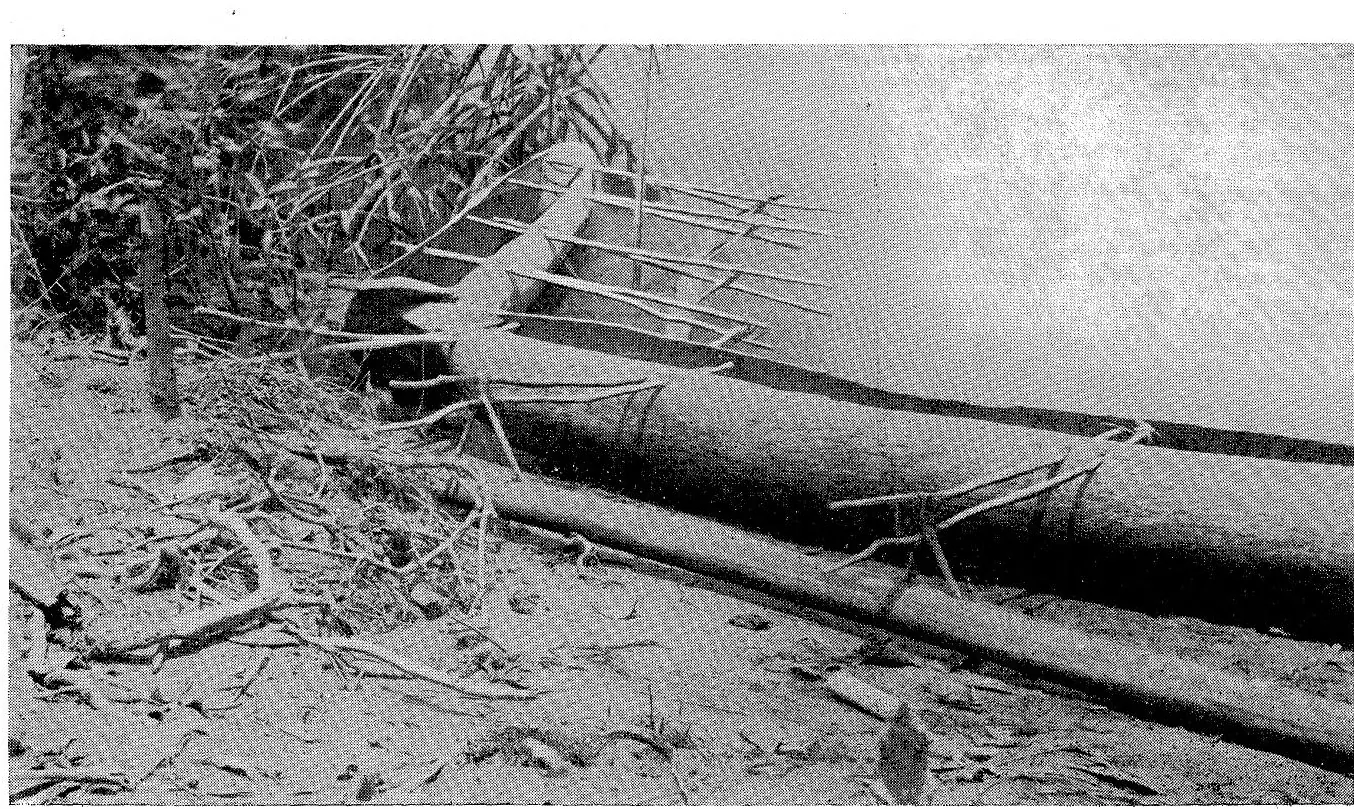
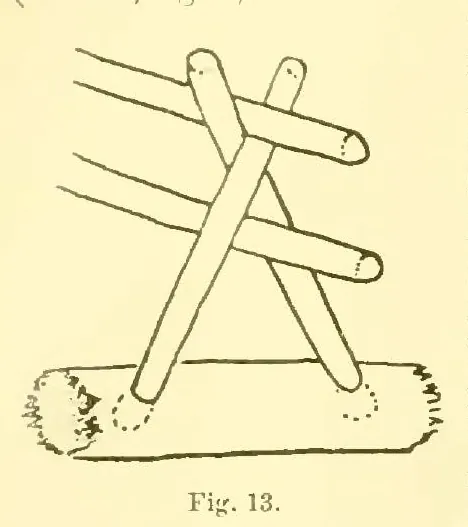
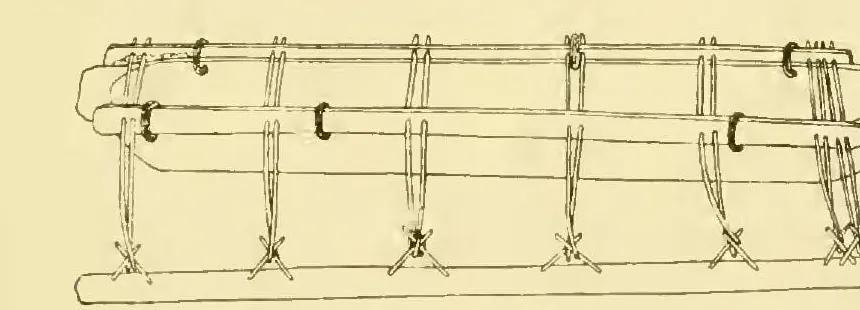
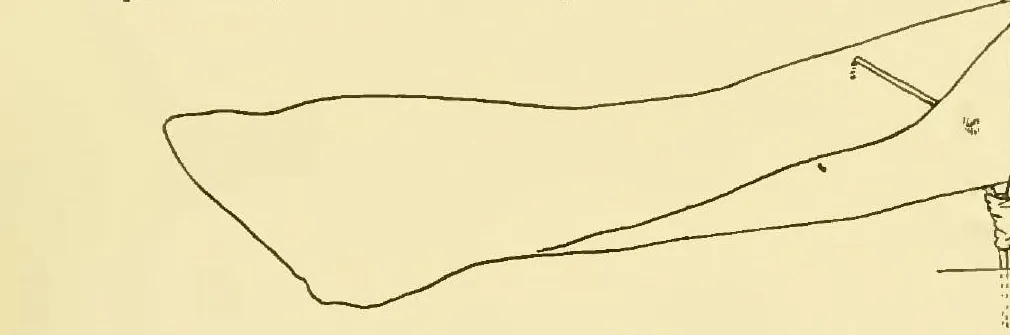
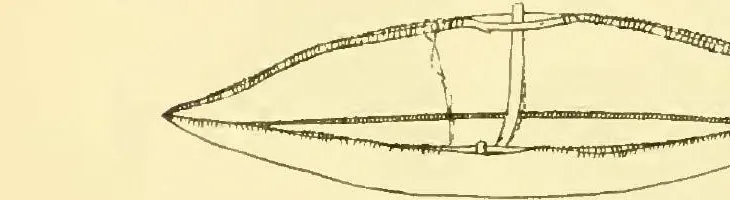
The Kuku Yalanji boat was the kaljan, the outrigger canoe: a hull dug out of one log of red cedar (marrakan), candlenut (bilar) or cotton tree (wawuburra), burnt and scraped hollow, with a float of lighter wood held out on the right-hand side by pairs of booms lashed to crossed pegs[1][2][3]. The first European to measure one found it beside the huts at the mouth of the Bloomfield River on 26 June 1819: twenty-one feet long, fifteen inches across the bilge, only six to eight and a half inches open at the gunwale, with an outrigger standing out two feet on one side and a platform at each end 'on which the natives carry their fire, or sit', and in it two paddles and a long pole[4]. Anderson's informants remembered canoes up to seven metres long that carried six or seven people, or two men and two large turtles; they were poled in the shallows, paddled in deep water, bailed with a bailer shell, and the last traditional one was seen at Bloomfield in the early 1960s[2]. Roth photographed a Bloomfield dug-out on the beach and drew how the booms meet the float; his pictures are on this page[3]. Inland there is no Kuku Yalanji canoe record: rivers were crossed by wading, swimming and log floats, and in flood on a lashed log raft, which is the other half of this page[3].
Hann River Cape York
Possum People's country on the upper river and Thaypan (Kuku Thaypan) country downstream: stringybark and bloodwood woodland and a spring-fed sandy river that runs north-east from the Great Dividing Range, past the Peninsula Developmental Road, into Rinyirru (Lakefield) and the North Kennedy. Not Kuku Yalanji country: the Kuku Yalanji words on this page are the dictionary's, not the Hann's own languages. Place guide
No canoe is recorded on the Hann itself. It is a spring-fed river that has not stopped flowing since its gauge opened in 1968, running low and clear between deep holes by the late dry[9][10]. The nearest canoes on record are downstream, around Princess Charlotte Bay, at the northern end of the single-outrigger kaljan coast that runs south to the Bloomfield[3].
The canoe tree here
Kuku Thaypan Elders name the messmate, Ku Aldkalemba, as a craft tree, and messmate woodland is one of the nine kinds of country they recognise[11]; stringybark grows along the Hann[12]. Elder Dr George Musgrave explained the tree to Victor Steffensen in 2003: 'Make a humpy, and you can make canoe out of him … Get this one Messmate, I call em Ku Aldkalemba.' The bark comes off only at a 'certain time after wet'[11]. Standley adds that the tall messmate 'was cut and traditionally used for canoe making in western Cape York'[11]. Bloodwood gum, mixed with grass-tree gum, would 'plug the, ah the, Mess Mate Bark (Stringy Bark bowl) anything leak like that'[11].
Crossing the Hann through the year
The Hann runs highest in February–March and lowest in September–November, but its gauge has not recorded a day without flow since 1968[9]. In the wet (December to March) the rivers flood, and the Rinyirru roads are usually closed from December to May[13][14]. In the late dry the river is a low clear run between deep holes[10]. Everywhere in North Queensland Roth found that people 'will rather wade across a stream than go to the exertion of swimming it', and would go a long way round to find a ford[3].
Canoes and crossings downstream
Princess Charlotte Bay. Roth put the northern end of the single-outrigger dug-out at the Flinders Group. At Flinders Island in 1902 he saw 'a dug-out canoe with stretchers placed within it cross-wise apparently with the object of preventing the sides approximating too much', and he wrote that 'The Bloomfield River dug-outs only differ from the Cape Bedford and Flinders type in the absence of wash-boards'[3]. Among Roth's string figures, 'Canoe' was made at Princess Charlotte Bay as well as on the coast to the south[15].
Lower Normanby. Where 'a known crocodile-infested river has to be crossed, and there is no canoe', people crossed by diving, close to the bottom. 'The Princess Charlotte Bay Natives never consider it safe to swim even silently on the surface of these waters, however clear they may be, when crocodiles are about'[3]. Both crocodiles live in the Hann country: see crocodiles.
On country today
The upper Hann is the Possum People's country[16]; the middle and lower Hann are in the Thaypan native title determination of November 2023, held by the Awu-Laya Indigenous Corporation[17]. Downstream, Rinyirru (Lakefield) National Park is jointly managed by the Rinyirru Aboriginal Corporation and the Queensland Government; its Traditional Owners are the Lama Lama and Kuku Thaypan peoples[13].
Upper Mitchell Western Yalanji
Western Yalanji country west of the Great Dividing Range: dry open woodland cut by the sandy, paperbark-lined upper Mitchell River, around Karma Waters and Mount Carbine. Place guide
No canoe is recorded on the upper Mitchell. Here the river was waded at the fords, swum, or crossed on a log, and in flood on a raft[3].
No canoe trees here
The coast's canoe timbers are not Karma Waters country. The upper Mitchell at Karma Waters is open woodland and river sand, and Roth's inland transport sections, not his canoe sections, describe it: fords, logs, swimming, and the light log float of the lower river[3]. The cotton tree does grow along the Mitchell's banks, and a big river red gum or paperbark could give a bark sheet; but no inland Kuku Yalanji canoe is recorded, and this page does not invent one.
Crossing the river through the year
Up here the river season is the reverse of the coast's: crossings are easy in the dry and dangerous in the wet, when the Mitchell runs bank to bank, and a raft was a flood-time thing[3].
Safety here
- Crocodiles. At Karma Waters the crocodile is the freshwater one, but the rule about not swimming at dusk or at night in deep pools holds[18].
- Flood. The Mitchell in the wet is a different river; King's crews, Roth's informants and the station all say the same: do not try to cross running water, wait, or go a long way round to a ford[3][19].
- Felling a canoe tree on the station is a matter for the lessee's permission; a bark sheet should be taken from a tree that will survive it[18].
On country today
On the Mitchell the river is crossed on foot at the fords in the dry, as it always was, and the station's river camps are on the sand beside the pools[19].
Eastern coast Eastern Kuku Yalanji
Eastern Kuku Yalanji country: rainforest, beaches, mangroves, reef and the short steep rivers from the Daintree to the Bloomfield and the Annan.
This is canoe country. The Bloomfield dug-out is the best-recorded Kuku Yalanji canoe: measured by King in 1819, photographed by Roth, and remembered by Anderson's Bloomfield informants in the 1970s[4][3][2].
The Bloomfield dug-out
What King saw, 1819. Sheltering in Weary Bay on 26 June 1819, Phillip Parker King sent Mr Bedwell to examine 'Blomfield's Rivulet'. 'Near the entrance upon the bank of the inlet several huts were noticed, and near them Mr. Bedwell found a canoe; which, being hollowed out of the trunk of a tree, was of very different construction to any we had before seen; its length was twenty-one feet, but its greatest breadth in the bilge did not exceed fifteen inches, whilst at the gunwale the opening was only from six to eight and a half inches wide; an outrigger, projecting about two feet, was neatly attached to one side, which prevented its liability to overset, and at each end was a projection, from fifteen to twenty inches long, on which the natives carry their fire, or sit; nothing was found in the canoe but two paddles and a long pole'[4]. A week later at the Endeavour River his party passed 'the wreck of a canoe, large enough to carry seven or eight persons; it measured nineteen feet in length, and twenty-two inches in the bilge, and appeared, like that of Blomfield's Rivulet, to be made of the trunk of the Erythrina indica, hollowed out either by fire or by some blunt tool', and watched two men 'shove their canoe over' the river shoals with poles[4]. In 1821 he saw a twelve-foot canoe of the same build, nine inches at the bilge, in Trinity Bay to the south[4].
What Anderson was told, 1970s. 'The boats used were outrigger canoes with a single outrigger on the starboard side. A variety of timbers were used in the construction of the dug-out portion, but Aleurites moluccana, Toona australis and a "cotton tree" (probably Bombax malabaricum) seem to have been most favoured on the Bloomfield coast. The trees were cut down with stone axes, and the inside burned out and scraped clean with adzes. The outrigger was attached with lawyer-vine. The canoes were poled in shallow water and paddled in deeper water. Paddles were made from Xylocarpus granatum. Bailer shells were used to keep excess water out. The canoes were up to seven metres in length and could carry six to seven people or two men and two large turtles'[2]. The dictionary's mararr, a sail of plaited palm leaves, is the only evidence of sail, apart from Roth's 1898 note that police-issue blankets at Bloomfield were being used as canoe sails[2][1].
Canoe trees here
The hull trees are rainforest and river-bank trees of the coast: red cedar in the Daintree and Bloomfield scrubs, candlenut along the creeks, and the cotton tree, wawuburra, whose big red flowers open the scrub-hen egg season[2][1].
On country today
Wooden dinghies had replaced the outrigger canoe at Bloomfield by the Second World War; a traditional canoe was still seen there in the early 1960s, and Roth's photograph and King's measurements are the record of what it was[2][4][3].
Everywhere
Names
kaljan is 'outrigger canoe'. marrakan is both the red cedar tree and the 'dugout canoe made of red cedar wood', the way warrbi is both the house and the axe that cut it[1]. The parts: dukul 'head', also 'bow of boat'; bijikan 'stern of a boat'; birungubay 'paddle, oar', often shortened to biruwybay or birubay, and birungubaynja manil 'to row'; warkal 'bailer shell used in the old time for a billy'; wuljil 'to empty out, bail out'; mararr, now 'cloth', but 'originally a sail made of plaited palm leaves'[1]. The trees: wawuburra 'cottontree. Canoes were made out of these and the candlenut tree, bilar'; bilar the candlenut; and one of the two words marril, a mangrove 'with apple-like seed only much bigger. The wood is hard and is good for making oars'[1]. The water: maraji and mariji-y 'to swim; to swim across or through water'; janjil 'wash, bathe, swim'; mala-kural 'good diver'; dajali 'deep water'; walngkal 'to float, as a log on the water'; walmba 'log'; yanday 'things that float up on the beach such as timber, usable things only'; kumuy 'fluorescence under water (salt water), as behind a boat in the water at night'; yulal 'board, plank', the word Roth heard at Cape Bedford for a European boat 'so applied to the planks with which it is built'[1][3].
Roth's canoe vocabulary from Cape Bedford is Guugu Yimithirr, the northern neighbours: wangga for the dug-out as a whole, the bow 'forehead', the stern 'buttocks', the keel 'backbone', the ribs, the float 'little finger', and dadetchin for the peg timber; the Kungganji of Cape Grafton called the float bunul, their word for mullet, 'indicative of its habit of skimming along the surface of the water'[3]. On the Endeavour River the log laid across a creek as a bridge was walmba, 'the same term as is applied to the forked limb put against a tree in order to climb it': the Kuku Yalanji dictionary's walmba 'log' is the same word[3][1].
The Bloomfield dug-out
What Roth saw, 1898–1902. Along the coast from the Flinders Group to Cape Grafton the dug-out has one outrigger; 'following upon this, to ensure rigidity of the surviving float, an increase in the number of booms; to restore the centre of gravity of the body to the vertical is the intervention of comparatively large pegs between the boom-extremities and the float'. Going south, 'the stern projection gradually becomes more and more developed, until it closely approximates that of the bows, both extremities simultaneously changing from oval to square. The booms are all double, i.e., in sets of two, and form a staging on to which the spears and harpoons may be laid or tied'[3]. Between the Flinders and the Endeavour two wash-boards are lashed along the outside of the gunwale and the booms pegged through them; 'they have already disappeared at the Bloomfield River, where the booms pierce the gunwale direct' (his Plate VI fig. 2, the photograph at the top of this page). 'The number of double booms will depend upon the size of the vessel, not less than four nor more than eight having been observed, a double one occasionally being made to pierce the extreme bows direct; their two components are lashed, one above, the other below, to the angle formed by the tops of the crossed pegs morticed into the float' (his fig. 13, on this page)[3]. At Cape Bedford, 'where the best specimens of canoe are to be seen, and whence the cast-offs and inferior ones are traded to Cooktown', the pegs were of a special timber and 'the floats are cut from a peculiarly light wood which is cast up on the beach, and preserved until required'. Because the bow is made from the wider butt of the log, the float sits a little closer to the hull in front than behind, so 'the total width of the vessel as a whole is practically the same fore and aft'. 'The Bloomfield River dug-outs only differ from the Cape Bedford and Flinders type in the absence of wash-boards'[3]. From the Mossman south to Cape Grafton the dug-out 'is cut very square at either extremity', so narrow that 'the occupants sitting on the double-booms are obliged to have their legs crossed one over the other, and yet I have known five or six people at one time travelling all the way from Port Douglas to beyond Cairns'; made 'from at least five kinds of timber', up to fifteen or sixteen feet[3]. Cape Grafton was the southern limit of the dug-out[3].
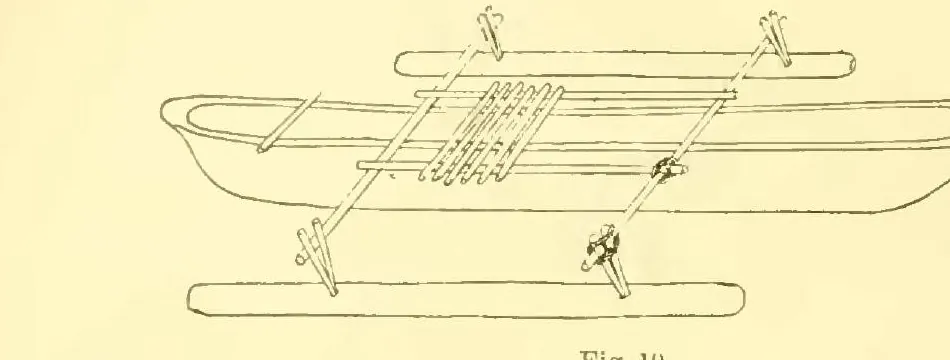
Where the dug-out came from. Roth judged the dug-outs of the Queensland coast 'of Papuan origin', the double-outrigger canoe of the Batavia (Wenlock) River being the original form (his fig. 10, on this page), with one float dropped and the booms multiplied as the type travelled south; Torres Strait sailing canoes came 'a long way down the Barrier Reef during the north west season'[3]. The Kuku Yalanji canoe is the southern end of that line.
Which craft for which water
- The dug-out outrigger (kaljan): the sea-going boat, for the reef, the estuary, turtle and dugong, and for night fishing on the tidal river; 'distinctly a sea-going craft as compared with the bark-canoe'[3][2].
- The bark canoe: one, two or three sheets of bark sewn with lawyer cane; 'in the main river-craft', though taken across to islands in fair weather. Roth records them from the Johnstone River south and on the Gulf coast, not on Kuku Yalanji country; the Tully method is given below as the nearest recorded[3].
- The log raft: four or five logs tied with lawyer cane at the ends, 'used rather in times of flood than at others, and generally discarded after use', among the scrub people from the Tully to the Mulgrave; see rafts[3].
- The log float: 'at the mouth of the Mitchell River, and some of the rivers to the south of it', a cut trunk of a very light tree five or six feet long, which the swimmer straddles 'somewhat in the position of a child riding a hobby-horse', balancing with one hand and keeping the other free for spears[3].
- Swimming and wading: the inland default, below.
- A toy canoe of bark or palm leaf, which is how children at Bloomfield learned the shape[2].
Signs
- The narrow hull. A Kuku Yalanji dug-out is recognisable in any old photograph by its slit of a gunwale, six to nine inches wide on a hull fifteen to twenty-two inches in the bilge, and by its one float on the right[4][2].
- Booms through the gunwale, no wash-boards: the Bloomfield mark, against the boarded canoes of Cape Bedford and the Endeavour[3].
- A platform at each end for the fire and the harpooner[4][3].
- Canoe trees: a big red cedar, candlenut or cotton tree gone from the river bank; the stump and chips of a stone-axe felling[2].
- Light driftwood (yanday) put aside above the tide line was float timber waiting[3][1].
- A log across a creek that did not fall there: walmba, the bridge[3].
- On the river at night, a torch in the bow meant spearing, not travelling[2].
Canoe trees and where they grow
The hull trees are soft rainforest and river-bank trees of the coast: red cedar, candlenut and the cotton tree[2][1]. King's Erythrina indica, the coral tree, is a soft, light, fast-growing tree of the same coastal scrubs; on the Endeavour Roth found hulls of cotton tree, milky mangrove (Excoecaria), Alstonia and Sonneratia; at Cape Bedford of brown cedar and Gmelina[4][3]. The float 'is not usually the same as that employed for the body, but of a more buoyant variety'[3]. Paddles came from the mangrove Xylocarpus granatum, the cannonball mangrove, and the dictionary's marril; the outrigger lashings from lawyer cane; the turtle-rope from kuralbi and the barks of Sterculia and Hibiscus (string); the gum to seal the ends from the brown cedar[2].
The canoe in the country
The canoe is what turned the reef, the islands and the tidal river into country that could be hunted. From the bow platform a man harpooned turtle with a kuralbi rope coiled in the prow, while two others paddled and watched; at night on the estuary one person 'sat at the front of the boat holding aloft a burning paperbark torch' and another speared the fish that came to the light, the mullet shoals of the late dry above all[2]. Stingrays, rock cod, coral cod, red emperor and black-tip shark were speared from it; it carried people to the islands for crabs and oysters, and up the river to the camps[2][3]. It needed the axe and the adze, fire, lawyer cane, gum, the bailer shell, and a canoe tree; and the cast-off canoes of Cape Bedford were themselves trade goods to Cooktown[3][2]. What rides under it: the saltwater crocodile (bilngkumu), which is why Roth's chapter on crossing water opens with auguries and diving, and why the canoe, not the swim, was the way across a tidal river[3].
Seasons
Canoe timber was cut after the first storms with the other big-timber work, when the sap was up and the logs were green and easier to hollow[2]. The canoe's working season was the dry and the calm weather: turtle and dugong hunting, the mullet runs of the late dry, and the trips to the islands 'only when the wind and weather are favourable'[2][3]. The Torres Strait canoes came south on the north-west wind of the wet and went home on the south-east trade[3]. See the year on country.
Uses
- Hunting turtle and dugong with the harpoon from the bow platform[2][5].
- Night spearing on the tidal river by torchlight; spearing stingray and reef fish[2].
- Carrying six or seven people, or two men and two big turtles; travel along the coast and to the islands[2][3].
- Carrying fire on the end platform, on clay or sand[4][3].
- A staging for spears and harpoons across the double booms[3].
- Trade: worn canoes went from Cape Bedford to Cooktown[3].
- Crossing a crocodile river without swimming it[3].
- The log raft and log float: crossing and travelling on a flooded river with spears kept dry[3].
Making and handling the craft
The dug-out, from Anderson's Bloomfield account, Roth's Cape Bedford description (which he says the Bloomfield canoe matched except for the wash-boards) and King's measurements[2][3][4]:
- Choose and fell the tree: red cedar, candlenut or cotton tree, big enough for a hull up to seven metres; the wider butt end will be the bow[2][3].
- Shape the ends into a bow and a stern, each with a projecting platform fifteen to twenty inches long[4][3].
- Hollow the log: burn the inside out and scrape it clean with adzes; Roth saw it done with fire and 'native gouges', and by 1904 with a piece of barrel-hoop or ground-down rasp wedged into a split handle up to twenty-five inches long, 'gripped with both hands', at the Endeavour and the Bloomfield[2][3][6]. Keep the opening narrow: six to nine inches at the gunwale on a fifteen-inch bilge[4].
- Make the float from a much lighter wood; light driftwood saved above the tide line is what Cape Bedford used[3].
- Cut the pegs from a hard timber and mortice them into the float in crossed pairs[3].
- Fit four to eight double booms through the gunwale on the right-hand side, each pair lashed with lawyer vine, one above and one below, to the angle of the crossed pegs; the float stands out about two feet[3][2][4].
- Seal and finish: gum on the ends and any cracks; a small peg forward to tie the harpoon line to; a stretcher across the hull if the sides pull in[2][3].
- Make the paddles (birungubay) of mangrove wood with a long narrow blade, a pole for the shallows, and keep a bailer shell (warkal) aboard[2][3][1].
- Launch: three people drag it to the water's edge, pole out 'one at the bows, the other at the stern, until such time as the water is deep enough for the paddles', then paddle with both hands, 'on either side of the canoe alternately'[3].
- Load it low: sit one behind the other on the booms or on sticks laid across the gunwale, legs crossed in the narrowest canoes; the steersman at the stern; the harpooner standing on the bow platform; the fire on its clay at the end[3][4].
A single-sheet bark canoe, the Tully River method, a neighbouring craft given because no Kuku Yalanji bark canoe is recorded[3]: strip a long sheet of bark from one of the canoe-bark trees (on the Tully, five kinds, one of them Calophyllum; their bark 'will strip more or less at any time of the year'); heat one end over a fire and fold the whole length lengthways, outer bark outwards; clamp the heated end in a vice of two switches tied round a bundle of grass and driven into the ground (Roth's fig. 4, on this page); jam in a spreader to set the shape; cut the end to a curve with a sharp shell, 'from below upwards, through both portions of the fold'; overcast the cut with split lawyer cane through holes drilled with a wallaby bone, folding in tea-tree bark, 'which swells when moistened', at the bottom of the seam; do the stern the same with a wider spreader; sew two tapered withies and unsplit lawyer cane along the inside as a gunwale; press five or six bent bark strips inside as ribs, held by split-cane hoops tucked under the gunwale; sew one tie across the middle; take out the spreaders; fix a stone anchor on a rope through a hole by the bow. One person, kneeling, paddles with a small oval of bark or a pearl shell in each hand. It took 'a little over a day to make', lasts long if kept out of the sun, and a crack 'is sewn up with intervening tea-tree bark and covered with bee's-wax' or gum[3]. The three-sheet canoe of the Whitsundays (fig. 9) uses one sheet for the bottom and two for the sides[3].
A log raft, the Tully to Mulgrave method: four or five logs of a light timber cut off blunt, 'tied, while afloat, with a length of lawyer-cane at the two ends only', first round the outside logs and then with a frapping turn between each log; a few cross-pieces at one end with tea-tree bark and sand on them so 'a fire can thus be kept burning'; no paddle, 'only a pole which can both steer and punt it', one or two people; made for a flood and left afterwards[3]. See rafts.
Crossing a river without a boat, from Roth's transport chapter[3]: 'the native will rather wade across a stream than go to the exertion of swimming it, and will often make a comparatively long detour to find a suitable ford'; where the trees meet overhead, climb across the branches; use a fallen log or lay one (walmba); carry goods in the teeth, on the head on a ring pad of tea-tree bark or grass, or 'in a bark or dug-out wooden vessel propelled in front' (a trough). Cross in company, 'in more or less close formation with a good deal of splashing and shouting'. 'A river in flood is met by diving across close to the bottom, where the natives say the current is never so strong.' Where a crocodile river must be crossed, dive and glide along the bottom, stirring up the mud if one is seen; when diving for lily seed in a suspected pool, keep a watcher on the bank or in a tree to splash the water with a stick at the first 'long streaky film of fine bubbles'. 'The Princess Charlotte Bay Natives never consider it safe to swim even silently on the surface of these waters, however clear they may be, when crocodiles are about'[3].
Safety
- Crocodiles. The whole of Roth's chapter on crossing water is about bilngkumu; a tidal river is crossed in a canoe or not at all[3].
- Flood. Do not try to cross a river in flood: wait, or go a long way round to a ford[3].
- The narrow hull capsizes without its float; King noted that the outrigger was what 'prevented its liability to overset'. Sit low and keep the weight on the float side[4][3].
- Fire aboard goes on clay or sand at the end platform, never on the hull[4][3].
- A dry log float rolls; the old method straddled it with the thick end in front[3].
On Country today
The trees, the cane, the bailer shells and the words are all still there. Fishing and hunting from the water on native title country, by any means, is covered by section 211 of the Native Title Act 1993[7][8]. If you have seen a canoe made, or know the trees that were used on the inland rivers, the contribution box below is for that.
Language
kaljan 'outrigger canoe'; marrakan 'dugout canoe made of red cedar wood'; dukul 'bow of boat'; bijikan 'stern of a boat'; birungubay 'paddle, oar'; birungubaynja manil 'to row'; warkal 'bailer shell'; wuljil 'to bail out'; mararr 'sail of plaited palm leaves'; wawuburra 'cottontree'; bilar 'candlenut'; marril mangrove 'good for making oars'; mariji-y 'to swim across'; janjil 'bathe, swim'; mala-kural 'good diver'; dajali 'deep water'; walngkal 'to float'; walmba 'log'; yanday 'usable things that float up on the beach'; kumuy 'fluorescence behind a boat at night'; yulal 'board, plank'; jalun 'sea'; bana 'water'; wangkar 'upriver'; bilngkumu 'saltwater crocodile'; kalka 'fishing spear'[1].
Images
References
- Hershberger, H. D. & Hershberger, R. (1982). Kuku-Yalanji Dictionary. Work Papers of SIL-AAB, Series B, Volume 7. With Toby Bloomfield, Roy Friday, Billy Roberts, Hector and Doris Sykes, Joe Walker and others. www.sil.org/resources/archives/18038
- Anderson, C. (1996). Traditional material culture of the Kuku-Yalanji of Bloomfield River, North Queensland. Records of the South Australian Museum 29(1): 63–83. Based on fieldwork at Wujal Wujal in the late 1970s and early 1980s. — Hunting (spears, spear-throwers, harpoons); fishing (stupefacients); manufacturing (gums and resins); post-contact bush component archive.org/details/RecordsSouthAus29Sout
- Roth, W. E. (1910). North Queensland Ethnography, Bulletin No. 14: Transport and Trade. Records of the Australian Museum 8(1). — Sects. 14–15, dug-out canoes from the Flinders Group to Cape Grafton archive.org/details/biostor-52863
- King, P. P. (1827). Narrative of a Survey of the Intertropical and Western Coasts of Australia, performed between the years 1818 and 1822. London: John Murray. Vol. 1: Blomfield's Rivulet (the Bloomfield River), 26 June 1819, and Endeavour River, July 1819; Vol. 2: Trinity Bay, June 1821. www.gutenberg.org/ebooks/11203
- Roth, W. E. (1901). North Queensland Ethnography, Bulletin No. 3: Food — its search, capture, and preparation. Brisbane: Government Printer. Bloomfield River information from the Hislops. — Sect. 6 'Cooking'; plant list ('Castanospermum australe', 'Dioscorea sativa', 'Elettaria Scottiana', 'Nymphaea') archive.org/details/northqueensland00landgoog
- Roth, W. E. (1904). North Queensland Ethnography, Bulletin No. 7: Domestic implements, arts, and manufactures. Brisbane: Government Printer. — Sect. 10 'Fire-tongs' archive.org/details/northqueensland00landgoog
- Australian Law Reform Commission. Review of the Native Title Act 1993 (DP 82), ch. 8: Relevant provisions in the Native Title Act (s 211). www.alrc.gov.au/publication/review-of-the-native-title-act-1993-dp-82/8-the-nature-and-content-of-native-title/relevant-provisions-in-the-native-title-act/
- Western Yalanji Aboriginal Corporation & CRC for Developing Northern Australia (2020). Western Yalanji Land Use and Economic Diversification Plan. CC BY 4.0. — Native Title Determinations 1–4 (pp. 13–18); ‘Fire Management and Carbon Farming’ (pp. 32–33); ‘Pastoralists’ crcna.com.au/wp-content/uploads/2024/05/westernyalanjilanduseplan_nov2020.pdf
- Bureau of Meteorology, Water Data Online. Station 105001B, Hann River at Sandy Creek: daily and monthly mean discharge 1968–2026 (recent data provisional), retrieved 28 October 2026. No day of zero mean flow in 20,711 days of record; mean flow highest in February–March, lowest in September–November. www.bom.gov.au/waterdata/
- Queensland Government, WetlandInfo. Normanby catchment story: physical features (springs and base flow). wetlandinfo.detsi.qld.gov.au/wetlands/ecology/processes-systems/water/catchment-stories/normanby/norm-physical.html
- Standley, P.-M. (2019). The importance of campfires to effective conservation. PhD thesis, James Cook University. Records the fire and country knowledge of Kuku Thaypan Elders Dr Tommy George and Dr George Musgrave. researchonline.jcu.edu.au/64274/
- Wikipedia. Hann River (Queensland) (accessed 28 October 2026). en.wikipedia.org/wiki/Hann_River_(Queensland)
- Queensland Parks and Wildlife Service. Nature, culture and history: Rinyirru (Lakefield) National Park (CYPAL) (web page, last updated 1 July 2024; accessed 28 October 2026). parks.qld.gov.au/parks/rinyirru-lakefield/about/culture
- Queensland Parks and Wildlife Service (2013). Rinyirru (Lakefield) Aggregation Management Statement 2013. parks.desi.qld.gov.au/__data/assets/pdf_file/0027/165771/rinyirru.pdf
- Roth, W. E. (1902). North Queensland Ethnography, Bulletin No. 4: Games, sports and amusements. Brisbane: Government Printer. — Sect. on string figures (cat's cradles): Plate XII fig. 2, 'Canoe', Princess Charlotte Bay archive.org/details/northqueensland00landgoog
- Ross on behalf of the Cape York United #1 Claim Group v State of Queensland (No 21) (Possum determination) [2023] FCA 1316 (Federal Court of Australia, 2 November 2023). — Determination area (upper Hann and Kennedy rivers); prescribed body corporate; affidavit evidence on hunting and fishing www.judgments.fedcourt.gov.au/judgments/Judgments/fca/single/2023/2023fca1316
- Ross on behalf of the Cape York United #1 Claim Group v State of Queensland (No 20) (Thaypan determination) [2023] FCA 1315 (Federal Court of Australia, 2 November 2023). — Determination area and waters; prescribed body corporate (Awu-Laya Indigenous Corporation); affidavit evidence on hunting www.judgments.fedcourt.gov.au/judgments/Judgments/fca/single/2023/2023fca1315
- Karma Waters Station. About: location, native title (web page, accessed 5 October 2026). www.karmawatersstation.com/about.html
- Karma Waters Station. Bush Camping at Karma Waters Station (web page, accessed 5 October 2026). www.karmawatersstation.com/bush-camping.html
From the community
Know this one? Add the words you use for it, what it is for, how it is done, a correction, or a photo from country. It shows here straight away with your name on it. Please keep anything restricted or sacred off the site.
Loading…