Birds
Bustard, the plains turkey (kurrbal)
kurrbalArdeotis australis
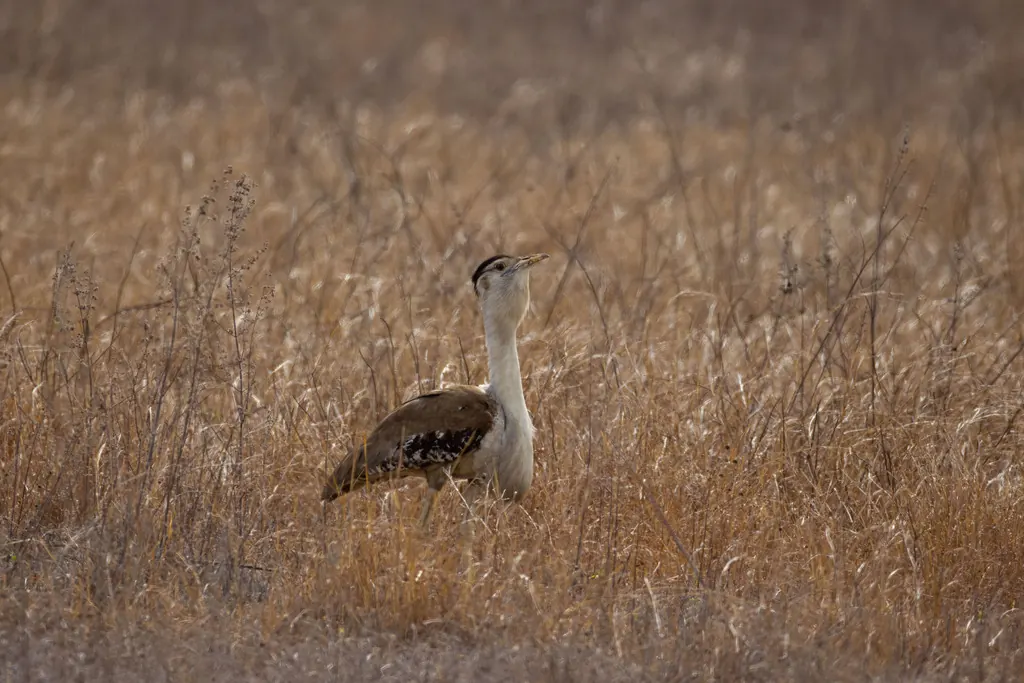
kurrbal is the plains turkey, the Australian bustard, the big grey ground bird that strides the open woodland and the grass plains of the north, 'about one metre high', with a wingspan 'around twice that length', and that 'when disturbed, often adopt a cryptic pose with neck erect and bill pointed skywards', then stalks away, runs, and flies 'as a last resort'[1][2]. It was the biggest game bird of the north: 'this so-called turkey may be speared, the commonest method, as a general rule, everywhere', Roth wrote, and in the west it was noosed with a grasshopper on a switch or surrounded with fires 'dazed with the smoke and din'[3]. It eats what the flats give, 'shoots, roots, leaves, flowerheads, seeds and fruit of plants, a variety of insects, especially grasshoppers', lizards and mice, and it is 'strongly attracted' to the wild oranges of the Capparis bushes, which hunters in the north-west used as a trap[2]. The male's display in the breeding season is 'a conspicuous performance that is accompanied by loud booming', the throat sac let down as 'a swaying skirt'; the female lays one egg on bare ground and sits it alone[2].
Nothing is written for the Eastern coast on this page yet. What follows is true across the country.
Hann River Cape York
Possum People's country on the upper river and Thaypan (Kuku Thaypan) country downstream: stringybark and bloodwood woodland and a spring-fed sandy river that runs north-east from the Great Dividing Range, past the Peninsula Developmental Road, into Rinyirru (Lakefield) and the North Kennedy. Not Kuku Yalanji country: the Kuku Yalanji words on this page are the dictionary's, not the Hann's own languages. Place guide
The plains turkey is a bird of this country. In Rinyirru (Lakefield) National Park, downstream, 'in the woodland and grassland area the agile wallaby, northern nailtail wallaby and Australian bustard may be found'[13]. The Atlas of Living Australia holds 164 bustard records, from 1963 to 2026, in a box of about 90 × 85 km around the middle Hann, Laura and western Rinyirru[14]. On the upper Hann it is still hunted: the Court recorded a Possum man's evidence of 'hunting pigs, kangaroos, goanna, porcupine, and plain turkeys'[15].
Where it lives here
Along the Hann the country is 'stringybark, bloodwood, Moreton Bay ash and ironbark trees with a ground cover of coarse grasses such as speargrass'[16]: open woodland with grass under it, the bustard's country. The Kuku Thaypan Elders name nine kinds of country, and one of them is Kwern, the open grassy plains[17]. The Atlas count above covers far more country than the river, so read it as 'common in this country', not as a map[14].
Its year here
Wet, December to March: the rivers flood and the plains go green; 'during this time animals disperse far and wide as food and water is plentiful'[18]. The bustard is nomadic and moves with the food[2].
Dry, April to October: the plains dry out, and 'by October the land is brown and parched'[18]. This is the burning time. The Kuku Thaypan Elders say 'open grassy plains are important for hunting, maintaining grass resources as food and habitat for a myriad of vertebrate and invertebrate species, importantly macropods, small mammals, birds, and reptiles'. At their cool fires 'the birds of prey feed off grasshoppers flying up out of the grass, small mammals and reptiles fleeing'[17]. The grasshoppers that bring the hawks to a burn are the bustard's food too[2].
How people hunted it here
A Possum man of the upper Hann told the Court that plain turkeys are among what he hunts[15]. No hunting method from the Hann, Laura or Princess Charlotte Bay is published. Roth's note that the bustard 'may be speared, the commonest method, as a general rule, everywhere' is for North Queensland as a whole[3]; see the general sections for it.
On country today
The upper Hann is the Possum People's country, held by the Possum Aboriginal Corporation[15]. The middle and lower Hann are Thaypan country, determined on 2 November 2023 and held by the Awu-Laya Indigenous Corporation[19]. Rinyirru's Traditional Owners are the Lama Lama and Kuku Thaypan peoples[18]. Native title holders may hunt for personal, domestic and non-commercial communal needs without the licences others need[20]. Everyone else needs the Traditional Owners' permission.
Language
The Hunter-Gatherer Language Database has no Kuku Thaypan word for the bustard. Olkola, to the west, calls it inh-atawangk, 'plains turkey', and Guugu Yimidhirr, at Hope Vale, wungguurrga[21]. Kuku Thaypan speakers' families may know the word; it is theirs to give.
Upper Mitchell Western Yalanji
Western Yalanji country west of the Great Dividing Range: dry open woodland cut by the sandy, paperbark-lined upper Mitchell River, around Karma Waters and Mount Carbine. Place guide
On the upper Mitchell kurrbal strides the open woodland and the grass flats. It is the biggest bird on Karma Waters, recorded fifteen times within 30 km of the homestead, and the first big bird a visitor sees on the station road[22].
Where it lives here
The open ironbark and bloodwood woodland and the grassy flats of Karma Waters, especially the freshly burnt and the green pick, and the station's paddocks[6]. Fifteen records within 30 km of the homestead. The emu has one record there, so it is not a bird to expect[22].
Its year here
The wild oranges Capparis canescens and C. lasiantha, whose fruit draws the bustard, are in the Karma Waters records, and Palmer wrote that they flower and fruit 'after the first thunder-showers in October'[23][9].
Safety here
The fire-ring method is a grass fire; permits and the station's fire rules apply, and the late dry is not the time[24].
On country today
Section 211 hunting rights are recognised in the Western Yalanji determinations[25]. Ask the Traditional Owners and the station before hunting.
Everywhere
Names
kurrbal 'plain turkey (native companion)'[1]. The two English names in that gloss belong to two birds: 'plains turkey' is the bustard across northern Australia, 'native companion' is the brolga; since the dictionary has kulbal for the brolga, kurrbal is read here as the bustard, with the caution that the two words are a letter apart[2][4]. In English: 'bustard, Australian bustard, plains turkey, wild turkey and native turkey', and 'bush turkey' in central Australia, 'particularly by Aboriginal people, who hunt it'[2]. The scrub turkey, diwan, is a different bird altogether[1].
The bird
'A large ground-dwelling bird that is common in grassland, woodland and open agricultural country across northern Australia and southern New Guinea. It stands at about one metre high, and its wingspan is around twice that length. The species is nomadic, flying to areas when food becomes plentiful'. 'Males are up to 1.2 m tall with a 2.3 m wingspan. The average weight for males is 6.3 kg, with a range of 4.3 to 12.76 kg. The female is quite a bit smaller at 80 cm tall, with a 1.8 m wingspan and an average body mass of 3.2 kg'; the heaviest recorded male was 14.5 kg[2].
'The species is mostly terrestrial and usually seen walking slowly alone or in pairs. When disturbed, Australian bustards often adopt a cryptic pose with neck erect and bill pointed skywards. They may stalk gradually away or run if alarmed, taking flight as a last resort. When leaving the ground they take to the air with heavy beats of the wings.' 'The habits of the bird are usually discreet and shy of disturbance, however, the display of males during the breeding season is a conspicuous performance that is accompanied by loud booming. The male is able to expand a sac at the neck to display their longer feathers as a swaying skirt, with the head held proud and upward facing'[2].
'Ardeotis australis does not make any attempt to construct a nest. The clutch size is usually one egg, sometimes two, laid close to a small shrub or bush on unadorned ground ... Incubation of the brood is maintained by the female', who 'will crouch and move away if disturbed'[2].
'The species is strongly attracted to capers, fruit of the plant Capparis nummularia ... and this behaviour is exploited by Indigenous peoples who dig pit traps around the bush and wait nearby to capture them. The omnivorous diet includes shoots, roots, leaves, flowerheads, seeds and fruit of plants, a variety of insects, especially grasshoppers', and small reptiles and mammals[2].
Roth's hunting note, 1901. 'This so-called turkey may be speared, the commonest method, as a general rule, everywhere. In the Boulia District it is either caught with a grasshopper and noose fixed to the extremity of a long thin switch held by the hunter, who gradually creeps forward unobserved, enveloped in boughs and bushes, or else quietly surrounded in the open. In the latter case numerous fires are simultaneously raised in more or less of the line of a circle right round the group of unsuspecting birds which, dazed with the smoke and din now suddenly evoked, are rushed upon and easily knocked over with boomerangs and nullas'[3].
Bustard, brolga, emu, scrub turkey
- Bustard: grey-brown, heavy-bodied, walks with its head up, stands still with its bill in the air; a boom in the breeding season[2].
- Brolga (kulbal): taller and thinner, grey with a red head, in pairs at the water, dancing; the 'native companion'[4].
- Emu: taller again, shaggy brown, a runner[5].
- Scrub turkey (diwan): black with a red head and yellow wattle, in the scrub, building a mound[1].
- A bustard in the grass with its neck up is easy to walk past; look for the pale neck and the slow turn of the head[2].
Signs
- A big three-toed track on a sandy flat, the toes thick and the stride long; no hind toe mark[2].
- A pale shape standing still in the grass after a fire or at the edge of a burn, where the grasshoppers are[2][6].
- Booming at dusk and dawn in the breeding season[2].
- One blotched olive egg on bare ground by a bush, and a bird crouching away from it[2].
- Birds walking the wild-orange bushes when the fruit is on them[2].
Where it lives
'Grassland, woodland and open agricultural country': the open woodland and the grassy flats, especially the freshly burnt ground and the green pick after it. It is nomadic, 'flying to areas when food becomes plentiful'[2].
The grasshopper bird
The bustard follows the grasshoppers and the fruit, which means it follows the fire: the early-dry burns of the woodland and the green pick after them are where the insects are, and the bustard walks the edges of the burn with the kites overhead[2][7]. It takes lizards and mice too, and is taken, as an egg and a chick, by the goanna and the dingo, and as a bird by the wedge-tailed eagle[2][8]. Its one egg a year on bare ground is why it has gone from the settled south and why it needs the open country here to be left open and burnt cool[2].
Seasons
Booming and display in the breeding season, the warm months into the storms; the egg on the ground after; the birds on the burns in the early dry and on the wild oranges 'after the first thunder-showers in October'[2][9]. See the year on country.
Uses
Taking a plains turkey
From Roth's North Queensland note and the western methods he recorded[3][2]:
- Find the birds walking the flats and burns in the morning and evening; a standing bird with its bill in the air has already seen you[2].
- Stalk with cover: the western hunter crept forward 'enveloped in boughs and bushes'; the bird lets a slow bush come closer than a man[3].
- Spear from as close as the cover allows, with the woomera; 'the commonest method'[3].
- Or noose: a grasshopper tied as bait at the end of a long thin switch with a slip-noose, offered to the feeding bird[3].
- Or the fire ring: a party lights a circle of fires round a group of birds at once and rushes them in the smoke; this is the plains-country method and a bushfire if done wrong[3].
- Cook in the earth oven as the camp's big birds were cooked[10].
- Leave the sitting birds: one egg a year, and the female on it[2].
Safety
On Country today
Native birds, the bustard among them, are protected wildlife in Queensland[11]. Whether kurrbal is this bird or the brolga, Kuku Yalanji speakers can say; the contribution box below is for that[1]. Each place on this page says who holds the country there.
Language
kurrbal 'plain turkey (native companion)'; kulbal 'brolga'; dikal 'bird'; kakarr 'grass'; balur 'spear thrower'[1].
References
- Hershberger, H. D. & Hershberger, R. (1982). Kuku-Yalanji Dictionary. Work Papers of SIL-AAB, Series B, Volume 7. With Toby Bloomfield, Roy Friday, Billy Roberts, Hector and Doris Sykes, Joe Walker and others. www.sil.org/resources/archives/18038
- Wikipedia. Australian bustard. en.wikipedia.org/wiki/Australian_bustard
- Roth, W. E. (1901). North Queensland Ethnography, Bulletin No. 3: Food — its search, capture, and preparation. Brisbane: Government Printer. Bloomfield River information from the Hislops. — Sect. 6 'Cooking'; plant list ('Castanospermum australe', 'Dioscorea sativa', 'Elettaria Scottiana', 'Nymphaea') archive.org/details/northqueensland00landgoog
- Wikipedia. Brolga (Antigone rubicunda). en.wikipedia.org/wiki/Brolga
- Wikipedia. Emu (Dromaius novaehollandiae). en.wikipedia.org/wiki/Emu
- Queensland Herbarium, Regional Ecosystem 9.11.26 (Einasleigh Uplands): Eucalyptus leptophleba and/or E. cullenii and/or Corymbia clarksoniana +/- E. platyphylla woodland on undulating terrain to rolling hills. Fire management guidelines. Queensland Government Regional Ecosystem Description Database. apps.des.qld.gov.au/regional-ecosystems/details/?re=9.11.26
- Wikipedia. Whistling kite (Haliastur sphenurus). en.wikipedia.org/wiki/Whistling_kite
- Wikipedia. Wedge-tailed eagle. en.wikipedia.org/wiki/Wedge-tailed_eagle
- Palmer, E. (1883). On plants used by the natives of North Queensland, Flinders and Mitchell Rivers, for food, medicine, &c., &c. Journal and Proceedings of the Royal Society of New South Wales 17: 93–113. Palmer's Mitchell River names come from the lower and middle Mitchell, not from Kuku Yalanji speakers. archive.org/details/journalandproce16walegoog
- Anderson, C. (1996). Traditional material culture of the Kuku-Yalanji of Bloomfield River, North Queensland. Records of the South Australian Museum 29(1): 63–83. Based on fieldwork at Wujal Wujal in the late 1970s and early 1980s. — Hunting (spears, spear-throwers, harpoons); fishing (stupefacients); manufacturing (gums and resins); post-contact bush component archive.org/details/RecordsSouthAus29Sout
- Queensland Government, State of the Environment. Nature Conservation Act 1992. www.stateoftheenvironment.des.qld.gov.au/biodiversity/management-responses/legislation/nature-conservation-act-1992
- Australian Law Reform Commission. Review of the Native Title Act 1993 (DP 82), ch. 8: Relevant provisions in the Native Title Act (s 211). www.alrc.gov.au/publication/review-of-the-native-title-act-1993-dp-82/8-the-nature-and-content-of-native-title/relevant-provisions-in-the-native-title-act/
- Wikipedia. Rinyirru (Lakefield) National Park (fauna; accessed 28 October 2026). en.wikipedia.org/wiki/Rinyirru_(Lakefield)_National_Park
- Atlas of Living Australia. Occurrence records of Ardeotis australis (164 records, 1963–2026) in a box of about 90 × 85 km around the middle Hann River, Laura and western Rinyirru (lat −15.6 to −14.8, long 143.5 to 144.3), queried 28 October 2026. biocache.ala.org.au/occurrences/search?q=taxon_name%3A%22Ardeotis%20australis%22
- Ross on behalf of the Cape York United #1 Claim Group v State of Queensland (No 21) (Possum determination) [2023] FCA 1316 (Federal Court of Australia, 2 November 2023). — Determination area (upper Hann and Kennedy rivers); prescribed body corporate; affidavit evidence on hunting and fishing www.judgments.fedcourt.gov.au/judgments/Judgments/fca/single/2023/2023fca1316
- Wikipedia. Hann River (Queensland) (accessed 28 October 2026). en.wikipedia.org/wiki/Hann_River_(Queensland)
- Standley, P.-M. (2019). The importance of campfires to effective conservation. PhD thesis, James Cook University. Records the fire and country knowledge of Kuku Thaypan Elders Dr Tommy George and Dr George Musgrave. — pp. 342 (birds of prey at the fire front), 436 (open grassy plains) researchonline.jcu.edu.au/64274/
- Queensland Parks and Wildlife Service. Nature, culture and history: Rinyirru (Lakefield) National Park (CYPAL) (web page, last updated 1 July 2024; accessed 28 October 2026). parks.qld.gov.au/parks/rinyirru-lakefield/about/culture
- Ross on behalf of the Cape York United #1 Claim Group v State of Queensland (No 20) (Thaypan determination) [2023] FCA 1315 (Federal Court of Australia, 2 November 2023). — Determination area and waters; prescribed body corporate (Awu-Laya Indigenous Corporation); affidavit evidence on hunting www.judgments.fedcourt.gov.au/judgments/Judgments/fca/single/2023/2023fca1315
- Native Title Act 1993 (Cth), section 211: preservation of certain native title rights and interests (hunting, fishing and gathering for personal, domestic or non-commercial communal needs). www.legislation.gov.au/C2004A04665/latest/text
- Hunter-Gatherer Language Database (University of Texas at Austin). Lexical feature 'bush turkey, australian bustard': Kuku-Thaypan (no entry), Uw-Olkol, Guugu Yimidhirr (accessed 28 October 2026). huntergatherer.la.utexas.edu/lexical/feature/264
- Atlas of Living Australia. Bird (Aves) occurrence records within 30 km of the Karma Waters homestead (16.62° S, 144.60° E), species counts (accessed 10 October 2026). biocache.ala.org.au/occurrences/search?q=*:*&lat=-16.62&lon=144.60&radius=30&fq=class:Aves
- Atlas of Living Australia. Plant occurrence records within 30 km of the Karma Waters homestead (16.62°S, 144.60°E), queried 10 October 2026: 832 records of 266 species. biocache.ala.org.au/occurrences/search?q=kingdom:Plantae&lat=-16.62&lon=144.60&radius=30
- Karma Waters Station. About: location, native title (web page, accessed 5 October 2026). www.karmawatersstation.com/about.html
- Western Yalanji Aboriginal Corporation & CRC for Developing Northern Australia (2020). Western Yalanji Land Use and Economic Diversification Plan. CC BY 4.0. — Native Title Determinations 1–4 (pp. 13–18); ‘Fire Management and Carbon Farming’ (pp. 32–33); ‘Pastoralists’ crcna.com.au/wp-content/uploads/2024/05/westernyalanjilanduseplan_nov2020.pdf
From the community
Know this one? Add the words you use for it, what it is for, how it is done, a correction, or a photo from country. It shows here straight away with your name on it. Please keep anything restricted or sacred off the site.
Loading…