Stone, ochre & earth
Stone
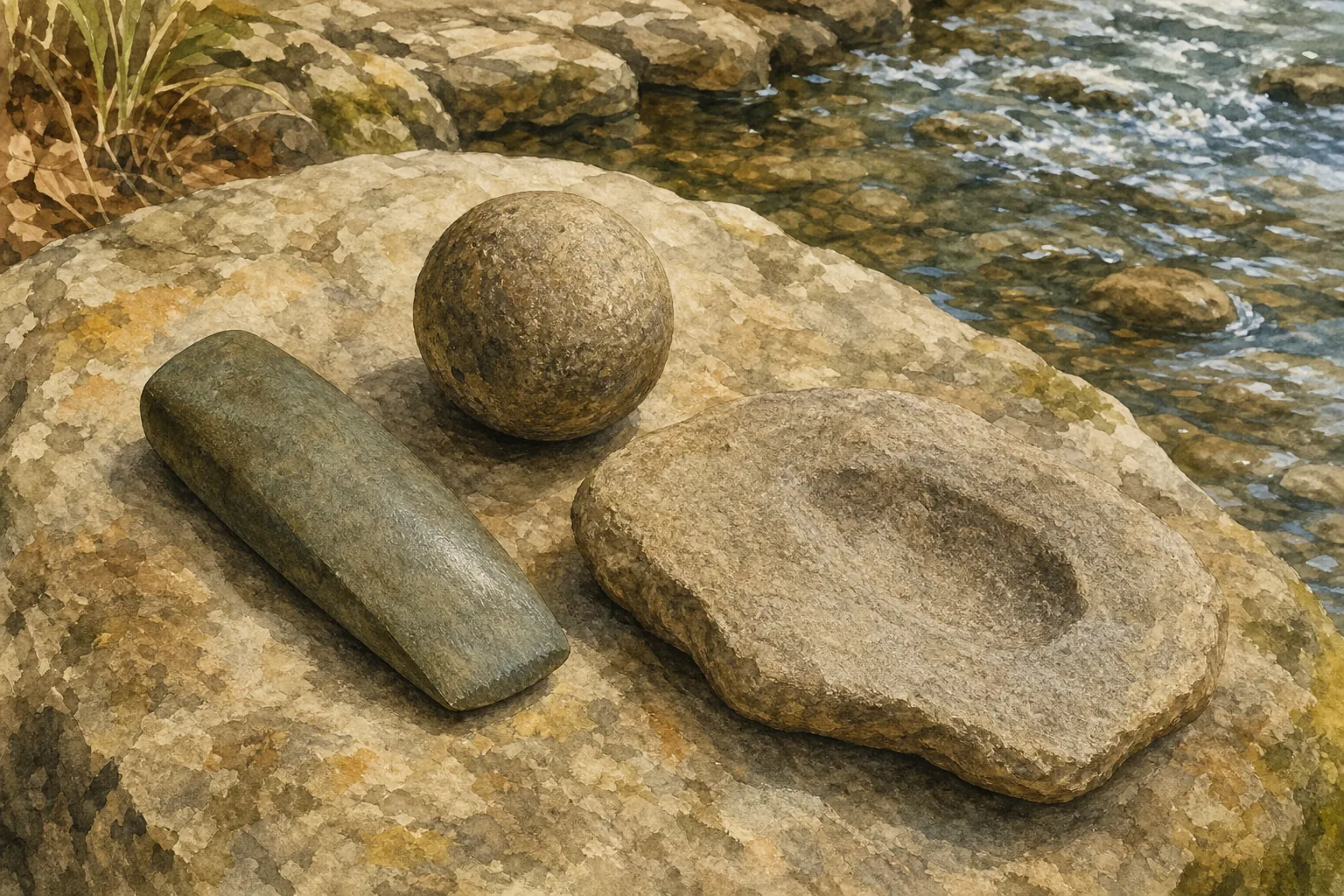
Jangka is stone in Kuku Yalanji, and the dictionary has a word for each kind that matters: kulji 'pebbles, small stones', jalngarr 'flat rock', jinali 'smooth rock' and jundi 'pumice stone, carborundum stone'[1]. Stone was the old tool kit: the axe, kulbanmuku, 'originally a stone axe'; the quartz-headed war spear kuyan; pounding and grinding stones for zamia, black bean and gum; and the hot stones of the earth oven[1][2][3]. Stone is also country: the river crossings, the boulder mountains of Kalkajaka, and rocks that are story places[1][4]. Eastern Kuku Yalanji law has 'strong rules that stones and other things must not be removed from our Country'[5].
Names
Stone words in the dictionary[1]:
- jangka 'stone'. (The dictionary's short gloss for this entry reads 'tree (this term is very rarely used for money)', which looks like a slip; its definition is 'stone'.)
- kulji 'pebbles, small stones', and also 'coins, money', a sense that is going out of use.
- jalngarr 'flat rock'.
- jinali 'smooth rock'; a rock surface that is smooth is dirka-dirka.
- jundi 'pumice stone, carborundum stone', the stone for rubbing and sharpening.
- binda-dijarr 'stony crossing'. Binda-dijarr is also the name of a place on the upper Daintree River.
Roth wrote down the Koko-yellanji (Kuku Yalanji) word for a stone axe-head as jangkawabi (his 1904 spelling), which looks as if it is built on jangka[6]. For the hot stones of the Bloomfield earth oven he wrote kurma[2], the dictionary's kurrma 'earth oven'[1].
Stone on country
Eastern Kuku Yalanji country is hard-rock country. Its best-known stone landmark is Kalkajaka (Black Mountain): a range of black granite boulders, some as big as houses, stacked on each other. It is an important meeting place for Eastern Kuku Yalanji people and the source of many Dreaming stories[4]. The dictionary lists Kalkajaka as 'Black Mountains (also the caves there)'[1]; the stories are the Traditional Owners' to tell.
In the rivers, stone makes the crossings (binda-dijarr) and the flat and smooth rocks people sit, work and wash on[1]. The dictionary marks several particular rocks, such as one in the Bloomfield River at Middle Camp (dilngku-baja), as story sites[1].
Western Yalanji country. Around Mount Carbine the stone has its own history: the town grew up from 1890 around wolfram (tungsten) mines[7].
Where the stone came from
Most tool stone was picked up close to hand. Roth wrote that the simplest stone axe-head was just a water-worn pebble or boulder of the right shape[6]. Other stone came by trade. Around 1900 Bloomfield River people exported red ochre and several kinds of gum-cement. Bloomfield and Endeavour River people also travelled inland towards the Laura with red ochre and white clay for the Koko-warra people[8]. Cape Bedford people, just to the north, received quartz-tipped spears and 'a rough kind of fixed grind-stone' in exchange for their own goods[8].
On the Tully River, to the south, Roth recorded pumice collected in the river and at its mouth[3].
Uses
- Axes. Kulbanmuku 'axe, originally a stone axe'; waymbil and warrbi also mean 'axe'[1]. Roth found that across Queensland the same ground stone head served as axe, adze or wedge[6].
- Quartz spear points. The kuyan is a 'war spear with quartz head'[1]. Roth recorded the quartz-tipped spear as ku-yan at Cape Bedford, with the 'same name on the Bloomfield River'[3].
- Pounding and grinding food. On the Bloomfield, women pounded roasted and cracked zamia kernels (marra) into flour; black bean was baked, pounded and sifted; and the rootstock of Colocasia macrorrhiza was roasted and pounded between two stones in turn[2].
- Gum-cement. On the Bloomfield the gum of the brown cedar (Canarium australasicum) was pounded between two stones until soft, and used to join the parts of spears and, in the old days, to fix the stone axe-head into its handle[6].
- Oven stones. The Bloomfield earth oven cooked with heated stones[2]. Around the Annan and Endeavour rivers, the northern edge of Kuku Yalanji country, old discarded stone axe-heads were used to line ground-ovens. Roth thought this was why so few were left by 1900[2].
- Smoothing and sharpening. Jundi, pumice or carborundum stone[1]; nyurrbal 'to grind, sharpen'[1]. On the Tully River boomerangs were finished by rubbing them with pumice[3].
- Signs. Duburan is 'a directional sign... as a heap of stones or grass twisted to point the way'[1].
How stone tools were made and used
Making a ground-stone axe. By 1904 Roth called this a lost art in Queensland, and rebuilt the process from old men's accounts and from the axe-heads themselves. Most of what follows comes from districts well away from Kuku Yalanji country, as marked[6]:
- Get the stone. Choose a hard, water-worn pebble or boulder already close to the shape you need, or take a piece off a rock face. Kalkadun men (north-west of Cloncurry) said they lit a big fire against the rock for a long time, then threw water on it so the stone split. Georgina River men said an axe could also be started from a large flake.
- Rough it out. Knock off the rough parts and flake the edges, probably with stone hammers. At Boulia, a day was enough to rough a boulder into shape.
- Grind the edge. Rub the blade on hard sandstone, with water, at first in all directions and then along the line of the edge. This takes much longer than the roughing out. At Boulia this slow job was sometimes said to be women's work. Near Brisbane, a rock under the water of the North Pine River was pointed out as an old axe-grinding place.
- Make the handle. In the north and west the handle was a strip of wood bent double at the middle into two limbs. The stone was set in the bend with twine and beeswax or gum-cement, and the limbs were bound together just below the stone and again at the grip. On Cape York (Batavia and Embley rivers) the binding went only next to the stone, so the two limbs crossed and gripped the stone tighter, like pincers, when held.
- Fix it (Bloomfield River). On the Bloomfield, R. Hislop told Roth, the axe-head was cemented into its handle with gum of the brown cedar (Canarium australasicum), which Roth wrote t-chaln-ji. The dry lumps were picked off the tree, baked in leaves or warmed at a fire, then pounded between two stones until soft enough to use. Hands and stones were greased so the gum would not stick[6]. (Roth's t-chaln-ji sounds like the dictionary's jalnji, a tree whose gum 'is not poisonous, used for making spears'[1], but the dictionary calls jalnji a poison-nut tree, so whether they are the same tree is not settled.)
- Use it. The same head could be used as an axe, an adze or a wedge. From Cook's notes Roth judged that on the Endeavour River axes were used both with and without handles.
Grinding and pounding food[2]:
- Grinding means pushing a small, flat, rounded stone straight forward with the hand along a larger fixed slab, sprinkling on a little water now and then so that the crushed seed turns to paste.
- Pounding, with a stick or stone, takes turns with roasting. This is how bitter roots are made eatable.
- On the Bloomfield, zamia was roasted, cracked and kept four or five days, because it then pounds finer. The women pounded it into flour, sifted it through a fine palm-fibre bag and leached it overnight in running water.
Roth found that specialised grindstones were rare on the east coast. Cape Bedford people still had names for the fixed slab and the hand stone (dindi and mar-ngumai, their words) but no stones left to show him[6].
Hafting quartz on the kuyan spear (Cape Bedford, the same spear and name as on the Bloomfield)[3]:
- Knock off small white quartz flakes. By 1909 bottle glass was often used instead.
- Lay a length of gum-cement along the spear tip and run a slot up it with your thumbnail.
- Set the flakes in the slot in two opposite rows, like the teeth of a small comb, pointing forward and getting smaller towards the tip. Fix them with heat and careful work of the fingers.
Oven stones (Cape Bedford and Bloomfield)[2]: heat a number of stones well in a fire, rake out the stones and ashes, dig a hole where the fire was, and build the oven with the hot stones packed among the food under leaves, bark and earth.
Safety and respect
Leave the stones where they are. Eastern Kuku Yalanji law has 'strong rules that stones and other things must not be removed from our Country', and when those rules are broken 'both people and Country get sick'[5]. In Kalkajaka National Park, do not break, alter or deface the rocks[4].
Story places. Some rocks are story sites, and the dictionary marks several[1]. Jabalbina asks people in boats to keep away from two rocks (kulji) in the Bloomfield River at Middle Camp, an important story place[5]. Ask before you go near or touch a notable rock.
Wet rock and river crossings. The language has words for the dangers: julbarr-warri 'to slip' (the dictionary's gloss is 'slippery rock'), jurrngaji 'to trip, as to trip over a stone', and kima-kima, an 'easy crossing of water, water isn't rushing as during a flood'[1]. Cross a stony crossing only when the water is easy, never in flood.
On Country today
Old stone tools are protected. Stone axe-heads, grinding stones and flaked stone are Aboriginal cultural heritage. Under Queensland's Aboriginal Cultural Heritage Act 2003 it is an offence to harm Aboriginal cultural heritage, or to excavate, move or take it away, and anyone carrying out an activity has a duty of care not to harm it[9]. If you find one, leave it where it lies and tell the Traditional Owners.
Native title. Eastern Kuku Yalanji native title, recognised in August 2026, covers about 217,884 ha from the Annan River to the Daintree River and includes Kalkajaka National Park (CYPAL)[10]. Western Yalanji native title was recognised the same week over 170,827 ha, including the right to protect significant places[11]. Visitors need the Traditional Owners' permission to go onto their country, and permission does not include taking stone away.
Language
nyurrbal 'to grind, sharpen'; nyandal 'to chop'; jalngkun 'sharp'; dudu 'blunt'; ngamar 'cliff, steep place'; manjal 'mountain'; jukar 'sand'; murbuy and wuba 'red ochre'; kambar 'white clay'; karrirrangkal 'coral crushed for lime'[1].
References
- Hershberger, H. D. & Hershberger, R. (1982). Kuku-Yalanji Dictionary. Work Papers of SIL-AAB, Series B, Volume 7. With Toby Bloomfield, Roy Friday, Billy Roberts, Hector and Doris Sykes, Joe Walker and others. www.sil.org/resources/archives/18038
- Roth, W. E. (1901). North Queensland Ethnography, Bulletin No. 3: Food — its search, capture, and preparation. Brisbane: Government Printer. Bloomfield River information from R. Hislop. — Sect. 4 'Preparations for cooking vegetables'; sect. 6 'Cooking'; plant list (Cycas media, Colocasia macrorrhiza, Castanospermum australe) archive.org/details/northqueensland00landgoog
- Roth, W. E. (1909). North Queensland Ethnography, Bulletin No. 13: Fighting Weapons. Records of the Australian Museum 7(4). — Sect. 4(c) quartz-tipped spears; boomerang manufacture (pumice) archive.org/details/biostor-52873
- Queensland Parks and Wildlife Service. About Kalkajaka National Park (CYPAL) (web page, accessed 5 October 2026). parks.qld.gov.au/parks/kalkajaka/about
- Yalanjiwarra People & Jabalbina Yalanji Aboriginal Corporation (2016). Nganjinanga Bubu, Nganjinanga Jalun, Nganjinanga Bama Plan: Our Land, Our Sea, Our People Plan 2016–2021. Eastern Kuku Yalanji Indigenous Protected Area Management Plan, Stage 3. Mossman: Jabalbina. — Section 4 ('Our Culture'); Action 4.4 www.wettropicsplan.org.au/wp-content/uploads/2019/09/Eastern-Kuku-Yalanji-Indgenous-Protected-Area-Management-Plan-Stage-3-Yalanjiwarra-Land-and-Sea-Country.pdf
- Roth, W. E. (1904). North Queensland Ethnography, Bulletin No. 7: Domestic Implements, Arts, and Manufactures. Brisbane: Government Printer. — Sect. 13 'Gums, resins, cements' (Canarium australasicum); sect. 25 'Stone-celts'; sects. 36–37 pounders and hammers; sect. 45 'Grinding-stones' archive.org/details/northqueensland00landgoog
- Wikipedia. Mount Carbine, Queensland (accessed 5 October 2026). en.wikipedia.org/wiki/Mount_Carbine,_Queensland
- Roth, W. E. (1910). North Queensland Ethnography, Bulletin No. 14: Transport and Trade. Records of the Australian Museum 8(1). — Part II 'Trade and barter', sects. 1–3 (Bloomfield River, Princess Charlotte Bay, Cape Bedford) archive.org/details/biostor-52863
- Aboriginal Cultural Heritage Act 2003 (Qld), sections 23–25 (cultural heritage duty of care; harming, excavating, relocating or taking away Aboriginal cultural heritage). www.legislation.qld.gov.au/view/html/inforce/current/act-2003-079
- National Indigenous Times (12 August 2026). 'More than 100 ancestral lines united in Eastern Kuku Yalanji native title determination.' nit.com.au/12-08-2026/25896/more-than-100-ancestral-lines-united-in-eastern-kuku-yalanji-native-title-determination
- National Indigenous Times (13 August 2026). 'Western Yalanji determination brings Cape York native title to the finish line.' nit.com.au/13-08-2026/25941/western-yalanji-determination-brings-cape-york-native-title-to-the-finish-line