Plants, vines & grasses
Lawyer cane
mawar · milmarr · kakuCalamus spp. (mainly Calamus australis and C. caryotoides)
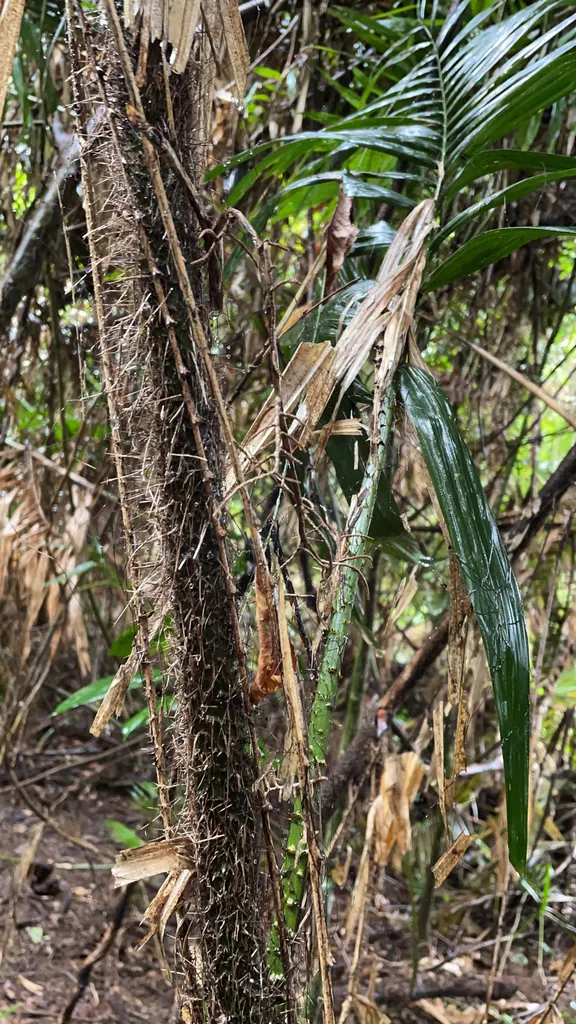
Lawyer cane is the climbing palm of the rainforest, Calamus. Its whip-like, hooked tendrils catch anyone walking past, which is why it is also called 'wait-a-while'[1][2]. Kuku Yalanji has several words for it. Mawar is 'the vine of the lawyer cane', milmarr is the 'edible lawyer cane' and kaku is the 'lawyer cane top'[3]. On the Bloomfield River the young shoots were eaten, the berries were made into a sour drink, and split cane became fire-tongs, fish-hooks, axe handles and lashings[4][5][6]. Further south it was the great basket and trap material of the rainforest peoples[7].
Names
Mawar is 'the vine of the lawyer cane'. The same word was later used for braces[3]. Milmarr is 'edible lawyer cane' and kaku is the 'lawyer cane top'[3].
Roth's Bloomfield names match these closely. In his food-plant list, the large lawyer cane, Calamus australis, is milma on the Bloomfield, and the small lawyer cane, C. caryotoides, is karko[4]. Milma is clearly the dictionary's milmarr, which ties that word to C. australis. Karko may be Roth's spelling of kaku, but only speakers can confirm that. At Cooktown the Guugu Yimithirr name for C. australis was go-ra go-ra, and the fire-tongs made from it were called koragora after the plant[4][5].
Description
Lawyer canes are climbing palms with thin, smooth, glassy stems up to about 2 cm thick[1]. In the large lawyer cane (C. australis), the leaf bases bristle with straight spines. The leaves are a metre or more long, with 34–40 leaflets. From the leaf bases grow long climbing tendrils armed with backward-pointing hooks. The round fruits, about 15 mm long, are covered in neat diamond-shaped scales like shingles[1]. The fish-tail lawyer cane (C. caryotoides) is smaller. It has only 6–12 leaflets, with jagged, fishtail-like tips, and the leaf sheaths are 'densely clothed in long dark irritant spiny hairs'. Its scaly fruits are 9–10 mm across, with an acidic pulp around a single seed[8].
Where it grows
C. australis grows only in Queensland, in gallery forest and in lowland, upland and mountain rainforest on many kinds of rock, from near sea level to 1600 m[1]. C. caryotoides grows on Cape York Peninsula and in North East Queensland. It 'usually grows in the drier more seasonal rain forests and monsoon forest', from sea level to 1500 m[8]. Both are at home across the rainforest country of the Mossman, Daintree and Bloomfield rivers, where Roth recorded them by their Kuku Yalanji names[4].
Western Yalanji country. Lawyer cane is a rainforest plant, not an open-woodland one. On the dry western side, look for it where rainforest holds on: gallery forest along permanent streams, where C. australis grows, and pockets of drier seasonal vine forest, which suit C. caryotoides[1][8].
Uses
Food and medicine (Bloomfield). The young shoots of the small lawyer cane were eaten on the Bloomfield[4]. They were also believed to cure headache[9]. The berries of the large lawyer cane were squashed in a bark trough and mixed with water to make an unfermented, sour drink[4]. At Atherton, among the peoples Roth called Chirpal and Ngatoban, the young growing point of C. moti was roasted, skinned and hammered before eating[4].
Tools on the Bloomfield. Fire-tongs were made from a split piece of lawyer cane bent double. They were used to pick up hot ashes and the hot stones for the earth oven[5][6]. The thorn of C. australis made the hook for freshwater lines, used for turtle, eelfish, catfish and perch[6]. Stone axe heads were hafted on a handle made of a piece of large lawyer cane, tied with bark fibre or sinew and gummed with beeswax and resin. A hooked swab of lawyer cane drew honeycomb out of a tree hollow[6]. Canoe outriggers were lashed on with lawyer vine. Huts were sometimes thatched with lawyer-palm leaves[6].
Play. On the Bloomfield children swung on a hanging lawyer cane cut 2½–3 ft (about 75–90 cm) above the ground, running and jumping at it[10].
Baskets and traps (neighbouring rainforest peoples). In the Cairns, Atherton and Tully districts, split lawyer cane was woven into the two-horned 'bicornual' baskets used for leaching nuts in running water, and into fish and wallaby traps[5][7][2]. At Atherton, black bean chips were left overnight in a lawyer-cane dilly bag in the creek[4]. On the Russell and Tully rivers, scrub-turkey traps were built of lawyer-cane hoops[4]. On the Bloomfield, the main bags were of black palm, grass and fig fibre[6]. Today Kuku Yalanji weaver Delissa Walker uses lawyer cane together with black palm in her kakan dilly bags[11].
How it was done
Cleaning and splitting cane, as Roth recorded it in the Atherton and Cairns districts[7]:
- Rub a length of stem all round with a stick to knock off the prickles.
- Grip the cleaned part in the left hand. With the right hand, pull the next ring of leaves sharply downwards while twisting. The leaves and the outer skin of the stem come away together.
- Keep dragging more cane down and cleaning it the same way until you have 12–14 ft (about 4 m).
- Cut it free. Split it by biting through the end and pulling the halves apart by hand.
- Split finer strands with the thumbnail or a mussel shell.
Fire-tongs, Bloomfield River[5][6]:
- Take a split length of lawyer cane.
- Bend it double so that the two ends meet like tongs.
- Use them to lift hot ashes, and to lift the heated stones out of the fire and into the earth-oven pit.
- Make the line from the bark fibre of Sterculia.
- Tie on a hook made from a lawyer-cane thorn.
- Bait it with grubs, small freshwater prawns or small frogs. Fish creeks and waterholes for turtle, eelfish, catfish and perch. Line-fishing was mostly women's work.
A fish or wallaby trap, Cairns and Atherton districts (not Kuku Yalanji country). Such a trap took three to four hours to make[7]:
- Sort the split cane strips into lengths.
- Bend three or four of the frame strands sharply to make the pointed end.
- Weave two continuous cane strands in and out around them in a spiral, adding frame strands as the cage widens towards the mouth.
- For a fish trap, cut the free ends level at the mouth and bend them outwards. For a wallaby trap, shape the top and sides into a projecting hood.
Safety
The tendrils of the large lawyer cane carry rows of backward-pointing hooks[1]. The name 'wait-a-while' says what to do when one catches you: stop, step back and unhook it, rather than pushing on and tearing skin and clothes[2]. The leaf sheaths of the fish-tail lawyer are clothed in irritant spiny hairs[8], so wear gloves or clean the cane first, as Roth describes. Roth's records of lawyer-cane foods are history, not tested recipes. Learn which canes and which parts are eaten from people who know.
On Country today
Most of the lawyer-cane rainforest between the Daintree and Bloomfield rivers is in national parks returned to Eastern Kuku Yalanji ownership on 29 September 2021 and jointly managed with the Queensland Government[12]. Native title holders may gather for personal, domestic and communal needs without permits under s 211 of the Native Title Act 1993[13]. Visitors need Traditional Owners' permission to cut cane, and park rules apply.
Language
mawar 'the vine of the lawyer cane'; milmarr 'edible lawyer cane'; kaku 'lawyer cane top'; dibul 'cane'; karra 'rope, cord, string'. Bangkal is 'tongs made from voya vine, used in cooking in a kurrma', and yibuy is 'loya cane', whose roots made walking sticks[3]. 'Loya' and 'voya' look like local spellings of 'lawyer', but the sources do not say whether yibuy is a Calamus or another climbing plant. Speakers can settle it.
Images
References
- Australian Tropical Rainforest Plants (RFK8), Calamus australis (lawyer cane, wait-a-while, hairy Mary). CSIRO / Lucidcentral. apps.lucidcentral.org/rainforest/text/entities/calamus_australis.htm
- State Library of Queensland (blog), 'Keeping culture alive through weaving'. www.slq.qld.gov.au/blog/keeping-culture-alive-through-weaving
- Hershberger, H. D. & Hershberger, R. (1982). Kuku-Yalanji Dictionary. Work Papers of SIL-AAB, Series B, Volume 7. With Toby Bloomfield, Roy Friday, Billy Roberts, Hector and Doris Sykes, Joe Walker and others. www.sil.org/resources/archives/18038
- Roth, W. E. (1901). North Queensland Ethnography, Bulletin No. 3: Food — its search, capture, and preparation. Brisbane: Government Printer. Bloomfield River information from R. Hislop. — Plant list, 'Calamus australis', 'C. caryotoides', 'C. Moti'; 'Castanospermum australe'; sect. 25 scrub-turkeys archive.org/details/northqueensland00landgoog
- Roth, W. E. (1904). North Queensland Ethnography, Bulletin No. 7: Domestic implements, arts, and manufactures. Brisbane: Government Printer. — Sect. 10 Fire-tongs; sect. 53 baskets; sect. 59 bi-cornual carriers archive.org/details/northqueensland00landgoog
- Anderson, C. (1996). Traditional material culture of the Kuku-Yalanji of Bloomfield River, North Queensland. Records of the South Australian Museum 29(1): 63–83. Based on fieldwork at Wujal Wujal in the late 1970s and early 1980s. — Fishing; gathering (honey, axes); cooking processes, pp. 68–75 archive.org/details/RecordsSouthAus29Sout
- Roth, W. E. (1901). North Queensland Ethnography, Bulletin No. 1: String, and other forms of strand: basketry-, woven bag-, and net-work. Brisbane: Government Printer. — Sect. 6 (Calamus, cleaning and splitting); sect. 29 (fish- and wallaby-traps) archive.org/details/northqueensland00landgoog
- Australian Tropical Rainforest Plants (RFK8), Calamus caryotoides (fish-tail lawyer cane). CSIRO / Lucidcentral. apps.lucidcentral.org/rainforest/text/entities/calamus_caryotoides.htm
- Roth, W. E. (1903). North Queensland Ethnography, Bulletin No. 5: Superstition, magic, and medicine. Brisbane: Government Printer. — Medicine, 'Calamus caryotoides' (Bloomfield River) archive.org/details/northqueensland00landgoog
- Roth, W. E. (1902). North Queensland Ethnography, Bulletin No. 4: Games, sports and amusements. Brisbane: Government Printer. — Plants, sect. 5 (swinging on the lawyer-cane, Bloomfield) archive.org/details/northqueensland00landgoog
- Cairns Art Gallery, Artist showcase: Delissa Walker (Kuku Yalanji), Kakan (dilly bag), 2017, black palm and lawyer cane. www.cairnsartgallery.com.au/art-artists/artist-showcase/delissa-walker
- Queensland Government (29 September 2021). Ministerial media statement: Daintree, Ngalba-bulal, Kalkajaka and Hope Islands National Parks returned to Eastern Kuku Yalanji Traditional Owners as Cape York Peninsula Aboriginal Land, to be jointly managed. statements.qld.gov.au/statements/93360
- Australian Law Reform Commission (2014). Review of the Native Title Act 1993, Discussion Paper 82, ch. 8: Relevant provisions in the Native Title Act (s 211, preservation of native title hunting, fishing, gathering and cultural activities). www.alrc.gov.au/publication/review-of-the-native-title-act-1993-dp-82/8-the-nature-and-content-of-native-title/relevant-provisions-in-the-native-title-act/