Trees
Red cedar
marrakanToona ciliata
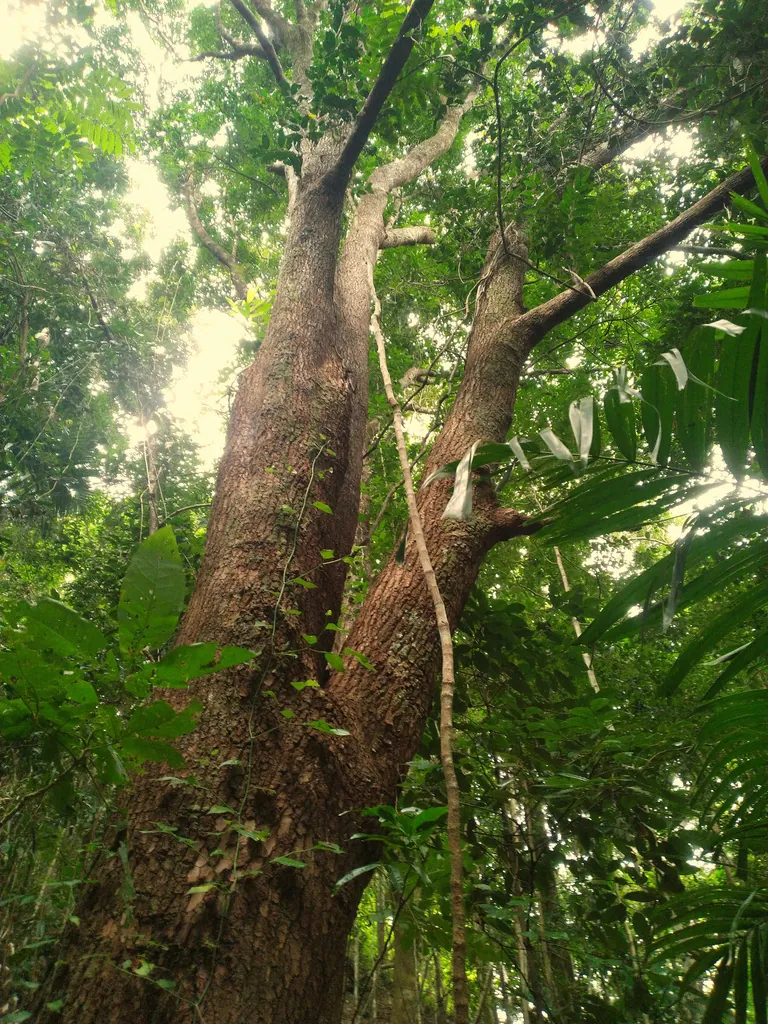
Marrakan is the red cedar tree (Toona ciliata), and the same word means a 'dugout canoe made of red cedar wood'[1]. Its soft, light, durable timber made it, with candlenut and cotton tree, a favourite for the hulls of the Bloomfield outrigger canoes, which were up to seven metres long and could carry six or seven people, or two men and two large turtles[2]. The same timber brought the cedar-getters: Daintree village was first settled in the late 1870s and early 1880s by timber workers after red cedar[3]. Red cedar is deciduous, standing bare from June to August[4].
Names
The dictionary gives marrakan for the 'red cedar tree', and the same word for a 'dugout canoe made of red cedar wood'[1]. Anderson confirms that red cedar, which he calls by its older botanical name Toona australis, was one of the most favoured canoe timbers on the Bloomfield coast[2]. Other 'cedars' have their own names: pencil cedar is milbanku or mirrbangku[1]. Cedar Bay is Mangkalba[1]. Roth's food and implement lists do not record a word for red cedar.
Description
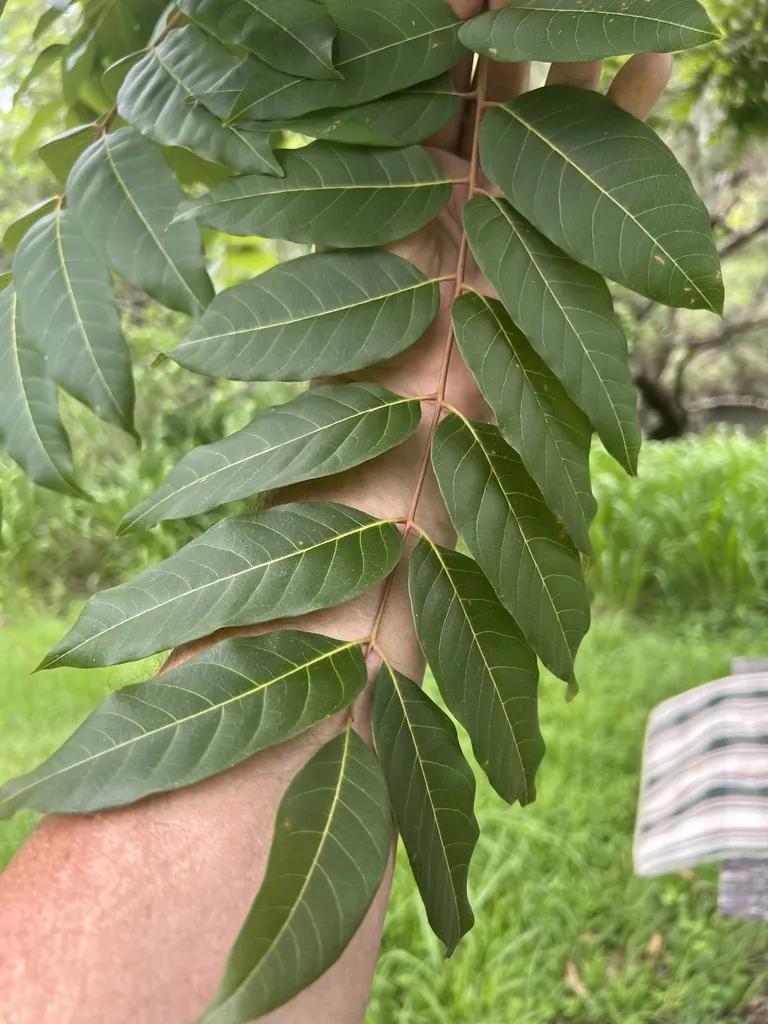
A big rainforest tree with compound leaves. Freshly broken twigs smell of incense, and a cut in the bark (the blaze) and the wood have 'a faint but rather pleasant aroma (cigar box or incense)'[4]. The leaflets are about 9–13 cm long and 2.5–5 cm wide; new leaves come out pink-red[4]. Small flowers hang in long sprays, often 30–40 cm long. The fruit is a small capsule, 15–20 mm long, that splits to release seeds with a wing at each end[4]. The timber is soft, durable and easy to work, and the logs float[4].
Where it grows
Red cedar grows in well-developed rainforest, especially upland forest on basalt soils, from near sea level to 1000 m, from Cape York Peninsula down to south-eastern New South Wales[4]. On Eastern Kuku Yalanji country it grew in the rainforest of the Daintree valley, where there were sizeable stands[3], and along the Bloomfield coast, where people cut it for canoes[2].
On Western Yalanji country it belongs to the rainforest on the ranges, not to the open woodland of the Mitchell River. Herbarium specimens come from the rainforest of the Mount Windsor Tableland, north of Mount Carbine[5].
Seasons
Red cedar is deciduous: it stands leafless between June and August, in the cool dry season, then puts out a flush of pink-red new leaves[4].
Uses
Canoes. The Bloomfield people used outrigger canoes with a single outrigger on the starboard side. Candlenut, red cedar and a cotton tree 'seem to have been most favoured on the Bloomfield coast' for the dug-out hull[2]. The canoes were up to seven metres long and could carry six or seven people, or two men and two large turtles[2]. Roth describes the Bloomfield dug-outs as differing from the Cape Bedford and Flinders Island type only in having no wash-boards along the gunwale[6]. Phillip Parker King saw several of these canoes at Bloomfield in 1819 and 1821, and a 1904 photograph shows Kuku Yalanji people in outrigger canoes on the Bloomfield River near Thompson Creek[2].
Sails. The dictionary says mararr, now 'cloth', was 'originally a sail made of plaited palm leaves'[1]. Anderson found no other evidence of sails, apart from police-issue blankets that Roth saw being used as canoe sails at Bloomfield in 1898[2].
After contact. Iron soon entered canoe-making: Roth found Bloomfield adzes with an iron blade wedged into a wooden handle, used for scraping out canoes[2]. A traditional canoe was still seen at Bloomfield in the early 1960s, but by the Second World War wooden dinghies had mostly replaced the outrigger canoe[2].
Timber-getting. Red cedar was the timber that opened the Daintree to Europeans. Daintree village was first settled in the late 1870s and early 1880s by timber workers after red cedar, and they moved the logs down the river to the coast on lashed rafts[3].
How a dug-out canoe was made
Pieced together from Anderson's Bloomfield account[2] and Roth's description of the Cape Bedford canoe, which he says the Bloomfield canoe matched except for the wash-boards[6]:
- Fell the tree with stone axes[2].
- Shape the ends into bow and stern. The wider butt end of the trunk becomes the bow[6].
- Hollow the trunk: burn out the inside and scrape it clean with adzes[2]. Roth describes the same work done with fire and 'native gouges'[6].
- Make the float for the outrigger from a lighter, more buoyant wood than the hull. At Cape Bedford, light driftwood cast up on the beach was saved for floats[6].
- Fit the booms. On the Bloomfield the outrigger booms pass straight through the gunwale. They go in pairs, four to eight pairs depending on the size of the canoe, and each pair is lashed — one above, one below — to the angle of two crossed pegs set into a single mortice in the float[6]. The outrigger sits on the starboard (right) side and was lashed on with lawyer vine[2].
- Make the paddles (birungubay) from the wood of the mangrove Xylocarpus granatum, and carry a bailer shell to keep the water out[2][1].
- Launch and travel. Pole the canoe through shallow water and paddle in deep water[2]. At Cape Bedford Roth saw three people drag a canoe down to the water and pole it out, one pole at the bow and one at the stern, until it was deep enough to paddle[6].
Safety
The botanical sources consulted record no poison in red cedar itself[4]. Be careful with other 'cedars', though. Kuku Yalanji people say the smoke of brown cedar (Canarium australasicum) causes blindness, as does the smoke of the mangrove Excoecaria agallocha, so neither should be burnt as firewood[2]. Roth notes that brown cedar was also called 'Mackay cedar' on the Bloomfield[7] — not the same tree as marrakan. Canoe-making itself meant felling big trees and burning them out, heavy and dangerous work best learnt from people who have done it.
On Country today
Red cedar is not listed as threatened; as a native plant it is 'least concern' wildlife under Queensland's Nature Conservation Act[8]. The Daintree's cedar stands were cut over by timber-getters from the late 1870s[3]; much of the rainforest where cedar grows is now national park.
Much of Eastern Kuku Yalanji country is now Aboriginal land. On 29 September 2021 more than 160,000 ha, taking in the Daintree, Ngalba-bulal, Kalkajaka and Hope Islands national parks between Mossman and Cooktown, was handed back to the Eastern Kuku Yalanji people, to be jointly managed with the Queensland Government through the Queensland Parks and Wildlife Service[9]. Under section 211 of the Native Title Act 1993, native title holders do not need a licence or permit to hunt, fish or gather for their personal, domestic or non-commercial communal needs[10]. Everyone else needs the Traditional Owners' permission to take anything from country, and park rules apply.
Language
Words for canoes and their gear: kaljan 'outrigger canoe'; birungubay 'paddle, oar'; warkal 'bailer shell used in the old time for a billy'; mararr 'cloth', originally a palm-leaf sail; kulbanmuku 'axe, originally a stone axe'; and wawuburra 'cottontree', the other canoe tree[1].
Images
References
- Hershberger, H. D. & Hershberger, R. (1982). Kuku-Yalanji Dictionary. Work Papers of SIL-AAB, Series B, Volume 7. With Toby Bloomfield, Roy Friday, Billy Roberts, Hector and Doris Sykes, Joe Walker and others. www.sil.org/resources/archives/18038
- Anderson, C. (1996). Traditional material culture of the Kuku-Yalanji of Bloomfield River, North Queensland. Records of the South Australian Museum 29(1): 63–83. — Watercraft; firewood; post-contact material culture change hdl.handle.net/2440/13994
- Wikipedia. Daintree, Queensland (history). en.wikipedia.org/wiki/Daintree,_Queensland
- Australian Tropical Rainforest Plants (RFK8), Toona ciliata. CSIRO / Lucidcentral. apps.lucidcentral.org/rainforest/text/entities/toona_ciliata.htm
- Queensland Herbarium (BRI) specimen AQ0763689, Toona ciliata, collected 2003, 'SF 144 Mt Windsor Tableland'. Atlas of Living Australia. biocache.ala.org.au/occurrences/6bfda614-3e4f-4811-b834-a51657ddacdb
- Roth, W. E. (1910). North Queensland Ethnography, Bulletin No. 14: Transport and trade. Records of the Australian Museum 8(1). — Sects. 11–17, dug-out canoes archive.org/details/biostor-52863
- Roth, W. E. (1904). North Queensland Ethnography, Bulletin No. 7: Domestic implements, arts, and manufactures. Brisbane: Government Printer. Bloomfield River information from R. Hislop. — Sect. 13, gums, resins and cements, 'Canarium australasicum' archive.org/details/northqueensland00landgoog
- Nature Conservation (Plants) Regulation 2020 (Qld), current as at 22 May 2026. — Sch. 1 pt 2 div 7 s 25 (least concern wildlife); sch. 2 (special least concern plants) www.legislation.qld.gov.au/view/pdf/inforce/current/sl-2020-0137
- Australian Geographic (September 2021). Daintree handed back to Traditional Owners. www.australiangeographic.com.au/news/2021/09/daintree-handed-back-to-traditional-owners/
- Australian Law Reform Commission. Review of the Native Title Act 1993 (DP 82), ch. 8: Relevant provisions in the Native Title Act (s 211). www.alrc.gov.au/publication/review-of-the-native-title-act-1993-dp-82/8-the-nature-and-content-of-native-title/relevant-provisions-in-the-native-title-act/