Skills & methods
Leaching poisonous plant foods
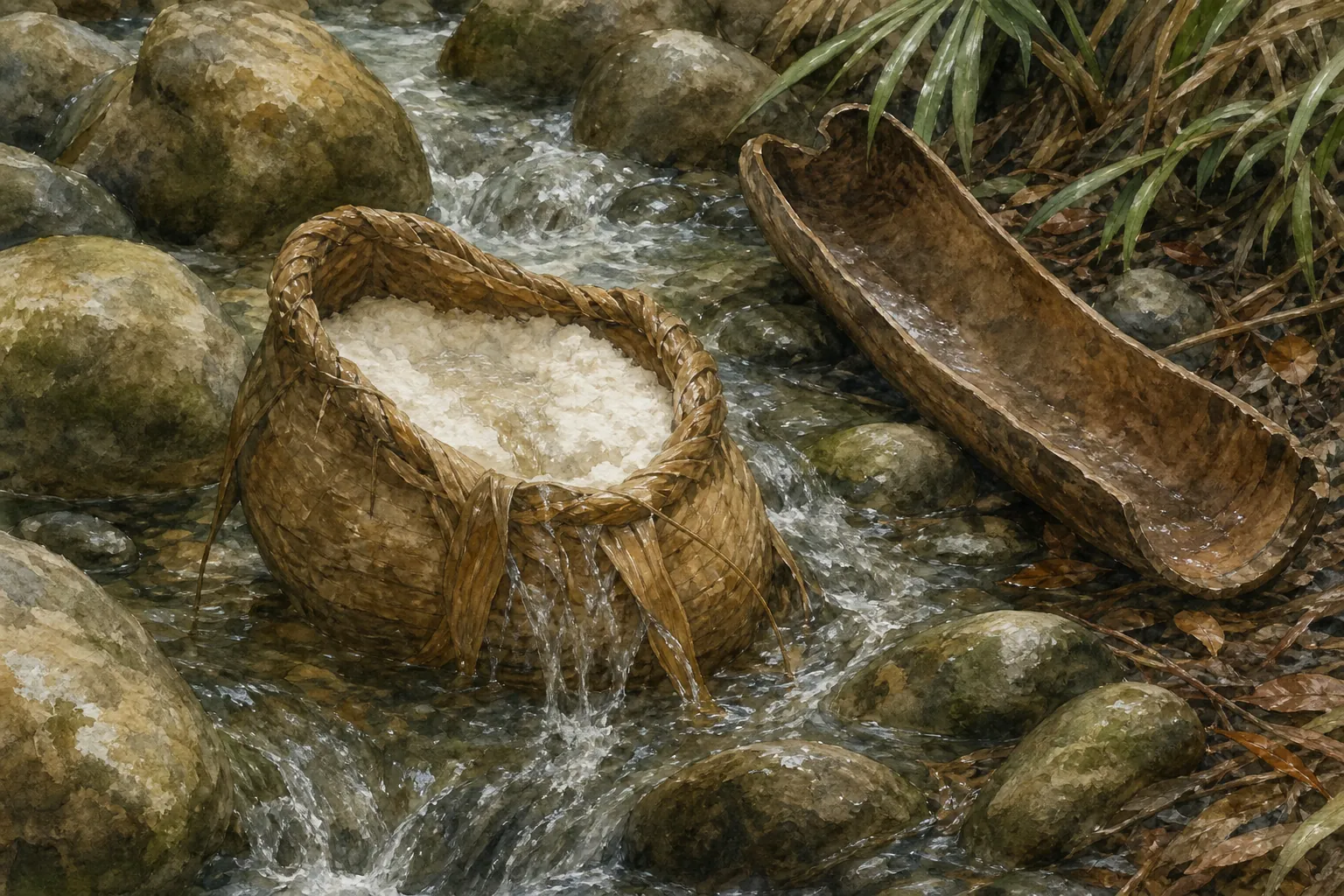
Leaching is how Kuku Yalanji people made poisonous plant foods safe to eat. The food was cooked, broken down very fine, sifted, and then washed in running water or in bark troughs of fresh water until the bitter taste, which is the poison, was gone. The dictionary's word is ngabal 'soak, leach'[1]. It was used for zamia, black bean, the hairy yam, bujabay, wild plums and mangrove fruits[1][2][3].
Safety first: these foods are poisonous until properly prepared. A short cut, such as coarse meal, too little water, still water or too short a time, can leave enough poison to make someone very sick. This page records how it was done. It is not a recipe to try from a book.
Names
Ngabal is 'soak, leach' and julurril is 'to wash something'. Nyurrbal is 'to grind, sharpen', and meal ground properly is dirka 'fine, finely ground'. The taste that leaching removes is marrbal 'sour, bitter taste', and kuli means 'poison' as well as 'anger' and 'trouble'[1]. Anderson recorded jinali, the dictionary's 'smooth rock', as the name of the flat creek-side grinding rocks with small hollows that were used every year at zamia camps[2][1].
The dictionary marks many foods as needing this treatment. Marra, the zamia nut, is 'roasted, ground and leached to make flour'. Julbin, the scrub zamia, is 'edible when ground and leached with water'. Wukay, the hairy yam, 'must be cooked, ground and leached before eating'. Biyangkal must be 'leached for a couple hours in many changes of water'. The fruit of bujabay 'must be leached (in water)'. Junda and jundul are wild plums that are poisonous unless leached. The fruit of the mangroves kajul and kakaji must be soaked or leached[1].
Description
Every recorded method has the same four stages:
- Cook the food by roasting, baking in the ashes or an earth oven, or steaming.
- Break it down by pounding, grinding, mashing, or cutting it into very fine chips or slices.
- Sift or strain it through a dilly bag.
- Wash it in running water, or in fresh water that is changed again and again.
The fineness matters. On the lower Tully River, black bean that was 'not sliced up very fine' kept its bitter taste[3]. So does the water. A creek or a steady trickle keeps carrying the poison away. In a trough, the water has to be poured off and replaced many times.
Where it was done
Leaching was done beside water. The Bloomfield zamia camps were set up 'ideally beside a shallow, but fast-flowing section of creek' next to the jinali grinding rocks. In the dry season these camps could hold up to 100 people, the women processing while the young men brought in meat and honey[2]. Yams were taken 'near a small, rapid creek'[2]. On the coast, mangrove food was finished in basin-shaped holes in the sand, 'often to be noticed along the coast-line' near the mangrove swamps[3].
Upper Mitchell. The zamia Cycas media has been collected in the dry country about 25 km north of Mount Carbine[4], but the Atlas holds no Cycas records within 30 km of Karma Waters[5]. Edward Palmer recorded a related technique from the Mitchell, Lynd and Pennefather rivers. Typhonium tubers were 'roasted and broken with a stone, pounded a good deal, and roasted several times before using', with no washing[3]. Western Yalanji people hold the knowledge of which foods were treated on this country.
Seasons
On the Bloomfield, zamia was 'fit to eat from July to January'[3], and Anderson puts the big processing camps in the mid to late dry season[2]. The hairy yam was the main food from about mid-February to mid-May, the wet season[3]. Nuts could be stored for up to two months. In the wet, that meant fewer trips away from camp in heavy rain and flood[2].
Food by food
- Zamia (marra), Bloomfield. Roast the nuts and crack them. Keep the kernels four or five days, then pound or grind them to flour. Sift through a palm-fibre bag. Put the flour in a grass bag folded into a basin beside a stream, and lead water into it along a channel of leaves so that it percolates 'right through the night'. Ready by morning, it keeps three or four days but no longer[3][2]. The dictionary records another way, kajimarra: the food is 'rolled in junjun leaves and left in water for several weeks, then ground and roasted'[1].
- Black bean (baway). On the Bloomfield it was baked, pounded, sifted and washed in a bark trough like the yam[3][2]. At Atherton it was baked from sunrise to midday, cut into very fine chips and left overnight in a lawyer-cane bag in a running creek. On the lower Tully it was steamed, sliced very fine and left in bags in a stream for 'quite a couple of days'[3].
- Hairy yam (wukay). Bake about four hours, mash in a palm-fibre bag over a bark trough, and strain. Then fill the trough, let it settle and pour off the water, 'seven or eight waters' in all. Eat it the same day[3][2]. Biyangkal needs 'a couple hours in many changes of water'[1].
- Bujabay. Anderson identifies it as Endiandra palmerstonii, Queensland walnut: roasted on the fire, pounded, sifted in a dilly bag and leached[2].
- Wild plums (junda, jundul). The sources disagree. The dictionary says junda 'is poisonous and must be leached before eating'[1]. Roth's Bloomfield junda (Pygeum turnerianum, in season January to March) was pounded whole, sifted through a palm bag, kneaded into cakes, wrapped in wild-ginger leaves and baked in the ashes[3]. Anderson's table marks it as not leached[2]. Jundul is not identified.
- Mangrove fruits (kajul, kakaji). Neither species is identified. Roth's entries for neighbouring mangroves, which carry Guugu Yimithirr names from Cooktown and Cape Bedford, show the methods. Avicennia fruit was baked, then washed in a sieve-bag. The long seedlings of Bruguiera were baked, pounded, skinned and washed four or five times in a bark trough, then drained in a sand hole. On the lower Tully, Bruguiera gymnorrhiza was baked, sliced and soaked all night[3].
How it was done: the Bloomfield trough method
This is the hairy-yam method, the fullest Kuku Yalanji account (Roth from R. Hislop[3]; Anderson from Kuku Yalanji teachers[2]):
- Go to a small, fast creek with the food, a palm-fibre dilly bag and bark troughs.
- Clean the food, removing dirt and roots.
- Cook it in a stone earth oven for about four hours, until soft, and let it cool.
- Mash it by hand inside the bag, holding the bag over a bark trough. Pour water through, mash again and strain, until only fibre and skin are left in the bag. Throw that away.
- Fill the trough with water, stir, and let it stand about half an hour until the food settles and the water clears.
- Watch for the oily film. 'Within a short time, an oily substance appeared on top of the water. This was said to be the ‘poison’'[2]. Pour it off with the water.
- Add fresh water and repeat, for several hours, 'until the water was completely free of the oil and any bitter taste gone'[2]. Roth says it can take seven or eight waters[3].
- Drain it in a hole about a metre across, lined with clean white sand, with a rolled leaf in the bottom to carry the water away[2].
- Eat it that day. It ferments quickly[3].
Containers. The palm-fibre bag has the finest mesh and was the sieve. The grass bag, folded into a basin, was the colander for running water[3]. Bark troughs, the dictionary's dubal 'coolamon' (Roth's Bloomfield tu-bal), were made of eucalypt or other bark[6][1][2]. Leaves of pandanus or wild ginger made a trough to lead water into the bag[2].
Safety
- Raw means poisonous. The dictionary calls junda and kakaji poisonous until leached, and Anderson calls the hairy yam 'otherwise toxic'[1][2].
- The oily-film and bitterness checks are traditional signs, not laboratory tests. They were used by experienced people who knew each plant. Do not rely on taste alone, and never feed experimental batches to children.
- Each food has its own method. Some yams need only roasting, others hours of washing[2]. Mistaking one plant for another is the main danger.
- Prepared food spoils. Yam mash ferments within the day, and zamia flour keeps only three or four days[3].
- Smoke can poison too. The smoke from roasting jinjay nuts is poisonous[1].
Learn these methods hands-on from Traditional Owners who still hold them.
On Country today
In 1982 Bloomfield women still processed hairy yam in bush camps. They boiled it in empty metal flour drums and separated the poison in plastic buckets, but still did the first mashing in palm-fibre dilly bags[2]. The jinali grinding stones were still in place at several sites, though unused for thirty or forty years[2]. They are cultural heritage, and Queensland law gives everyone a duty of care not to harm Aboriginal cultural heritage[7]. Native title holders' gathering for personal, domestic or non-commercial communal needs is protected from licence and permit requirements by section 211 of the Native Title Act 1993[8].
Language
Nyangarril 'pour, spill'; dindal 'to roast on coals'; kurrma 'earth oven'; banjay, a small round wild yam 'roasted in the fire, ground up and eaten'; balja, 'a kind of food. It is cooked in the fire, ground up and eaten'[1].
References
- Hershberger, H. D. & Hershberger, R. (1982). Kuku-Yalanji Dictionary. Work Papers of SIL-AAB, Series B, Volume 7. With Toby Bloomfield, Roy Friday, Billy Roberts, Hector and Doris Sykes, Joe Walker and others. www.sil.org/resources/archives/18038
- Anderson, C. (1996). Traditional material culture of the Kuku-Yalanji of Bloomfield River, North Queensland. Records of the South Australian Museum 29(1): 63–83. Based on fieldwork at Wujal Wujal in the late 1970s and early 1980s. — 'Preparation of cycad nuts'; Table 2, nut species eaten at Bloomfield; 'Yam preparation'; 'Cooking processes' (bark troughs); 'Bloomfield since 1873' archive.org/details/RecordsSouthAus29Sout
- Roth, W. E. (1901). North Queensland Ethnography, Bulletin No. 3: Food — its search, capture, and preparation. Brisbane: Government Printer. Bloomfield River information from the Hislops. — Plant list ('Avicennia officinalis', 'Bruguiera', 'Castanospermum australe', 'Cycas media', 'Dioscorea sativa', 'Pygeum Turnerianum', 'Typhonium angustilobum') archive.org/details/northqueensland00landgoog
- Queensland Herbarium (BRI) specimen AQ0832928, Cycas media subsp. banksii, collected 2012 at about 16.3°S 145.1°E. Atlas of Living Australia. biocache.ala.org.au/occurrences/d7280064-c270-44c4-89f3-8430e68aa419
- Atlas of Living Australia. Occurrence records within 30 km of the Karma Waters homestead (16.618° S, 144.605° E) for the genera Lomandra, Ficus, Brachychiton, Hibiscus, Sterculia and Cycas, queried 6 October 2026. biocache.ala.org.au/occurrences/search?q=genus:Lomandra&lat=-16.6179&lon=144.6047&radius=30
- Roth, W. E. (1904). North Queensland Ethnography, Bulletin No. 7: Domestic implements, arts, and manufactures. Brisbane: Government Printer. — Sect. 58 'The pleat-type of bark trough' (Bloomfield tu-bal) archive.org/details/northqueensland00landgoog
- Aboriginal Cultural Heritage Act 2003 (Qld), sections 23–25 (cultural heritage duty of care; harming, excavating, relocating or taking away Aboriginal cultural heritage). www.legislation.qld.gov.au/view/html/inforce/current/act-2003-079
- Australian Law Reform Commission. Review of the Native Title Act 1993 (DP 82), ch. 8: Relevant provisions in the Native Title Act (s 211). www.alrc.gov.au/publication/review-of-the-native-title-act-1993-dp-82/8-the-nature-and-content-of-native-title/relevant-provisions-in-the-native-title-act/