Insects & honey
Witchetty grubs and green ants
mujurr · jambun · kuran · jiljay · kurran · durra · munjurr · kurrmaja · kalbalWood-boring larvae of beetles and moths (mujurr is a beetle larva); Oecophylla smaragdina (green tree ant)
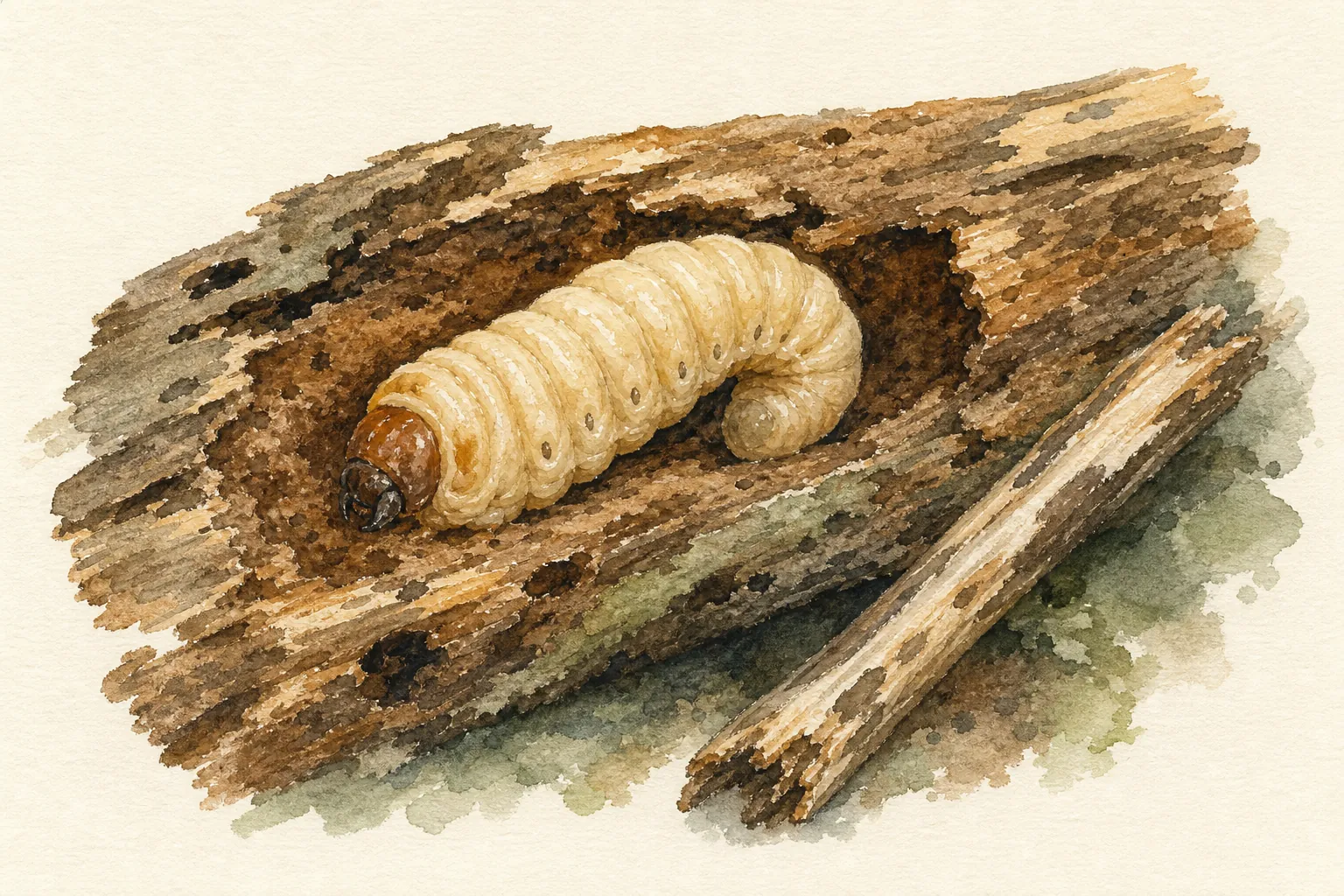
Mujurr is the fat white grub found in rotting wood, which turns into the beetle ngirran[1]. Kuku Yalanji also names a grub of green wood (kuran, a case-moth larva), a grub found in antbed (jiljay) and one in dry grass trees (kuru)[1]. Grubs were hooked out with a stripped lawyer-cane feeler or cut out of soft timber, then eaten raw or roasted[2][3]. The nests of the green ant, munjurr, gave food and medicine. On the Bloomfield River the ants and their eggs were squeezed into water, saltwater for preference, and the milky liquid was sopped up with chewed grass[2]. The dictionary records the green-ant mixture kalbal as a remedy for chest sickness and colds[1].
Names
Mujurr is the 'witchetty grub found in rotting wood', and jambun is the Mareeba dialect word for it[1]. The dictionary gives ngirran for the 'beetle fully developed from mujurr', and calls dili, the corkwood pine, 'the tree from which witchetty comes'[1]. Other grubs: kuran, the edible larva of a case moth found in green wood; jiljay, a grub found in antbed; kuru, a grub found in dry grass tree; kurran, 'kind of grub'; bikarrakal, a grub used for bait; and durra, 'caterpillar, worm'[1].
For green ants the dictionary has munjurr and yangka 'green ant', nyirran 'the big green ant that is eaten', kurrmaja 'larvae of green ants', and kalbal, the medicine made from them[1]. Roth recorded the Bloomfield name of a chrysalis found in green-ant nests as bi-i bi-i (Roth's 1901 spelling)[2].
Description
In English, 'witchetty' first meant the Central Australian grub of the cossid wood moth Endoxyla leucomochla. It is now used for any fat, white, wood-boring grub, including those of other wood moths, swift moths and, in eastern Australia, longicorn beetles[4]. Because the dictionary says mujurr grows into a beetle, ngirran, mujurr is a beetle grub[1].
The big moth grubs of the coast are different. The giant wood moth, Endoxyla cinereus, lives in living eucalypts along the Queensland coast. Its larvae grow up to 15 cm long and 2–3 cm wide and feed for about two years in J-shaped tunnels. A pile of coarse, sawdust-like frass at the foot of the tree and a frass-covered hole in the trunk give it away[5].
The green tree ant, Oecophylla smaragdina, is very common in far north Queensland. It builds nests in trees by sticking leaves together at the ends of branches. It bites rather than stings, then sprays formic acid into the bite[6]. Inside the nest are the white eggs, larvae and pupae, kurrmaja[1].
Where they are found
Mujurr comes from rotting logs and stumps, and kuran from green, living wood[1]. Jiljay is found in antbed, and kuru in dry grass trees, so these grubs belong to the open woodland as much as to the rainforest[1]. The black ant jabarrangkul also nests in rotten logs[1].
For dry inland country like Western Yalanji's, Roth noted E. Palmer's report that people on the Mitchell River ate a grub found in galls at the tips of young Eucalyptus tetrodonta and E. corymbosa trees[2]. Jambun, the Mareeba word, also shows that grubs were named and eaten on the drier tablelands[1]. Green ants nest in trees across the region, in rainforest edges, gardens and open forest[6].
Seasons
The dictionary says nyirran, the big green ant that is eaten, comes in December and January[1]. Giant wood moths come out of their trees through the summer, usually after heavy rain[5], so a tree with a fresh exit hole has already lost its grub.
Uses
Food. Grubs were eaten raw or roasted. On the lower Tully River Roth saw both[2]. In the Boulia and Cloncurry districts, small grass grubs and caterpillars were eaten raw and whole. The bigger tree grubs were roasted, with the heads left uneaten, or dried in the sun and kept for later[2]. Large wood-boring grubs are a rich source of protein[4].
Bait. Bikarrakal is 'a kind of grub used for bait'[1].
Green ants as food and medicine. Roth found green ants and their larvae eaten by men and women, and also used as medicine for diarrhoea, headache and the like at Princess Charlotte Bay, Cooktown and the Bloomfield[2]. Elsewhere he called them 'a very common remedy everywhere' for anything from diarrhoea to coughs and colds[7]. The Kuku Yalanji dictionary is specific. Green ants are a medicine for the common cold and other chest complaints. They can be crushed and the smell breathed in to cure a headache, or the eggs, larvae and pupae can be mixed with salt water and drunk[1]. Kalbal is that mixture, 'eaten for chest sickness and the common cold'[1].
How grubs and green ants were gathered and prepared
Hooking a grub with a lawyer feeler (Rockingham Bay, quoted by Roth[3]):
- Cut a lawyer-cane feeler, which can be had up to 10 feet long.
- Strip off all the prickles except one at the tip.
- Push the feeler gently into the hole the grub has made. It is pliable enough to follow the bends of the tunnel.
- When it stops, you have reached the grub.
- Keep pressing and turning for a few moments, then draw it out slowly. The grub comes out hooked on the spine.
Cutting grubs out of rotten wood. On the lower Tully people sawed into soft, rotten timber with a length of lawyer cane, using it like a crosscut saw, and then broke the wood open[2]. On the Pennefather River a club cut from a mangrove root was used to splinter up rotten timber that held edible grubs[3]. Look for a log that is soft and riddled, the kind of wood the dictionary says mujurr is found in[1].
Cooking. Eat the grub raw, or roast it in the hot ashes[2].
Green ants, the Bloomfield way (from Hislop's account, in Roth[2]):
- Pull down the nest and shake everything out onto a piece of bark or a large leaf.
- Knead it lightly so that the grown ants cannot get away.
- Squeeze the mass of crushed ants and eggs into a trough of water. The water turns milky.
- Use saltwater rather than fresh if you can. It is preferred.
- Sop up the liquid with chewed grass, and eat what is left of the ants and eggs.
- Eat the queens whole, without squashing them. A nest with more eggs than ants is the best eating.
- If you find the chrysalis of the moth-butterfly Liphyra in the nest, keep it. The Bloomfield people counted it a great delicacy[2].
At Cooktown and Princess Charlotte Bay the nest was cut down and opened on a rock so the ants scattered and left the white larvae behind. Remaining ants were brushed off the arm, and the larvae were rolled into a ball between the palms and swallowed[2].
Safety
Green ants bite and spray formic acid, and they drop onto you from the branches when a nest is disturbed[6]. Keep them out of your eyes, and shake the nest well away from your face. Other ants are worse. The dictionary warns that some people have become sick and vomited after being bitten by the red jumper ant, karrkil[1]. Anyone with an insect allergy should treat a mass of biting ants with caution.
Rotten logs are shelter for other animals too, so look before you reach in. Cut grubs only from dead wood or trees you have the right to cut. In national parks, plants, animals and natural resources are protected and must not be disturbed[8].
On Country today
Grubs and green ants are still gathered on Country, and green-ant medicine is still known. Much of Eastern Kuku Yalanji country is now Traditional-Owner-owned national park, handed back in 2021 and jointly managed with the Queensland Parks and Wildlife Service[9]. Section 211 of the Native Title Act 1993 protects native title holders' gathering for personal, domestic or non-commercial communal needs from licence and permit requirements[10]. On Western Yalanji country the 2026 determination recognised rights to access Country, camp, hunt, fish and gather natural resources across most of the area[11]. Visitors need the Traditional Owners' permission, and on pastoral leases the landholder's as well.
Language
Ngirran 'beetle fully developed from mujurr'; jungu-jungu 'white ant eggs'; kabay 'small ant bed'; jawurraji 'large ant bed'; karrkil 'red jumper ant'[1]. Jambun is a Mareeba word, a reminder that the dialects of the tablelands and inland have their own vocabulary[1].
References
- Hershberger, H. D. & Hershberger, R. (1982). Kuku-Yalanji Dictionary. Work Papers of SIL-AAB, Series B, Volume 7. With Toby Bloomfield, Roy Friday, Billy Roberts, Hector and Doris Sykes, Joe Walker and others. www.sil.org/resources/archives/18038
- Roth, W. E. (1901). North Queensland Ethnography, Bulletin No. 3: Food — its search, capture, and preparation. Brisbane: Government Printer. Bloomfield River information from the Hislops. — Sect. 10 'Ants'; sect. 12 'Other insects, grubs, caterpillars' archive.org/details/northqueensland00landgoog
- Roth, W. E. (1904). North Queensland Ethnography, Bulletin No. 7: Domestic implements, arts, and manufactures. Brisbane: Government Printer. — 'Prodder, lawyer-feeler'; Pennefather River mangrove-root club archive.org/details/northqueensland00landgoog
- Australian Museum. Witchetty grubs (Bugwise). australian.museum/learn/teachers/learning/bugwise/witchetty-grubs/
- Business Queensland. Giant wood moth (Endoxyla cinereus). www.business.qld.gov.au/industries/farms-fishing-forestry/forests-wood/pests-diseases/trees-timber/giant-wood-moth
- Wet Tropics Management Authority. Ants. www.wettropics.gov.au/ants
- Roth, W. E. (1903). North Queensland Ethnography, Bulletin No. 5: Superstition, magic, and medicine. Brisbane: Government Printer. — Sect. 158 'Animal preparations' archive.org/details/northqueensland00landgoog
- Queensland Parks and Wildlife Service. Camping: legal requirements. parks.qld.gov.au/camping/legal-requirements
- National Indigenous Times (1 October 2021). Daintree Rainforest handed back to Eastern Kuku Yalanji people. nit.com.au/01-10-2021/2393/daintree-rainforest-handed-back-to-eastern-kuku-yalanji-people
- Australian Law Reform Commission. Review of the Native Title Act 1993 (DP 82), ch. 8: Relevant provisions in the Native Title Act (s 211). www.alrc.gov.au/publication/review-of-the-native-title-act-1993-dp-82/8-the-nature-and-content-of-native-title/relevant-provisions-in-the-native-title-act/
- National Indigenous Times (13 August 2026). Western Yalanji determination brings Cape York native title 'to the finish line'. nit.com.au/13-08-2026/25941/western-yalanji-determination-brings-cape-york-native-title-to-the-finish-line