Birds
Scrub turkey
diwanAlectura lathami
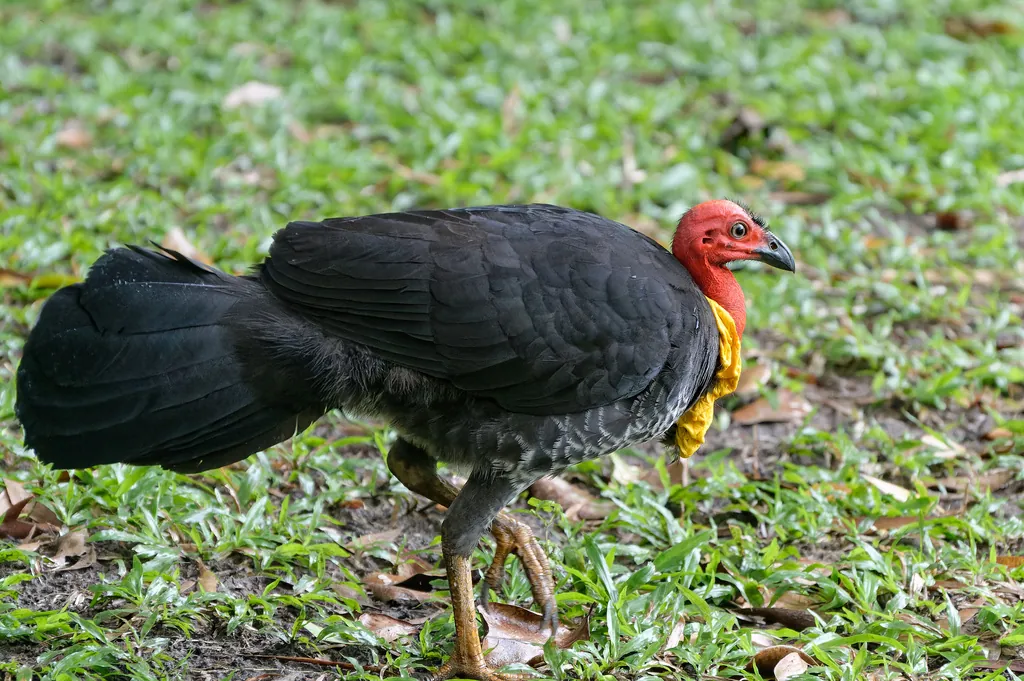
Diwan, the scrub turkey or Australian brush-turkey (Alectura lathami), is the big black mound-building bird of the rainforest. It has a bare red head and a yellow wattle[1]. Kuku Yalanji knowledge ties it to the seasons. The dictionary records that diwan normally lives in the high country but comes down to feed when junjun fruit ripens in March–May. It also names a mountain locust, kalkamal, 'which tells when to collect turkey eggs'[2]. The Queensland Parks and Wildlife Service records the same knowledge: when blue ginger is fruiting, it is time to catch diwan[3]. The male builds a huge compost mound and the females bury their eggs in it, up to 24 of them about half a metre down[1]. Nearby rainforest peoples caught the birds in lawyer-cane traps along their daily paths[4].
Names
The dictionary gives diwan 'scrub turkey'. It is careful to keep it apart from wungku 'domestic turkey, not the scrub turkey', the introduced farm bird, and from kurrbal 'plain turkey (native companion)', a bird of the open plains[2]. The word is shared with Kuku Yalanji's northern neighbours. Roth's 1901 Cape Bedford (Guugu Yimithirr) list gives de-wan for the scrub-turkey[5].
Description
A large ground bird, 60–75 cm long, with blue-black feathers, an upright, flattened tail held like a fan, and a bare, featherless red head and neck. The male has a bright yellow wattle at the base of the neck. The female's wattle is smaller and paler[1]. It feeds by raking leaf litter and tearing open rotten logs with its big feet, looking for insects, seeds and fallen fruit[6].
The male builds a mound of plant litter and soil, usually 2–4 m across and about 1 m high. He adds or removes material to keep the inside at a steady 33 °C[1]. The heat of the mound, not the parent's body, hatches the eggs. The chicks hatch after about 50 days and are independent straight away[1].
Where it lives
The brush-turkey ranges along eastern Australia from Cape York Peninsula to the Sydney region. It lives in rainforest and wet forest and also in drier scrubs, and northern birds move to higher altitudes in winter[6]. That matches the Kuku Yalanji record that diwan normally lives in the high country and comes down at junjun time[2]. In Daintree National Park brush-turkeys are seen all year round[3].
Western Yalanji country. Brush-turkeys are mainly a rainforest bird, but they also live in drier scrubs[6]. The Atlas of Living Australia holds records from the Mitchell River country west of Mt Carbine[7]. Look for them in the thicker, shadier scrub along the rivers and gullies rather than in the open grassy woodland.
Seasons
Kuku Yalanji reads the turkey's year from other living things[2]:
- Junjun is a wild fruit 'ripe in March – May'. 'During the junjun season, the scrub turkey, which normally lives in the high country, will come down to feed on them'[2]. This is the time to hunt the bird itself. The Queensland Parks and Wildlife Service puts it the same way: when blue ginger is fruiting, it is time to catch diwan[3].
- Kalkamal is 'a locust in the mountains which tells when to collect turkey eggs'. The same word also names 'the time to collect the eggs'[2].
Zoologists record that brush-turkeys can breed at any time of year, with a peak from September to December[1]. That peak is the time when the mounds hold the most eggs.
Uses
Meat and eggs. Both were food. The dictionary links diwan to hunting the bird (junjun season) and to collecting its eggs (kalkamal)[2]. Kuku Yalanji has words for every part of an egg: diburr 'egg', yijirr 'shell of egg', birukay 'yolk of the egg' and jamal 'white of egg'[2]. One mound can hold eggs from several females, up to 24 in all, laid into holes about half a metre deep and covered over[1]. That made a single well-tended mound a rich, reusable store of food.
Speaking of North Queensland generally, Roth wrote that birds', crocodile and turtle eggs were taken 'whenever found'[4].
How it was caught, gathered and cooked
Trapping the bird. No published account describes turkey trapping on the Bloomfield itself. The fullest record comes from the rainforest people of the Russell River, south of Cairns[4]:
- Find the path. A scrub turkey 'usually pass[es] along the same path daily' to and from water. Pick the exact spot on it.
- Build the trap from lawyer cane. Stick a row of cane hoops into the ground and join them with cane strips along the top and sides. An average trap is about 4 ft long, about 1½ ft high near the entrance, and about 15 in wide at the mouth.
- Bait it well in the morning with nuts and fruit.
- About sundown, hide in a shelter of leafy branches about 12 ft away, directly in front of the opening.
- Rush out the moment the turkey walks into the trap. A hunter usually built two traps close together so he could work both from one hide.
On the Tully River the same kind of trap had 'wings' of brush or half-hoops of cane to steer the bird in, and took about half a day to set up. The hunter crouched behind the wings under a cover of leaves and called the turkey in[4].
Gathering the eggs. The sources give the timing (the kalkamal locust)[2] and the biology, but no published step-by-step Kuku Yalanji account of opening a mound has been found. The eggs lie in holes about half a metre deep in the mound, and each hole is covered over after laying[1]. Collecting means digging down into the warm litter by hand to reach them.
Cooking. Roth describes two ways of cooking meat[4]:
- Roast it on and in the hot ashes, the simplest way (dindal 'to roast on coals')[2].
- Or bake it in the Bloomfield stone earth oven (kurrma). Heat the stones, dig the hole where the fire was, line it with ginger leaves, pack in the meat with the hot stones and ashes, then cover with leaves or tea-tree bark and a layer of earth[4][2].
Safety
Brush-turkeys are not dangerous to people. The cautions are practical ones. A mound is used through a long laying season and each egg takes about 50 days to hatch[1], so eggs dug from one mound can be at very different stages of development. Only a small share of eggs ever become adult birds, as few as one in 200[1], so the mounds matter to the bird's future. Cook meat and eggs through.
On Country today
The Australian brush-turkey is listed as Least Concern under Queensland's Nature Conservation Act 1992[1]. Like other native animals it is still protected, and anyone else needs a licence or permit to take it or its eggs[8].
Much of the turkey's rainforest is now Eastern Kuku Yalanji land. In 2021 the Daintree, Ngalba Bulal, Kalkajaka and Hope Islands national parks were handed back, to be jointly managed with the Queensland Government until Traditional Owners take over sole management[9]. The Eastern Kuku Yalanji native title determination (2007) recognises rights to hunt animals and gather, but not for trade or commerce[10]. The Western Yalanji determinations (2013) recognise rights to hunt and gather for personal, domestic and non-commercial communal purposes[11]. Section 211 of the Native Title Act 1993 protects native title holders hunting and gathering for personal, domestic or non-commercial communal needs[12]. The right to give permission to come onto country belongs to the Traditional Owners[10]. Visitors must ask them first.
Language
Words around the turkey: diwan 'scrub turkey'; junjun, the wild fruit that brings it down from the hills; kalkamal, the locust that signals egg time; diburr 'egg'; yijirr 'shell of egg'; birukay 'yolk'; jamal 'white of egg'; minya 'meat, eggs (protein food)'; wungku 'domestic turkey'[2].
References
- Queensland Government. Living with wildlife: Brush turkeys. www.qld.gov.au/environment/plants-animals/animals/living-with/brush-turkeys
- Hershberger, H. D. & Hershberger, R. (1982). Kuku-Yalanji Dictionary. Work Papers of SIL-AAB, Series B, Volume 7. With Toby Bloomfield, Roy Friday, Billy Roberts, Hector and Doris Sykes, Joe Walker and others. www.sil.org/resources/archives/18038
- Queensland Parks and Wildlife Service. Nature, culture and history — Daintree National Park (CYPAL). parks.qld.gov.au/parks/daintree/about/culture
- Roth, W. E. (1901). North Queensland Ethnography, Bulletin No. 3: Food — its search, capture, and preparation. Brisbane: Government Printer. Bloomfield River information from K. and R. Hislop. — Sect. 3 'Food in season', sect. 6 'Cooking', sect. 25 'Scrub turkeys, scrub hens, &c.' archive.org/details/northqueensland00landgoog
- Roth, W. E. (1901). North Queensland Ethnography, Bulletin No. 2: The structure of the Koko-Yimidir language. Brisbane: Government Printer. — Vocabulary, '(5) Birds' archive.org/details/northqueensland00landgoog
- Australian Museum. Australian Brush-turkey (Alectura lathami). Animal fact sheet. australian.museum/learn/animals/birds/australian-brush-turkey/
- Atlas of Living Australia. Occurrence records for Alectura lathami within 60 km of the Mitchell River west of Mt Carbine, queried 5 October 2026. biocache.ala.org.au/occurrences/search?q=taxon_name%3A%22Alectura%20lathami%22
- Queensland Government, State of the Environment. Nature Conservation Act 1992. www.stateoftheenvironment.des.qld.gov.au/biodiversity/management-responses/legislation/nature-conservation-act-1992
- Australian Geographic (29 September 2021). Daintree handed back to Traditional Owners. www.australiangeographic.com.au/news/2021/09/daintree-handed-back-to-traditional-owners/
- Walker on behalf of the Eastern Kuku Yalanji People v State of Queensland [2007] FCA 1907 (Federal Court of Australia, 9 December 2007). www.judgments.fedcourt.gov.au/judgments/Judgments/fca/single/2007/2007fca1907
- Brady on behalf of the Western Yalanji People #4 v State of Queensland [2013] FCA 958 (Federal Court of Australia, 24 September 2013). www.judgments.fedcourt.gov.au/judgments/Judgments/fca/single/2013/2013fca0958
- Australian Law Reform Commission. Review of the Native Title Act 1993 (DP 82), ch. 8: Relevant provisions in the Native Title Act (s 211). www.alrc.gov.au/publication/review-of-the-native-title-act-1993-dp-82/8-the-nature-and-content-of-native-title/relevant-provisions-in-the-native-title-act/