Insects & honey
Cicadas, grasshoppers, grubs and the other insects
yinja-yinja · dujandujan · jimu · durra · kuran · jingka-jingka · murrmun
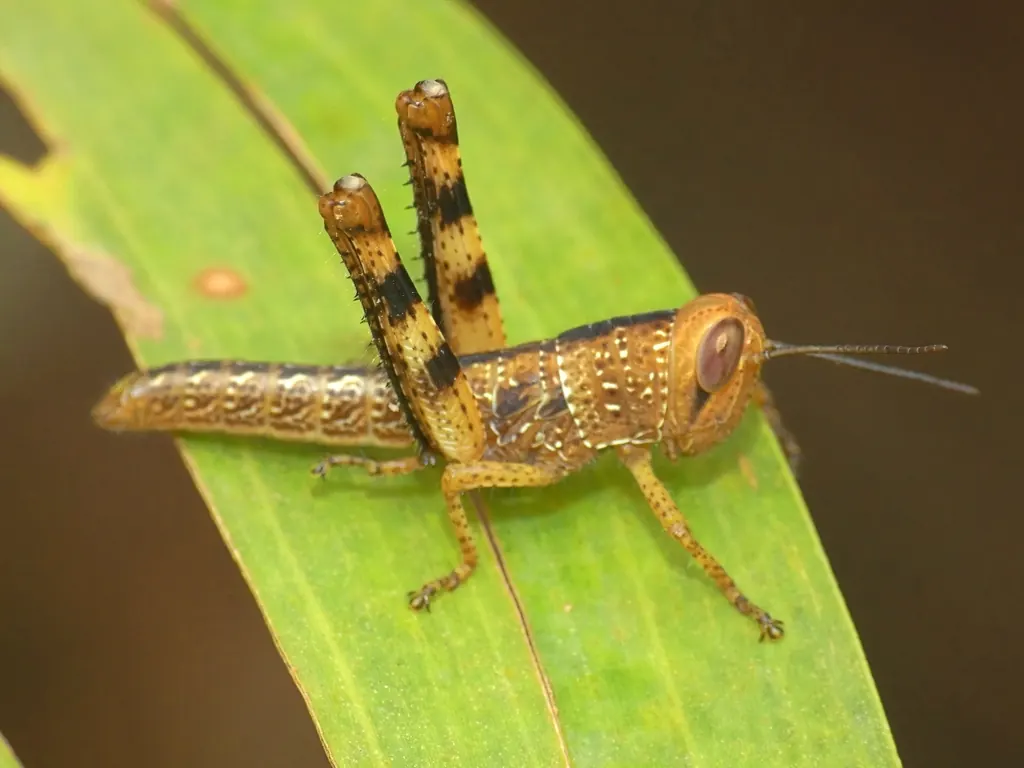
The dictionary knows its insects: yinja-yinja the cicada, dujandujan the 'locust, large cicada found in mountains', kurrmbal 'species of cicada or locusts', jimu and yiljun the grasshoppers, yijil-yijin the cricket, durra and kinga the caterpillar, kuran 'larva of case moth, edible, found in green wood', jingka-jingka 'honey ant, the abdomen enlarges after eating', murrmun the rhinoceros beetle and murrumun the black beetle, walbul-walbul the butterfly, dijaraban and wurarr-wurarr the dragonfly, and jambun, 'grub, Mareeba dialect for mujurr', the one western word in the list[1]. Roth's 1901 chapter on 'other insects, grubs, caterpillars' is short and plain: 'certain longicorn Coleoptera are eaten by the natives on the upper reaches of the Embley River. March flies are often treated similarly with by the Tully River children, etc. Grubs are hooked out of tree-butts and roots by means of the "feelers" of the lawyer cane, or else by sawing into soft and rotten timber with a piece of lawyer after the manner of a crosscut ... the blacks eat these grubs raw or roasted. In the Boulia and Cloncurry districts the smaller kinds of grubs and caterpillars, especially those found on grass, may be eaten raw and whole: the larger varieties, found in trees, are usually roasted, their heads not being eaten, or may be dried in the sun and put away for future occasions. E. Palmer states that on the Mitchell and Cloncurry the natives utilise a grub contained in the galls growing terminal on young trees of Eucalyptus tetrodonta and E. corymbosa', the stringybark and the bloodwood[2][3]. The best of the insect foods was a secret of the green ants' nest: 'the chrysalis of a lepidopteron, Liphyra brassolis, is found in the green-ant nests. The Bloomfield blacks, who call it bi-i bi-i, consider it a great delicacy', the caterpillar of the moth butterfly, which 'can devour the entire broods of green ant nests' under an orange armour the ants cannot bite through[2][4]. The witchetty grub, the green ants, the native bees and the biting things have their own pages; this is the rest of the small life of the country, the sound of the build-up and the food of every bird, lizard and fish on the river.
Hann River Cape York
Possum People's country on the upper river and Thaypan (Kuku Thaypan) country downstream: stringybark and bloodwood woodland and a spring-fed sandy river that runs north-east from the Great Dividing Range, past the Peninsula Developmental Road, into Rinyirru (Lakefield) and the North Kennedy. Not Kuku Yalanji country: the Kuku Yalanji words on this page are the dictionary's, not the Hann's own languages. Place guide
The Hann's woodland is well collected for insects: the Atlas of Living Australia holds 4,232 insect records, from 1909 to 2026, in a box of about 90 × 85 km around the middle Hann, Laura and western Rinyirru[21]. No published record says which insects the Possum People or the Thaypan people of the Hann ate[22][23]. The nearest food records are the green ants of Princess Charlotte Bay and Laura, and the witchetty grubs of Kuku Thaypan country[2][24][25].
Which insects live here
In that box the Atlas has 53 records of cicadas, 27 of grasshoppers and locusts (the migratory locust among them), 177 of the skimmer dragonflies, 56 of March flies, 17 of case moths, 6 of longhorn beetles and one of a rhinoceros beetle[21]. It also has 14 records of the green tree ant and one, from 2025, of the moth butterfly whose caterpillar lives in the green-ant nests, so that delicacy can be found here too[21].
The insect year here
Kuku Thaypan Elders read the insects as a calendar. As the wet ends and the south-east winds pick up, 'insect life, notably native Arear kun Tetragonula hoskingsi and Nye yelia butterfly species begin to increase in number and activity'[25]. A cool burn moves slowly: 'the birds of prey feed off grasshoppers flying up out of the grass', and 'low intensity burns protect grasshoppers, stick insect and mantis species important for soil nutrient cycling'[25]. On the grassy plains the termites are 'the dominant biomass'; see termites and ant beds[25].
How the people of this country used them
Green ants (Princess Charlotte Bay, about 1900). 'Green ants, as well as their larvae, are eaten as food both by men and women, and at Princess Charlotte Bay, Cooktown, Bloomfield, etc., are in addition used as medicine'. 'At Princess Charlotte Bay and Cooktown, I have seen the nest cut down and opened on a piece of stone or rock whence the green ants scatter about in all directions, leaving the white larvae behind'[2].
Green ants (Kuku Warra, Laura side, today). 'With green ants, you crush the nest, mix it with water and it cures a headache too. If you catch the ants at the right time of the year they have white eggs, and when you crush the eggs with water, it makes a milky drink'[24].
Witchetty grubs (Kuku Thaypan). 'The Lancewood and wattle roots provide a good source of fiber for witchetty grubs and a good food source for people'; Standley's field records show how they are dug from the lancewood base[25]. See witchetty grub.
For the other insects on this page, nothing is published from the Hann; the general sections above are the guide.
Language
Kuku Thaypan (Awu Alaya): Nye yelia 'butterfly species'; Arear 'sugarbag', the native bee[25]. These are not Kuku Yalanji words.
Upper Mitchell Western Yalanji
Western Yalanji country west of the Great Dividing Range: dry open woodland cut by the sandy, paperbark-lined upper Mitchell River, around Karma Waters and Mount Carbine. Place guide
On the western side of the range the dictionary's one insect word is the Mareeba dialect's jambun 'grub', and what the Western Yalanji of the upper Mitchell ate is still to be written[1].
Names here
The Mareeba dialect word jambun is the one that belongs to the western side of the range, and the contribution box below is for the others.
Insects around Karma Waters
The dung beetles in the Karma Waters list are mostly the introduced ones that bury the cattle dung, with the native Onthophagus beside them[26]. Whether honey ants were dug on the Mitchell is for the contribution box below.
On country today
The cicadas tell the Karma Waters build-up and the grasshoppers feed the station's birds; the grubs are in every dead ironbark[5][26]. The dictionary's insect words are the coast's and one is Mareeba's; which insects were food on the Mitchell is for the contribution box below[1].
Eastern coast Eastern Kuku Yalanji
Eastern Kuku Yalanji country: rainforest, beaches, mangroves, reef and the short steep rivers from the Daintree to the Bloomfield and the Annan.
On the Bloomfield the insect delicacy Roth recorded was the moth-butterfly chrysalis from the green ants' nests, bi-i bi-i[2].
How people used them here
Roth: 'it is interesting to note that on the Bloomfield, as well as at Cooktown, etc., the chrysalis of a lepidopteron, Liphyra brassolis, is found in the green-ant nests. The Bloomfield blacks, who call it bi-i bi-i, consider it a great delicacy, while the Cooktown natives, who speak of it as ged-ya, break it up in water, drink the mixture, and say it is very good for bad constipation'[2]. Roth's bi-i bi-i is not in the dictionary, and the contribution box below is for it.
Everywhere
Names
Cicadas: yinja-yinja 'cicada'; dujandujan 'locust, large cicada found in mountains'; kurrmbal 'species of cicada or locusts'. Grasshoppers: jimu 'grasshopper'; yiljun 'type of grasshopper'; yijil-yijin 'cricket'. Caterpillars and grubs: durra 'caterpillar, worm'; kinga 'caterpillar'; kuran 'larva of case moth, edible. Found in green wood'; mujurr 'witchetty grub found in rotting wood' and jambun 'grub. Mareeba dialect for mujurr'; ngirran 'beetle fully developed from mujurr'; kurran 'kind of grub'; bikarrakal 'a kind of grub used for bait'. Beetles: murrmun 'rhinoceros beetle'; murrumun 'black beetle'. Ants and bees: jingka-jingka 'honey ant, the abdomen enlarges after eating' (also 'silverfish'); dabadaba 'larvae and eggs of any kind of bee'; kurrmaja 'larvae of green ants'; nyirran 'the big green ant that is eaten, comes in December - January'. Others: walbul-walbul 'butterfly'; dijaraban 'mayfly, dragonfly'; wurarr-wurarr 'dragon fly'; biray 'grey March fly'[1].
The insects, and which were food
Cicadas. 'They have an exceptionally loud song, produced in most species by the rapid buckling and unbuckling of drum-like tymbals'; 'they typically live in trees, feeding on watery sap from xylem tissue, and laying their eggs in a slit in the bark. Most cicadas are cryptic. The vast majority of species are active during the day as adults, with some calling at dawn or dusk'; 'cicadas are eaten by humans in various parts of the world, including China, Myanmar, Malaysia, central Africa and parts of Mexico'; the nymphs live underground on root sap for years before the summer emergence[5]. The dictionary's three cicada words and the empty brown shells on the trunks in the build-up are the north's version[1]. The sources used here record no eating of cicadas in Kuku Yalanji country.
Grasshoppers. 'Typically ground-dwelling insects with powerful hind legs which allow them to escape from threats by leaping vigorously'; 'they hatch from an egg into a nymph or "hopper" which undergoes five moults'; 'grasshoppers are plant-eaters'; 'at high population densities and under certain environmental conditions, some grasshopper species can change colour and behaviour and form swarms'; 'grasshoppers are diurnal insects'; 'they are used as food in countries such as Mexico and Indonesia'[6]. Here they are the kestrel's, the bee-eater's, the kookaburra's and the frilled lizard's food, and the fish's when they fall in[7][8].
Grubs and caterpillars. Roth: 'grubs are hooked out of tree-butts and roots by means of the "feelers" of the lawyer cane, or else by sawing into soft and rotten timber with a piece of lawyer after the manner of a crosscut. Both procedures are in vogue on the lower Tully, where the blacks eat these grubs raw or roasted. In the Boulia and Cloncurry districts the smaller kinds of grubs and caterpillars, especially those found on grass, may be eaten raw and whole: the larger varieties, found in trees, are usually roasted, their heads not being eaten, or may be dried in the sun and put away for future occasions. E. Palmer states that on the Mitchell and Cloncurry the natives utilise a grub contained in the galls growing terminal on young trees of Eucalyptus tetrodonta and E. corymbosa'[2][3]. The lawyer feeler for grubs is 'stripped of all its spikes but one — the one is left at the point — and is inserted in the hole made by the grub, and gently pushed down. The pliability of the feeler enables it to follow the bends and turnings of the hole until it reaches the grub'[9]. The big grubs are the larvae of the longhorn beetles and the wood moths: longhorn larvae 'are 0.5–22 cm long, elongated in shape', and 'all known longhorn beetle larvae feed on plant tissue such as stems, trunks, or roots of both herbaceous and woody plants, often in injured or weak trees'[10]. The witchetty grub page has the dictionary's grubs in detail. The case moth's larva, kuran, 'edible, found in green wood', builds a case: 'the caterpillar larvae of Psychidae construct cases out of silk and environmental materials such as sand, soil, lichen, or plant materials. These cases are attached to rocks, trees or fences while resting or during their pupa stage, but are otherwise mobile'; in Madagascar one species 'is in some places encouraged to breed on wattle trees, because its pupae are collected as a protein-rich food'[11][1].
The moth butterfly in the green-ant nest. 'The larvae are predatory and feed on ant larvae. This is one of the largest species of lycaenid butterflies'; 'oval flattened and slug like with a hard and smooth covering. The caterpillars can devour the entire broods of green ant nests. The protective orange carapace is virtually impervious to the bites of soldier ants and it is so heavy that the ants cannot flip it over to get at the caterpillar's soft underbody. Once the caterpillar transforms into a butterfly inside the nest, its soft body is vulnerable to the ants ... it is protected by white scales from its new wings; the scales are slippery enough to prevent most ants from getting a foothold'[4].
Honey ants. 'Honey ants are unique in using their own bodies as living storage, used later by their fellow ants when food is otherwise scarce. Designated worker ants, called "repletes," are the main group that store food for the colony. Repletes are fed by other worker ants until their abdomens become swollen with honey'; in the Australian Camponotus inflatus 'repletes formed 49% (516 ants) of a colony of 1063 ants'; 'the largest replete was 15 millimetres long and had a mass of 1.4 grams. The nest had a maximum depth of 1.7 metres', and the workers 'collect nectar from Mulga nectaries, and meat from the carcass of a Tiliqua blue-tongued lizard'[12]. The dictionary's jingka-jingka, 'honey ant, the abdomen enlarges after eating', is the coast's knowledge of the inland's sweet[1].
Beetles. The brown rhinoceros beetle, murrmun, 'can reach a length of 3.5–7 centimetres'; males 'have two chitinous bifurcated horns ... which they use to eliminate their rivals'; 'when disturbed these beetles make a hissing noise'; the larvae 'develop in decaying vegetable matter and usually take two years'[13][1]. Roth's 'certain longicorn Coleoptera' eaten on the Embley are the adult longhorns[2][10].
Bee and wasp brood. The dictionary's dabadaba, 'larvae and eggs of any kind of bee', and Roth's wasp larvae 'picked out and eaten raw' after the nest is smoked are on the native bees page[1][2].
Telling them
- Cicada: a fat, wide-headed, clear-winged bug on a trunk, screaming; its brown split shell on the bark[5].
- Grasshopper or locust: long hind legs, jumps and flies a short way; the cricket is its night cousin[6].
- Witchetty grub: a fat white larva in rotten wood; case-moth larva: a caterpillar inside a bag of silk and sticks hanging on a twig[11].
- Moth-butterfly caterpillar: a flat orange slug-shaped armoured thing inside a green-ant nest[4].
- Honey ant: an ant with a swollen clear abdomen, deep in a nest[12].
- Rhinoceros beetle: big, shiny, horned, hissing when picked up[13].
- Dragonfly (dijaraban): over the pool by day; mayfly: the same word in the dictionary[1].
Signs
- Cicada shells on the trunks and the roar at dusk: the build-up has come[5].
- A gall on a young stringybark or bloodwood: a grub inside[3][2].
- Sawdust at the base of a tree or a round hole in a trunk: a longhorn or wood-moth grub[10].
- A green-ant nest with a lump in it: the moth butterfly's caterpillar[4].
- Grasshoppers rising in clouds before a walking person on the flat in the wet, and the bee-eaters and kestrels working them[6][8].
- Dragonflies over the pool: the midges and mosquitoes they hunt are hatching.
Where they are
The cicadas in the trees and their nymphs in the ground under them; the grasshoppers in the grass of the flats and the woodland; the grubs in the dead and dying wood and the galls; the honey ants in the sandy ground of the inland; the beetles in the rotting logs; the dragonflies and mayflies over the waterhole[5][6][10][12].
The base of the chain
The insects are what the country's animals are made of: the grasshoppers and cicadas feed the kookaburras, the bee-eaters, the kestrel, the lizards and the frilled lizard; the caterpillars and grubs the honeyeaters, the quoll and the bandicoot; the night insects the bats and the frogs; the ants and termites the echidna; and the insects that fall on the water the archerfish, the saratoga and the rainbowfish[7][8][14][15][16][17]. The grubs eat the dying trees and the beetles the dead ones, which is how the woodland's wood goes back into the ground[10][13].
Seasons
The cicadas and the grasshoppers come with the heat and the first rains; the flying termites with the first storms; the grubs are in the wood all year and the galls on the young trees after the wet growth; the big green ant nyirran 'comes in December - January'[5][6][1]. See the year on country.
Uses
- Food: tree grubs roasted or sun-dried, grass caterpillars raw, the gall grubs, the moth-butterfly chrysalis, longhorn beetles, wasp and bee brood[2][3].
- Bait: bikarrakal, 'a kind of grub used for bait', and any grasshopper on a hook; see hooks and lines[1].
- Medicine: the Cooktown use of the moth-butterfly chrysalis in water 'for bad constipation', and the green ants; see bush medicine[2].
- A clock: the cicadas' roar for the build-up; see seasons[5].
- A children's game: birray, the March-fly chase; see bites and stings[18].
Getting grubs with the lawyer feeler
- Find the hole: a round bore-hole in a trunk or root with fresh sawdust at it, or a gall on a young stringybark or bloodwood[2][3].
- Make the feeler: a length of lawyer cane 'stripped of all its spikes but one — the one is left at the point'[9].
- Push it gently down the hole until it stops at the grub, then press and turn it for a few moments so the spike takes hold, and draw the grub out[9].
- Or saw the rotten wood open with a piece of cane 'after the manner of a crosscut'[2].
- Eat raw or roast on the coals, heads off the big ones, or dry the rest in the sun to carry[2].
- Gall grubs: break the gall open and take the grub[3].
- The moth butterfly: look for the armoured lump in a green-ant nest when the nest is taken for its eggs; see green ants[2][4].
Safety
- Hairy caterpillars sting; 'if caterpillar hairs get stuck on your skin, remove them with tweezers or sticky tape'[19].
- The green-ant nest fights back; see green ants[20].
- The stingers and biters are on the bites and stings page.
- Native insects are not protected wildlife in the way the vertebrates are, but the country they live on is; take what you eat.
Language
yinja-yinja, dujandujan, kurrmbal cicadas; jimu, yiljun grasshoppers; yijil-yijin 'cricket'; durra, kinga 'caterpillar'; kuran case-moth larva; mujurr, jambun 'grub'; jingka-jingka 'honey ant'; murrmun 'rhinoceros beetle'; walbul-walbul 'butterfly'; dijaraban 'mayfly, dragonfly'; minya 'meat, eggs (protein food)'[1].
References
- Hershberger, H. D. & Hershberger, R. (1982). Kuku-Yalanji Dictionary. Work Papers of SIL-AAB, Series B, Volume 7. With Toby Bloomfield, Roy Friday, Billy Roberts, Hector and Doris Sykes, Joe Walker and others. www.sil.org/resources/archives/18038
- Roth, W. E. (1901). North Queensland Ethnography, Bulletin No. 3: Food — its search, capture, and preparation. Brisbane: Government Printer. Bloomfield River information from the Hislops. — Sect. 6 'Cooking'; plant list ('Castanospermum australe', 'Dioscorea sativa', 'Elettaria Scottiana', 'Nymphaea') archive.org/details/northqueensland00landgoog
- Palmer, E. (1883). On plants used by the natives of North Queensland, Flinders and Mitchell Rivers, for food, medicine, &c., &c. Journal and Proceedings of the Royal Society of New South Wales 17: 93–113. Palmer's Mitchell River names come from the lower and middle Mitchell, not from Kuku Yalanji speakers. archive.org/details/journalandproce16walegoog
- Wikipedia. Moth butterfly (Liphyra brassolis). en.wikipedia.org/wiki/Liphyra_brassolis
- Wikipedia. Cicada. en.wikipedia.org/wiki/Cicada
- Wikipedia. Grasshopper. en.wikipedia.org/wiki/Grasshopper
- Wikipedia. Laughing kookaburra (Dacelo novaeguineae). en.wikipedia.org/wiki/Laughing_kookaburra
- Wikipedia. Rainbow bee-eater (Merops ornatus). en.wikipedia.org/wiki/Rainbow_bee-eater
- Roth, W. E. (1904). North Queensland Ethnography, Bulletin No. 7: Domestic implements, arts, and manufactures. Brisbane: Government Printer. — Sect. 10 'Fire-tongs' archive.org/details/northqueensland00landgoog
- Wikipedia. Longhorn beetle (Cerambycidae). en.wikipedia.org/wiki/Longhorn_beetle
- Wikipedia. Psychidae, the bagworm or case moths. en.wikipedia.org/wiki/Psychidae
- Wikipedia. Honeypot ant. en.wikipedia.org/wiki/Honeypot_ant
- Wikipedia. Brown rhinoceros beetle (Xylotrupes gideon). en.wikipedia.org/wiki/Xylotrupes_gideon
- Wikipedia. Blue-faced honeyeater. en.wikipedia.org/wiki/Blue-faced_honeyeater
- Wikipedia. Northern quoll (Dasyurus hallucatus). en.wikipedia.org/wiki/Northern_quoll
- Wikipedia. Smaller horseshoe bat (Rhinolophus megaphyllus). en.wikipedia.org/wiki/Eastern_horseshoe_bat
- Wikipedia. Short-beaked echidna. en.wikipedia.org/wiki/Short-beaked_echidna
- Anderson, C. (1996). Traditional material culture of the Kuku-Yalanji of Bloomfield River, North Queensland. Records of the South Australian Museum 29(1): 63–83. Based on fieldwork at Wujal Wujal in the late 1970s and early 1980s. — Hunting (spears, spear-throwers, harpoons); fishing (stupefacients); manufacturing (gums and resins); post-contact bush component archive.org/details/RecordsSouthAus29Sout
- healthdirect Australia. Insect bites and stings (accessed 10 October 2026). www.healthdirect.gov.au/insect-bites-and-stings
- Wikipedia. Oecophylla smaragdina (green tree ant, weaver ant). en.wikipedia.org/wiki/Oecophylla_smaragdina
- Atlas of Living Australia. Occurrence records of insects (class Insecta: 4,232 records, 1909–2026), including cicadas (Cicadidae, 53 records, 1973–2026), grasshoppers and locusts (Acrididae, 27, 1989–2026), skimmer dragonflies (Libellulidae, 177, 1974–2026), March flies (Tabanidae, 56, 1984–2025), case moths (Psychidae, 17, 1977–2025), longhorn beetles (Cerambycidae, 6, 1989–2025), green tree ants (Oecophylla smaragdina, 14, 1980–2022), the moth butterfly (Liphyra brassolis, 1, 2025) and a rhinoceros beetle (Xylotrupes australicus, 1, 2023) in a box of about 90 × 85 km around the middle Hann River, Laura and western Rinyirru (lat −15.6 to −14.8, long 143.5 to 144.3), queried 28 October 2026. biocache.ala.org.au/occurrences/search?q=*:*&fq=decimalLatitude:%5B-15.6%20TO%20-14.8%5D&fq=decimalLongitude:%5B143.5%20TO%20144.3%5D
- Ross on behalf of the Cape York United #1 Claim Group v State of Queensland (No 21) (Possum determination) [2023] FCA 1316 (Federal Court of Australia, 2 November 2023). — Determination area (upper Hann and Kennedy rivers); prescribed body corporate; affidavit evidence on hunting and fishing www.judgments.fedcourt.gov.au/judgments/Judgments/fca/single/2023/2023fca1316
- Ross on behalf of the Cape York United #1 Claim Group v State of Queensland (No 20) (Thaypan determination) [2023] FCA 1315 (Federal Court of Australia, 2 November 2023). — Determination area and waters; prescribed body corporate (Awu-Laya Indigenous Corporation); affidavit evidence on hunting www.judgments.fedcourt.gov.au/judgments/Judgments/fca/single/2023/2023fca1315
- Ross on behalf of the Cape York United #1 Claim Group v State of Queensland (No 19) (Kuku Warra determination) [2023] FCA 1314 (Federal Court of Australia, 2 November 2023). www.judgments.fedcourt.gov.au/judgments/Judgments/fca/single/2023/2023fca1314
- Standley, P.-M. (2019). The importance of campfires to effective conservation. PhD thesis, James Cook University. Records the fire and country knowledge of Kuku Thaypan Elders Dr Tommy George and Dr George Musgrave. researchonline.jcu.edu.au/64274/
- Atlas of Living Australia. All occurrence records within 30 km of the Karma Waters homestead (16.618° S, 144.605° E), species facet, queried 5 October 2026 (4,053 records; 601 species). biocache.ala.org.au/occurrences/search?q=*:*&lat=-16.6179&lon=144.6047&radius=30
From the community
Know this one? Add the words you use for it, what it is for, how it is done, a correction, or a photo from country. It shows here straight away with your name on it. Please keep anything restricted or sacred off the site.
Loading…