Trees
Black bean
bawayCastanospermum australe
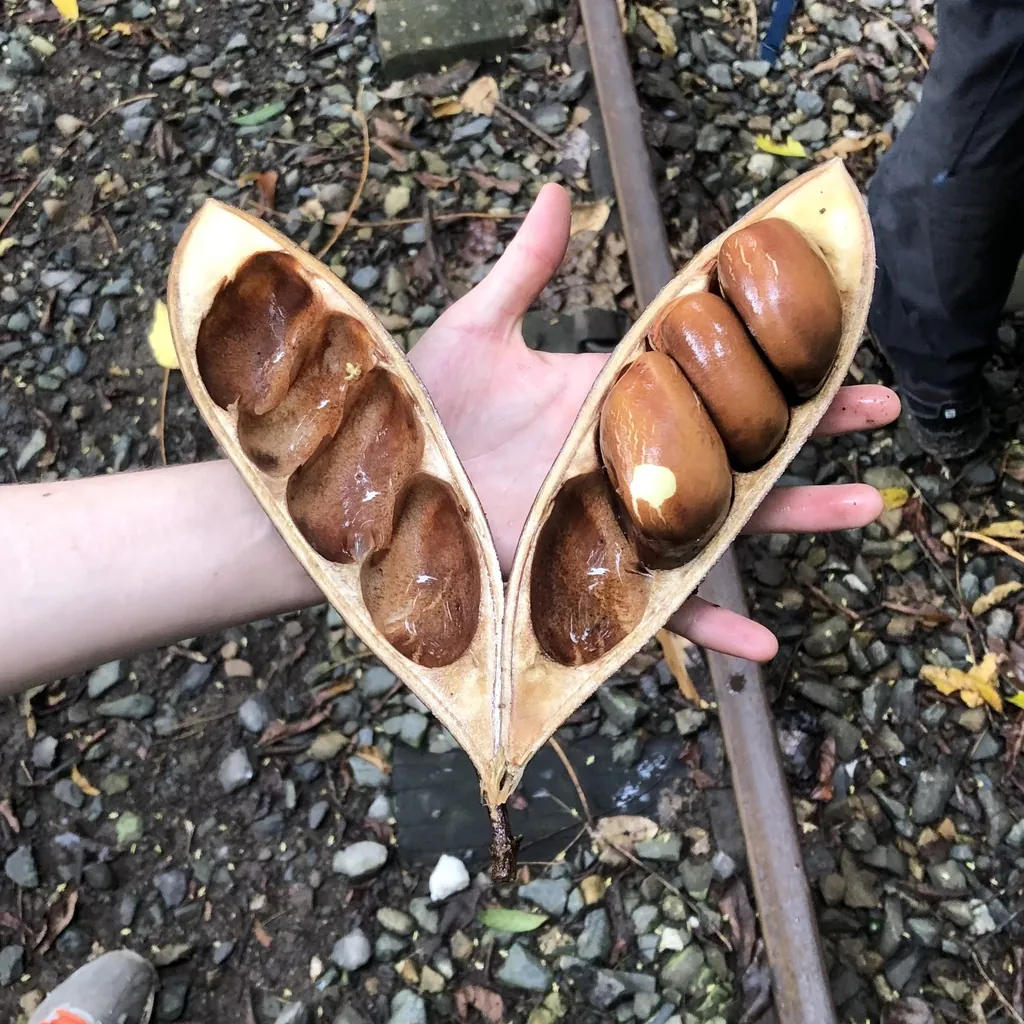
Baway, the black bean or Moreton Bay chestnut (Castanospermum australe), is a large rainforest tree that grows along creeks and rivers. Its seeds are big, chestnut-like and poisonous raw. Bama made them into food by baking, slicing or pounding, then leaching them for hours in running water[1][2]. Roth wrote that on the Bloomfield River the nut was 'nearly always obtainable' but 'not relished': it was one of the hardest foods to prepare, because washing out the bitter taste took so long[1].
Names
The Kuku Yalanji dictionary gives baway for the black bean tree[3], and Anderson's study of Bloomfield River material culture lists baway as Castanospermum australe[2]. Roth's 1901 Bloomfield River list, written in an older English-based spelling, gives marchai for Castanospermum australe[1]. It is not yet known whether marchai is another name, a dialect form or a mishearing. Elders are the right people to settle that.
Description
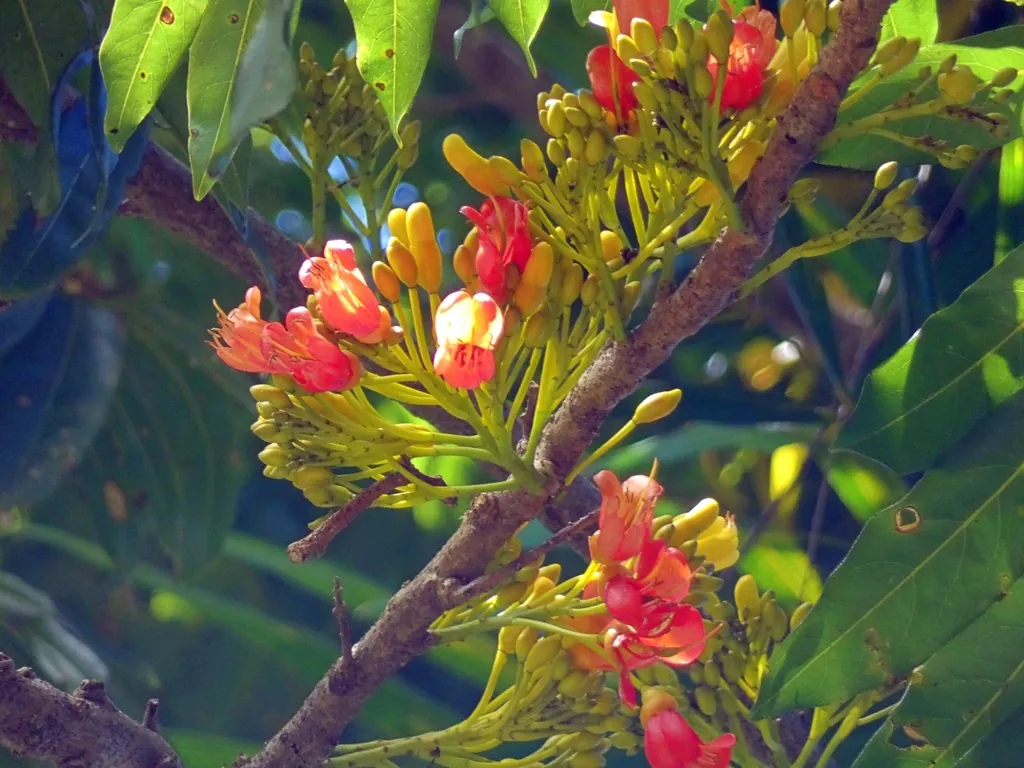
A tall, solid rainforest tree with glossy compound leaves. Crushed leaves smell like freshly cut grass, and a cut in the bark smells of cucumber or pumpkin[4]. The pea-shaped flowers are about 3–4 cm long. They open yellow and turn orange-red as they age, and they grow straight from the older branches. The fruit is a heavy woody pod more than 15 cm long. Each pod holds a few large, smooth seeds, about 3–4 cm across or more, that look like chestnuts[4]. Fallen pods and seeds often cover the ground under big trees[4].
Where it grows
Black bean grows in well-developed rainforest, especially in gallery forest along creeks and rivers. Its range runs from Cape York Peninsula down to north-eastern New South Wales, from near sea level to about 800 m in the tropics[4]. On Kuku Yalanji country, look for it along the river and creek banks of the rainforest country between the Mossman, Daintree and Bloomfield rivers.
Uses
Food. The seeds were a staple that could be had most of the year, a fallback food when better ones were scarce. Roth recorded that on the Bloomfield the nut was 'nearly always obtainable' but not well liked, because of the time and labour needed to make it safe and palatable[1]. Anderson explains why such hard foods mattered. Nuts could be gathered and kept for up to two months. In the wet season, a time of heavy continuous rain and flooded creeks, that meant fewer trips away from camp[2].
The processing belongs to a whole rainforest technology for poisonous foods. Kuku Yalanji people leached many foods: marra (zamia), bujabay, wild plums and mangrove fruits are all recorded in the dictionary as needing to be soaked or leached before eating[3].
How it was prepared
Every recorded method cooks the seed, breaks it down very fine, then washes it in running water for a long time.
At Bloomfield. Anderson's table of Bloomfield nut foods records five steps for baway[2]. The kernels were baked in the ashes (not roasted on an open fire), pounded with stones, sifted in a dilly bag, and leached. Roth's Bloomfield note, from K. Hislop, gives the same order[1]:
- Bake the nuts in a stone (earth) oven.
- Pound and sift the cooked kernels.
- Put the meal into a bark trough and wash it, as with the bitter yam, until the bad taste is gone.
The Bloomfield yam method shows what that washing involved[2]. It was done near a small, fast creek. The mash was worked in a palm-fibre dilly bag held over a bark trough, with water poured through again and again. The trough was then left to settle. When an oily film rose to the top, people said it was the 'poison' and poured it off with the water.
At Atherton the black bean method is written down in more detail[1]:
- Break the shells and start baking the kernels about sunrise, under leaves and earth.
- Uncover them about midday.
- Cut them into very fine chips with a sharp shell.
- At sunset, put the chips into a lawyer-cane dilly bag in the creek so that running water percolates through them.
- Leave them overnight. By the next morning they are about ready to eat.
On the lower Tully River people steamed the nuts in heaps in a ground oven, covered with leaves and sand with a fire on top, for a few hours up to a whole day. They sliced them very fine with a snail-shell knife and left them in dilly bags in a running stream for a couple of days. Roth notes: 'If not sliced up very fine, the bitter taste remains'[1].
Safety
The raw seeds are poisonous and should be treated that way[4]. They have poisoned livestock and people. The bitterness the old methods remove is the poison, so a short cut (thick slices, too little time in the water, still water instead of running water) can leave enough to make someone very sick. The instructions above are a record of how it was done. They are not a tested recipe. Learn it hands-on from people who still know it.
On Country today
Much of the black bean country between the Daintree and Bloomfield rivers is now national park, handed back to Eastern Kuku Yalanji ownership in 2021 and jointly managed with the Queensland Parks and Wildlife Service[5]. Under section 211 of the Native Title Act 1993, native title holders do not need a licence or permit to hunt, fish or gather for their personal, domestic or non-commercial communal needs[6]. Anyone else needs the Traditional Owners' permission, and park rules apply.
Language
Words for this kind of work: ngabal 'soak, leach'; kurrma 'earth oven'; dindal 'to roast on coals'; munja-l 'to gather, collect (nuts, plant food)'[3].
Images
References
- Roth, W. E. (1901). North Queensland Ethnography, Bulletin No. 3: Food — its search, capture, and preparation. Brisbane: Government Printer. Bloomfield River information from K. Hislop. — Plant list, 'Castanospermum australe' archive.org/details/northqueensland00landgoog
- Anderson, C. (1996). Traditional material culture of the Kuku-Yalanji of Bloomfield River, North Queensland. Records of the South Australian Museum 29(1): 63–83. — Table 2, nut species eaten at Bloomfield; 'Yam preparation' hdl.handle.net/2440/13994
- Hershberger, H. D. & Hershberger, R. (1982). Kuku-Yalanji Dictionary. Work Papers of SIL-AAB, Series B, Volume 7. With Toby Bloomfield, Roy Friday, Billy Roberts, Hector and Doris Sykes, Joe Walker and others. www.sil.org/resources/archives/18038
- Australian Tropical Rainforest Plants (RFK8), Castanospermum australe. CSIRO / Lucidcentral. apps.lucidcentral.org/rainforest/text/entities/castanospermum_australe.htm
- National Indigenous Times (1 October 2021). Daintree Rainforest handed back to Eastern Kuku Yalanji people. nit.com.au/01-10-2021/2393/daintree-rainforest-handed-back-to-eastern-kuku-yalanji-people
- Australian Law Reform Commission. Review of the Native Title Act 1993 (DP 82), ch. 8: Relevant provisions in the Native Title Act (s 211). www.alrc.gov.au/publication/review-of-the-native-title-act-1993-dp-82/8-the-nature-and-content-of-native-title/relevant-provisions-in-the-native-title-act/