Frogs
Frogs, and the cane toad
yirku-yirku · karrkurr · yuday
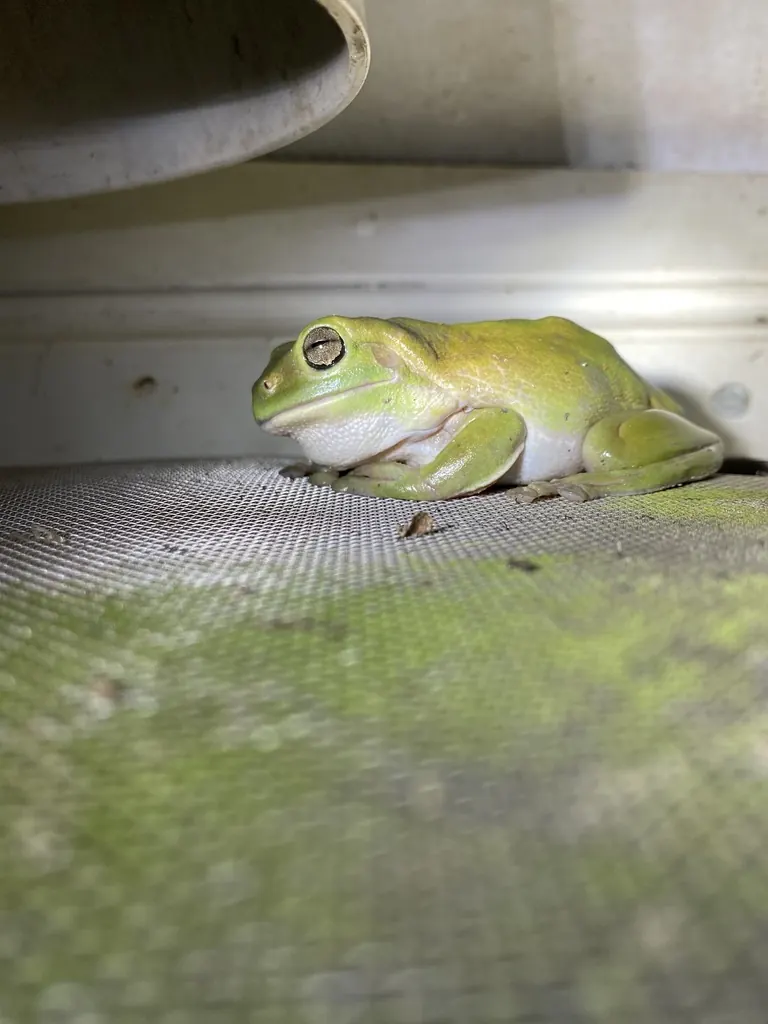
yirku-yirku is a frog, karrkurr the green frog, and yuday a 'large frog, edible', which is the whole of what the dictionary says and enough: frogs were bait, food and the first sound of the wet[1]. On the lower Tully in flood people waded into the shallows with a stick and a dilly bag and took the green frogs 'dozens and dozens' at a time, and in the dry north-west frogs 'are usually dug up from their burrows'[2]. The cane toad is the thing on this page to know first: it kills the dogs, the goannas and the snakes that eat it, and it is not a frog to touch or to eat[3].
Hann River Cape York
Possum People's country on the upper river and Thaypan (Kuku Thaypan) country downstream: stringybark and bloodwood woodland and a spring-fed sandy river that runs north-east from the Great Dividing Range, past the Peninsula Developmental Road, into Rinyirru (Lakefield) and the North Kennedy. Not Kuku Yalanji country: the Kuku Yalanji words on this page are the dictionary's, not the Hann's own languages. Place guide
Frogs are plentiful on the Hann. The Atlas of Living Australia holds 568 frog records of 27 kinds, from 1960 to 2026, in a box of about 90 × 85 km around the middle Hann, Laura and western Rinyirru[13]. The cane toad is here too: 27 records in the same box, the first in 1970[13]. Treat every warty frog at the camp light as a toad.
Which frogs live here
Most of the records are tree frogs: Litoria pallida (60), Roth's tree frog (L. rothii, 55) and the green tree frog (L. caerulea, 18). The burrowing frogs, Cyclorana, have 47 records of five kinds, the New Holland frog among them (23, 1981–2025); the ornate burrowing frog has 25 (1960–2026); and Papurana daemeli, a true frog of the water's edge, has 15 (1968–2024)[13]. The box takes in far more than the Hann, so read it as 'these frogs live in this country', not as a map.
Their year here
In the wet, December to March, the rivers spill onto the floodplains and fill the lagoons and swamps[14]: that is the breeding time, when the burrowing frogs come up. Through the dry the plains go brown, but the Hann itself never stops running[15], so its holes keep their tree frogs and water frogs all year. Downstream at Catfish Waterhole on the North Kennedy, the crocodiles of the dry season feed on 'fish, frogs, turtles, mammals and birds'[14].
Frogs in the culture of this country
No record of eating or using frogs has been published for the Possum or Thaypan peoples of the Hann[16][17]; Roth's methods in the general sections come from other districts. Downstream at Princess Charlotte Bay Roth recorded a string figure called 'Frog'[18], and a Koko-rarmul story in which the frog and the goanna appear[19]. The story belongs to its custodians: ask them, not this page.
Upper Mitchell Western Yalanji
Western Yalanji country west of the Great Dividing Range: dry open woodland cut by the sandy, paperbark-lined upper Mitchell River, around Karma Waters and Mount Carbine. Place guide
Within 30 km of Karma Waters the Atlas has the green tree frog, Roth's tree frog, the desert tree frog, the New Holland frog that sits out the dry underground, and the ornate burrowing frog[7]. It also has the cane toad, five times within 30 km and 1,079 times within 60[6].
Which frogs live here
The green tree frog has two records within 30 km of the homestead and seventy-nine within 60. Roth's tree frog (L. rothii), the desert tree frog (L. rubella), the bumpy rocket frog (L. inermis), L. nigrofrenata and L. pyrina are the other tree frogs in the 30 km records: the small brown and grey frogs of the paperbarks, the grass and the camp tank, which come out in hundreds with the first storms[7]. The New Holland frog has one record within 30 km and forty-three within 60, with the striped burrowing frog and the short-footed frog; the ornate burrowing frog has 157 records within 60 km. The cane toad has five records within 30 km of the homestead and 1,079 within 60[7][6].
On country today
The frogs still come up with the first storm at Karma Waters, and the green tree frog is in every tank and toilet on the station; the toad is at every light[6][4].
Eastern coast Eastern Kuku Yalanji
Eastern Kuku Yalanji country: rainforest, beaches, mangroves, reef and the short steep rivers from the Daintree to the Bloomfield and the Annan.
On the Bloomfield, frogs were bait: for the freshwater lines 'bait was generally grubs, small freshwater prawns or small frogs'[20].
Bait frogs
Bait frogs: the small tree frogs at the camp light or in the grass at the water's edge after dark, by hand[20]. See hooks and lines for the rest.
Everywhere
Names
yirku-yirku 'frog'; karrkurr 'green frog'; yuday 'large frog, edible'[1]. The dictionary has no word for the cane toad, which reached Kuku Yalanji country long after the dictionary's speakers learned their words for frogs[3].
The frogs, and the toad
Green tree frog (Litoria caerulea, karrkurr). 'Larger than most Australian frogs, the Australian green tree frog reaches 10 cm or more in length. Its average lifespan in captivity, about 16 years, is long compared with most frogs. Docile and well suited to living near human dwellings, Australian green tree frogs are often found on window sills or inside houses, eating insects drawn by the light.' 'A plump, rather large tree frog, and can grow up to 11.5 cm in length ... A distinctive fatty ridge is seen over the eye'. 'The call is a low, slow brawk-brawk-brawk, repeated many times. For most of the year, the frogs call from high positions, such as trees and gutters, but during the breeding season, they descend to near the ponds and pools, where they breed ... They are particularly vocal after rain'. 'They favour old stands of Eucalyptus, where the trees have hollows in which water collects'. 'The skin secretions of the frog have antibacterial and antiviral properties'[4].
The small tree frogs, Roth's tree frog (L. rothii), the desert tree frog (L. rubella), the bumpy rocket frog (L. inermis) and their kin, are the small brown and grey frogs of the paperbarks, the grass and the camp tank.
New Holland frog (Cyclorana novaehollandiae) and the other burrowing frogs. 'Cyclorana inhabits some of the most arid zones of Australia. Some species burrow underground and remain dormant for more than 5 years to survive drought conditions. They can store large amounts of water in their bladders, and form a "cocoon" around themselves to reduce loss of water, so are often called "water-holding frogs". They only return to the surface to breed and eat, and normally only after heavy summer' rain[5]. These are the big burrowing frogs of the flats, and the dictionary's yuday, 'large frog, edible', is likely one of them or the green tree frog[1]. The ornate burrowing frog (Platyplectrum ornatum) is the small round one that comes up in the sand after rain[6].
Cane toad (Rhinella marina). Not a frog of this country at all: introduced to Queensland in 1935 and across the north since, poisonous at every stage from egg to adult. The goannas, the frog-eating snakes, the death adders, the quolls and the freshwater crocodiles that eat it die; dogs that mouth it die; the keelback is one of the few snakes that survives it[3].
Frog or toad
- Cane toad: dry warty skin, a bony ridge over each eye, big swollen glands behind the head, sits upright and walks as much as hops; the tadpoles are small and black in shoals; the eggs in long jelly strings. No native frog here has the glands[3].
- Green tree frog: smooth, bright to dull green, a fatty ridge over the eye, sticky toe pads, on tanks, trees and walls[4].
- Burrowing frogs: round, smooth, mottled, with a shovel on the heel; found by digging, or out in numbers after storms[5].
- The small tree frogs: brown, grey or pale, with toe pads, in the paperbarks and the grass[7].
- Rule: a warty one with glands is a toad; leave it, and keep the dog off it[3].
Signs
- The first chorus after the first storm: every frog in the country calling, and the red-bellied black and the keelback at the pools the next night[4][8].
- A slow brawk-brawk from a tank or a hollow on a dry night: the green tree frog[4].
- Black tadpole shoals in a shrinking pool and jelly strings on the weed: cane toad[3].
- A burrow mouth in sand with a frog's shape pressed in it, Roth's 'surface indications' of a buried frog[2].
- Dead goannas and snakes near water with nothing wrong with them but a toad inside[3].
Where they live
The tree frogs in the hollows of the old gums and the paperbarks by the waterhole, the camp tank and the shed; the burrowing frogs under the sandy flats and the clay pans, down for the dry; the ornate burrowing frog in the river sand; all of them at the pools when they breed[4][5][6]. The cane toad is everywhere the others are, and at the camp light every night[3].
Frogs in the chain
Frogs are the link between the insects and everything else: they eat the moths and ants at the light and the water's edge, and they feed the red-bellied black snake, the keelback, the sleepy cod, the kingfishers and the egrets, the goannas and the freshwater crocodile[8][3]. The cane toad has stepped into that link and poisoned it: the animals that ate frogs now eat toads and die, which is why goannas, death adders and quolls have crashed across the north where the toad has gone[3]. The burrowing frogs are the river's drought bank, down in the clay with a bladder full of water for years, up for a week of rain to breed[5].
Seasons
The first storms of the build-up bring the frogs up and the chorus on; the wet is the breeding season at the pools; through the dry the tree frogs sit in the hollows and the tanks, 'particularly vocal after rain', and the burrowing frogs are underground[4][5][9]. See the year on country.
Uses
- Bait for the freshwater lines: see the Bloomfield record under its place.
- Food: yuday, 'large frog, edible'; on the Tully the green frogs were taken 'dozens and dozens' in a flood; in the north-west dug from their burrows[1][2].
- A calendar and a weather sign: the chorus says rain[4].
- A warning: toads at the camp mean the dog on a lead at night[3].
Taking frogs, and not taking toads
From Roth[2]:
- Know the toad first. Warts, glands behind the head, the upright sit: never a toad, never with bare hands if you can help it, and wash after[3].
- The Tully flood method: wade the shallows with a stick in the left hand and a bag over the shoulder; each frog caught with the right hand is struck on the stick and slung into the bag[2].
- Burrowing frogs: in the dry, dig where the surface shows the burrow, by hand in sand, with the digging stick in hard ground[2].
- Cook on the coals; a big yuday is a mouthful[1].
Safety
- Cane toads are poisonous to eat and to handle carelessly; the glands squirt; dogs die of mouthing them[3].
- Frog-hunting at the water's edge at night is snake and crocodile time: a torch, a stick, boots, and someone watching[10][8].
- Native frogs are protected wildlife in Queensland; native title holders taking them for personal, domestic or non-commercial communal needs are covered by section 211 of the Native Title Act 1993[11][12].
- A green tree frog in the tank is cleaning it of mosquito larvae; leave it[4].
On Country today
Which frog is yuday is for the people who ate it; the contribution box below is for that[1].
Language
yirku-yirku 'frog'; karrkurr 'green frog'; yuday 'large frog, edible'; bana 'water'; bindimu 'red bellied black snake', the frog's hunter[1].
References
- Hershberger, H. D. & Hershberger, R. (1982). Kuku-Yalanji Dictionary. Work Papers of SIL-AAB, Series B, Volume 7. With Toby Bloomfield, Roy Friday, Billy Roberts, Hector and Doris Sykes, Joe Walker and others. www.sil.org/resources/archives/18038
- Roth, W. E. (1901). North Queensland Ethnography, Bulletin No. 3: Food — its search, capture, and preparation. Brisbane: Government Printer. Bloomfield River information from the Hislops. — Sect. 6 'Cooking'; plant list ('Castanospermum australe', 'Dioscorea sativa', 'Elettaria Scottiana', 'Nymphaea') archive.org/details/northqueensland00landgoog
- Wikipedia. Cane toads in Australia: effects on native predators (goannas, snakes, freshwater crocodiles) and on dogs. en.wikipedia.org/wiki/Cane_toads_in_Australia
- Wikipedia. Australian green tree frog (Pelodryas / Litoria caerulea). en.wikipedia.org/wiki/Australian_green_tree_frog
- Wikipedia. Cyclorana (water-holding and burrowing frogs). en.wikipedia.org/wiki/Cyclorana
- Atlas of Living Australia. Occurrence records within 60 km of the Karma Waters homestead (16.62° S, 144.60° E), species counts for Animalia (accessed 10 October 2026). biocache.ala.org.au/occurrences/search?q=*:*&lat=-16.62&lon=144.60&radius=60
- Atlas of Living Australia. All occurrence records within 30 km of the Karma Waters homestead (16.618° S, 144.605° E), species facet, queried 5 October 2026 (4,053 records; 601 species). biocache.ala.org.au/occurrences/search?q=*:*&lat=-16.6179&lon=144.6047&radius=30
- Wikipedia. Red-bellied black snake (Pseudechis porphyriacus). en.wikipedia.org/wiki/Red-bellied_black_snake
- Bureau of Meteorology. Climate statistics for Australian locations: Palmerville (station 028004), records from 1889 (accessed 5 October 2026). www.bom.gov.au/climate/averages/tables/cw_028004.shtml
- Queensland Government. Be Crocwise top tips; Be Crocwise in Croc Country (web pages, accessed 5 October 2026). www.qld.gov.au/environment/plants-animals/animals/living-with/crocodiles/becrocwise/be-crocwise-top-tips
- Queensland Government, State of the Environment. Nature Conservation Act 1992. www.stateoftheenvironment.des.qld.gov.au/biodiversity/management-responses/legislation/nature-conservation-act-1992
- Australian Law Reform Commission. Review of the Native Title Act 1993 (DP 82), ch. 8: Relevant provisions in the Native Title Act (s 211). www.alrc.gov.au/publication/review-of-the-native-title-act-1993-dp-82/8-the-nature-and-content-of-native-title/relevant-provisions-in-the-native-title-act/
- Atlas of Living Australia. Amphibian occurrence records in a box of about 90 × 85 km around the middle Hann River, Laura and western Rinyirru (lat −15.6 to −14.8, long 143.5 to 144.3), queried 28 October 2026: 568 records of 27 species, 1960–2026, including Litoria pallida 60, L. rothii 55, Cyclorana (five species) 47, Rhinella marina 27 (1970–2026), Platyplectrum ornatum 25 (1960–2026), C. novaehollandiae 23 (1981–2025), L. caerulea 18 (2005–2026), Papurana daemeli 15 (1968–2024). biocache.ala.org.au/occurrences/search?q=class%3AAmphibia
- Queensland Parks and Wildlife Service. Nature, culture and history: Rinyirru (Lakefield) National Park (CYPAL) (web page, last updated 1 July 2024; accessed 28 October 2026). parks.qld.gov.au/parks/rinyirru-lakefield/about/culture
- Bureau of Meteorology, Water Data Online. Station 105001B, Hann River at Sandy Creek: daily and monthly mean discharge 1968–2026 (recent data provisional), retrieved 28 October 2026. No day of zero mean flow in 20,711 days of record; mean flow highest in February–March, lowest in September–November. www.bom.gov.au/waterdata/
- Ross on behalf of the Cape York United #1 Claim Group v State of Queensland (No 21) (Possum determination) [2023] FCA 1316 (Federal Court of Australia, 2 November 2023). — Determination area (upper Hann and Kennedy rivers); prescribed body corporate; affidavit evidence on hunting and fishing www.judgments.fedcourt.gov.au/judgments/Judgments/fca/single/2023/2023fca1316
- Ross on behalf of the Cape York United #1 Claim Group v State of Queensland (No 20) (Thaypan determination) [2023] FCA 1315 (Federal Court of Australia, 2 November 2023). — Determination area and waters; prescribed body corporate (Awu-Laya Indigenous Corporation); affidavit evidence on hunting www.judgments.fedcourt.gov.au/judgments/Judgments/fca/single/2023/2023fca1315
- Roth, W. E. (1902). North Queensland Ethnography, Bulletin No. 4: Games, sports and amusements. Brisbane: Government Printer. — String figures, 'Frog' (Princess Charlotte Bay) archive.org/details/northqueensland00landgoog
- Roth, W. E. (1903). North Queensland Ethnography, Bulletin No. 5: Superstition, magic, and medicine. Brisbane: Government Printer. — Sect. 36, a story from the Koko-rarmul of Princess Charlotte Bay archive.org/details/northqueensland00landgoog
- Anderson, C. (1996). Traditional material culture of the Kuku-Yalanji of Bloomfield River, North Queensland. Records of the South Australian Museum 29(1): 63–83. Based on fieldwork at Wujal Wujal in the late 1970s and early 1980s. — Hunting (spears, spear-throwers, harpoons); fishing (stupefacients); manufacturing (gums and resins); post-contact bush component archive.org/details/RecordsSouthAus29Sout
From the community
Know this one? Add the words you use for it, what it is for, how it is done, a correction, or a photo from country. It shows here straight away with your name on it. Please keep anything restricted or sacred off the site.
Loading…