Mammals
Quolls, bandicoots and the native rats
jungarr · waykal · kulngu · ngumbi · kukur · durrkin · jayjuDasyurus hallucatus; Isoodon macrourus; Hydromys chrysogaster; Zyzomys argurus and the other native rodents
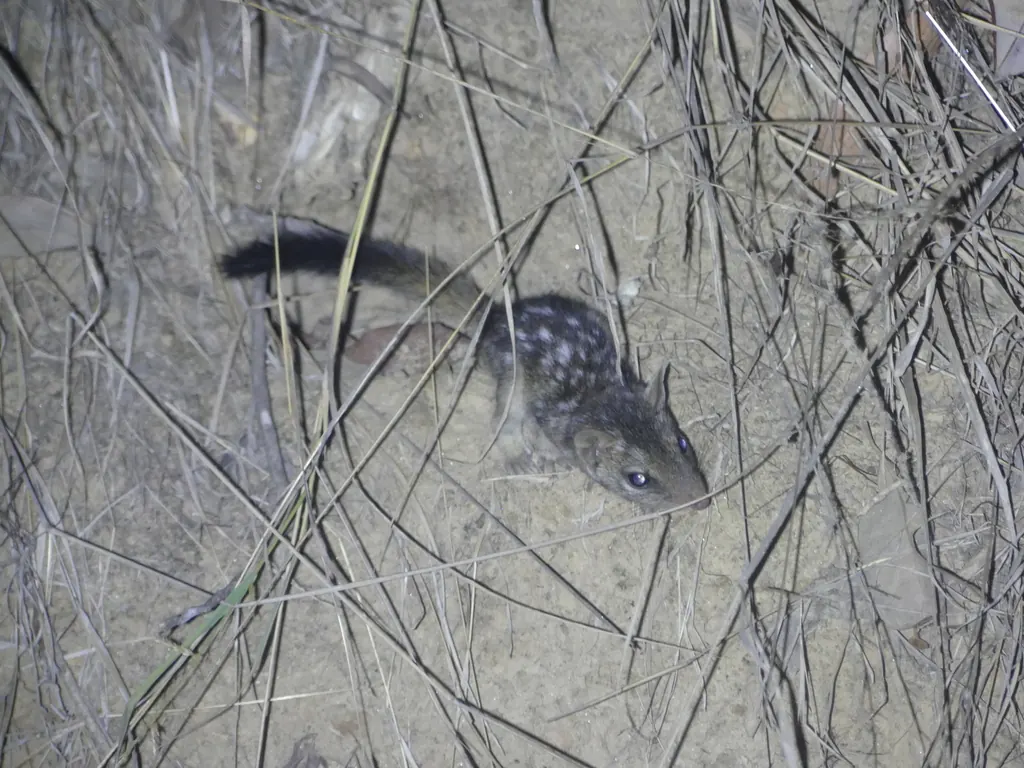
jungarr and waykal are the 'native cat', the quoll; kulngu the bandicoot and ngumbi the 'little spotted bandicoot'; kukur the rat, durrkin the 'white-tailed rat' and jayju the 'kangaroo rat'[1]. They are the small meat of the night: the northern quoll, 'the smallest of the four Australian quoll species', which 'feed[s] primarily on invertebrates, but also consume[s] fleshy fruit (particularly figs), and a wide range of vertebrates, including small mammals, birds, lizards, snakes, and frogs', and whose males all die after the mating season; the northern brown bandicoot, '1,200 g', with 'a reverse pouch so it won't fill with soil when digging'; the rakali or water-rat, which 'lives in burrows on the banks of rivers, lakes and estuaries and feeds on aquatic insects, fish, crustaceans, mussels, snails, frogs, cane toads, bird's eggs and small water birds'; and the rock rats, melomys and bush rats of the ridges and the grass[2][3][4]. Roth's people took bandicoots by digging: 'bandicoots may be sought for and dug out of their burrows and from dead logs. In the Princess Charlotte Bay District the lawyer-cane prodder is often found useful in determining the actual presence of the animal', a three-metre cane with a knob of beeswax on the end that 'picks up any opossum- or bandicoot-fur' and tells the digger exactly where to dig[5][6].
Nothing is written for the Eastern coast on this page yet. What follows is true across the country.
Hann River Cape York
Possum People's country on the upper river and Thaypan (Kuku Thaypan) country downstream: stringybark and bloodwood woodland and a spring-fed sandy river that runs north-east from the Great Dividing Range, past the Peninsula Developmental Road, into Rinyirru (Lakefield) and the North Kennedy. Not Kuku Yalanji country: the Kuku Yalanji words on this page are the dictionary's, not the Hann's own languages. Place guide
On the Hann the Atlas of Living Australia holds no quoll records in a box of about 90 × 85 km around the middle Hann, Laura and western Rinyirru. It holds 2 northern brown bandicoot records (2022–2025), 5 rakali (1994–2021), 39 of the canefield rat Rattus sordidus (2006–2023), a few melomys, planigales and Lakeland Downs mice, and one rufous bettong, a 'kangaroo rat' (2014)[13]. Feral cats, 19 records from 1993 to 2025, hunt them all[13]. The upper Hann is the Possum People's country, and one of their clans is the Kangaroo-Rat clan[14].
Where they live here
The rakali lives in the banks of the Hann's deep holes, which never go dry: the river has run every day since its gauge was put in, in 1968[15]. The bandicoot keeps to thick cover in the dry and comes out onto the grass in the wet, as described above[3]. The quoll has gone quiet here. The Kuku Thaypan Elders name the northern quoll, 'the bigger one' (the spotted-tailed quoll) and the black-footed tree rat among the animals 'once known to have existed in higher numbers', and read their decline as a sign of 'the absence of people on country'[16]. The Atlas box has no quoll records at all[13].
How people took them here
No record of hunting these animals has been published for the Possum or Thaypan peoples of the Hann[14][17]. The nearest written record is Roth's from the Princess Charlotte Bay District, downstream: there the lawyer-cane prodder was used to find a bandicoot in its burrow or log before digging, as set out in the how-to above[5]. Roth also wrote down a story from Lakefield about the kangaroo-rat and the yams[18]. It belongs to its custodians: ask them, not this page.
Upper Mitchell Western Yalanji
Western Yalanji country west of the Great Dividing Range: dry open woodland cut by the sandy, paperbark-lined upper Mitchell River, around Karma Waters and Mount Carbine. Place guide
Within 60 km of Karma Waters the Atlas has twenty-five records of the quoll, twenty-seven of the bandicoot, twenty-four of the common rock rat, three of the rakali and a scatter of the rest[8]. The quolls are still in the Karma Waters rock country, which is the news in this page[8].
Which ones live here
The common rock rat (Zyzomys argurus), twenty-four records, on the rock piles; the bush rat, fourteen; the grassland melomys, eight, and the fawn-footed melomys, five, in the grass and the river scrub; the yellow-footed and rusty antechinus, the mouse-sized marsupial hunters, and a planigale; and the house mouse, twenty-five, and the black rat, six, round the homestead[8]. The feral cat has thirty-three records within 60 km; it eats all of them[8].
On country today
The bandicoots dig the river flats and the rakali works the pools at dusk[8]. Hunting for personal, domestic or non-commercial communal needs is a native title right recognised in the Western Yalanji determinations[19].
Everywhere
Names
jungarr 'marsupial native cat'; waykal 'native cat'. kulngu 'bandicoot'; ngumbi 'little spotted bandicoot'. kukur 'rat'; durrkin 'white-tailed rat', the big rainforest rat of the coast; jayju 'kangaroo rat', the bettong[1]. The rakali's English name is itself a borrowing: 'adoption of the Ngarrindjeri name rakali is intended to foster a positive public attitude by Environment Australia', replacing 'water-rat'[4].
The small mammals
Northern quoll (Dasyurus hallucatus, jungarr, waykal). 'A carnivorous marsupial native to Australia', 'also known as the northern native cat'; 'the smallest of the four Australian quoll species. Females are smaller than males, with adult females weighing between 240 and 690 g and adult males 340 and 1,120 g. Head and body length ranges from 27–37 cm for adult males'. 'Northern quolls feed primarily on invertebrates, but also consume fleshy fruit (particularly figs), and a wide range of vertebrates, including small mammals, birds, lizards, snakes, and frogs. They also scavenge on roadkills, around campsites, and in garbage tins.' 'During the mating season, males exhibited weight loss, fur loss, parasite infestation, increased testosterone levels and anaemia', and die; 'this quoll species is most abundant in rocky ranges and open eucalypt forest ... rocky areas are important for the species'[2]. The cane toad is its killer, 'the depletion of native species that die eating cane toads'[7].
Northern brown bandicoot (Isoodon macrourus, kulngu). 'Typical body and tail lengths of 40 and 15 cm, respectively. On average it weighs 1,200 g. This marsupial has a thick harsh coat but is not spiny. The dorsal pelage is light brown in appearance with speckled black patterns throughout. On the ventral surface it is solid white. The northern brown bandicoot has a reverse pouch so it won't fill with soil when digging. This bandicoot also has short, rounded ears and a short nose.' 'During the dry season, this species lives in thick vegetation consisting of tall weeds, small trees, and dense shrubs ... During the wet season though, the northern brown bandicoot "comes out" and roams open grasslands where sources of food are more abundant.' 'The northern brown bandicoot makes individual nests or homes on the ground consisting of simple mounds of hay and twigs that are well camouflaged and waterproof. The inside is hollow and large enough for just the single bandicoot. Some bandicoots use hollowed-out tree trunks'[3].
Rakali, the water-rat (Hydromys chrysogaster). 'Having adapted to and colonised a unique niche of a semiaquatic and nocturnal lifestyle, this species lives in burrows on the banks of rivers, lakes and estuaries and feeds on aquatic insects, fish, crustaceans, mussels, snails, frogs, cane toads, bird's eggs and small water birds.' 'A body length of 23–37 cm, weigh 340–1,275 g, and have a thick tail measuring around 24–35 cm ... They have partially webbed hind legs, waterproof fur, a flattened head, a long blunt nose, many whiskers and small ears and eyes ... They are black to brown in colour with an orange to white belly, and dark tail with a white tip.' 'Long considered a nuisance animal, rakali were hunted for their soft fur, particularly in the Depression of the 1930s'; 'a protection order was issued in 1938'[4].
Roth, 1901 and 1904 (Princess Charlotte Bay District). 'Bandicoots may be sought for and dug out of their burrows and from dead logs. In the Princess Charlotte Bay District the lawyer-cane prodder is often found useful in determining the actual presence of the animal, and so save fruitless digging away of earth or cutting away of timber'[5]. 'The prodder consists of a piece of lawyer-cane (Calamus sp.) some 10 or 12 feet long (with all its "prickles" removed), upon the extremity of which a bulbous knob of bees' wax has been fixed. It is inserted into tree- or ground-holes, the cane being naturally well adapted for the purpose, when the waxed tip picks up any opossum- or bandicoot-fur, etc., against which it may be pressed. It thus serves the double purpose of confirming the presence of some particular animal, and accurately gauging its situation in the log or hole, so far as distance is concerned, whereby the labour of cutting away or digging at the right spot is reduced to a minimum. For transport purposes, the implement is bound round into a coil, so as to be slung on the shoulder, and is carried about by men'[6]. Roth also lists the 'ring-tailed spotted opossum — black with white spots', which 'is tracked not only by its claw-marks, but also by its scent, which is as strong-smelling as a pole-cat's', a description that fits the quoll[5].
Telling them
- Quoll: cat-sized, brown with white spots on the body but not the tail, a pointed face, pink nose; in the rocks and on the campsite at night[2].
- Bandicoot: a long pointed snout, a rat's tail, a rounded back, bouncing run; conical holes in the ground[3].
- Rakali: an otter-shaped swimmer with a white tail-tip, in the pool at dusk[4].
- Rock rat: a rat with a fat-based tail on the rock piles[8].
- Antechinus: mouse-sized, a pointed face, all teeth; not a mouse[8].
- Black rat and house mouse: the homestead's; a black rat's tail is longer than its body[8].
Signs
- Conical diggings in soft ground with a snout-hole at the bottom: a bandicoot after beetles and roots[3].
- A waterproof heap of grass on the ground in thick cover: a bandicoot's nest[3].
- Mussel shells and cherabin claws on a flat rock or a log by the water: a rakali's feeding table[4].
- A burrow in the bank just above the waterline[4].
- White-spotted scats on a rock ledge and a pole-cat smell: a quoll[2][5].
- Fur on the end of the prodder[6].
Where they live
The quoll and the rock rat on the rock piles and ridges and in the open forest; the bandicoot in the thick cover of the creeks in the dry and out on the grass in the wet; the rakali in the river bank; the melomys in the grass and river scrub[2][3][4][8].
The small hunters of the night
The quoll is the night's small carnivore, the mouse-and-lizard hunter and the figs' eater, and the thing that the cane toad kills first[2][7]. The bandicoot turns the soil for beetles and grubs and is the python's, the owl's and the dingo's food[3][9]. The rakali is one of the few native animals recorded eating the cane toad, and it takes the mussels and cherabin of the pool and the eggs of the water birds[4]. The rats and antechinus feed the owls, the kookaburras, the snakes and the quoll; the feral cat feeds on all of them[8].
Seasons
The bandicoot keeps to cover in the dry and 'comes out' onto the grass in the wet; the quoll's males die after the dry-season mating; the rakali works the shrinking pools in the late dry when the mussels and cherabin are crowded[3][2][4]. See the year on country.
Uses
- Meat: the bandicoot, dug out of its burrow or log, roasted whole in the ashes[5].
- The prodder: a hunting tool made from lawyer cane and beeswax[6].
- A sign of the cane toad's reach: where the quolls are still, the toads are not yet, or the quolls have learnt[7].
- Fur: the rakali was a fur animal in the 1930s, and is protected since 1938[4].
The prodder and the dig
- Make the prodder: a length of lawyer cane three to four metres long, every prickle stripped, a knob of beeswax worked onto the tip; coil it to carry on the shoulder[6].
- Find the hole in the ground or the hollow log by its fresh diggings and tracks[5].
- Feed the cane in and press the waxed tip against the far end; draw it out and look for fur on the wax[6].
- Measure the cane against the log or the ground to find exactly where the animal lies, and dig or cut there, 'whereby the labour of cutting away or digging at the right spot is reduced to a minimum'[6].
- Roast whole in the ashes.
- Leave the quoll and the rakali; both are rare, one is a cane-toad casualty and the other has been protected since 1938[2][4].
Safety
- Native animals are protected wildlife in Queensland under the Nature Conservation Act 1992; native title holders hunting for personal, domestic or non-commercial communal needs are covered by section 211 of the Native Title Act 1993[10][11]. The quoll is the cane toad's first casualty and the rakali has been protected since 1938[2][4].
- A hollow log with fur on the prodder may also hold a python or a goanna; look before you reach in.
- A quoll on the campsite at night steals meat; store food up and closed[2].
- The rakali's burrow in the bank is at the crocodile's water-line[12].
On Country today
Which bandicoot is ngumbi and which rat is kukur on each stretch of country is for the contribution box below[1].
Language
jungarr, waykal 'native cat'; kulngu 'bandicoot'; ngumbi 'little spotted bandicoot'; kukur 'rat'; durrkin 'white-tailed rat'; jayju 'kangaroo rat'; kanka 'hole'; janku 'hole in the ground'; jila 'beeswax'; minya 'meat, animal'[1].
References
- Hershberger, H. D. & Hershberger, R. (1982). Kuku-Yalanji Dictionary. Work Papers of SIL-AAB, Series B, Volume 7. With Toby Bloomfield, Roy Friday, Billy Roberts, Hector and Doris Sykes, Joe Walker and others. www.sil.org/resources/archives/18038
- Wikipedia. Northern quoll (Dasyurus hallucatus). en.wikipedia.org/wiki/Northern_quoll
- Wikipedia. Northern brown bandicoot (Isoodon macrourus). en.wikipedia.org/wiki/Northern_brown_bandicoot
- Wikipedia. Rakali, the water-rat (Hydromys chrysogaster). en.wikipedia.org/wiki/Rakali
- Roth, W. E. (1901). North Queensland Ethnography, Bulletin No. 3: Food — its search, capture, and preparation. Brisbane: Government Printer. Bloomfield River information from the Hislops. — Sect. 6 'Cooking'; plant list ('Castanospermum australe', 'Dioscorea sativa', 'Elettaria Scottiana', 'Nymphaea') archive.org/details/northqueensland00landgoog
- Roth, W. E. (1904). North Queensland Ethnography, Bulletin No. 7: Domestic implements, arts, and manufactures. Brisbane: Government Printer. — Sect. 10 'Fire-tongs' archive.org/details/northqueensland00landgoog
- Wikipedia. Cane toads in Australia: effects on native predators (goannas, snakes, freshwater crocodiles) and on dogs. en.wikipedia.org/wiki/Cane_toads_in_Australia
- Atlas of Living Australia. Occurrence records within 60 km of the Karma Waters homestead (16.62° S, 144.60° E), species counts for Animalia (accessed 10 October 2026). biocache.ala.org.au/occurrences/search?q=*:*&lat=-16.62&lon=144.60&radius=60
- Wikipedia. Morelia spilota (carpet python). en.wikipedia.org/wiki/Morelia_spilota
- Queensland Government, State of the Environment. Nature Conservation Act 1992. www.stateoftheenvironment.des.qld.gov.au/biodiversity/management-responses/legislation/nature-conservation-act-1992
- Australian Law Reform Commission. Review of the Native Title Act 1993 (DP 82), ch. 8: Relevant provisions in the Native Title Act (s 211). www.alrc.gov.au/publication/review-of-the-native-title-act-1993-dp-82/8-the-nature-and-content-of-native-title/relevant-provisions-in-the-native-title-act/
- Queensland Government. Be Crocwise top tips; Be Crocwise in Croc Country (web pages, accessed 5 October 2026). www.qld.gov.au/environment/plants-animals/animals/living-with/crocodiles/becrocwise/be-crocwise-top-tips
- Atlas of Living Australia. Mammal occurrence records in a box of about 90 × 85 km around the middle Hann River, Laura and western Rinyirru (lat −15.6 to −14.8, long 143.5 to 144.3), queried 28 October 2026: no Dasyurus; Isoodon macrourus 2 (2022–2025); Hydromys chrysogaster 5 (1994–2021); Rattus sordidus 39 (2006–2023); Melomys 2 (2022–2023); Leggadina lakedownensis 3 (2022); Planigale 2 (2007); Aepyprymnus rufescens 1 (2014); Felis catus 19 (1993–2025). biocache.ala.org.au/occurrences/search?q=class%3AMammalia
- Ross on behalf of the Cape York United #1 Claim Group v State of Queensland (No 21) (Possum determination) [2023] FCA 1316 (Federal Court of Australia, 2 November 2023). — Determination area (upper Hann and Kennedy rivers); prescribed body corporate; affidavit evidence on hunting and fishing www.judgments.fedcourt.gov.au/judgments/Judgments/fca/single/2023/2023fca1316
- Bureau of Meteorology, Water Data Online. Station 105001B, Hann River at Sandy Creek: daily and monthly mean discharge 1968–2026 (recent data provisional), retrieved 28 October 2026. No day of zero mean flow in 20,711 days of record; mean flow highest in February–March, lowest in September–November. www.bom.gov.au/waterdata/
- Standley, P.-M. (2019). The importance of campfires to effective conservation. PhD thesis, James Cook University. Records the fire and country knowledge of Kuku Thaypan Elders Dr Tommy George and Dr George Musgrave. — p. 28 (decline of the northern quoll, spotted-tailed quoll and black-footed tree rat) researchonline.jcu.edu.au/64274/
- Ross on behalf of the Cape York United #1 Claim Group v State of Queensland (No 20) (Thaypan determination) [2023] FCA 1315 (Federal Court of Australia, 2 November 2023). — Determination area and waters; prescribed body corporate (Awu-Laya Indigenous Corporation); affidavit evidence on hunting www.judgments.fedcourt.gov.au/judgments/Judgments/fca/single/2023/2023fca1315
- Roth, W. E. (1903). North Queensland Ethnography, Bulletin No. 5: Superstition, magic, and medicine. Brisbane: Government Printer. — Sect. 59, a story from Lakefield (Koko-warra of Princess Charlotte Bay) archive.org/details/northqueensland00landgoog
- Western Yalanji Aboriginal Corporation & CRC for Developing Northern Australia (2020). Western Yalanji Land Use and Economic Diversification Plan. CC BY 4.0. — Native Title Determinations 1–4 (pp. 13–18); ‘Fire Management and Carbon Farming’ (pp. 32–33); ‘Pastoralists’ crcna.com.au/wp-content/uploads/2024/05/westernyalanjilanduseplan_nov2020.pdf
From the community
Know this one? Add the words you use for it, what it is for, how it is done, a correction, or a photo from country. It shows here straight away with your name on it. Please keep anything restricted or sacred off the site.
Loading…