Plants, vines & grasses
Weeds and feral animals
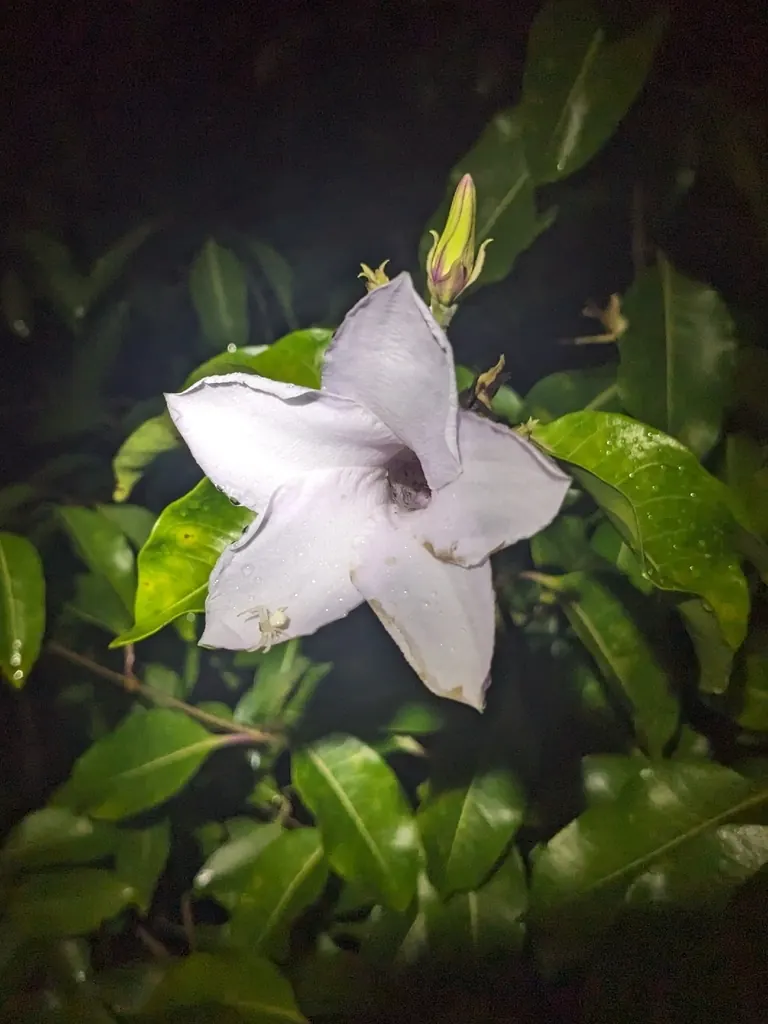
The dictionary has words for the things that came with the settlers, biki the pig and wunba 'the English bee and its honey', and none for the plants that came with them, which is a measure of how new they are[1]. The worst of the weeds is rubber vine, 'a woody-perennial vine that is native to south-west Madagascar', 'sometimes regarded as the worst weed in all of Australia', which 'smothers riparian vegetation and forms dense thickets', 'is extremely toxic to horses and cattle' and 'can grow as much as five metres in one month'[2][3][4]. Behind it come hyptis, a minty square-stemmed weed of the flats; red Natal grass; devil's claw, with its hooked fruits; common wireweed; and the cattle-forage stylo[2][5][6][7][8][9]. The feral animals are the pigs, the cats, the cane toads, the wild dogs, the rabbits, the black rats and house mice, and stray cattle and horses[10][11]. 'There are estimated to be up to 6 million feral cats found in almost every remote area across the country', descended from the First Fleet's and from cats released in the 1860s and 1870s to control rat plagues[12]. Queensland's Biosecurity Act 2014 lists rubber vine, pigs and dingoes as restricted and puts a 'general biosecurity obligation' on everyone on the land, which on a station means burning, baiting, trapping and pulling[4][13][14][15].
Nothing is written for the Eastern coast on this page yet. What follows is true across the country.
Hann River Cape York
Possum People's country on the upper river and Thaypan (Kuku Thaypan) country downstream: stringybark and bloodwood woodland and a spring-fed sandy river that runs north-east from the Great Dividing Range, past the Peninsula Developmental Road, into Rinyirru (Lakefield) and the North Kennedy. Not Kuku Yalanji country: the Kuku Yalanji words on this page are the dictionary's, not the Hann's own languages. Place guide
The Hann's country has the same invaders, and the people who manage it have named them. Kuku Thaypan Elders' country is suffering 'significant impacts' from 'feral pigs and exotic weeds, including; Weeds of National Significance Rubber Vine (Cryptostegia grandiflora), increasing Sicklepod (Senna obtusifolia) and the existence of significant areas of Grader Grass (Themeda quadravilus) that has the potential to replace entire systems of native grass'[22]. Olive hymenachne and gamba grass, a 'known fire transformer', are already in the catchment upstream of Rinyirru[22].
The weeds and ferals here
In a box of about 90 × 85 km around the middle Hann, Laura and western Rinyirru, the Atlas of Living Australia holds 455 records of lion's tail, 366 of hyptis, 229 of grader grass, 43 of gamba grass, 35 of sicklepod, 12 of olive hymenachne, 8 of rubber vine and 6 of red Natal grass; and 27 of cane toads, 20 of dogs, 19 of cats and 9 of pigs[23]. The counts follow where people surveyed, not how much of each there is.
Downstream in Rinyirru the joint managers name 'olive hymenachne', 'rubbervine', 'sicklepod' and 'lantana' as the major pest plants, with lion's tail, Senna siamea, hyptis and bauhinia; 'Hyptis is very competitive, and not considered to be treatable'[24]. 'Feral pigs Sus scrofa occur in large numbers throughout the park', where they 'dig up large areas of soil, eat the bulbs of water lilies and turtle eggs. Their activities create disturbed environments where pest plants flourish.' Feral cats 'exist in large numbers on the park': at one time '10 cats were taken per night over a period of a fortnight'. Stray cattle 'degrade wetlands, introduce pest plants' and pad the fence lines; de-stocking began in 2011[24].
Fire and weeds here
In Rinyirru, 'burning programs are likely to be significantly increasing grader grass populations, as fire promotes the grader grass', and 'late season, hot fires and early storm burns are being trialled to control pest plants such as lion's tail, sicklepod and hyptis'[24]. The Kuku Thaypan Elders read it differently. When their first small burns of 2004 left hyptis standing, they 'indicated that by targeting the native grass curing over time this weed would be outcompeted by recovering native grass species'; and a fire that was too hot in ironbark country left grader grass and sicklepod that 'turned country "upside down"'[22].
The one feral that is food here
Pig is hunted on this country today: the Court recorded a Possum man's evidence of 'hunting pigs, kangaroos, goanna, porcupine, and plain turkeys', and a Kuku Warra man of 'hunting for pig, bandicoot, porcupine and wallaby'[25][26]. See pigs.
On country today
The Elders' answer to pigs and cattle at the waterholes is plain: 'They want to simply fence the water hole off to keep pigs and cattle out'[22]. Native title holders hunt pigs under their own rights[27]. Visitors to Rinyirru are asked to 'limit the spread of weeds by ensuring clothes, shoes, gear, bikes and vehicles are clean and free of seeds before arriving', and to leave their pets at home: 'Domestic animals are not permitted in national parks'[28].
Upper Mitchell Western Yalanji
Western Yalanji country west of the Great Dividing Range: dry open woodland cut by the sandy, paperbark-lined upper Mitchell River, around Karma Waters and Mount Carbine. Place guide
Around Karma Waters the Atlas lists rubber vine thirteen times within 30 km, hyptis six times and red Natal grass three times; within 60 km it lists pigs forty-five times and cats thirty-three[2][10].
The weeds and ferals here
Within 30 km of the homestead the Atlas holds one record each of grader grass, devil's claw, common wireweed, shrubby stylo and the sponge gourd[2]. Thirty-three cat records lie within 60 km of the homestead[10]. The rabbit's four records within 60 km are the surprise of the list[10].
Fire on the station
Fire is the station's answer to the vine and the grass, 'to clear excess fuel and control weeds', and the cool, late burn the finches need is the same burn the rubber vine hates least, which is the dilemma of the river[15][19].
The weed year here
The station burns in the early and late dry[15].
On country today
The rubber vine on the Mitchell and the pigs on the lagoons are the biggest changes to Karma Waters' country since the cattle came, and the station's fire, baits and traps are the fight[2][15]. What the Western Yalanji call the weeds, and what they want done about them, is for the holders and the contribution box below[29].
Everywhere
Names
biki, bikibiki 'pig'; wunba 'name of the English bee and its honey. Also used for honey bought in store'; kaya 'dog' beside murramu 'dingo'; nyamun 'rubbish, (but not household rubbish) such as dead leaves or stuff washed up on the beach. Also leaf mould from scrub, good for growing things'[1]. The weeds have no names in the dictionary. 'Rubber vine', 'hyptis', 'stylo', 'Natal grass' and 'grader grass' are the English names.
The weeds and ferals
Rubber vine (Cryptostegia grandiflora). 'A woody-perennial vine that is native to south-west Madagascar. It is also a significant weed in northern Australia, sometimes regarded as the worst weed in all of Australia. It has also been introduced to most other tropical and subtropical regions because of its attractive flowers and its latex containing commercial quality rubber'. 'Seeds germinate after the first rains of the wet season ... if enough water is available, rubber vine can grow as much as five metres in one month. Flowering usually occurs after the wet season ends'; 'evidence shows individual seed dispersal as far as ten kilometres'; 'a rubber vine can grow up to 2 metres tall as a shrub, but when it is supported on other vegetation as a vine, it can reach up to 30 metres'; 'rubber vine thrives on (and requires) the extreme variability of rainfall and streamflow characteristic of central Queensland'[3]. Queensland: 'native to Madagascar, rubber vine is a vigorous climber with twining, whip-like shoots. It can grow unsupported as an untidy shrub with many stems. Rubber vine smothers riparian vegetation and forms dense thickets. It is found in central and northern Queensland', and it is a restricted invasive plant with a herbicide fact sheet[4]. The woodland page has it as 'extremely toxic to horses and cattle'[3].
Hyptis, pignut (Mesosphaerum suaveolens). 'A branching pseudocereal plant native to tropical regions of Mexico, Central, the West Indies, and South America, as well as being naturalized in tropical parts of Africa, Asia and Australia. It is generally 1–1.5 m tall, occasionally up to 3 m. Stems are hairy, and square in cross section. Leaves are oppositely arranged, 2–10 cm long, with shallowly toothed margins, and emit a strong minty odor if crushed. Flowers are pink or purple'[5]. In its home countries the seed is 'made into a refreshing drink by soaking the seeds in water', which is a thing to know about a weed that covers the flats[5].
Red Natal grass (Melinis repens). 'A species of grass known by the common names rose Natal grass, Natal red top, or simply Natal grass. It is native to southern Africa and an introduced species, often considered a noxious weed, on other continents such as North America and Australia. It is an annual or perennial grass, growing up to a meter tall ... The inflorescence is an open array of branches bearing spikelets densely coated in silky white or pink'[6]. Grader grass (Themeda quadrivalvis) is an introduced annual cousin of the kangaroo grass, spread along the roads as its name says[2].
Devil's claw (Martynia annua). 'An erect, somewhat shrubby annual plant about 1 metre tall, covered with glandular hairs'; 'fruits become blackened when ripe and have hooked spines at the tip, lending their name "cat's claw" or "tiger's claw". They stick to animal fur and eventually the seeds fall out as the fruit gets crushed by the animal's feet'[7]. Common wireweed (Sida acuta) 'is believed to have originated in Central America, but today has a pantropical distribution and is considered a weed'[8]. Shrubby stylo (Stylosanthes scabra), 'native to tropical South America, and introduced to Hawaii and Australia', 'widely planted as a drought-tolerant livestock forage', which is how it came to cattle country[9]. The sponge gourd Luffa aegyptiaca, Palmer's 'Bun-bun', was already 'a vine growing in the bed of the Mitchell' in 1883, 'used to poison fish when green'; see fish-poison plants[16][2].
Feral cats. 'There are estimated to be up to 6 million feral cats found in almost every remote area across the country'; 'several native species have evolved cat-like characteristics through a process of convergent evolution, including the marsupial quolls, known as a "native cat"'; 'historical records date the introduction of cats to the First Fleet in 1788'; 'in 1864 a mass release of cats in the Lachlan River in New South Wales was aimed at controlling a rat plague. Similar introductions to control rodent plagues occurred in rural areas of Western Australia and Victoria in the 1860s, and the Warrego River in Queensland in 1874'[12]. The quolls, bandicoots and rats, the lizards and the ground birds are what they eat[10].
Pigs, dogs, toads, cattle, horses, rabbits, rats. The pigs page has Queensland's 2.3 million and the damage; the dingo and dogs page the wild-dog law and the station's baiting; the frogs and goanna pages the cane toad's toll; the woodland page the cattle[13][14][17][11].
Telling the weeds from the natives
- Rubber vine: glossy dark paired leaves, milky sap, big pale-pink trumpet flowers, long paired pods full of silky seed, climbing the river trees; the native milky vines of the bank do not climb thirty metres[3][4].
- Hyptis: square hairy stems, a mint smell when crushed, small purple flowers in the leaf axils[5].
- Red Natal grass: a pink silky plume; the native blady grass plume is white and the kangaroo grass rusty[6].
- Devil's claw: sticky rhubarb-like leaves and a black hooked fruit[7].
- Stylo: a low leguminous shrub with three-part leaves and small yellow pea flowers, planted for stock[9].
- A cat's track: round, no claws, in a straight line; a quoll's shows claws and toes[12].
- Pig rooting, cattle pads, horse dung, rabbit scrapes: see tracks and signs.
Signs
- A river bank gone dark green and tangled under a curtain of vine: rubber vine[4].
- Silky seed blowing off the vine in the dry: next wet's crop, up to ten kilometres away[3].
- A mint smell from the weeds on a disturbed flat: hyptis[5].
- Pink plumes on a road verge: Natal grass[6].
- Hooked burrs in a dog's coat or a cow's tail: devil's claw[7].
- Feathers and a half-eaten skink at a hollow log's mouth: a cat[12].
- Dead goannas and quolls, and frogs by the hundred at the lights: the toads[17].
Where they are
Rubber vine on the river and creek banks and anywhere it can climb; hyptis, wireweed and devil's claw on the trampled, disturbed flats and yards; Natal grass and grader grass on the roads; stylo where it was sown; the cats everywhere the small animals are; the pigs on the lagoons; the toads at the water[4][5][6][10].
What they do to the country
Rubber vine takes the river: it smothers the paperbarks, the Leichhardt trees and the river red gums under thirty metres of vine, closes the banks, poisons the stock and feeds its seed down the river to the next station[3][4]. The pasture weeds take the flats after the cattle and the fire have opened them, and the flats are where the finches and the bustard feed on the native seed[5][18]. The cat hunts what the dingo and the quoll hunted, from the rock rat to the frilled lizard, and the toad kills the hunters[12][17].
Seasons
Rubber vine germinates 'after the first rains of the wet season', grows fastest in the wet, flowers and seeds after it, and blows its seed in the dry; the pasture weeds follow the wet; the pigs breed up after the wet[3][13]. See the year on country.
Uses, such as they are
- Pig: the one feral that is food; see pigs[1].
- Hyptis seed as a drink in its home countries; not a recorded use here[5].
- Stylo as cattle feed, which is why it was sown[9].
- Sponge gourd as Palmer's fish poison and a scrubbing sponge[16].
- Devil's claw fruits 'for making beads and ornaments' elsewhere[7].
- Firewood: dead rubber vine burns; the live vine's milky sap does not go on the cooking fire.
Fighting the weeds and ferals on country
- Rubber vine: the station's cycle of fire and the herbicide fact sheet are the tools; pull or cut seedlings on the bank before they climb, and never carry the silky seed on clothes or a vehicle from an infested creek to a clean one[4][15].
- Pasture weeds: cool burns and keeping the native grass seeding; see wild rice and grass seed[19].
- Pigs: trap with pre-feeding and pig-specific triggers; see pigs[13].
- Cats: keep food and rubbish closed at the camp, and report them to the landholder[12].
- Toads: no local fix; the keelback, the rakali and the crows have learnt to eat them, and the goannas have not[17].
- Dogs: keep yours away from the baits and the stock; see dingo and dogs[15].
- Know the obligation: 'you must take all reasonable and practical measures that are under your control to minimise the biosecurity risks', the Act's general biosecurity obligation[14].
Safety
Language
biki 'pig'; wunba 'the English bee and its honey'; kaya 'dog'; murramu 'dingo'; nyamun 'rubbish, dead leaves, leaf mould'; ngalku 'bush fire'; jikan 'grass'[1].
References
- Hershberger, H. D. & Hershberger, R. (1982). Kuku-Yalanji Dictionary. Work Papers of SIL-AAB, Series B, Volume 7. With Toby Bloomfield, Roy Friday, Billy Roberts, Hector and Doris Sykes, Joe Walker and others. www.sil.org/resources/archives/18038
- Atlas of Living Australia. Plant occurrence records within 30 km of the Karma Waters homestead (16.62°S, 144.60°E), queried 10 October 2026: 832 records of 266 species. biocache.ala.org.au/occurrences/search?q=kingdom:Plantae&lat=-16.62&lon=144.60&radius=30
- Wikipedia. Cryptostegia grandiflora (rubber vine). en.wikipedia.org/wiki/Cryptostegia_grandiflora
- Queensland Government (Business Queensland). Rubber vine: restricted invasive plant (accessed 10 October 2026). www.business.qld.gov.au/industries/farms-fishing-forestry/agriculture/biosecurity/plants/invasive/restricted/rubber-vine
- Wikipedia. Mesosphaerum suaveolens (hyptis, pignut). en.wikipedia.org/wiki/Mesosphaerum_suaveolens
- Wikipedia. Melinis repens (red Natal grass). en.wikipedia.org/wiki/Melinis_repens
- Wikipedia. Martynia annua (devil's claw). en.wikipedia.org/wiki/Martynia
- Wikipedia. Sida acuta (common wireweed). en.wikipedia.org/wiki/Sida_acuta
- Wikipedia. Stylosanthes scabra (shrubby stylo). en.wikipedia.org/wiki/Stylosanthes_scabra
- Atlas of Living Australia. Occurrence records within 60 km of the Karma Waters homestead (16.62° S, 144.60° E), species counts for Animalia (accessed 10 October 2026). biocache.ala.org.au/occurrences/search?q=*:*&lat=-16.62&lon=144.60&radius=60
- Karma Waters Station. Cattle (web page, accessed 5 October 2026). www.karmawatersstation.com/cattle.html
- Wikipedia. Feral cats in Australia. en.wikipedia.org/wiki/Feral_cats_in_Australia
- Queensland Government (Business Queensland). Feral pig: restricted invasive animal (accessed 10 October 2026). www.business.qld.gov.au/industries/farms-fishing-forestry/agriculture/biosecurity/animals/invasive/restricted/feral-pig
- Queensland Government (Business Queensland). Dingo: restricted invasive animal (accessed 10 October 2026). www.business.qld.gov.au/industries/farms-fishing-forestry/agriculture/biosecurity/animals/invasive/restricted/dingo
- Karma Waters Station. Land management (web page, accessed 6 October 2026). www.karmawatersstation.com/land-management.html
- Palmer, E. (1883). On plants used by the natives of North Queensland, Flinders and Mitchell Rivers, for food, medicine, &c., &c. Journal and Proceedings of the Royal Society of New South Wales 17: 93–113. Palmer's Mitchell River names come from the lower and middle Mitchell, not from Kuku Yalanji speakers. archive.org/details/journalandproce16walegoog
- Wikipedia. Cane toads in Australia: effects on native predators (goannas, snakes, freshwater crocodiles) and on dogs. en.wikipedia.org/wiki/Cane_toads_in_Australia
- Wikipedia. Black-throated finch. en.wikipedia.org/wiki/Black-throated_finch
- Queensland Parks and Wildlife Service (2013). Planned Burn Guidelines: Cape York Peninsula Bioregion of Queensland. Department of National Parks, Recreation, Sport and Racing. — 'Fire in the monsoonal tropics of the Cape York Peninsula bioregion'; ch. 1–2 season guidance (storm burns) parks.desi.qld.gov.au/__data/assets/pdf_file/0019/151480/pbg-cape-york.pdf
- Queensland Government (Business Queensland). Wild dog: restricted invasive animal (accessed 10 October 2026). www.business.qld.gov.au/industries/farms-fishing-forestry/agriculture/biosecurity/animals/invasive/restricted/wild-dog
- NSW Health. Brucellosis: fact sheet (accessed 10 October 2026). www.health.nsw.gov.au/Infectious/factsheets/Pages/brucellosis.aspx
- Standley, P.-M. (2019). The importance of campfires to effective conservation. PhD thesis, James Cook University. Records the fire and country knowledge of Kuku Thaypan Elders Dr Tommy George and Dr George Musgrave. researchonline.jcu.edu.au/64274/
- Atlas of Living Australia. Occurrence records of introduced plants and animals: lion's tail Leonotis nepetifolia (455 records, 1998–2014), hyptis Mesosphaerum suaveolens (366, 1980–2020), grader grass Themeda quadrivalvis (229, 1983–2026), gamba grass Andropogon gayanus (43, 2008–2014), sicklepod Senna obtusifolia (35, 2010–2014), olive hymenachne Hymenachne amplexicaulis (12, 2008–2015), rubber vine Cryptostegia grandiflora (8, 1984–2026), red Natal grass Melinis repens (6, 2011–2014); cane toad Rhinella marina (27, 1970–2026), dog Canis familiaris (20, 1993–2026), cat Felis catus (19, 1993–2025), pig Sus scrofa (9, 1979–2024) in a box of about 90 × 85 km around the middle Hann River, Laura and western Rinyirru (lat −15.6 to −14.8, long 143.5 to 144.3), queried 28 October 2026. biocache.ala.org.au/occurrences/search?q=*:*&fq=decimalLatitude:%5B-15.6%20TO%20-14.8%5D&fq=decimalLongitude:%5B143.5%20TO%20144.3%5D
- Queensland Parks and Wildlife Service (2013). Rinyirru (Lakefield) Aggregation Management Statement 2013. parks.desi.qld.gov.au/__data/assets/pdf_file/0027/165771/rinyirru.pdf
- Ross on behalf of the Cape York United #1 Claim Group v State of Queensland (No 21) (Possum determination) [2023] FCA 1316 (Federal Court of Australia, 2 November 2023). — Determination area (upper Hann and Kennedy rivers); prescribed body corporate; affidavit evidence on hunting and fishing www.judgments.fedcourt.gov.au/judgments/Judgments/fca/single/2023/2023fca1316
- Ross on behalf of the Cape York United #1 Claim Group v State of Queensland (No 19) (Kuku Warra determination) [2023] FCA 1314 (Federal Court of Australia, 2 November 2023). www.judgments.fedcourt.gov.au/judgments/Judgments/fca/single/2023/2023fca1314
- Native Title Act 1993 (Cth), section 211: preservation of certain native title rights and interests (hunting, fishing and gathering for personal, domestic or non-commercial communal needs). www.legislation.gov.au/C2004A04665/latest/text
- Queensland Parks and Wildlife Service. About Rinyirru (Lakefield) National Park (CYPAL): park features and looking after the park (web page, last updated 1 July 2024; accessed 28 October 2026). parks.qld.gov.au/parks/rinyirru-lakefield/about
- Western Yalanji Aboriginal Corporation & CRC for Developing Northern Australia (2020). Western Yalanji Land Use and Economic Diversification Plan. CC BY 4.0. — Native Title Determinations 1–4 (pp. 13–18); ‘Fire Management and Carbon Farming’ (pp. 32–33); ‘Pastoralists’ crcna.com.au/wp-content/uploads/2024/05/westernyalanjilanduseplan_nov2020.pdf
From the community
Know this one? Add the words you use for it, what it is for, how it is done, a correction, or a photo from country. It shows here straight away with your name on it. Please keep anything restricted or sacred off the site.
Loading…