Mammals
Feral pigs
biki · bikibiki · muyu · muyu wayjulSus scrofa
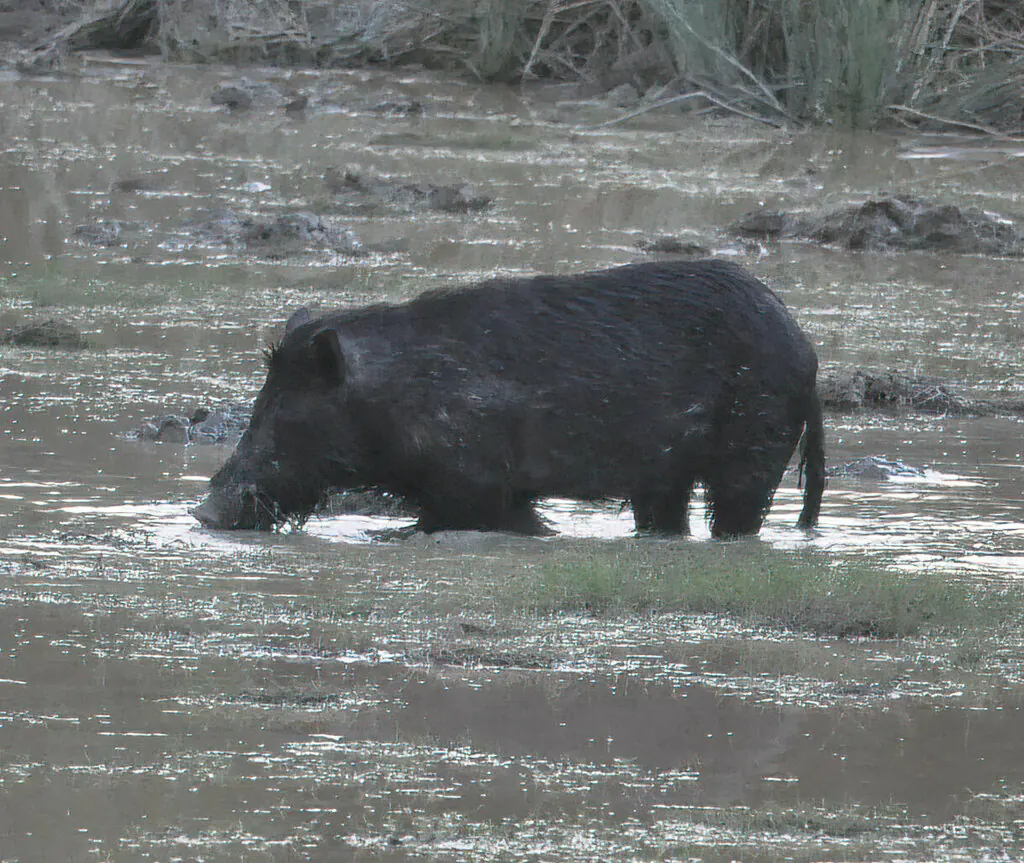
biki and bikibiki are the pig, muyu its hair and muyu wayjul 'singeing the hair of the pig before cooking', and the dictionary's example for ngingkirr is 'we were going, heard a grunt, a pig coming'[1]. The pig is not an animal of the old country: 'pigs were brought from Europe to Australia by the First Fleet in 1788. Imported as livestock, pigs soon escaped and established wild populations that have expanded over time. In 2021, it was estimated that Queensland had up to 2.3 million feral pigs. They are among Queensland's most widespread and damaging pest animals. Feral pigs spread invasive plants, degrade soil and water, prey on native species, damage crops and livestock, and carry diseases'[2]. A pig is the biggest meat on the river and the most dangerous to butcher: brucellosis from feral pigs 'typically begins with a flu-like illness', passes through cuts and splashes while gutting, and 'freezing, smoking, drying and pickling do not kill the bacteria'[3].
Hann River Cape York
Possum People's country on the upper river and Thaypan (Kuku Thaypan) country downstream: stringybark and bloodwood woodland and a spring-fed sandy river that runs north-east from the Great Dividing Range, past the Peninsula Developmental Road, into Rinyirru (Lakefield) and the North Kennedy. Not Kuku Yalanji country: the Kuku Yalanji words on this page are the dictionary's, not the Hann's own languages. Place guide
Feral pigs are everywhere in the Hann's country. Downstream in Rinyirru (Lakefield) National Park, 'Feral pigs Sus scrofa occur in large numbers throughout the park, and are commonly observed during park patrols and aerial activities'[9]. The Atlas of Living Australia holds 9 records of the pig, from 1979 to 2024, in a box of about 90 × 85 km around the middle Hann, Laura and western Rinyirru[10]. The people of this country hunt them today: a Possum man of the upper Hann and a Kuku Warra man of Laura both named pigs among the animals they hunt in their native title evidence[11][12].
Where they are here
On the water. In Rinyirru 'Pig impacts are evident around swamps and other water bodies'[9]. On Kuku Thaypan country in the park, Standley wrote that 'On all trips on country feral pigs and cattle were present on lagoon systems'[13]. The Hann itself never stops running, even in the late dry, so the pigs here are never short of water[14].
What they do here
Around the swamps and lagoons the pigs 'dig up large areas of soil, eat the bulbs of water lilies and turtle eggs. Their activities create disturbed environments where pest plants flourish'[9]. They dig up crocodile nests too: over 70 per cent of freshwater crocodile eggs are lost to floods or eaten by feral pigs, goannas and snakes[15]. The national Directory of Important Wetlands names feral pigs as a threat to the Rinyirru wetlands, and pigs threaten the Lakefield coolibah woodland, which grows nowhere but the Laura Basin[9]. Even the banks suffer: 'the movement of cattle and pigs is causing compaction, especially along the watercourses'[9].
How people deal with them here
The pig came with the Europeans, so there is no old record of it in this country; the general sections above have the dictionary's words and the cooking.
- Hunting. Palmer Lee Cheu, a Possum man, 'describes hunting pigs, kangaroos, goanna, porcupine, and plain turkeys'[11]. A Kuku Warra man of Laura talks about 'hunting for pig, bandicoot, porcupine and wallaby'[12].
- Keeping them off the water. Standley records the Kuku Thaypan Traditional Owners' answer for a fouled waterhole: 'They want to simply fence the water hole off to keep pigs and cattle out or take other ameliorating actions'. In their law the lagoons and wetlands are 'a vital part of the overall network of the river system all the way to the ocean', and 'Cattle and pigs in these areas need to be controlled and an appropriate fire regime implemented to improve water quality'[13].
On country today
In Rinyirru. Rangers use 'aerial shooting and baiting programs', aimed at 'areas of high conservation value', and they have fenced a lagoon to keep the pigs out[9]. The Australian Quarantine and Inspection Service 'undertake regular sampling of pig populations' in the park[9]. Visitors may not bring guns or dogs: firearms are prohibited in national parks and domestic animals are not permitted[16].
Native title. The upper Hann is the Possum People's country[11]. The middle and lower Hann are in the Thaypan determination of 2 November 2023, held by the Awu-Laya Indigenous Corporation, which recognises rights to hunt, fish and gather on the land and waters[17]. Ask them before hunting.
Brucellosis is a risk with every feral pig: see Safety above.
Upper Mitchell Western Yalanji
Western Yalanji country west of the Great Dividing Range: dry open woodland cut by the sandy, paperbark-lined upper Mitchell River, around Karma Waters and Mount Carbine. Place guide
On Karma Waters the pigs root the river margins and the water-lily lagoons, and the station's cattle country is the kind of country they damage most[18][2][19].
Hunting here
On a working station the station's rules come first: the induction says 'weapons and hunting dogs are not allowed' for visitors, the land-management page says when the baits are down, and native title holders arrange their own hunting with the station[20][21][22].
The law here
The pig is not native, so native title hunting rights are not the question; the station's permission and firearms law are[20].
On country today
The pigs are on the Karma Waters river every dry season and the station fights them with the rest of Cape York; the pig the Bloomfield families ate at the mission is the same animal the Western Yalanji take on the Mitchell now[18][6].
Eastern coast Eastern Kuku Yalanji
Eastern Kuku Yalanji country: rainforest, beaches, mangroves, reef and the short steep rivers from the Daintree to the Bloomfield and the Annan.
But by the mission years at Bloomfield the pig was already bush food: Anderson lists the 'bush-food resources important during this time' as 'fish, shellfish, pig, turtle and cassowary meat, wild fruits, hairy yam'[6].
The pig as food
Anderson, writing of the Bloomfield mission years, puts pig second only to fish and shellfish among the bush foods: 'fish, shellfish, pig, turtle and cassowary meat, wild fruits, hairy yam and the introduced "New Guinea yam"'[6]. The dictionary's muyu wayjul, the singeing of the hair before cooking, is the cooking of a whole pig on the coals or in the earth oven[1].
Everywhere
Names
biki 'pig (also reduplicated as bikibiki)', bikibiki 'pig'. muyu 'hair of a pig'; muyu wayjul 'singeing the hair of the pig before cooking'. ngingkirr, with the example 'we were going, heard a grunt, a pig coming'. muna 'tame, as a tame pig'[1]. The word is the English one taken into the language, as the animal was taken into the country.
The feral pig
'A feral pig is a pig that lives in a wild state and is not being farmed or kept for another purpose'[2]. They are black, ginger, spotted or sandy, long-snouted and razor-backed, the boars with tusks, and they run in mobs of sows and young with the boars alone. 'In 2021, it was estimated that Queensland had up to 2.3 million feral pigs. They are among Queensland's most widespread and damaging pest animals'[2].
What they do to country. 'Feral pigs spread invasive plants, degrade soil and water, prey on native species, damage crops and livestock, and carry diseases'[2]. On a river that means the soft ground: the lily lagoons, the drying margins of the pools, the turtle and crocodile nests in the sand, the cherabin and mussel beds in the shallows, and the ground under the figs and wild plums when the fruit falls[2].
Control, as Queensland describes it. 'Difficult to control in some situations. Effective control requires integrated, collaborative approach'; 'most effective strategy is to combine various control methods (including shooting, poisoning, trapping and fencing) with appropriate land management practices.' 'Trapping is most useful in populated areas, on smaller properties (<5,000ha), and where pig numbers are low. Trapping can be particularly useful in removing survivors from poisoning programs. Trapping is most successful when food resources are limited. Trigger mechanisms for pig traps can be made pig-specific so that they pose little danger to other wild or domestic animals.' 'Pre-feeding is the most important step in ground poisoning. To maximise effectiveness, free feed pigs with non-poisoned bait for several days before laying poisoned baits.' 'Shooting pigs by helicopter is most effective where pigs exist in reasonable numbers and are observable from the air ... In dry tropics, aerial shooting is the most cost-effective method of control. Ground shooting is generally not effective in reducing pig populations unless intense shooting is undertaken on small, isolated, accessible populations of pigs.' 'CSSP (yellow phosphorus) pig poison must not be used to control feral pigs. CSSP is inhumane and its use is prohibited under the Animal Care and Protection Act 2001.' 'The feral pig is a category 3, 4 and 6 restricted invasive animal under the Biosecurity Act 2014'[2].
Telling the sign
- Pig rooting: ground turned over as if by a plough, along the water's edge and under fruiting trees[2].
- Wallows: mud baths in the drying margins, with mud rubbed on the trees beside them.
- Tracks: cloven, rounder and blunter than a wallaby's, the dew-claws showing in soft ground.
- Cattle sign is bigger and the dung is different; a goanna's digging is a neat hole, not a ploughed patch.
- A grunt in the scrub, ngingkirr: 'a pig coming'[1].
Signs
- Fresh rooting with wet soil means the mob was there last night; they feed at night and lie up in the thick shade by day in the heat.
- A mob of sows with young is the most dangerous; a sow will charge for her piglets.
- A dug-out turtle nest on a sandbank with broken shells: pigs or goannas.
- Kites and crows over the scrub: a dead pig, or a kill[4].
Where they are
Along the river and the creeks, in the lily lagoons and the paperbark fringe, wherever there is water, shade and soft ground; out into the woodland after the wet when the ground is soft and the grass seed and fruit are down[2]. 'Trapping is most successful when food resources are limited', which in the dry tropics is the late dry[2].
What the pig eats and what eats it
The pig eats everything the river offers: lily tubers and stems, roots, fallen fruit, grass seed, mussels and cherabin, frogs, turtle and crocodile eggs, carrion and the newborn calf, which is what 'prey on native species' and 'damage ... livestock' mean on the ground[2]. It is eaten by the saltwater crocodile at the water's edge and by the dingo, which takes the piglets, and by people[5][6]. It carries disease to the cattle and to the people who butcher it, and it spreads the weeds along the river[2][3].
Seasons
The pigs breed through the year and the mobs are biggest after the wet; in the late dry they are tied to the last water and the last soft ground, which is when trapping works and when the river margins show their rooting most[2]. See the year on country.
Uses
- Meat, the biggest on the river, cooked whole after singeing the hair, as the dictionary's muyu wayjul says[1][6].
- Pig fat for cooking and for greasing tools and leather.
- Tusks as ornaments and tools.
- Country care: taking pigs off the lagoons is one of the few things a hunter does that the lilies and the turtles are better for[2].
Taking and cooking a pig
Whoever's country it is, the landholder's and the Traditional Owners' rules come first: see each place above.
- Read the sign at the water in the morning: fresh rooting, wallows and tracks tell you the mob's size and its line back to the shade it lies up in by day.
- Trap rather than chase where numbers are low: build a mesh trap on a pad the pigs are already using, 'free feed pigs with non-poisoned bait for several days' with the gate tied open, then set a pig-specific trigger so that it 'pose[s] little danger to other wild or domestic animals'[2].
- Dispatch cleanly and at once; a wounded boar is dangerous and a wounded pig left in the lagoon fouls the water.
- Butcher with gloves and covered cuts, away from the water, and wash afterwards; 'transmission can occur during field-dressing or handling of infected carcasses, as Brucella bacteria can enter the body through skin abrasions, mucous membranes, or inhalation'[7].
- Singe the hair off over the fire, muyu wayjul, scrape, gut, and cook on the coals or in the earth oven[1].
- Cook it right through: 'thoroughly cook meat from feral pigs (and other game) before eating – freezing, smoking, drying and pickling do not kill the bacteria that cause brucellosis'[3].
- Do not feed raw pig to the dogs; brucellosis in dogs passes on to people[3].
- Bury or burn the offal away from the water, so the crocodile is not taught to come to the butchering place[8].
Safety
- Brucellosis. 'Brucellosis typically begins with a flu-like illness. This may include fever, headache, weakness, drenching sweats, chills, weight loss, joint and muscle pain'; 'the symptoms usually start 5-60 days after a person has been infected'; 'the infection typically lasts for days or months but can occasionally last for a year or more and may recur'. 'Pregnant women and their babies are at risk of developing severe disease', and 'those vulnerable to severe disease (such as pregnant women) should avoid all contact with feral pigs, hunting activities and pig hunting dogs'[3]. 'B. suis is of intermediate virulence and chiefly infects pigs'; 'hunters and individuals who consume wild game face an elevated risk'[7].
- The boar's tusks and the sow's charge: never between a sow and her young, never follow a wounded pig into cover.
- Pig dogs are a brucellosis route to the family; see dingo and dogs[3].
- The crocodile works the same water's edge the pigs do; see Crocwise[8].
- Poisons: CSSP is prohibited; 1080 only through authorised persons; and a 1080 pig bait kills a dog[2].
On Country today
The dictionary already has the pig's cooking word; the hunting words are for the contribution box below[1].
Who may hunt pigs, and how, differs from place to place: see each place above, and ask the Traditional Owners and the landholder first.
Language
biki, bikibiki 'pig'; muyu 'hair of a pig'; muyu wayjul 'singeing the hair of the pig before cooking'; wayjul the verb to cook or burn; ngingkirr 'a grunt'; muna 'tame, as a tame pig'; kurrma 'earth oven'; minya 'meat'[1].
References
- Hershberger, H. D. & Hershberger, R. (1982). Kuku-Yalanji Dictionary. Work Papers of SIL-AAB, Series B, Volume 7. With Toby Bloomfield, Roy Friday, Billy Roberts, Hector and Doris Sykes, Joe Walker and others. www.sil.org/resources/archives/18038
- Queensland Government (Business Queensland). Feral pig: restricted invasive animal (accessed 10 October 2026). www.business.qld.gov.au/industries/farms-fishing-forestry/agriculture/biosecurity/animals/invasive/restricted/feral-pig
- NSW Health. Brucellosis: fact sheet (accessed 10 October 2026). www.health.nsw.gov.au/Infectious/factsheets/Pages/brucellosis.aspx
- Wikipedia. Whistling kite (Haliastur sphenurus). en.wikipedia.org/wiki/Whistling_kite
- Queensland Government (Business Queensland). Dingo: restricted invasive animal (accessed 10 October 2026). www.business.qld.gov.au/industries/farms-fishing-forestry/agriculture/biosecurity/animals/invasive/restricted/dingo
- Anderson, C. (1996). Traditional material culture of the Kuku-Yalanji of Bloomfield River, North Queensland. Records of the South Australian Museum 29(1): 63–83. Based on fieldwork at Wujal Wujal in the late 1970s and early 1980s. — Hunting (spears, spear-throwers, harpoons); fishing (stupefacients); manufacturing (gums and resins); post-contact bush component archive.org/details/RecordsSouthAus29Sout
- Wikipedia. Brucellosis. en.wikipedia.org/wiki/Brucellosis
- Queensland Government. Be Crocwise top tips; Be Crocwise in Croc Country (web pages, accessed 5 October 2026). www.qld.gov.au/environment/plants-animals/animals/living-with/crocodiles/becrocwise/be-crocwise-top-tips
- Queensland Parks and Wildlife Service (2013). Rinyirru (Lakefield) Aggregation Management Statement 2013. parks.desi.qld.gov.au/__data/assets/pdf_file/0027/165771/rinyirru.pdf
- Atlas of Living Australia. Occurrence records of Sus scrofa (9 records, 1979–2024) in a box of about 90 × 85 km around the middle Hann River, Laura and western Rinyirru (lat −15.6 to −14.8, long 143.5 to 144.3), queried 28 October 2026. biocache.ala.org.au/occurrences/search?q=taxon_name%3A%22Sus%20scrofa%22&fq=decimalLatitude%3A%5B-15.6%20TO%20-14.8%5D&fq=decimalLongitude%3A%5B143.5%20TO%20144.3%5D
- Ross on behalf of the Cape York United #1 Claim Group v State of Queensland (No 21) (Possum determination) [2023] FCA 1316 (Federal Court of Australia, 2 November 2023). — Determination area (upper Hann and Kennedy rivers); prescribed body corporate; affidavit evidence on hunting and fishing www.judgments.fedcourt.gov.au/judgments/Judgments/fca/single/2023/2023fca1316
- Ross on behalf of the Cape York United #1 Claim Group v State of Queensland (No 19) (Kuku Warra determination) [2023] FCA 1314 (Federal Court of Australia, 2 November 2023). www.judgments.fedcourt.gov.au/judgments/Judgments/fca/single/2023/2023fca1314
- Standley, P.-M. (2019). The importance of campfires to effective conservation. PhD thesis, James Cook University. Records the fire and country knowledge of Kuku Thaypan Elders Dr Tommy George and Dr George Musgrave. researchonline.jcu.edu.au/64274/
- Bureau of Meteorology, Water Data Online. Station 105001B, Hann River at Sandy Creek: daily and monthly mean discharge 1968–2026 (recent data provisional), retrieved 28 October 2026. No day of zero mean flow in 20,711 days of record; mean flow highest in February–March, lowest in September–November. www.bom.gov.au/waterdata/
- Queensland Government. Freshwater crocodile (web page, accessed 28 October 2026). www.qld.gov.au/environment/plants-animals/animals/living-with/crocodiles/freshwater-crocodile
- Queensland Parks and Wildlife Service. About Rinyirru (Lakefield) National Park (CYPAL): looking after the park (web page, accessed 28 October 2026). parks.qld.gov.au/parks/rinyirru-lakefield/about
- Ross on behalf of the Cape York United #1 Claim Group v State of Queensland (No 20) (Thaypan determination) [2023] FCA 1315 (Federal Court of Australia, 2 November 2023). — Determination area and waters; prescribed body corporate (Awu-Laya Indigenous Corporation); affidavit evidence on hunting www.judgments.fedcourt.gov.au/judgments/Judgments/fca/single/2023/2023fca1315
- Atlas of Living Australia. Occurrence records within 60 km of the Karma Waters homestead (16.62° S, 144.60° E), species counts for Animalia (accessed 10 October 2026). biocache.ala.org.au/occurrences/search?q=*:*&lat=-16.62&lon=144.60&radius=60
- Karma Waters Station. Cattle (web page, accessed 5 October 2026). www.karmawatersstation.com/cattle.html
- Karma Waters Station. Induction, waiver and indemnity form (updated 9 June 2023). www.karmawatersstation.com/uploads/3/1/9/2/31929385/induction_waiver_and_indemnity.pdf
- Karma Waters Station. Land management (web page, accessed 6 October 2026). www.karmawatersstation.com/land-management.html
- Karma Waters Station. About: location, native title (web page, accessed 5 October 2026). www.karmawatersstation.com/about.html
From the community
Know this one? Add the words you use for it, what it is for, how it is done, a correction, or a photo from country. It shows here straight away with your name on it. Please keep anything restricted or sacred off the site.
Loading…