Mammals
Cattle and horses
yarraman · danda · mala-yarraman · marrkin-marrkin · wubun · wuybu · kubarruBos taurus × Bos indicus; Equus caballus
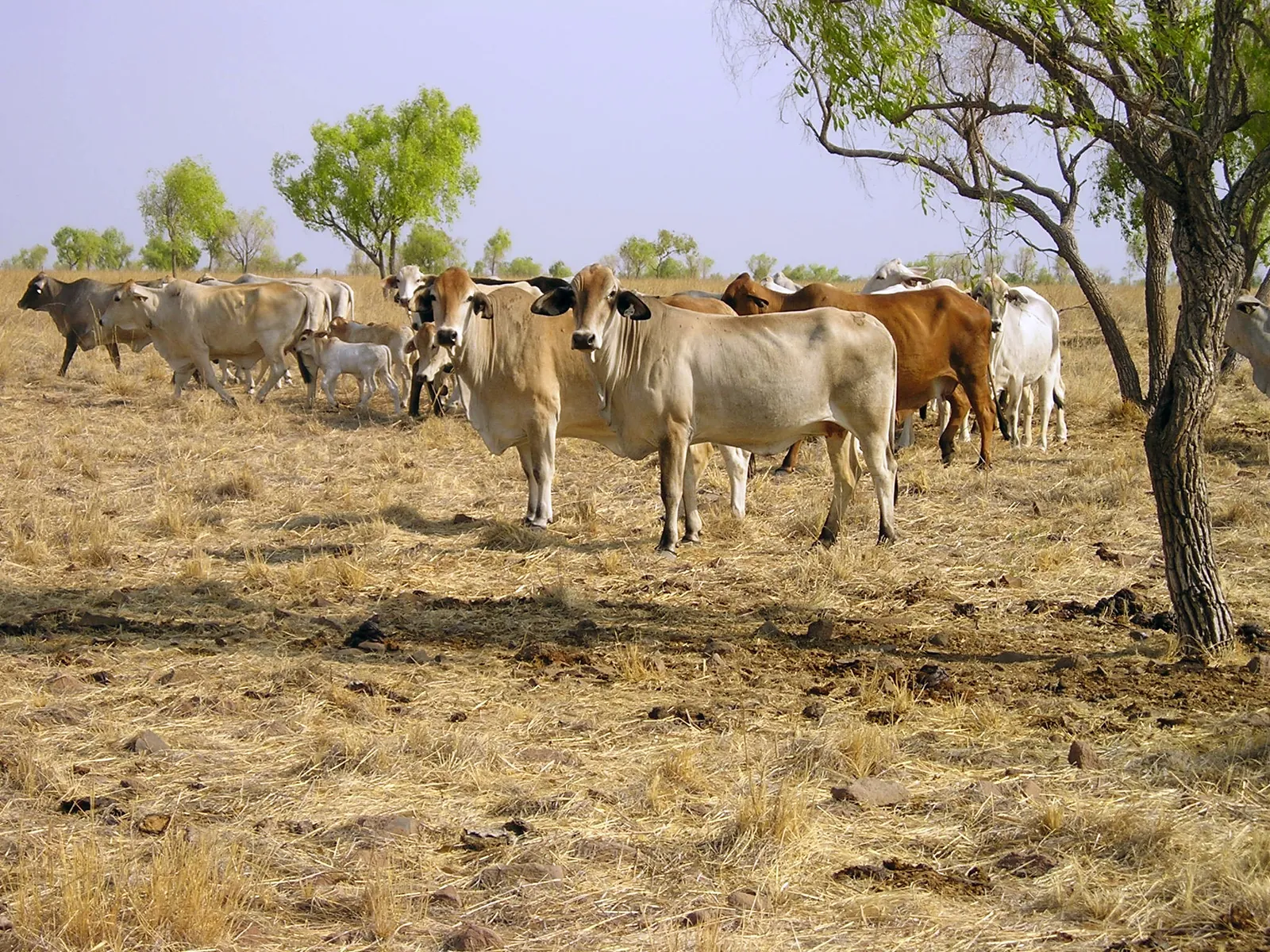

yarraman 'horse', danda 'chestnut horse', mala-yarraman 'good rider', marrkin-marrkin 'nickname for a stockman', wubun 'hump, as on a Brahman bull', wuybu 'whip' and kubarru 'sound of whip' are the dictionary's station words; there is no word for cattle in it, and that gap is for the contribution box below[1]. The Brahman 'has a high tolerance of heat, sunlight and humidity, and good resistance to parasites' and 'in Australia it is the most numerous breed of cattle'; the station horse is the Australian Stock Horse, 'a hardy breed of horse noted for endurance, agility, and good temperament'[2][3]. Both came north with the gold rushes and the stations that followed them, and both run wild: Queensland 'may have as many as 200,000 feral horses', an animal that 'competes with cattle for food and water' and 'damages creek banks and waterways'[4][5]. This page is the cattle and horses as things on country: how to read them, how to be safe around them, what the stations' and parks' rules are, and the long history of Aboriginal people as the stockmen and stockwomen of the north, from the stations that took the waterholes to the Wave Hill walk-off of 1966 and the stolen wages settlement of 2019[6][7].
Nothing is written for the Eastern coast on this page yet. What follows is true across the country.
Hann River Cape York
Possum People's country on the upper river and Thaypan (Kuku Thaypan) country downstream: stringybark and bloodwood woodland and a spring-fed sandy river that runs north-east from the Great Dividing Range, past the Peninsula Developmental Road, into Rinyirru (Lakefield) and the North Kennedy. Not Kuku Yalanji country: the Kuku Yalanji words on this page are the dictionary's, not the Hann's own languages. Place guide
The Hann's country has been cattle country since the gold rush. Laura Station was taken up in 1879 and 'by 1894 the property was carrying 8000 head of cattle'; Lakefield followed, and was 'associated with the cattle industry for almost a century' before it became Rinyirru (Lakefield) National Park in 1979[21][10]. 'Aboriginal people contributed significantly to the early success of the cattle industry'[21]: the Kuku Thaypan Elders of this country grew up as stockmen[22]. Today the park is being cleared of cattle, and the Elders want their lagoons fenced from them[10][22].
Cattle and horses here
'Branded and unbranded cattle occur on Rinyirru', and 'Cattle grazing still occurs on adjacent areas'[10]. Thaypan country, held under native title, includes Musgrave and Mary Valley stations[23]. The Atlas of Living Australia holds only 4 cattle records (2008–2025) and none of horses in a box of about 90 × 85 km around the middle Hann, Laura and western Rinyirru, which says only that nobody records stock[24].
Horses came first. Breeza Station in the park was taken up 'to breed horses for the Palmer Goldfields. With the decline of the gold rush, horse breeding gave way to cattle breeding and fattening', until the family gave up after 'the cattle tick outbreak of the 1890s'[21].
What cattle do to this country
In Rinyirru cattle 'degrade wetlands, introduce pest plants, change the structure of vegetation, and form deep pads along fence lines and in places where they enter and exit watering points', and 'the movement of cattle and pigs is causing compaction, especially along the watercourses'[10].
The Kuku Thaypan Elders' fire knowledge runs into the cattle at every turn. Boxwood country is 'some of the most productive country for cattle during the dry season' and today suffers 'from impacts resulting from over stocking'; after an early burn, cattle crowd onto the regrowth, and 'Traditional fire regimes or water management cannot be effective … if cattle are roaming free to devour the regrowth'[22]. 'Cattle too are attracted to the ash and come in and lick it once the flames have passed'[22].
The people of this country and the cattle
Stockmen. Standley writes that 'well into the 1950s people were still living on country. As children, the Elders were fortunate enough to maintain connection with their cultural lands by working as stockmen. Dr Musgrave was later a police tracker … They were able to apply their cultural knowledge of fire in practice as workers for non-Indigenous pastoralists'[22].
The track to the gold. The road to the Palmer ran through this country, and the general history above, of the Normanby, the Kennedy and Battle Camp, is its history[4][21]. Old Laura homestead, with its saddlery, cattle yards, 'station hands' accommodation and the meat house', still stands in the park[21].
The names of the stockmen and stockwomen of the Hann and Laura stations, and their own words for cattle and horses, are for their families to tell.
Safety here
'Cattle also present a danger to park users and staff' in Rinyirru[10]. Give any beast in the scrub a wide berth (see Walking through cattle above), and 'Avoid places where native animals and domestic stock drink' when you choose a camp[25].
On country today
Clearing the park. 'In 2011, work started to de-stock the park and upgrade the boundary fence to a stock-proof condition', with almost 350 km of boundary fence to install, replace or repair[10]. Standley records that the Kuku Thaypan study area 'experienced relatively heavy grazing pressure up until 2015, when a feral cattle eradication policy began to be enacted'[22].
The Elders' answer. For a fouled lagoon, 'They want to simply fence the water hole off to keep pigs and cattle out', and the Elders spent years negotiating to fence one lagoon from cattle 'to protect this cultural area and water quality'[22].
The upper Hann is the Possum People's country, and the middle and lower Hann are Thaypan country, determined in November 2023[26][23].
Upper Mitchell Western Yalanji
Western Yalanji country west of the Great Dividing Range: dry open woodland cut by the sandy, paperbark-lined upper Mitchell River, around Karma Waters and Mount Carbine. Place guide
Karma Waters is a cattle station: 'cattle on Karma Waters are Braham Cross and we run a herd of around 1600 mixed cattle', with 'two rounds of mustering undertaken annually in May and September', 'carried out with 6 to 8 men on horseback and helicopter'[27]. The station musters 'feral cattle' out of the river and fences 'to exclude feral bulls'[18][27].
The cattle here
The cattle here. 'Cattle on Karma Waters are Braham Cross'[27].
The feral cattle. 'Fencing the country into large paddocks has cut back on mustering costs, and has improved the quality of cattle by excluding feral bulls'; on the muster film the station's owner is 'running a few feral cattle mainly into portable yard here', because 'cattle get into the river here and they're pretty hard to get out sometimes'[27][18]. A feral bull is a bull born and grown unbranded in the scrub; it is the most dangerous animal on the station after the saltwater crocodile, and the one a walker in the river country is most likely to meet.
Station stock or wild
Branded or clean. The station's cattle carry its brand and the National Livestock Identification tag, since 'all livestock leaving property is identified with the NLIS standards'; a grown beast with neither is a cleanskin, and a cleanskin bull is a feral bull, which the fences are there to exclude[27]. The weaners 'are taken off during both rounds' and run in their own paddocks, so a mob of small cattle in a river paddock in June is the station's, not strays[27].
Cattle or buffalo. There are no water buffalo on this river in the sources used here; a big dark animal with swept-back horns wallowing in a lagoon on the lower Mitchell is a question for the Kowanyama rangers, and on the upper river it is a Brahman bull[27].
Signs on the station
Pads and water. The station 'constructed 45km of fence to exclude stock from the Mitchell River in 1992 and constructed 15 stock dams to compensate for the loss of stock access to the river'[28]. A river pool with cattle sign on the sand, dung, pads cut into the bank and the water muddied, is one where the fence is down, and that is worth telling the station[28].
Dung and grazing. The station runs 'monthly dung tests' and feeds phosphorus 'all year as protein levels are sufficient to allow for weight gains'; dung is also the sign of what is being eaten, and a paddock eaten flat to the stylo is one that is due for spelling, since 'our breeders alternate on a year on year off spelling regime which allows the country to regenerate and maintain our stylos and 3 p grasses'[27]. The 'stylos' are the introduced legumes the station seeds; see weeds and ferals[28].
The helicopter. In May and September the muster is 'carried out with 6 to 8 men on horseback and helicopter', and the film has 'two choppers on the other side and we've got one chopper on this side'; a helicopter working low over the river country is the sign the muster is on, and the yards and the paddocks being worked are no place to be[27][18].
Bones. Botulism kills cattle in phosphorus-poor country when they chew bones; 'all stock are inoculated for botulism' on Karma Waters, and the licked, scattered bones of a dead beast are the sign of the hunger behind it[27]. A carcass is also where the wild dogs, pigs and kites gather, and where the baits go down: 'wild dog baiting is carried out on an "as required" basis which usually consists of two programs annually', with strychnine in the wet and 1080 'in the latter part of the year'[28].
The paddocks and the river
'We have developed the Mitchell country into 5 main paddocks for breeders and 8 smaller paddocks for weaners, finishing steers, aged cows and holding our bulls which we take out in September and return to the breeders in early February', 'to eliminate winter calving and maximise calving percentages'; 'during their time out of the herd the bulls are kept in good stylo country to maintain body weight'[27]. The property 'is approximately 45000 hectares, made up of shaly or greywacke ridges'; the block north of the St George 'is very hilly country', and the river block 'enjoys a 50 km frontage to the Mitchell River which is where the homestead is situated'[29]. 'Both blocks were bare of infrastructure and cattle' when the family took them in 1989 and 1991, so everything on them, the fences, the dams, the yards, the paddocks, has been built since[29].
The cattle live in the open woodland on the native pastures and the stylos, come to the dams to drink, and camp under the shade trees in the heat; the river is fenced from them and the places they get in are the problem: 'just in the river here cattle get into the river here and they're pretty hard to get out sometimes'[28][18]. The Atlas has 131 records of cattle and 6 of horses within 60 km of the homestead, which says only that nobody records cattle[30]. Karma Waters' neighbours are the stations of the Mitchell, Walsh and Palmer.
What cattle and horses do here
Grass, fire and weeds. Cattle eat grass, and the station manages the grass with fire and spelling: 'most of our country is burnt on a 3-4 year cycle', 'we use fire to clean up the country or get rid of excessive fuel loads which has been part of land management in this country for thousands of years', and 'we also use fire to control some weeds and introduced stylos when they become too dominant in the pasture make up'[28]. That is the same fire as on the hunting-with-fire page, used for a different animal[28]. The weeds the cattle spread and the station fights are 'Rubber Vine, Giant rats tail (one or two plants annually in a known area) Wynn Cassia, Devils Claw and Calatrope'; 'small infestations are hand pulled while larger areas are poisoned'[28].
Water. The river is fenced because cattle foul and trample water[28]. The clean pools that the turtles, cherabin and waterlilies need are the fenced ones[28].
Dogs, roos and calves. 'This routine management of wild dogs has seen a marked decrease in dog bitten calves and a huge increase in kangaroos and wallaroos which don't pose a problem in this country'[28]. The dog baiting that protects the calves is the reason a hunting dog cannot run free on the station, and the kangaroos it has let increase are the ones on the wallaby page[28][31].
Carbon. The station 'conducted a field trail with the Department of Agriculture, Fisheries and Forestry on carbon emissions', trialling 'practices than can reduce methane emissions from cattle and increase sequestration of soil carbon', and since 2005 has 'been taking photo points twice year; end of year at break of season and post wet season to monitor the ground cover and species'[28].
The station year
The station year runs on the river's: the bulls go 'out in September' and 'return to the breeders in early February', so the calves drop after the wet rather than in the cold; the musters are in 'May and September', when the roads are open and the cattle are on the dams; 'the wet season program' of dog baiting 'is targeted at problem areas using strychnine as it holds up better in the wet conditions', and the big 1080 program 'is usually carried out in the latter part of the year'[27][28]. The aerial-seeded paddocks 'are used to carry weaners through to the storm season and finish off steers for processing'[28]. The photo points are taken at 'break of season', the first storms, and 'post wet season'[28].
Set against the seasons page: the wet closes the station and the river to everything; the little rains bring the first muster; the cold is the quiet grazing time, with the bulls out; the hot season is the second muster, the baits, the burning; the storms are the break[27][28][32]. A native title holder's calendar on the same country fits around those dates: fishing and gathering in the fenced river paddocks any time, hunting arranged with the station outside the musters and the bait programs[31][28].
Beef
Beef. The station's product is cattle for the meatworks, under the Livestock Production Assurance program 'covering food safety, animal welfare and biosecurity', and the killer, the beast killed for the station's own meat, is the station's to give[27].
Living with cattle on the station
The station's rules come first. The induction form every visitor signs says 'weapons and hunting dogs are not allowed', gates are left as found, fires only where and when the station says, and the muster, the yards and the baits are out of bounds; native title holders arrange their own hunting with the station, and the law page has the native title side[31][28][16].
Gates and fences. 'Fencing the country into large paddocks' is the station's whole system; a gate left open mixes the bulls with the breeders or lets the weaners into the river, and a cut fence lets cattle into the fenced pools; leave every gate as you found it and report a fence down[27][28].
Feral cattle. They are the station's to muster or shoot; a cleanskin in the river is 'pretty hard to get out', and it is not a hunting target for a visitor under the induction[18][31].
Baits
Baits. The 1080 and strychnine baits laid for wild dogs kill any dog that finds them; 'the second program is usually carried out in the latter part of the year and covers a much larger area'[28]. No dog on the station without the station's say, and no touching a bait or a baited carcass[31][28].
This station
This station. The Western Yalanji determination over Karma Waters in 1998 was 'the first consent determination of native title over a pastoral property in Australia', and in the station's words 'this agreement was the first on pastoral lands in Australia negotiated with the Traditional Owners Western Yalanji in good faith even though it took 7 years to complete'[33][29]. Native title and the pastoral lease run together on the same paddocks; the Western Yalanji land use plan of 2020 sets out the holders' own aims for the country, and the station's land management is the other half of the same ground[33][28]. The stockmen and stockwomen who worked the Mitchell stations, which families, which years, which camps, are a history the contribution box below is for.
Everywhere
Names
yarraman 'horse'[1]. danda 'chestnut horse'[1]. mala-yarraman 'good rider', built on mala as in mala-kural 'good diver'[1]. marrkin-marrkin 'nickname for a stockman', doubled from marrkin 'gun'[1]. wubun 'hump, as on a Brahman bull'[1]. wuybu 'whip (english loan word)', kubarru 'sound of whip', and dalkil 'to crack a nut or whip, or shoot a gun'[1]. karra 'rope, cord, string' and ngurran 'rope, also dilly bag made from rope'; wukurril 'follow; weave; make a fence; imitate'; yamba 'house'[1].
There is no Kuku Yalanji word for cattle, bullock or beef in the dictionary: the cattle came with the stations and the people who made the dictionary at the Bloomfield used the English words[1]. The words the Western Yalanji stock-workers used on the Mitchell and Palmer stations, for cattle, for the camp, for the gear, are the kind of thing the contribution box below is for.
Description
The cattle. The Brahman 'is an American breed of zebuine-taurine hybrid beef cattle', 'bred in the United States from 1885 using cattle originating in India'; it 'has a high tolerance of heat, sunlight and humidity, and good resistance to parasites', 'in Australia it is the most numerous breed of cattle', and 'exports of cattle of this breed to Australia began in 1933', so that 'by 1987 there were over a million in Queensland alone'[2]. The hump the dictionary names, wubun, is the Brahman's mark: a fleshy hump over the shoulders, a loose dewlap, long ears and a grey or red coat; a Brahman bull weighs about '887 kg'[1][2]. Cattle 'are large artiodactyls, mammals with cloven hooves', 'like all bovid species, they can have horns, which are unbranched and are not shed annually', 'bulls are larger than cows of the same breed by up to a few hundred kilograms', and 'the gestation period for a cow is about nine months'[8]. They are ruminants: 'cattle have one large stomach with four compartments; the rumen, reticulum, omasum, and abomasum', and a mob at rest in the shade in the heat of the day is chewing the cud[8].
The horses. 'The Australian Stock Horse (or Stockhorse), has been especially bred for Australian conditions. It is a hardy breed of horse noted for endurance, agility, and good temperament', 'still valued as a working horse by stockmen and stockwomen throughout Australia', and 'formal recognition of Australian Stock Horses as a distinct breed began in June 1971'[3]. The feral horse is the same animal gone wild: 'average size 1–1.6m shoulder height', 'average weight 350–450kg', 'coat colour varies, ranging from bay (brown body with black mane and tail) to chestnut (orange), black, brown and grey', with 'strong legs well adapted to long-distance travel in search of food and water'[5]. The dictionary's danda is the chestnut[1].
Station stock or wild
Horse or brumby. A station horse is shod or recently shod, handled and in a paddock near the homestead or at the muster camp; a feral horse is in a small mob with a stallion, unshod and shy, and it 'disrupts station horses during stock mustering (feral stallions may take mares from station stocks and upset breeding programs)'[5]. 'The feral horse is not a prohibited or restricted invasive animal under the Biosecurity Act 2014', unlike the pig, the wild dog and the cat; it is the station's to manage[5][9].
Tracks. A cow's track is a cloven print, two toes with a gap, larger and rounder than a pig's, which shows the dew claws; a horse's is a single round hoof, the only one on country; the tracks page has the native prints beside them[8].
Signs
Pads and water. Cattle make pads, the worn single-file tracks that run to water, and they foul it. In Rinyirru they 'form deep pads along fence lines and in places where they enter and exit watering points'[10]. Feral horses 'degrade soil by overgrazing and trampling, mainly around water holes' and 'damage watering points (particularly during drought), as well as fences'[5].
Stations and the open country
The wider country. A cattle station 'is a large farm', 'each station has a homestead where the property owner or the manager lives', and 'water may be supplied from a river, bores or dams, in conjunction with rainwater tanks', and the stock routes that once walked cattle to the railhead, 'six miles a day', are the roads[11][12].
Feral horses 'can occupy wide range of habitats, although best adapted to open grassy plains', and in Australia they 'inhabit range of habitats, including deserts, semi-desert plains, rocky ranges, tropical savanna grasslands, forests, scrubs'[5].
What cattle and horses do to country
Water. Cattle and horses foul and trample water; feral horses 'remove native vegetation by grazing and trampling, with flow-on effects to native wildlife' and 'damage creek banks and waterways', and 'a feral horse consumes plant matter comparable to that consumed by 1–2 cows'[5].
Uses
Beef. Beef is cooked the way the cooking-meat page describes for kangaroo, and salted and corned in the old station way; the camp cook's fare is on the damper page[13].
Work. 'A stockman is responsible for the care for livestock and treatment of their injuries and illnesses. This includes feeding, watering, mustering, droving, branding, castrating, ear tagging, weighing, vaccinating livestock and dealing with their predators'; 'a good stockman is aware of livestock behavioural characteristics, and has an awareness of flight zone distances of the livestock being handled', and 'apart from livestock duties a stock person will inspect, maintain and repair fences, gates and yards'[13]. 'Mustering is a long, difficult and sometimes dangerous job, especially on the vast Australian cattle stations of the Top End', done 'on foot, with various vehicles, horses or with aircraft', and 'cattle mustering lends itself more towards the use of horses'[14]. That work was Aboriginal work across the north for a century: on the stations people 'take work as stockmen and domestic help', and 'the pastoralists wanted cheap labour, and workers were exploited and abused'[6].
Hides, horn and hair. Cattle hide, horn and hoof, and horsehair, replaced possum skin and sinew for some jobs on the stations: a greenhide rope, a hair belt, a hide water bag; the dictionary's karra 'rope, cord, string' covers them all[1][15].
The whip. 'The sound of whip', kubarru, is the muster's sound; a stockwhip is plaited from kangaroo hide or redhide on a cane handle, and the string page has the plaiting[1][15].
Living with cattle and horses on the station
The landholder's rules come first. Every station and park has its own; see your place for them, and the law page for the native title side[16].
Walking through cattle. Walk, do not run; talk so they know where you are; give a cow with a calf and any bull a wide berth; never get between a beast and the gap it wants; if a bull turns to face you with its head down, back off slowly toward a tree or a fence[13]. The 'flight zone' is the distance at which an animal moves off; stay outside it and the mob walks away from you, inside it and the mob can go anywhere[13].
Around horses. Approach from the front quarter where the horse can see you, speak, hand flat; never walk close behind; a feral mob is left alone, since a stallion defends his mares and 'ground shooting is discouraged because it is difficult to follow up on any wounded horses'[5].
Riding. The horses are the station's; a rider who wants to learn the station's work asks the station. The old way of learning was the camp: 'in these areas the days in the saddle are often very long as the cattle have to be mustered and then driven to yards or a paddock where they can be held', 'sleeping in a swag (bedroll) on the ground with limited food choices'[13][17].
Feral horses. Feral horses 'may be trapped in trap yards or mustered', and 'aerial shooting can be a humane control method when carried out by skilled shooters'[5].
Safety
Bulls and cows with calves. A Brahman bull weighs near 900 kg; a feral bull in the river scrub is the most dangerous land animal on the station[2][18]. Keep a tree between you and a bull, never a fence you cannot get through, and never go into the yards during a muster[13].
Horses. Kicks, bites and falls are the stockman's injuries; a horse kicks backward and sideways, so stand at the shoulder[13].
Disease. Cattle carry nothing a walker catches in passing, but the feral animals that live with them do: the pig page has brucellosis and leptospirosis, 'wild dogs' carry hydatids, and the cattle tick is the reason the Brahman was brought in[19][20][2]. Wash after handling any carcass; a station killer is dressed clean on a rail, not on the ground[19].
Vehicles. Cattle on the road at night, and feral horses that 'pose danger to drivers on some roads', are the commonest station accident; drive slowly at dusk and dawn[5].
On Country today
The history. Cattle came to the Palmer and its neighbours behind the gold: William Hann 'found gold in a sandy bed of the river in 1872', the Palmer rush began in 1873, the track from Cooktown was cut by an expedition that 'shot a lot' and 'hunted' Aboriginal people 'along the way at the Normanby River, Kennedy River, Kavanaugh Creek, St George River and at Battle Camp', and the stations followed the diggers[4]. Across the north the same story ran: Aboriginal peoples 'found their waterholes and soakages fenced off or fouled by cattle', suffered 'lethal reprisals for any attempt to eat the cattle', and 'there was little choice to stay alive but to move onto the cattle stations, receive rations, adopt a more sedentary life and, where possible, take work as stockmen and domestic help'[6]. 'Under the system of Aboriginal Protection Boards established by state and federal legislation, Indigenous Australian workers' wages were paid into government-owned trust accounts', 'their access to the bank accounts was severely restricted and in some cases governments illegally expropriated the trust funds', and 'employers frequently underpaid Indigenous workers or made illegal withholdings'[7]. The Queensland class action for 'work done from 1939 to 1972 by Aboriginal and Torres Strait Islander people in Queensland' 'represented about 10,000 Aboriginal Queenslanders' and 'was settled in July 2019 with a payout of A$190,000,000', 'the biggest ever payout to Indigenous Australians' outside native title[7]. The Wave Hill walk-off of 1966, 'a walk-off and strike by 200 Gurindji stockmen, house servants and their families', 'led by Gurindji man Vincent Lingiari', became 'a key moment in the movement for Aboriginal land rights in Australia'[6].
Language
yarraman 'horse'; danda 'chestnut horse'; mala-yarraman 'good rider'; marrkin-marrkin 'nickname for a stockman'; wubun 'hump, as on a Brahman bull'; wuybu 'whip'; kubarru 'sound of whip'; dalkil 'to crack a nut or whip, or shoot a gun'; karra 'rope, cord, string'; ngurran 'rope'; wukurril 'make a fence'; yamba 'house'[1].
References
- Hershberger, H. D. & Hershberger, R. (1982). Kuku-Yalanji Dictionary. Work Papers of SIL-AAB, Series B, Volume 7. With Toby Bloomfield, Roy Friday, Billy Roberts, Hector and Doris Sykes, Joe Walker and others. www.sil.org/resources/archives/18038
- Wikipedia. Brahman cattle. en.wikipedia.org/wiki/Brahman_cattle
- Wikipedia. Australian Stock Horse. en.wikipedia.org/wiki/Australian_Stock_Horse
- Wikipedia. Palmer River (Queensland). en.wikipedia.org/wiki/Palmer_River
- Queensland Government (Business Queensland). Feral horse (accessed 10 October 2026). www.business.qld.gov.au/industries/farms-fishing-forestry/agriculture/biosecurity/animals/invasive/other/feral-horse
- Wikipedia. Wave Hill walk-off. en.wikipedia.org/wiki/Wave_Hill_walk-off
- Wikipedia. Stolen wages. en.wikipedia.org/wiki/Stolen_wages
- Wikipedia. Cattle. en.wikipedia.org/wiki/Cattle
- Queensland Government (Business Queensland). Feral pig: restricted invasive animal (accessed 10 October 2026). www.business.qld.gov.au/industries/farms-fishing-forestry/agriculture/biosecurity/animals/invasive/restricted/feral-pig
- Queensland Parks and Wildlife Service (2013). Rinyirru (Lakefield) Aggregation Management Statement 2013. parks.desi.qld.gov.au/__data/assets/pdf_file/0027/165771/rinyirru.pdf
- Wikipedia. Cattle station. en.wikipedia.org/wiki/Cattle_station
- Wikipedia. Stock route. en.wikipedia.org/wiki/Stock_route
- Wikipedia. Stockman (Australia). en.wikipedia.org/wiki/Stockman_(Australia)
- Wikipedia. Muster (livestock). en.wikipedia.org/wiki/Muster_(livestock)
- Roth, W. E. (1904). North Queensland Ethnography, Bulletin No. 7: Domestic implements, arts, and manufactures. Brisbane: Government Printer. — Sect. 10 'Fire-tongs' archive.org/details/northqueensland00landgoog
- Australian Law Reform Commission. Review of the Native Title Act 1993 (DP 82), ch. 8: Relevant provisions in the Native Title Act (s 211). www.alrc.gov.au/publication/review-of-the-native-title-act-1993-dp-82/8-the-nature-and-content-of-native-title/relevant-provisions-in-the-native-title-act/
- Wikipedia. Swag (bedroll). en.wikipedia.org/wiki/Swag_(bedroll)
- Karma Waters Station. Outback Cuppa: transcript of a film of a muster on Karma Waters, with Alan, Karen and Ron Pedersen (web page, accessed 5 October 2026). www.karmawatersstation.com/outback-cuppa.html
- NSW Health. Brucellosis: fact sheet (accessed 10 October 2026). www.health.nsw.gov.au/Infectious/factsheets/Pages/brucellosis.aspx
- Queensland Government (Business Queensland). Wild dog: restricted invasive animal (accessed 10 October 2026). www.business.qld.gov.au/industries/farms-fishing-forestry/agriculture/biosecurity/animals/invasive/restricted/wild-dog
- Queensland Parks and Wildlife Service. Nature, culture and history: Rinyirru (Lakefield) National Park (CYPAL) (web page, last updated 1 July 2024; accessed 28 October 2026). parks.qld.gov.au/parks/rinyirru-lakefield/about/culture
- Standley, P.-M. (2019). The importance of campfires to effective conservation. PhD thesis, James Cook University. Records the fire and country knowledge of Kuku Thaypan Elders Dr Tommy George and Dr George Musgrave. researchonline.jcu.edu.au/64274/
- Ross on behalf of the Cape York United #1 Claim Group v State of Queensland (No 20) (Thaypan determination) [2023] FCA 1315 (Federal Court of Australia, 2 November 2023). — Determination area and waters; prescribed body corporate (Awu-Laya Indigenous Corporation); affidavit evidence on hunting www.judgments.fedcourt.gov.au/judgments/Judgments/fca/single/2023/2023fca1315
- Atlas of Living Australia. Occurrence records of cattle, genus Bos (4 records, 2008–2025), and horses, Equus (no records) in a box of about 90 × 85 km around the middle Hann River, Laura and western Rinyirru (lat −15.6 to −14.8, long 143.5 to 144.3), queried 28 October 2026. biocache.ala.org.au/occurrences/search?q=*%3A*&fq=decimalLatitude%3A%5B-15.6%20TO%20-14.8%5D&fq=decimalLongitude%3A%5B143.5%20TO%20144.3%5D
- Queensland Parks and Wildlife Service. Visiting Rinyirru (Lakefield) National Park (CYPAL) safely (web page, last updated 1 June 2025; accessed 28 October 2026). parks.qld.gov.au/parks/rinyirru-lakefield/visiting-safely
- Ross on behalf of the Cape York United #1 Claim Group v State of Queensland (No 21) (Possum determination) [2023] FCA 1316 (Federal Court of Australia, 2 November 2023). — Determination area (upper Hann and Kennedy rivers); prescribed body corporate; affidavit evidence on hunting and fishing www.judgments.fedcourt.gov.au/judgments/Judgments/fca/single/2023/2023fca1316
- Karma Waters Station. Cattle (web page, accessed 5 October 2026). www.karmawatersstation.com/cattle.html
- Karma Waters Station. Land management (web page, accessed 6 October 2026). www.karmawatersstation.com/land-management.html
- Karma Waters Station. About: location, native title (web page, accessed 5 October 2026). www.karmawatersstation.com/about.html
- Atlas of Living Australia. Occurrence records within 60 km of the Karma Waters homestead (16.62° S, 144.60° E), species counts for Animalia (accessed 10 October 2026). biocache.ala.org.au/occurrences/search?q=*:*&lat=-16.62&lon=144.60&radius=60
- Karma Waters Station. Induction, waiver and indemnity form (updated 9 June 2023). www.karmawatersstation.com/uploads/3/1/9/2/31929385/induction_waiver_and_indemnity.pdf
- Bureau of Meteorology. Climate statistics for Australian locations: Palmerville (station 028004), records from 1889 (accessed 5 October 2026). www.bom.gov.au/climate/averages/tables/cw_028004.shtml
- Western Yalanji Aboriginal Corporation & CRC for Developing Northern Australia (2020). Western Yalanji Land Use and Economic Diversification Plan. CC BY 4.0. — Native Title Determinations 1–4 (pp. 13–18); ‘Fire Management and Carbon Farming’ (pp. 32–33); ‘Pastoralists’ crcna.com.au/wp-content/uploads/2024/05/westernyalanjilanduseplan_nov2020.pdf
From the community
Know this one? Add the words you use for it, what it is for, how it is done, a correction, or a photo from country. It shows here straight away with your name on it. Please keep anything restricted or sacred off the site.
Loading…