Reptiles
Lizards: frilled lizard, dragons, skinks and geckos
binanjal · bajabaja · jirabay · bilbil-bilbil · kulmba-kulmba · junbirrChlamydosaurus kingii; Diporiphora australis; Tiliqua scincoides; Carlia, Ctenotus, Cryptoblepharus and Lygisaurus skinks; Gehyra, Heteronotia, Oedura and Lucasium geckos; Lialis burtonis
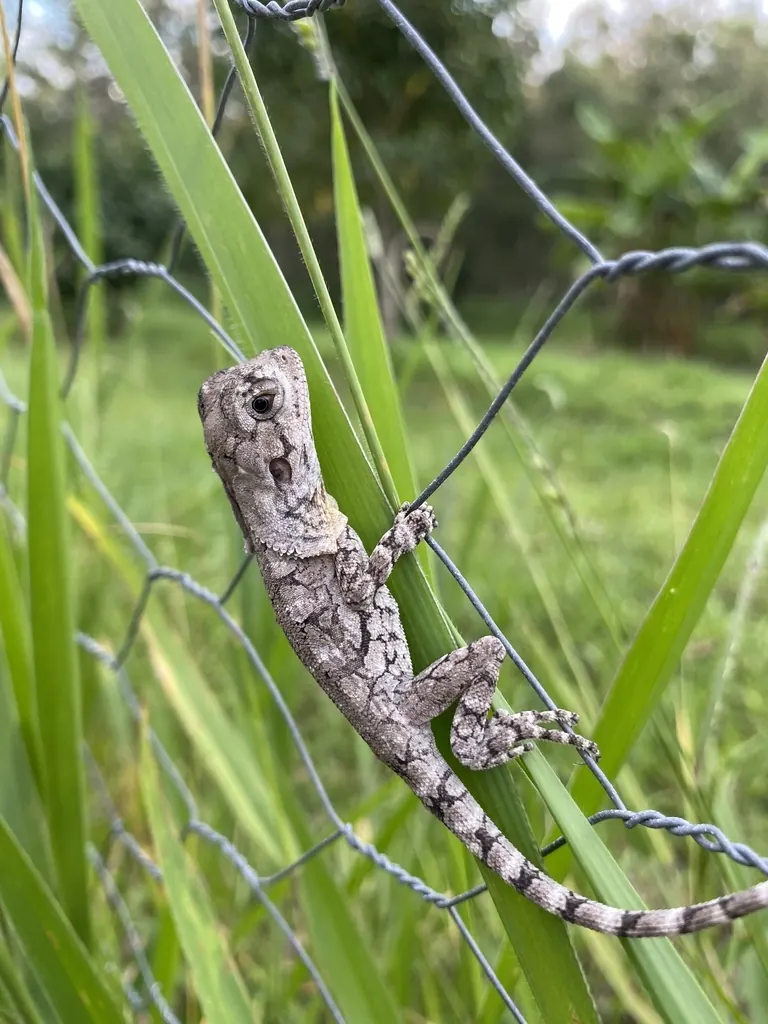
binanjal is the frill-necked lizard, bajabaja the blue-tongue, jirabay a 'ground lizard, larger than the blue-tongue lizard', bilbil-bilbil and kulmba-kulmba the geckos, the second 'small house lizard', junbirr a 'small lizard, common in leaves and grass before and during wet season, with reddish markings on head', dukul-mukul a 'small lizard with big head', jabil a 'scrub lizard', bajuy a 'slippery lizard', wangku a 'small tree or wood goanna', and murrbun another lizard[1]. The goannas have their own page; this one is the rest. The frilled lizard 'grows to 90 cm from head to tail tip', 'is largely arboreal, spending most of its time in trees. Its diet consists mainly of insects', and 'is more active during the wet season, when it spends more time near or on the ground'[2]. The skinks and geckos are the woodland's small change, the insect-eaters that feed the kookaburras, the butcherbirds, the kestrel, the snakes, the goannas and the quoll, and the geckos on the homestead wall at night are the same native gecko 'frequently found at night on walls, floors, or windowpanes'[3][4]. Burton's legless lizard is the one that gets killed as a snake: it has 'visible ear holes, and remnant hind limbs', a fleshy tongue, and no venom[5].
Nothing is written for the Eastern coast on this page yet. What follows is true across the country.
Hann River Cape York
Possum People's country on the upper river and Thaypan (Kuku Thaypan) country downstream: stringybark and bloodwood woodland and a spring-fed sandy river that runs north-east from the Great Dividing Range, past the Peninsula Developmental Road, into Rinyirru (Lakefield) and the North Kennedy. Not Kuku Yalanji country: the Kuku Yalanji words on this page are the dictionary's, not the Hann's own languages. Place guide
The Hann's woodland is full of small lizards. The Atlas of Living Australia holds hundreds of lizard records in a box of about 90 × 85 km around the middle Hann, Laura and western Rinyirru. The commonest by far is the Tommy roundhead dragon, 364 records from 1958 to 2026, then the rainbow skinks (Carlia, seven species, 205 records) and the snake-eyed skinks (86). The frilled lizard has 15 records (1993–2026) and the blue-tongue 15 (1972–2025)[24]. No published record of how the people of this country used the small lizards has been found.
Where they live here
Along the Hann the country is stringybark, bloodwood, Moreton Bay ash and ironbark woodland over coarse speargrass[25]: the dragons' open ground, the skinks' leaf litter and the geckos' loose bark. The Atlas also holds the native house gecko 34 times, Bynoe's gecko 26, the northern velvet gecko 5 and Burton's legless lizard twice in the box[24].
Their year here
Fire. The Kuku Thaypan Elders burn early and cool, so most animals get away. 'The birds of prey feed off grasshoppers flying up out of the grass, small mammals and reptiles fleeing, they dive into the ash and pick up lizards that are exposed'[26].
Wet and dry. The wet, December to March, floods the plains and 'animals disperse far and wide'; by October 'the land is brown and parched'[27]. The frilled lizard comes down out of the trees with the rain (see Seasons on this page).
How people used them here
The goannas were the lizards that were hunted. The Court recorded a Possum man's evidence of 'hunting pigs, kangaroos, goanna, porcupine, and plain turkeys' on the upper Hann[28]; see goanna. No published record from the Possum, Thaypan, Kuku Warra or Lama Lama peoples mentions eating the small lizards.
A boys' game (upper Normanby, Roth about 1900). In 'Iguanas', one boy half-lay on the ground with his forearm dug into the sand up to the elbow and poked out a finger here and there, and his mates tried to hit it with a stick[29].
On country today
The upper Hann is the Possum People's country and the middle and lower Hann are Thaypan country, under native title determinations of November 2023[28][30]. Lizards are protected wildlife in Queensland[21].
Upper Mitchell Western Yalanji
Western Yalanji country west of the Great Dividing Range: dry open woodland cut by the sandy, paperbark-lined upper Mitchell River, around Karma Waters and Mount Carbine. Place guide
Around Karma Waters there are a lot of lizards: within 60 km of Karma Waters the Atlas has more than a thousand records of one rainbow skink, three hundred of the Tommy roundhead dragon, two hundred and sixty of the native house gecko, two hundred each of the velvet gecko, Bynoe's gecko and a ground gecko, and a dozen more kinds of skink, twenty-four records of the frilled lizard and four of the blue-tongue[11].
Where they live here
Atlas of Living Australia records within 60 km of Karma Waters[11]:
- Skinks: shaded-litter rainbow-skink Carlia munda 1,049, the lizard of the leaf litter here, with four more Carlia rainbow skinks; the litter skink Lygisaurus foliorum 257; Carlia vivax 232; the comb-eared skinks Ctenotus zebrilla 149 and C. spaldingi 139; the metallic snake-eyed skink 94 and the striped snake-eyed skink 45; Hosmer's skink, a spiny rock skink, 3; the blue-tongue 4.
- Dragons: the Tommy roundhead 313, the commonest dragon, with four other Diporiphora dragons; the frilled lizard 24.
- Geckos: the native house gecko 261; the box-patterned gecko 202; the northern velvet gecko 201; Bynoe's gecko 197; the fat-tailed gecko 176; the northern spotted velvet gecko 35; the ring-tailed gecko 29.
- Legless lizards: Burton's legless lizard 33; the excitable delma 10.
On country today
The Karma Waters rock piles, ironbark trunks and homestead walls carry one of the richest lizard lists in the Atlas; the frilled lizard and the blue-tongue are the rare ones[11].
Everywhere
Names
binanjal 'frill necked lizard'. bajabaja 'blue-tongue lizard'. jirabay 'ground lizard, larger than the blue-tongue lizard'. bilbil-bilbil 'gecko'; kulmba-kulmba 'gecko, small house lizard'. junbirr 'small lizard. Common in leaves and grass before and during wet season, with reddish markings on head'. dukul-mukul 'species of small lizard with big head'. jabil 'scrub lizard'. bajuy 'slippery lizard'. wangku 'small tree or wood goanna'. murrbun 'species of lizard' (also 'scabies'). jimalili 'mountain lizard', of which the firestick page has the dictionary's note[1]. The dictionary has several more lizard words that belong to stories, and they are left in the dictionary.
The lizards
Frilled lizard (Chlamydosaurus kingii, binanjal). 'Its common names refer to the large frill around its neck, which usually stays folded against the lizard's body. The frilled lizard grows to 90 cm from head to tail tip and can weigh 600 g. Males are larger and more robust than females. The lizard's body is generally grey, brown, orangish-brown, or black in colour. The frills have red, orange, yellow, or white colours.' 'The frilled lizard is largely arboreal, spending most of its time in trees. Its diet consists mainly of insects and other invertebrates. It is more active during the wet season, when it spends more time near or on the ground, and is less observed during the dry season, during which it seeks shade in the branches of the upper canopy. It breeds in the late dry season and early wet season. The lizard uses its frill to scare off predators and display to other individuals'[2].
Tommy roundhead (Diporiphora australis): a slim, pale, long-tailed lizard of the grass and low branches, 'a species of agama found in Australia and Papua New Guinea'[6].
Blue-tongue (Tiliqua scincoides, bajabaja). 'Most species of blue-tongued skinks are diurnal, ground-foraging omnivores, feeding on a wide variety of insects, gastropods, flowers, fruits, and berries'[7]. The eastern blue-tongue 'weighs approximately 1 kilogram and extends approximately 60 centimeters'; 'its blue tongue can be used to warn off predators. In addition to flashing its blue tongue, the skink hisses and puffs up its chest to assert dominance and appear bigger'; it 'is ovoviviparous', bearing live young, 'is not venomous or poisonous to humans', takes 'shelter among large objects on the ground like logs or rocks or among leaf litter', and spends 'mornings in the sun before looking for food'[8]. The dictionary's jirabay, 'larger than the blue-tongue', is probably one of the bigger skinks or a small goanna[1].
The geckos. The native house gecko or dubious dtella (Gehyra dubia, kulmba-kulmba): 'a small gecko; its snout-to-vent length ranges up to 6 cm, and its tail length ranging up to 14 cm'; 'a dull gray-brown color' with dark spots; circular toe pads so that 'they can grip onto ceilings and glass windows'; 'these geckos also lack eyelids and have vertical eyes like most other gecko species. Therefore, they lick their eyes with their tongues rather than blinking'; 'their big eyes are about 350 times more sensitive than human eyes in the dark'; it 'can lose its tail as a mechanism for feigning injury'; 'mainly arboreal' in dry woodland, and 'frequently found at night on walls, floors, or windowpanes'. 'These geckos are often confused with the Asian common house gecko, which was introduced to Australia from Indonesia, but G. dubia has distinct rounded feet and quieter calls'[3]. Bynoe's gecko (Heteronotia binoei): 'a slender, long-tailed species which may grow to a total length of 11–12 cm'; 'slim toes which end with strong claws, but unlike many other gecko species, it does not have expandable toe pads'; 'small spine like ridges which run down the length of the back', the 'prickly gecko'; 'a terrestrial species, it takes shelter under all types of ground cover including leaves, logs, stumps, stones, termite mounds, loose bark at the base of trees, and animal burrows', and 'is often the most abundant reptile found in many arid areas'[9]. The northern velvet gecko (Oedura castelnaui) and the northern spotted velvet gecko are the big soft-skinned geckos under the loose bark of the ironbarks and on the rock; the box-patterned gecko (Lucasium steindachneri) and the fat-tailed gecko (Diplodactylus conspicillatus) live on the ground and in spider burrows; the ring-tailed gecko (Cyrtodactylus mcdonaldi) is the big banded gecko of the rock piles[10][11].
The skinks. The shaded-litter rainbow-skink (Carlia munda) is a lizard of the leaf litter; in the other Carlia rainbow skinks too the breeding males with orange flanks, which fits the dictionary's junbirr with its 'reddish markings on head' in the wet[12][11][1]. The striped snake-eyed skink (Cryptoblepharus virgatus) and its relative the metallic snake-eyed skink: 'a relatively small, flat-bodied skink of a silver-gray coloring. It has a distinct white stripe running along the body from the eye to the base of the tail. It typically grows to a snout-to-vent length of around 4 cm'; 'it lacks eyelids, instead having a translucent layer of scales covering its eyes similar to that of snakes'; 'an active little lizard, and if threatened will often play dead'; 'often be seen on vertical surfaces such as trees, fences, and walls'[13]. The comb-eared skinks (Ctenotus): 'lizards in the genus Ctenotus are commonly called comb-eared skinks, a reference to the scales aligned near the ear. Ctenotus lizards are able to move very quickly, disappearing whilst being observed', and in the tropical north they account 'for 10–20% of the lizard species'[14]. The litter skinks (Lygisaurus), the dwarf skinks (Menetia, Pygmaeascincus) and the fire-tailed skink (Morethia) are the tiny ones under the leaves[11].
Burton's legless lizard (Lialis burtonis). A snake-shaped lizard that 'can swallow relatively large prey whole'; 'differences between legless lizards and snakes include the lack of venom glands in legless lizards, their inability to constrict prey, the presence of a fleshy tongue rather than a forked tongue, visible ear holes, and remnant hind limbs'; it is 'essentially' a legless gecko, with 'an elongated snout' and hinged teeth to grip the skinks it hunts[5]. Its cousin the excitable delma is smaller and jumps[11].
Roth. The lizards Roth's people hunted were the goannas, and the goanna page has his account; of the small ones he records only that on the lower Tully 'snakes are often hunted for in iguana burrows', and in the children's games the catching of lizards and 'iguanas by the tail, with the usual results'[15][16].
Telling them
- Frilled lizard: big, on a trunk with its frill folded, or standing up on its hind legs and running; the frill opens when it is cornered[2].
- Dragons (Tommy roundhead and the rest): rough-scaled, long-tailed, long-legged, head-bobbing on a stick or a rock by day[6].
- Skinks: smooth, shiny, fast, under the leaves and on the logs; the rainbow skinks with orange breeding colours, the snake-eyed skinks flat on the trunks, the comb-eared skinks striped and gone before you look[12][13][14].
- Blue-tongue: big, slow, banded, a fat body and short legs; the tongue[8].
- Geckos: soft skin, big eyes, out at night; pads on the house gecko, claws on Bynoe's[3][9].
- Legless lizard or snake: ear holes, a flat fleshy tongue, a wedge snout, tiny flap hind legs, a tail longer than the body: lizard. No ear holes and a forked tongue: snake, and stand back[5][17].
- Goanna: a forked tongue and a long neck; see goanna.
Signs
- Geckos on the wall at night and their chirp: the insects are at the light[3].
- A rustle in the leaf litter at midday: rainbow skinks[12].
- A dragon on a fence post bobbing its head[6].
- A kookaburra or butcherbird dropping on the ground: a skink taken[4].
- A frilled lizard flattened on a trunk in the wet, and up in the canopy in the dry, which is why it is rarely seen then[2].
- Shed gecko skins under loose bark[10].
Where they are
The frilled lizard and the velvet geckos in the trees and under the bark of the woodland; the dragons on the open ground, sticks and rocks; the rainbow and litter skinks in the leaf litter under the trees; the snake-eyed skinks on the trunks, fences and the homestead walls; the ground geckos under logs, stones and termite mounds; the ring-tailed gecko and the rock skinks on the rock piles; the house gecko on the house[2][9][13][3][11].
The small change of the woodland
The lizards are the link between the insects and everything that eats meat: the skinks and geckos eat the ants, termites, moths and grasshoppers, the dragons and the frilled lizard the bigger insects, Burton's legless lizard the skinks, and all of them feed the kookaburras, 'lizards, insects, worms, snakes, mice', the butcherbirds, the kestrel, the snakes, the goannas, the quoll and the whistling spider in its burrow, whose diet includes 'geckos, skinks and frogs'[4][5][18][19]. The day belongs to the skinks and dragons, the night to the geckos, which is why the house gecko's eyes are '350 times more sensitive than human eyes in the dark'[3]. The wet is the lizards' season: the frilled lizard comes down from the canopy, the rainbow skinks colour up and breed, and the dictionary's junbirr is 'common in leaves and grass before and during wet season'[2][1]. The cane toad takes their insects and their ground, and poisons the goannas and quolls that would have eaten both[20].
Seasons
The frilled lizard 'breeds in the late dry season and early wet season' and is out in the wet; the skinks breed with the rains; the blue-tongue basks in the cool mornings of the dry; the geckos are on the walls every warm night[2][8]. See the year on country.
Uses
- Food: the goannas were the lizard that was eaten, and the dictionary's jadi, the sand goanna, had its own rule; see goanna[1][15]. The sources used here record no eating of the small lizards.
- A camp's insect control: the geckos at the light and the skinks in the litter[3].
- A children's game: catching lizards, 'with the usual results' when a goanna is caught by the tail[16].
- A sign of the season: the frilled lizard down from the trees means the wet[2].
Living with the lizards
- Leave the geckos on the walls; the native house gecko with its rounded feet is the one you want there, and it eats the mosquitoes[3].
- Look at the tongue and the ears before you kill a 'snake' in the woodpile; a legless lizard has ear holes and a fleshy tongue, and no venom[5]. If you cannot see, treat it as a snake[17].
- A blue-tongue in the garden eats the snails; it hisses and shows its tongue and bites hard if picked up, and lets go[8].
- Watch the frilled lizard from a distance in the wet, flattened on a trunk; it runs on two legs and opens the frill if you press it, which is the photograph, and stress for the lizard[2].
- Turn logs back the way they lay; the skinks and geckos under them are the kookaburra's dinner and the woodland's insect-eaters[9].
Safety
- No Australian lizard here is venomous: the blue-tongue 'is not venomous or poisonous to humans' and the legless lizards have no 'venom glands'[8][5]. A big lizard's bite still breaks the skin; wash it.
- The snake you mistake for a legless lizard is the danger; see snakes[17].
- Native animals are protected wildlife in Queensland under the Nature Conservation Act 1992; native title holders hunting for personal, domestic or non-commercial communal needs are covered by section 211 of the Native Title Act 1993, recognised in the Western Yalanji determinations[21][22][23].
On Country today
Which skink is junbirr and which gecko bilbil-bilbil is for Kuku Yalanji speakers to say; the contribution box below is for that[1]. Native title holders' rights differ from place to place: see each place above.
Language
binanjal 'frill necked lizard'; bajabaja 'blue-tongue lizard'; jirabay 'ground lizard, larger than the blue-tongue'; bilbil-bilbil, kulmba-kulmba 'gecko'; junbirr, dukul-mukul, jabil, bajuy, murrbun small lizards; wangku 'small tree or wood goanna'; jadi 'sand goanna'; kakarr 'grass'; jangka 'stone'[1].
References
- Hershberger, H. D. & Hershberger, R. (1982). Kuku-Yalanji Dictionary. Work Papers of SIL-AAB, Series B, Volume 7. With Toby Bloomfield, Roy Friday, Billy Roberts, Hector and Doris Sykes, Joe Walker and others. www.sil.org/resources/archives/18038
- Wikipedia. Frilled lizard (Chlamydosaurus kingii). en.wikipedia.org/wiki/Frilled_lizard
- Wikipedia. Dubious dtella, the native house gecko (Gehyra dubia). en.wikipedia.org/wiki/Gehyra_dubia
- Wikipedia. Laughing kookaburra (Dacelo novaeguineae). en.wikipedia.org/wiki/Laughing_kookaburra
- Wikipedia. Burton's legless lizard (Lialis burtonis). en.wikipedia.org/wiki/Burton%27s_legless_lizard
- Wikipedia. Tommy roundhead (Diporiphora australis). en.wikipedia.org/wiki/Diporiphora_australis
- Wikipedia. Blue-tongued skink (Tiliqua). en.wikipedia.org/wiki/Blue-tongued_skink
- Wikipedia. Eastern blue-tongued skink (Tiliqua scincoides scincoides). en.wikipedia.org/wiki/Eastern_blue-tongued_lizard
- Wikipedia. Bynoe's gecko (Heteronotia binoei). en.wikipedia.org/wiki/Bynoe%27s_gecko
- Wikipedia. Northern velvet gecko (Oedura castelnaui). en.wikipedia.org/wiki/Oedura_castelnaui
- Atlas of Living Australia. Occurrence records within 60 km of the Karma Waters homestead (16.62° S, 144.60° E), species counts for Animalia (accessed 10 October 2026). biocache.ala.org.au/occurrences/search?q=*:*&lat=-16.62&lon=144.60&radius=60
- Wikipedia. Shaded-litter rainbow-skink (Carlia munda). en.wikipedia.org/wiki/Carlia_munda
- Wikipedia. Striped snake-eyed skink (Cryptoblepharus virgatus). en.wikipedia.org/wiki/Cryptoblepharus_virgatus
- Wikipedia. Ctenotus, the comb-eared skinks. en.wikipedia.org/wiki/Ctenotus
- Roth, W. E. (1901). North Queensland Ethnography, Bulletin No. 3: Food — its search, capture, and preparation. Brisbane: Government Printer. Bloomfield River information from the Hislops. — Sect. 6 'Cooking'; plant list ('Castanospermum australe', 'Dioscorea sativa', 'Elettaria Scottiana', 'Nymphaea') archive.org/details/northqueensland00landgoog
- Roth, W. E. (1902). North Queensland Ethnography, Bulletin No. 4: Games, sports and amusements. Brisbane: Government Printer. — Sect. 4 'Realistic games (animals)' archive.org/details/northqueensland00landgoog
- healthdirect Australia (Australian Government). Snake bites: symptoms, first aid and the pressure immobilisation bandage (accessed 10 October 2026). www.healthdirect.gov.au/snake-bites
- Wikipedia. Northern quoll (Dasyurus hallucatus). en.wikipedia.org/wiki/Northern_quoll
- Wikipedia. Queensland whistling tarantula (Selenocosmia crassipes). en.wikipedia.org/wiki/Phlogius_crassipes
- Wikipedia. Cane toads in Australia: effects on native predators (goannas, snakes, freshwater crocodiles) and on dogs. en.wikipedia.org/wiki/Cane_toads_in_Australia
- Queensland Government, State of the Environment. Nature Conservation Act 1992. www.stateoftheenvironment.des.qld.gov.au/biodiversity/management-responses/legislation/nature-conservation-act-1992
- Australian Law Reform Commission. Review of the Native Title Act 1993 (DP 82), ch. 8: Relevant provisions in the Native Title Act (s 211). www.alrc.gov.au/publication/review-of-the-native-title-act-1993-dp-82/8-the-nature-and-content-of-native-title/relevant-provisions-in-the-native-title-act/
- Western Yalanji Aboriginal Corporation & CRC for Developing Northern Australia (2020). Western Yalanji Land Use and Economic Diversification Plan. CC BY 4.0. — Native Title Determinations 1–4 (pp. 13–18); ‘Fire Management and Carbon Farming’ (pp. 32–33); ‘Pastoralists’ crcna.com.au/wp-content/uploads/2024/05/westernyalanjilanduseplan_nov2020.pdf
- Atlas of Living Australia. Occurrence records of lizards (Squamata other than snakes), queried by species: Diporiphora australis 364 records (1958–2026), Carlia 205 (seven species; C. jarnoldae 54), Cryptoblepharus 86, Gehyra dubia 34, Heteronotia binoei 26, Chlamydosaurus kingii 15 (1993–2026), Tiliqua 15 (1972–2025), Oedura castelnaui 5, Lialis burtonis 2 in a box of about 90 × 85 km around the middle Hann River, Laura and western Rinyirru (lat −15.6 to −14.8, long 143.5 to 144.3), queried 28 October 2026. biocache.ala.org.au/occurrences/search?q=*:*&fq=decimalLatitude:%5B-15.6%20TO%20-14.8%5D&fq=decimalLongitude:%5B143.5%20TO%20144.3%5D
- Wikipedia. Hann River (Queensland) (accessed 28 October 2026). en.wikipedia.org/wiki/Hann_River_(Queensland)
- Standley, P.-M. (2019). The importance of campfires to effective conservation. PhD thesis, James Cook University. Records the fire and country knowledge of Kuku Thaypan Elders Dr Tommy George and Dr George Musgrave. — Fire and ash: birds of prey taking lizards after cool burns (p. 342) researchonline.jcu.edu.au/64274/
- Queensland Parks and Wildlife Service. Nature, culture and history: Rinyirru (Lakefield) National Park (CYPAL) (web page, last updated 1 July 2024; accessed 28 October 2026). parks.qld.gov.au/parks/rinyirru-lakefield/about/culture
- Ross on behalf of the Cape York United #1 Claim Group v State of Queensland (No 21) (Possum determination) [2023] FCA 1316 (Federal Court of Australia, 2 November 2023). — Determination area (upper Hann and Kennedy rivers); prescribed body corporate; affidavit evidence on hunting and fishing www.judgments.fedcourt.gov.au/judgments/Judgments/fca/single/2023/2023fca1316
- Roth, W. E. (1902). North Queensland Ethnography, Bulletin No. 4: Games, sports and amusements. Brisbane: Government Printer. — Imitative games: 'Iguanas', upper Normanby district archive.org/details/northqueensland00landgoog
- Ross on behalf of the Cape York United #1 Claim Group v State of Queensland (No 20) (Thaypan determination) [2023] FCA 1315 (Federal Court of Australia, 2 November 2023). — Determination area and waters; prescribed body corporate (Awu-Laya Indigenous Corporation); affidavit evidence on hunting www.judgments.fedcourt.gov.au/judgments/Judgments/fca/single/2023/2023fca1315
From the community
Know this one? Add the words you use for it, what it is for, how it is done, a correction, or a photo from country. It shows here straight away with your name on it. Please keep anything restricted or sacred off the site.
Loading…