Fish
Archerfish, rainbowfish and the small fish of the pools
mujarrka · dalku · julba · bayil · dijarrToxotes chatareus; Melanotaenia splendida; Nematalosa erebi; Amniataba percoides
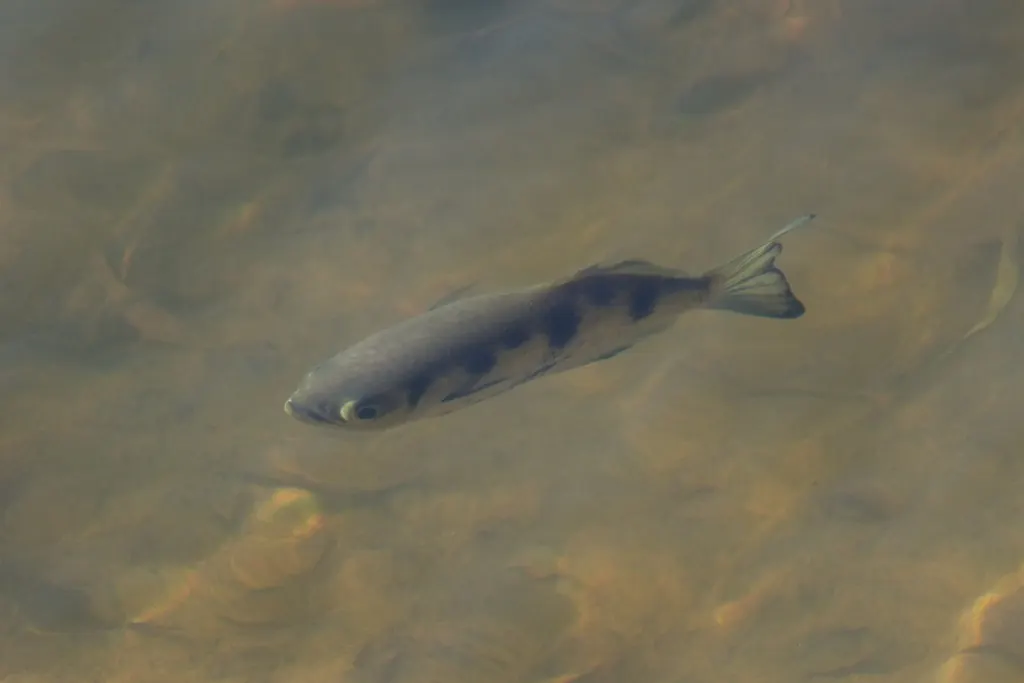
mujarrka in Yalanji and dalku in Nyungkul is the archerfish, the fish that shoots; julba is the 'fresh water minnow', which on the Mitchell is the rainbowfish and the bony bream, and bayil and dijarr are freshwater perches, the dictionary's words for the small grunters[1]. These are the fish that feed the fish: 'small fish (rainbowfish, young grunter, bony bream) feed barramundi, saratoga, mouth almighty and sleepy cod, the darter, the cormorants, the kingfishers, the kites and the crocodiles', as the waterhole page puts it, and a pool with no small fish in it is a pool with nothing bigger either[2][3][4]. The archerfish is the one with a trick: the genus was named by Cuvier 'after he noted the "remarkable" ability of these fish to shoot drops of water at insects within reach, making them fall into the water to be eaten'; 'an adult fish almost always hits the target on the first shot'[5][6]. The rainbowfish school in the shallows by day, the bony bream shoal near the bottom and are 'often the first species to succumb when ephemeral habitats begin to dry up', and the banded grunter, 'usually under 10 cm, with a yellowish body crossed by four or five vertical black bands', will eat 'anything resembling food'[7][8][9]. Two snakes live on them: the Arafura file snake, a loose-skinned water snake that grows to 2.5 m and preys 'on large fish, such as eel-tailed catfish', and the harmless keelback, 'one of the few Australian snakes that can eat cane toads'[10][11].
Nothing is written for the Eastern coast on this page yet. What follows is true across the country.
Hann River Cape York
Possum People's country on the upper river and Thaypan (Kuku Thaypan) country downstream: stringybark and bloodwood woodland and a spring-fed sandy river that runs north-east from the Great Dividing Range, past the Peninsula Developmental Road, into Rinyirru (Lakefield) and the North Kennedy. Not Kuku Yalanji country: the Kuku Yalanji words on this page are the dictionary's, not the Hann's own languages. Place guide
The small fish of the pools live in the Hann's waters. Anglers in Lakefield National Park (now Rinyirru), downstream of the Hann, caught archerfish in 1986–91[21], and a Kuku Warra man from Laura spoke of fishing for 'rifle fish', another name for the archerfishes[22][23]. Because the Hann never stops running, its holes do not shrink to dying pools the way cut-off waterholes do[24].
Which small fish are here
Atlas of Living Australia records in a box of about 90 × 85 km around the middle Hann, Laura and western Rinyirru[25]:
- Seven-spot archerfish: 6 records, 1972–2026.
- Rainbowfish (Melanotaenia splendida): 48 records, 1973–2026, the most of these fish.
- Bony bream: 3 records, 1972–2015.
- Banded grunter: 2 records, 1984–2017.
- Keelback: 20 records, 1968–2026. No Arafura file snake is recorded in the box.
Other small fish in the same box include glassfish (Ambassis agrammus, 7 records), purple-spotted gudgeons (Mogurnda mogurnda, 7), the mouth almighty (Glossamia aprion, 5) and fly-specked hardyheads (Craterocephalus stercusmuscarum, 4)[25]. The Hann's water runs to Princess Charlotte Bay on the east coast[26], so its rainbowfish is the eastern form, the one 'found in river systems east of the Great Dividing Range'[7].
The Lakefield anglers' freshwater catch also took 'archerfish (Toxotes sp), tarpon (Megalops cyprinoides), sooty grunter (Therapon fuliginosus), sleepy cod (Oxyeleotris lineolatus)' and long tom[21].
Their year here
In the wet (December to March) the rivers flood across the plains; through the dry they shrink back to permanent waterholes[26]. The Hann itself keeps flowing: its gauge has never recorded a day without flow since 1968, and flow is lowest from September to November[24]. So the bony-bream die-off of a failing pool is less likely in the running river than in the lagoons beside it[8].
How small fish were caught nearby
No method is published for the Hann itself. Roth, about 1900, describes the net of the neighbouring rivers[27]:
- An oval frame of lawyer cane, in two or three pieces lashed together, usually about 2½ feet wide and 5 feet long; these nets reached 'their maximum size' in the hinterland of Princess Charlotte Bay. He saw it on the Morehead, Musgrave, Normanby, Laura and Palmer rivers.
- The mesh woven in the hour-glass pattern, of twine from Acacia latifolia or the cabbage palm (Livistona). Its Koko-rarmul name was algomarda and its Koko-warra name arwi-a.
- Two boys carry it 'along in the water more or less vertically', 'their friends in front acting as "beaters"'.
Before fishing, a Kuku Warra man will 'sing out to the old people' and ask for 'a little bit'[22]; see sleepy cod for his words.
On country today
The upper Hann is the Possum People's country and the middle and lower Hann are Thaypan country; their November 2023 determinations recognise rights to 'hunt, fish and gather on the land and waters of the area'[28][29].
Upper Mitchell Western Yalanji
Western Yalanji country west of the Great Dividing Range: dry open woodland cut by the sandy, paperbark-lined upper Mitchell River, around Karma Waters and Mount Carbine. Place guide
Every Karma Waters pool has its rainbowfish and grunters, and the Atlas has records of all these fish within 60 km of the homestead[30].
Names here
The dictionary's coastal small fish, jilngu, bunjulu, kalngkan, ngalkun and milkaji, do not come this far up the Mitchell[1]. Which small fish is julba and which perch is bayil and dijarr here is for the contribution box below[1].
Which small fish are here
Atlas records near Karma Waters: seven-spot archerfish, seven within 60 km; rainbowfish, twenty-one within 60 km; bony bream, five; banded grunter, twenty within 60 km and one within 30; Arafura file snake, three within 60 km; keelback, one[30]. The Mitchell's rainbowfish is the Gulf-draining form[7].
Freshwater sole (Brachirus salinarum), one record: a flatfish of the sand bottom, the one fish here that lies on its side[31].
On country today
Every Karma Waters pool has its rainbowfish and its grunters, and the deep ones under the pandanus have the archerfish shooting at evening[30][5].
Everywhere
Names
mujarrka 'archer fish (Yalanji) (Nyungkul - dalku)', also glossed 'spotted jewfish, fresh and saltwater, in King's Plains rivers'; dalku 'archer fish (Nyungkul dialect)'. julba 'fresh water minnow'. bayil 'fresh water perch'; dijarr 'species of fresh water perch'. kurrubal 'fresh water cod'[1]. The dictionary's coastal small fish are jilngu 'boney salmon, ox eye herring', bunjulu 'giant herring', kalngkan 'small mullet', ngalkun 'mullet' and milkaji 'blue tailed mullet', fish of the coast and the estuaries[1].
The small fish of the pools
Seven-spot archerfish (Toxotes chatareus, mujarrka, dalku). 'They are usually no larger than 20 centimetres but may grow up to 40 centimetres. Unlike most archerfish, T. chatareus are sooty rather than silvery in colour. They are omnivorous, feeding on insects, fish, and vegetative matter at the surface of the water. Breeding occurs in the wet season, and 20,000 to 150,000 eggs may be laid at one time'; 'they may live in brackish or fresh water, inhabiting mangrove swamps and estuaries as well as further upstream in slow-moving rivers'; 'white and usually has six or seven dark blotches, alternating long and short, along the dorsal side ... The colour of these blotches may become darker or lighter due to time of day, environment, and stress'; 'weigh up to 700 grams'; 'a lifespan of three to five years'[12]. It 'is commonly found in brackish estuaries but also ranges well into freshwater, sometimes several hundred kilometres upstream of tidal influence'; 'an intact riparian zone is critical for Toxotes chatareus, since it supplies much of its food; inland, it favours deep waterholes fringed with overhanging vegetation, especially Pandanus'; 'small juveniles are most often seen around dense macrophyte beds, while adults, being predominantly surface feeders, are usually observed near the surface'[5]. The shooting: 'archerfish are remarkably accurate in their shooting; an adult fish almost always hits the target on the first shot'; 'young archerfish start shooting when they are about 2.5 cm long but are inaccurate at first and must learn from experience', hunting 'in small schools' and learning by watching each other[6].
Rainbowfish (Melanotaenia splendida, julba). The splendida rainbowfish 'is usually found in large schools inhabiting small freshwater streams, but is also found in lakes and reservoirs'; there is a Gulf-draining form and an eastern form, the eastern one 'found in river systems east of the Great Dividing Range'[7]. A finger-long fish with a rainbow sheen down the flank, the male brighter, in the warm shallows over sand and weed.
Bony bream (Nematalosa erebi). 'A deep bodied, laterally compressed fish with a blunt snout. Spineless dorsal fin with the posterior ray developed into a long filament. Usually silver overall, sometimes grey to greenish dorsally'; 'tends to forms large shoals near the bottom'; found 'mostly in shallow areas of slow flowing or still rivers and streams, especially in turbid conditions'; 'can tolerate water temperatures between 9° and 38°C ... Despite these wide tolerances, bony bream are susceptible to low oxygen levels and are often the first species to succumb when ephemeral habitats begin to dry up'; in the dams they are 'often referred to as "Barra lollies" because of a tendency for impoundment barramundi to round them up'[8].
Banded grunter (Amniataba percoides, the dictionary's freshwater perch). 'The second most widespread of Australia's freshwater grunters, after the spangled perch, Amniataba percoides is also one of the smaller and more attractive members of the family, usually under 10 cm, with a yellowish body crossed by four or five vertical black bands of variable width'; it 'will cruise the tank ... searching for anything resembling food', takes 'shrimp, earthworms and small fish with equal enthusiasm' and is an 'excellent jumper'[9]. Its big cousins are the spangled perch and the sooty grunter.
The two fish-eating snakes. The Arafura file snake (Acrochordus arafurae): 'an aquatic snake species found in northern Australia and New Guinea'; 'adults grow to 2.5 m in length. They have very loose skin and are known to prey on large fish, such as eel-tailed catfish. Females are usually larger than males and they have been known to give birth to up to 17 young'[10]. The keelback or freshwater snake (Tropidonophis mairii): 'preys mainly on frogs, but also eats small fishes, lizards, and mammals. It is one of the few Australian snakes that can eat cane toads, up to a certain size, without being harmed'[11].
Telling them
- Archerfish: deep-bodied, pointed head, big eyes, dark blotches on a pale side, hanging just under the surface by the overhanging branches[12].
- Rainbowfish: small, slim, iridescent, in a school in the sunlit shallows[7].
- Bony bream: silver, deep, a trailing thread off the back of the dorsal fin, in a shoal low down in muddy water[8].
- Banded grunter: yellowish with four or five black bars, under 10 cm; a young spangled perch is spotted, not barred[9].
- Young sooty grunter, sleepy cod and mouth almighty are the other small fish; see their pages.
- File snake: wrinkled loose skin, a flat head, never on land; the keelback is a small brown snake of the water's edge with keeled scales, harmless, and easily mistaken for a brown snake, so treat every snake as venomous until it is in the water and swimming[10][11][13].
Signs
- Rises in the evening under the branches: saratoga, archerfish and rainbowfish on the insects[5][3].
- A spurt of water at a leaf and an insect falling: the archerfish[6].
- Schools flickering in the shallows at midday: rainbowfish, and the azure kingfisher on the branch above them[14].
- Silver fish dead on the surface of a shrinking pool: bony bream, the first to go, and the pool's warning[8].
- A big boil near a snag at dusk: a barramundi into the bony bream[2].
Where they are
The archerfish in the deep pools under overhanging pandanus and paperbark; the rainbowfish in the small streams and the sunlit shallows; the bony bream in the slow turbid water low down; the grunters everywhere; the file snake in the deep still water and the keelback at the edge[5][7][8][10][11]. See the waterhole page for the parts of a pool.
The forage base, by the hour
The waterhole page gives the whole food web; the small fish are its middle. Day: the rainbowfish and young grunters graze insects and algae in the warm shallows, the bony bream work the biofilm on the bottom, and the kingfishers, the darter and the cormorants take them from above[15][4][14]. Evening: the insects come down to the water, and the archerfish, rainbowfish and saratoga rise to them, the archerfish shooting the ones still on the leaves[5][3]. Night: the mouth almighty and sleepy cod hunt the small fish by ambush in the dark, the barramundi rounds up the bony bream, and the file snake and the crocodile hunt in the deep water[2][8][10][16]. The dry: as the pool shrinks the bony bream die first, feeding the kites and the crocodile, and the archerfish and grunters hold on in the deepest hole until the first flood, when the archerfish spawns its tens of thousands of eggs[8][12]. The keelback is the one snake here that profits from the cane toad, eating the small ones unharmed[11][17].
Seasons
The archerfish breeds in the wet; the small fish fill the shallows through the early dry; the bony bream die-off is the late-dry sign that a pool is failing[12][8]. See the year on country.
Uses
- Bait: the small fish are what the hooks and lines for barramundi, sleepy cod and saratoga are baited with[2].
- Food: the archerfish is 'occasionally caught and eaten', and a pan of grunters and bony bream is a meal, bony as the name says[12][8].
- A net fishery: the dictionary's warrur is 'tree bark which can be used as vine. It was used to make fishnets, which were dragged through the water in the dry season when the water goes down', which is small-fish fishing; see nets[1].
- Reading the pool: the small fish are the measure of what the pool holds[8].
Netting small fish and reading the archerfish
- Watch the shallows at midday for the rainbowfish schools and the sand bottom for the grunters; that is where to set a small-mesh drag.
- The drag net, as the dictionary's warrur describes it: a bark-fibre net 'dragged through the water in the dry season when the water goes down', two people walking it through a shallow bay to the bank; see nets and string and twine[1].
- A scoop or a dilly bag under the weed edge takes bait fish in a minute; see dilly bags.
- Keep bait fish alive in a bucket in the shade; a dead rainbowfish is still bait for a sleepy cod.
- For the archerfish, sit still above a pandanus-fringed pool at evening and watch the leaves; the spurt and the splash are the fish, and a small insect-baited hook dropped where it rose will take it[5][6].
- Queensland's rules on bait nets and sizes are in the fishing law page; check them before dragging a net.
Safety
- A snake in the water is a snake; the keelback is harmless and the brown snake swims too, so leave both[11][13].
- The dragging shallows are the crocodile's shallows; see Crocwise[18].
- Queensland's fishing rules apply to nets and bait as to everything else, with native title rights alongside them[19][20].
- A pool with dead bony bream on it is low in oxygen and going bad; do not drink from it[8].
On Country today
Which small fish is julba, and which perches are bayil and dijarr, is for the contribution box below[1].
Language
mujarrka, dalku 'archer fish'; julba 'fresh water minnow'; bayil, dijarr 'fresh water perch'; kurrubal 'fresh water cod'; kuyu 'fish'; yarru 'deep water hole'; yalkan 'shallow water'; dajali 'deep water'[1].
References
- Hershberger, H. D. & Hershberger, R. (1982). Kuku-Yalanji Dictionary. Work Papers of SIL-AAB, Series B, Volume 7. With Toby Bloomfield, Roy Friday, Billy Roberts, Hector and Doris Sykes, Joe Walker and others. www.sil.org/resources/archives/18038
- Northern Territory Government. Barramundi: what they eat, spawning and migration (fish species page). nt.gov.au/marine/recreational-fishing/types-of-fish/fish-species/barramundi
- Wikipedia. Gulf saratoga (Scleropages jardinii). en.wikipedia.org/wiki/Gulf_saratoga
- Wikipedia. Australasian darter (Anhinga novaehollandiae). en.wikipedia.org/wiki/Australasian_darter
- Australia New Guinea Fishes Association. Toxotes chatareus, seven-spot archerfish (species profile). rainbowfish.angfa.org.au/archerfishes/toxotes_chatareus.html
- Wikipedia. Archerfish (Toxotidae). en.wikipedia.org/wiki/Archerfish
- Wikipedia. Eastern rainbowfish (Melanotaenia splendida splendida). en.wikipedia.org/wiki/Eastern_rainbowfish
- Wikipedia. Bony bream (Nematalosa erebi). en.wikipedia.org/wiki/Bony_bream
- Australia New Guinea Fishes Association. Amniataba percoides, banded grunter (species profile). rainbowfish.angfa.org.au/grunters/amniataba_percoides.html
- Wikipedia. Arafura file snake (Acrochordus arafurae). en.wikipedia.org/wiki/Arafura_file_snake
- Wikipedia. Mair's keelback, the freshwater snake (Tropidonophis mairii). en.wikipedia.org/wiki/Tropidonophis_mairii
- Wikipedia. Seven-spot archerfish (Toxotes chatareus). en.wikipedia.org/wiki/Seven-spot_archerfish
- healthdirect Australia (Australian Government). Snake bites: symptoms, first aid and the pressure immobilisation bandage (accessed 10 October 2026). www.healthdirect.gov.au/snake-bites
- Wikipedia. Azure kingfisher (Ceyx azureus). en.wikipedia.org/wiki/Azure_kingfisher
- Jardine, T. D., Hunt, R. J., Faggotter, S. J., Valdez, D., Burford, M. A. & Bunn, S. E. (2013). Carbon from periphyton supports fish biomass in waterholes of a wet–dry tropical river. River Research and Applications 29: 560–573. Mitchell River. doi.org/10.1002/rra.2554
- Webb, G. J. W., Manolis, S. C. & Buckworth, R. (1982). Crocodylus johnstoni in the McKinlay River area, N.T. I. Variation in the diet, and a new method of assessing the relative importance of prey. Australian Journal of Zoology 30: 877–899. doi.org/10.1071/ZO9820877
- Wikipedia. Cane toads in Australia: effects on native predators (goannas, snakes, freshwater crocodiles) and on dogs. en.wikipedia.org/wiki/Cane_toads_in_Australia
- Queensland Government. Be Crocwise top tips; Be Crocwise in Croc Country (web pages, accessed 5 October 2026). www.qld.gov.au/environment/plants-animals/animals/living-with/crocodiles/becrocwise/be-crocwise-top-tips
- Australian Law Reform Commission. Review of the Native Title Act 1993 (DP 82), ch. 8: Relevant provisions in the Native Title Act (s 211). www.alrc.gov.au/publication/review-of-the-native-title-act-1993-dp-82/8-the-nature-and-content-of-native-title/relevant-provisions-in-the-native-title-act/
- Western Yalanji Aboriginal Corporation & CRC for Developing Northern Australia (2020). Western Yalanji Land Use and Economic Diversification Plan. CC BY 4.0. — Native Title Determinations 1–4 (pp. 13–18); ‘Fire Management and Carbon Farming’ (pp. 32–33); ‘Pastoralists’ crcna.com.au/wp-content/uploads/2024/05/westernyalanjilanduseplan_nov2020.pdf
- Russell, D. J. & Hales, P. W. (1993). A survey of the Princess Charlotte Bay recreational barramundi fishery. Queensland Department of Primary Industries, QI93049. era.dpi.qld.gov.au/id/eprint/6393/1/Survey%20of%20the%20Princess%20Charlotte%20Bay%20recreational%20barramundi%20fishery_QI93049_1993_russell.pdf
- Ross on behalf of the Cape York United #1 Claim Group v State of Queensland (No 19) (Kuku Warra determination) [2023] FCA 1314 (Federal Court of Australia, 2 November 2023). www.judgments.fedcourt.gov.au/judgments/Judgments/fca/single/2023/2023fca1314
- Australian Faunal Directory. Family Toxotidae: Archerfishes, Rifle Fish (accessed 28 October 2026). biodiversity.org.au/afd/taxa/TOXOTIDAE
- Bureau of Meteorology, Water Data Online. Station 105001B, Hann River at Sandy Creek: daily and monthly mean discharge 1968–2026 (recent data provisional), retrieved 28 October 2026. No day of zero mean flow in 20,711 days of record; mean flow highest in February–March, lowest in September–November. www.bom.gov.au/waterdata/
- Atlas of Living Australia. Occurrence records of Toxotes chatareus (6 records, 1972–2026), Melanotaenia splendida (48, 1973–2026), Nematalosa erebi (3, 1972–2015), Amniataba percoides (2, 1984–2017), Tropidonophis mairii (20, 1968–2026), Ambassis agrammus (7), Mogurnda mogurnda (7), Glossamia aprion (5), Craterocephalus stercusmuscarum (4) and Acrochordus arafurae (none) in a box of about 90 × 85 km around the middle Hann River, Laura and western Rinyirru (lat −15.6 to −14.8, long 143.5 to 144.3), queried 28 October 2026. biocache.ala.org.au/occurrences/search?q=genus:Toxotes&fq=decimalLatitude:%5B-15.6%20TO%20-14.8%5D&fq=decimalLongitude:%5B143.5%20TO%20144.3%5D
- Queensland Parks and Wildlife Service. Nature, culture and history: Rinyirru (Lakefield) National Park (CYPAL) (web page, last updated 1 July 2024; accessed 28 October 2026). parks.qld.gov.au/parks/rinyirru-lakefield/about/culture
- Roth, W. E. (1901). North Queensland Ethnography, Bulletin No. 3: Food — its search, capture, and preparation. Brisbane: Government Printer. — Fish-nets: the oval-frame 'hour-glass' net of the Morehead, Musgrave, Normanby, Laura and Palmer rivers and the hinterland of Princess Charlotte Bay archive.org/details/northqueensland00landgoog
- Ross on behalf of the Cape York United #1 Claim Group v State of Queensland (No 21) (Possum determination) [2023] FCA 1316 (Federal Court of Australia, 2 November 2023). — Determination area (upper Hann and Kennedy rivers); prescribed body corporate; affidavit evidence on hunting and fishing www.judgments.fedcourt.gov.au/judgments/Judgments/fca/single/2023/2023fca1316
- Ross on behalf of the Cape York United #1 Claim Group v State of Queensland (No 20) (Thaypan determination) [2023] FCA 1315 (Federal Court of Australia, 2 November 2023). — Determination area and waters; prescribed body corporate (Awu-Laya Indigenous Corporation); affidavit evidence on hunting www.judgments.fedcourt.gov.au/judgments/Judgments/fca/single/2023/2023fca1315
- Atlas of Living Australia. Occurrence records within 60 km of the Karma Waters homestead (16.62° S, 144.60° E), species counts for Animalia (accessed 10 October 2026). biocache.ala.org.au/occurrences/search?q=*:*&lat=-16.62&lon=144.60&radius=60
- Atlas of Living Australia. All occurrence records within 30 km of the Karma Waters homestead (16.618° S, 144.605° E), species facet, queried 5 October 2026 (4,053 records; 601 species). biocache.ala.org.au/occurrences/search?q=*:*&lat=-16.6179&lon=144.6047&radius=30
From the community
Know this one? Add the words you use for it, what it is for, how it is done, a correction, or a photo from country. It shows here straight away with your name on it. Please keep anything restricted or sacred off the site.
Loading…