Trees
Leichhardt tree
kabalNauclea orientalis
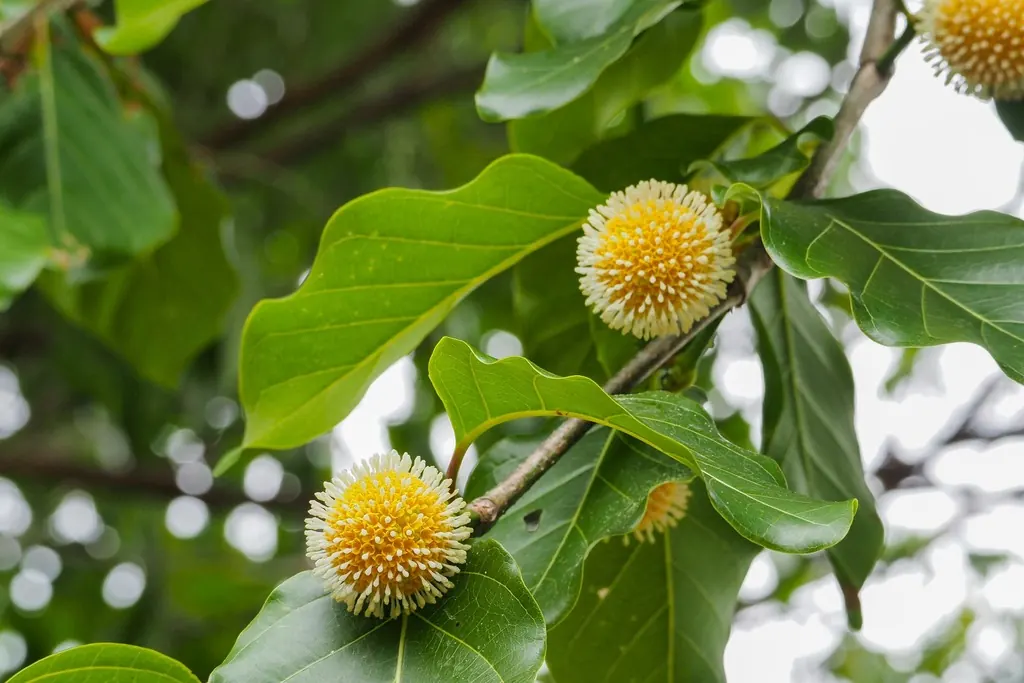
kabal is the Leichhardt tree and its fruit: 'the fruit is edible, it is small and round with small seeds. If you have a sore joint, boil the bark in water, rub the cooled water on the sore joint'[1]. It is the big-leaved shade tree of the river bank, 'a large tree, growing in scrubs along the banks of rivers, 40 feet high or more, a beautiful shade tree, wood yellow and bitter', as Palmer described it on the Mitchell in 1883, where its name was 'Oolpanje' and the fruit was 'eaten raw'[2]. It 'grows to a maximum of around 30 m in height and has large glossy leaves. It bears spherical clusters of fragrant flowers that develop into golf-ball-sized edible but bitter fruits. The yellowish-to-orange soft wood is also used for timber and in woodcarving and folk medicine', and 'among the Kuku Yalanji, they are known as kabal'[3]. The tree drops its leaves in the dry, flowers and fruits with the wet, and feeds the flying foxes, the birds and the fish under it.
Nothing is written for the Eastern coast on this page yet. What follows is true across the country.
Hann River Cape York
Possum People's country on the upper river and Thaypan (Kuku Thaypan) country downstream: stringybark and bloodwood woodland and a spring-fed sandy river that runs north-east from the Great Dividing Range, past the Peninsula Developmental Road, into Rinyirru (Lakefield) and the North Kennedy. Not Kuku Yalanji country: the Kuku Yalanji words on this page are the dictionary's, not the Hann's own languages. Place guide
The Leichhardt tree is not recorded on the Hann itself. The Atlas of Living Australia holds no Leichhardt tree records in a box of about 90 × 85 km around the middle Hann, Laura and western Rinyirru[7]. But it grew close by: in Rinyirru, the timber of the old Laura Station homestead 'was pitsawn locally from Leichhardt trees'[8]. No use of it is published for this country.
Where it grows here
Along the Hann the woodland is mostly stringybark, bloodwood, Moreton Bay ash and ironbark, with speargrass beneath[9]. A Leichhardt tree here would be on the river bank or at a permanent waterhole, as everywhere else, but none has been recorded. Rinyirru's homestead timber shows the tree was once common enough nearby to be sawn for building[8]. If you know one on the Hann, it is worth recording.
How people used it here
Nothing is published on the Leichhardt tree from the Possum, Thaypan, Kuku Warra or Lama Lama peoples. The nearest record of use is Roth's, from the Koko-minni of the middle Palmer River, who ate its bark as a strong medicine (see the upper Mitchell segment)[10]. Ask the Traditional Owners rather than this page.
On country today
In Rinyirru (Lakefield) National Park: 'Do not remove plant material, living or dead'[11]. Upstream, the native title determinations of November 2023 recognise the Possum and Thaypan peoples' rights to take the natural resources of their country[12][13].
Upper Mitchell Western Yalanji
Western Yalanji country west of the Great Dividing Range: dry open woodland cut by the sandy, paperbark-lined upper Mitchell River, around Karma Waters and Mount Carbine. Place guide
The Queensland Herbarium maps it with the river red gum and the paperbarks in the fringing woodland of the Mitchell's channels, and two of its records are within 30 km of Karma Waters[4][14].
Where it grows here
Two Atlas of Living Australia records lie within 30 km of Karma Waters[14]. Look for the big glossy leaves over the long pools of the Mitchell, among the red gums and paperbarks of the fringing woodland[4].
How people used it here
Bark as medicine (Koko-minni, middle Palmer River). Roth, about 1900: 'The Koko-minni break up the bark: if eaten, it produces vomiting, and is employed for curing "sore belly" and certain snake-bites.' For a black snake bite on the Palmer, 'the limb is held tightly with the hand, just above the injury, and the patient made to eat some raw bark of the Leichhardt-tree ... which soon makes him vomit, and so gives him relief'[10].
This is a record of what was done, not first aid. For any snakebite today, use a pressure immobilisation bandage, keep the person still and call for help[15].
On country today
The Leichhardt trees stand over the Karma Waters pools with the red gums, bare in October and green by Christmas[4][14]. Western Yalanji names and uses for it are for the contribution box below.
Everywhere
Names
kabal 'leichardt tree and its fruit. The fruit is edible, it is small and round with small seeds. If you have a sore joint, boil the bark in water, rub the cooled water on the sore joint'[1]. 'Among the Kuku Yalanji, they are known as kabal'; the neighbours' names run west down the Mitchell: 'kaapi or kalpi in Pakanh, atulwanyj in Uw Oykangand, atulganyj in Uw Olkola', and the Djabugay of the Barron call it 'gadugay'[3]. Palmer's Mitchell River name in 1883 was 'Oolpanje', and on the Cloncurry 'Goobiaby'[2]. In English it is 'bur tree, canary wood, Leichhardt pine, yellow cheesewood', and 'Leichhardt pine' is a misnomer, 'though it is not a conifer'[3].
Description
'Leichhardt trees are medium to tall trees, reaching maximum height of around 30 m with a diameter of 1 m. They are deciduous, shedding their leaves during the dry season. The bark surface of Leichhardt trees are grayish-to-reddish-brown and may be smooth or fissured and flaky. It is orange-to-yellow in color when cut'[3]. Palmer, 1883: 'A large tree, growing in scrubs along the banks of rivers, 40 feet high or more, a beautiful shade tree, wood yellow and bitter, called the Leichhardt tree. Leaves broad, oblong, very glossy, deciduous. Flowers globular and fragrant. Fruit 1½ to 2 inches in diameter, spherical, soft when ripe, the pulp slightly bitter; eaten raw. Native name on Mitchell, "Oolpanje" ... Grows on the Gregory River, and Mitchell and other rivers; fruits during wet season'[2]. 'It bears spherical clusters of fragrant flowers that develop into golf-ball-sized edible but bitter fruits'[3].
Telling it from the other river trees
- Leichhardt tree: the biggest leaves on the bank, glossy, oval, in opposite pairs; a round yellow-brown fruit the size of a golf ball; yellow wood under the bark; bare in the late dry[3][2].
- River red gum: smooth white bark, narrow gum leaves, small capsule fruit.
- Paperbark: papery layered bark, bottlebrush flowers.
- Fig: milky sap when a leaf is broken; the Leichhardt tree's sap is not milky.
- Cotton tree and the kapok: big leaves too, but lobed, and a seed pod of fluff.
Signs
- The round fruit on the sand under the tree in the wet, and the pigs' rooting where it falls[2].
- The fragrant balls of flower at the start of the wet, loud with insects and the honeyeaters[3].
- A bare big tree on the bank in October: the Leichhardt tree before its leaves[3].
- Yellow wood in a fallen branch[2].
Where it grows
'A large tree, growing in scrubs along the banks of rivers', on the Mitchell, the Gregory and the Gulf rivers, with the river red gum and the paperbarks over bare sand in the Herbarium's 'Melaleuca fringing woodland on channels and levees'[2][4].
The tree over the pool
The Leichhardt tree is a waterhole tree: its shade keeps the pool cool, its branches hang over the water where the archerfish wait for the insects on its leaves, its flowers feed the honeyeaters and the bees, and its fruit feeds the flying foxes, the birds, the pigs and the fish that take what drops in[5][3]. Being deciduous, it is one of the river's clocks: bare in the late dry, in leaf and flower with the storms, in fruit through the wet[3][2].
Seasons
Leaves drop in the dry; flower and new leaf with the first storms; 'fruits during wet season'[3][2]. See the year on country.
Uses
- Fruit, 'small and round with small seeds', 'eaten raw', 'slightly bitter'[1][2].
- Bark water for sore joints: 'boil the bark in water, rub the cooled water on the sore joint'[1]. See bush medicine.
- Shade: 'a beautiful shade tree', the camp tree of the river bank[2].
- Timber: 'the yellowish-to-orange soft wood is also used for timber and in woodcarving'[3].
Using the Leichhardt tree
- Fruit: take it soft and ripe from the ground or the low branches in the wet; it is bitter, and a mouthful at a time is the way the old people ate it[2][1].
- Joint wash: strip a hand's width of bark from a branch, not a ring round the trunk; boil it in water; let the water cool; rub it on the sore joint[1]. This is the dictionary's recipe as given; it is a wash, not a drink, and the bush medicine page has the cautions.
- Camp under it for the shade, but not in a storm: a big deciduous tree on a sand bank drops limbs.
- Carving: the yellow wood is soft and works green[3].
Safety
- The fruit is edible but bitter; the dictionary says edible and Palmer says eaten raw, and that is as far as the sources go[1][2].
- The bark water is for rubbing on, not drinking, in the dictionary's recipe[1].
- Never ring-bark the tree for its bark; the bank needs it.
- The pool under it is the crocodile's; see Crocwise[6].
On Country today
Native title holders' rights differ from place to place: see each place above, and ask the Traditional Owners before cutting bark or gathering fruit.
Language
kabal 'leichardt tree and its fruit'; mayi 'vegetable food, fruit'; bana 'water'[1].
References
- Hershberger, H. D. & Hershberger, R. (1982). Kuku-Yalanji Dictionary. Work Papers of SIL-AAB, Series B, Volume 7. With Toby Bloomfield, Roy Friday, Billy Roberts, Hector and Doris Sykes, Joe Walker and others. www.sil.org/resources/archives/18038
- Palmer, E. (1883). On plants used by the natives of North Queensland, Flinders and Mitchell Rivers, for food, medicine, &c., &c. Journal and Proceedings of the Royal Society of New South Wales 17: 93–113. Palmer's Mitchell River names come from the lower and middle Mitchell, not from Kuku Yalanji speakers. archive.org/details/journalandproce16walegoog
- Wikipedia. Nauclea orientalis (Leichhardt tree). en.wikipedia.org/wiki/Nauclea_orientalis
- Queensland Herbarium, Regional Ecosystem 9.3.14 (Einasleigh Uplands): Melaleuca fringing woodland on channels and levees. Fire management guidelines. Queensland Government Regional Ecosystem Description Database. apps.des.qld.gov.au/regional-ecosystems/details/?re=9.3.14
- Australia New Guinea Fishes Association. Toxotes chatareus, seven-spot archerfish (species profile). rainbowfish.angfa.org.au/archerfishes/toxotes_chatareus.html
- Queensland Government. Be Crocwise top tips; Be Crocwise in Croc Country (web pages, accessed 5 October 2026). www.qld.gov.au/environment/plants-animals/animals/living-with/crocodiles/becrocwise/be-crocwise-top-tips
- Atlas of Living Australia. Occurrence records of Nauclea (no records) in a box of about 90 × 85 km around the middle Hann River, Laura and western Rinyirru (lat −15.6 to −14.8, long 143.5 to 144.3), queried 28 October 2026. biocache.ala.org.au/occurrences/search?q=*:*&fq=decimalLatitude:%5B-15.6%20TO%20-14.8%5D&fq=decimalLongitude:%5B143.5%20TO%20144.3%5D
- Queensland Parks and Wildlife Service. Nature, culture and history: Rinyirru (Lakefield) National Park (CYPAL) (web page, last updated 1 July 2024; accessed 28 October 2026). parks.qld.gov.au/parks/rinyirru-lakefield/about/culture
- Wikipedia. Hann River (Queensland) (accessed 28 October 2026). en.wikipedia.org/wiki/Hann_River_(Queensland)
- Roth, W. E. (1903). North Queensland Ethnography, Bulletin No. 5: Superstition, magic, and medicine. Brisbane: Government Printer. — Sect. 159 (Sarcocephalus cordatus, the Leichhardt tree, among the Koko-minni of the middle Palmer); sect. 164 (treatment of snake-bite, Palmer River) archive.org/details/northqueensland00landgoog
- Queensland Parks and Wildlife Service. About Rinyirru (Lakefield) National Park (CYPAL) (web page, last updated 1 July 2024; accessed 28 October 2026). Park rules for visitors. parks.qld.gov.au/parks/rinyirru-lakefield/about
- Ross on behalf of the Cape York United #1 Claim Group v State of Queensland (No 21) (Possum determination) [2023] FCA 1316 (Federal Court of Australia, 2 November 2023). — Determination area (upper Hann and Kennedy rivers); prescribed body corporate; affidavit evidence on hunting and fishing www.judgments.fedcourt.gov.au/judgments/Judgments/fca/single/2023/2023fca1316
- Ross on behalf of the Cape York United #1 Claim Group v State of Queensland (No 20) (Thaypan determination) [2023] FCA 1315 (Federal Court of Australia, 2 November 2023). — Determination area and waters; prescribed body corporate (Awu-Laya Indigenous Corporation); affidavit evidence on hunting www.judgments.fedcourt.gov.au/judgments/Judgments/fca/single/2023/2023fca1315
- Atlas of Living Australia. Plant occurrence records within 30 km of the Karma Waters homestead (16.62°S, 144.60°E), queried 10 October 2026: 832 records of 266 species. biocache.ala.org.au/occurrences/search?q=kingdom:Plantae&lat=-16.62&lon=144.60&radius=30
- healthdirect Australia (Australian Government). Snake bites: symptoms, first aid and the pressure immobilisation bandage (accessed 10 October 2026). www.healthdirect.gov.au/snake-bites
From the community
Know this one? Add the words you use for it, what it is for, how it is done, a correction, or a photo from country. It shows here straight away with your name on it. Please keep anything restricted or sacred off the site.
Loading…