Foods & cooking
Wild rice and grass seed
jikan · kakarr · jumul-jumul · diburr · janbanOryza australiensis; Panicum, Sporobolus and the other seed grasses
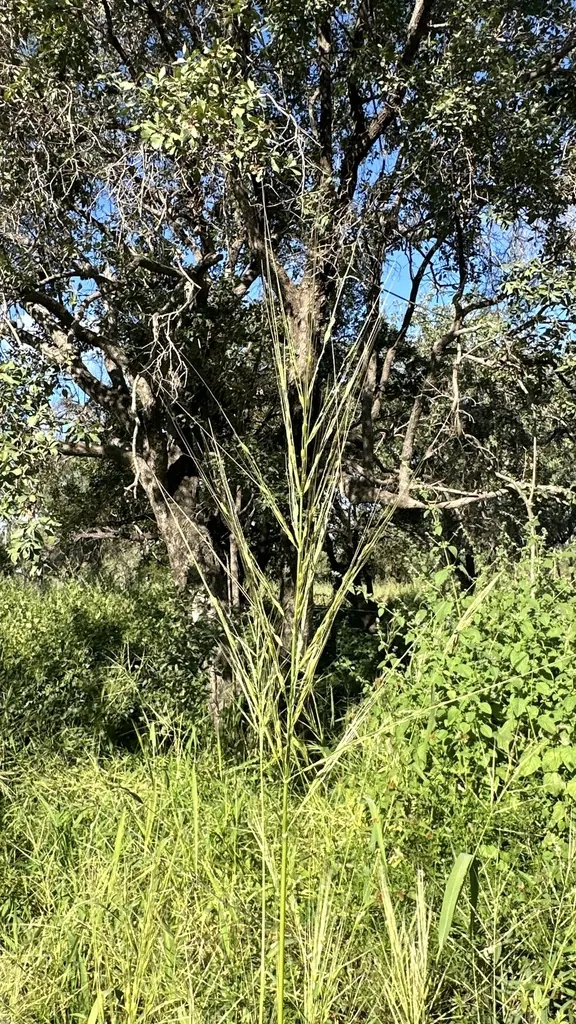
jikan and kakarr are grass, diburr is seed, jumul-jumul 'the grass seeds that get stuck in clothes, which come during the wet season', and janban is the dictionary's word for rice, taken from English[1]. The Kuku Yalanji of the coast lived on roots and fruit, and Roth found that on the eastern seaboard 'it is comparatively rare to come across any specialised form of grindstone ... considering that, instead of grain, we meet with a vegetable diet composed almost entirely of roots and fruits'[2]. West of the divide, on the Mitchell's plains and swamps, it was different: Australian wild rice, 'a tall grass, 4 to 6 feet high, called wild rice; grows during and after the wet season on all the plains and swamps all over the Gulf country', was a harvest, 'the heads ... gathered before the seed falls, and then threshed out on a flat stone. The seeds are then broken and winnowed, to separate the husks and beards from the eatable part, which is then ground between two stones with water, and roasted'[3]. Roth's version: 'the plants are collected, tied into bundles, and kept some considerable time under water: at last, they are taken out, dried, shaken, and the seeds winnowed — these are then ground between two stones, etc., and the pasty mass cooked like a "damper"', and his Cooktown name for the plant was jikan, the dictionary's word for grass[4][1]. The wild rice, Oryza australiensis, grows 'in wet areas near or on the edge of fresh water', and the seed grasses of the flats, the panics, dropseeds, kangaroo and spear grasses, are common through the north's woodland[5][6].
Nothing is written for the Eastern coast on this page yet. What follows is true across the country.
Hann River Cape York
Possum People's country on the upper river and Thaypan (Kuku Thaypan) country downstream: stringybark and bloodwood woodland and a spring-fed sandy river that runs north-east from the Great Dividing Range, past the Peninsula Developmental Road, into Rinyirru (Lakefield) and the North Kennedy. Not Kuku Yalanji country: the Kuku Yalanji words on this page are the dictionary's, not the Hann's own languages. Place guide
Wild rice is a food of this country. Kuku Thaypan Elders call it Che giuill, 'an important food source in Kuku Thaypan country'[14]. Around 1900 Roth wrote down its names on Princess Charlotte Bay: kwang-an among the Koko-warra and ari-yuma among the Koko-rarmul, in his spelling[4]. The Hann's own banks carry 'coarse grasses such as speargrass' under the stringybark and bloodwood[15].
Where the seed grasses grow here
In a box of about 90 × 85 km around the middle Hann, Laura and western Rinyirru, the Atlas of Living Australia holds 53 records of wild rice: 27 of Oryza meridionalis, 17 of O. rufipogon and 5 of O. australiensis[16]. The same box has 111 records of the panics (46 of Panicum seminudum, 4 of native millet), 107 of Eriachne, 76 of native sorghums, 18 each of giant spear grass and kangaroo grass, 10 of black spear grass, 7 of cockatoo grass and 6 of the dropseeds[16]. In the permanent swamps of Kuku Thaypan country 'emergent grasses (e.g. Oryza rufipogon)' are common[14].
The seed year here
The Kuku Thaypan Elders' calendar reads the grass. Leading into the cool months, the 'knock-em-down rain' 'knocks down the grass seed heads providing moisture for re-generation as many native grass species contain hydroscopic awns that fall from the seed head and drill into the grass when wet'[14]. Then, in their order[14]:
- Autumn: black spear grass seeding; cockatoo grass, Kwern yulan, 'finished flowering and fruiting'.
- Winter, May to September: Kwern umbayal, giant spear grass, 'begins to fall over', the sign to get ready to burn.
- Also in winter: 'Che giuill Wild rice Oryza sp.is ready'; Eriachne and Themeda setting seed.
Fire follows the seed: country is ready 'for burning once the seed has set'[14].
How the people of this country used them
- Wild rice (Che giuill) is food[14]. Roth's wild-rice method in the sections above sits beside his Princess Charlotte Bay names, but he does not say in which district he saw it[4].
- Giant spear grass (Kwern umbayal): 'following the wet season it's root base is a vital source of nutritious moisture at this time and leading into the dry'[14].
- Cockatoo or sugarbag grass (Kwern yulan) 'was used in medicines and its root base was used as a mop in the collection of sugarbag or native honey'[14]. See native bees.
Native title holders may gather for their own needs without a licence[17]; in Rinyirru everyone else must 'not remove plant material, living or dead'[18].
Language
Kuku Thaypan (Awu Alaya): grasses are 'identified collectively as "Kwern"'; Kwern umbayal 'giant spear grass'; Kwern yulan 'cockatoo grass, sugarbag grass'; Che giuill 'wild rice'[14]. Koko-warra kwang-an and Koko-rarmul ari-yuma 'wild rice', in Roth's spelling[4]. None of these are Kuku Yalanji words.
Upper Mitchell Western Yalanji
Western Yalanji country west of the Great Dividing Range: dry open woodland cut by the sandy, paperbark-lined upper Mitchell River, around Karma Waters and Mount Carbine. Place guide
Around Karma Waters the wild rice, Oryza australiensis, has three Atlas records within 30 km, and the seed grasses of the flats are all through the list[6].
Where they grow here
The Karma Waters list has the native millet's relatives Panicum seminudum, six records, and P. trichoides; and kangaroo grass, black spear grass, native sorghum, Chrysopogon, Eriachne and the wire grasses are all in it[6].
On country today
The wild rice is in the Karma Waters lagoons and the seed grasses on every flat, but the grass-seed harvest was the Gulf side's craft, and whether the Western Yalanji of the upper Mitchell ground seed is for the old people to say; the contribution box below is for it[6][2]. Gathering for personal use on native title country here is covered by the Western Yalanji determinations[19].
Everywhere
Names
jikan 'grass'; kakarr 'grass' (also 'blanket to lie on' and 'year'); kumul 'species of grass'; mawu 'a coarse grass used in the making of dilly bags'; bilanji 'grass used to make dilly bags'; diburr 'seed, egg, bullet, tablets'; jumul-jumul 'the grass seeds that get stuck in clothes, which come during the wet season'; janban 'rice'[1]. Roth's 1901 food list gives for the wild rice 'KYI, Ckn., jikan', the Koko-Yimidir name at Cooktown, the same word the Kuku Yalanji dictionary has for grass, and mokomurdo in the Cloncurry district, where Palmer heard the dropseed grass called 'Jil-crow-arberry' and Roth wrote the same name jilgrubari[4][3][1].
The seed grasses and the harvest
Australian wild rice (Oryza australiensis). 'A wild rice species native to monsoonal northern Australia'; 'a perennial plant'; 'within northern Australia, it is found in wet areas near or on the edge of fresh water. It grows in the open in black, clay, or red loam soil'; 'it survives the dry season through its rhizomes'; it stands heat to 45°C and drought, 'has been described as an extremophile', and 'has the largest genome in the genus', for which it is 'used in breeding programs'[5]. Palmer, 1883, writing it as the cultivated species: 'a tall grass, 4 to 6 feet high, called wild rice; grows during and after the wet season on all the plains and swamps all over the Gulf country. It soon dries, and bends over or breaks. The seeds are large, with flat husk and a long awn or beard. The heads are gathered before the seed falls, and then threshed out on a flat stone. The seeds are then broken and winnowed, to separate the husks and beards from the eatable part, which is then ground between two stones with water, and roasted'[3]. Roth, 1901: '"Wild Rice." The plants are collected, tied into bundles, and kept some considerable time under water: at last, they are taken out, dried, shaken, and the seeds winnowed — these are then ground between two stones, etc., and the pasty mass cooked like a "damper"'[4].
Native millet (Panicum decompositum): 'seed winnowed and ground, and cooked like a "damper"', tindil in the Cloncurry district[4].
Dropseed grasses (Sporobolus). Palmer: S. indicus, 'a fine grass, about 9 to 12 inches high', 'the stalks are steeped several hours in water, when the seeds are easily rubbed out, and then ground between two stones and baked for bread. Wherever this grass grows in N. Queensland the natives use it in the same manner'; and S. lindleyi, 'the fine seeds are gathered and ground up with water into a paste, and baked'[3]. Roth's fuller method for S. actinocladus: 'This is cut down, tied into small bundles, taken down to the nearest waterhole, and dipped under, just for a minute or two: the bundles are next laid out to dry in the sun for a quarter of an hour or so, but to prevent the desiccation taking place too rapidly, especially on a very hot day, they may be covered over with some other grasses or bushes. When the moisture has been sufficiently removed, each bundle is firmly held by the stalk-portion with one hand, while the head-portion is gently brushed over and squeezed with the other, the seed so loosened being allowed to fall into the water contained in a wooden bowl beneath. The water is drawn off subsequently by tipping up the vessel, and so letting the fluid escape through the interdigital spaces of the hollowed hand; the seed itself is then dried again before being ground and made up into a "damper"'[4].
The other grasses of the flats. Kangaroo grass (Themeda triandra) and black spear grass (Heteropogon contortus) under the woodland, native sorghum (Sorghum laxiflorum), Chrysopogon, Eriachne and the wire grasses (Aristida) all set seed after the wet; see blady grass for the grass of the damp flats[7].
The stones. Roth, 1904: 'A special form of grinding- or mealing-stones is met with. Each set consists of a movable stone or rubber, and a fixed slab upon which it is rubbed and pressed. The former is bilaterally convex on its under surface, more or less circular, and anything between 4 and 6 inches in diameter: it is pressed with both hands backwards and forwards, each change in direction being accompanied with a kind of initial half-circular movement at the wrist. The oval slab, up to 18 inches long ... almost invariably shows two longitudinal shallow depressions along which the mealing-stone or rubber has been working.' 'In the upper Peninsula and along the eastern seaboard it is comparatively rare to come across any specialised form of grindstone ... There is evidence, however, that some of these coastal natives, amongst whom these articles are no longer met with, used in former times to possess them: the Cape Bedford aboriginals, for instance, speak of the fixed stone as dindi, and of the rubber as mar-ngumai, although they have no examples to show me.' Pounders: 'any basalt, diorite, etc., boulder-pebble conveniently to hand', used 'in pairs, like mill-stones', and the Rockhampton people 'never carried them about when shifting camp: they just planted them, when not in use, up in the fork of a tree'[2]. See stone.
Telling the seed grasses
- Wild rice: tall, in and beside standing water on black or clay soil, a loose head of big seeds each with a long beard; perennial from a rhizome[5][3].
- Native millet: an open, spreading head on a knee-high grass of the flats[4].
- Dropseed: a fine grass a foot high with tiny seeds, on the ridges[3].
- Kangaroo grass: rusty-red nodding heads; spear grass: the black twisted awns that drill into socks, the dictionary's jumul-jumul[1][6].
- Blady grass: a silky white plume, no seed worth gathering.
- Cultivated rice (janban) is the same genus and a different plant[1].
Signs
- Grass heads bending and breaking at the end of the wet: the harvest is now or not at all, 'gathered before the seed falls'[3].
- Finches on the seed: the black-throated finch 'feeds mainly on fallen grass seed'; where the finches are, the seed is ripe[8].
- A flat rock with two shallow grooves worn in it near an old camp: a mealing slab[2].
- Seeds in your socks: jumul-jumul, the wet-season sign[1].
Where the seed grasses grow
The wild rice 'in wet areas near or on the edge of fresh water', in the lagoons and swampy flats that hold water after the wet; the millets on the flats; the dropseeds on the ridges; kangaroo and spear grass under the woodland[5][3][7].
Seed for everyone
The grass seed of the flats is the food of the finches, the pigeons, the rosellas, the rats and the ants, and so of the hawks and snakes that eat them, and a seed year after a good wet is a bird year[8][9][10]. The wild rice stands in the lagoons with the water lilies, and the magpie geese and the pigs work the same ground[5]. Fire decides the seed: a cool, late burn after the seed drops keeps the seed grasses; a hot early burn before it kills the year's crop and the finches' with it; see hunting with fire and the Gouldian finch[7].
Seasons
Wild rice 'grows during and after the wet season' and the harvest is in the early dry, 'before the seed falls'; the dropseeds and millets seed with the end of the rains; the grindstone's season is the dry[3][4]. See the year on country.
Uses
- Seed flour and damper from wild rice, millet and dropseed, ground wet and roasted[3][4].
- Grass for dilly bags (mawu, bilanji), bedding (kakarr) and hut thatch[1].
- Grass hoods and bundles for hunting ducks and hiding from cockatoos; see ducks and geese and cockatoos[4].
- The grass sponge wuju for eating honey; see native bees[1].
Harvesting and grinding seed
Palmer's and Roth's methods, combined[3][4][2]:
- Cut the heads of wild rice or dropseed when the seed is full but before it drops, and tie them in small bundles[3][4].
- Dip the bundles in the waterhole for a minute or two (dropseed) or steep the plants for hours (dropseed) or days (Roth's rice, 'kept some considerable time under water') so the seed loosens[4][3].
- Dry them in the sun for a quarter of an hour, covered with other grass on a hot day so they do not dry too fast[4].
- Hold each bundle by the stalk and brush the head with the other hand over a bowl of water; the seed falls in, the chaff floats; tip the water off through the fingers and dry the seed again[4].
- Thresh wild rice on a flat stone, break the husks and winnow the beards away[3].
- Grind wet between the fixed slab and the hand-rubber, 'pressed with both hands backwards and forwards' with a half-turn of the wrist at each change, adding water to make a paste[2][3].
- Roast or bake as a damper in the ashes[3][4].
- Leave the stones in a tree fork for next year, as the old people did[2].
Safety
- Native plants are protected; gathering for personal use on native title country is covered by section 211 of the Native Title Act 1993[11][12].
- The wild-rice lagoons are the crocodile's and the pigs'; see Crocwise[13].
- Seed with black mould or ergot on the head is left; a wet-season seed harvest spoils fast, so dry it well.
Language
jikan, kakarr 'grass'; kumul 'species of grass'; mawu, bilanji dilly-bag grasses; diburr 'seed'; jumul-jumul the wet-season grass seeds; janban 'rice'; jalngarr 'flat rock'; jinali 'smooth rock'; jangka 'stone'; mayi 'vegetable food'[1].
References
- Hershberger, H. D. & Hershberger, R. (1982). Kuku-Yalanji Dictionary. Work Papers of SIL-AAB, Series B, Volume 7. With Toby Bloomfield, Roy Friday, Billy Roberts, Hector and Doris Sykes, Joe Walker and others. www.sil.org/resources/archives/18038
- Roth, W. E. (1904). North Queensland Ethnography, Bulletin No. 7: Domestic implements, arts, and manufactures. Brisbane: Government Printer. — Sect. 10 'Fire-tongs' archive.org/details/northqueensland00landgoog
- Palmer, E. (1883). On plants used by the natives of North Queensland, Flinders and Mitchell Rivers, for food, medicine, &c., &c. Journal and Proceedings of the Royal Society of New South Wales 17: 93–113. Palmer's Mitchell River names come from the lower and middle Mitchell, not from Kuku Yalanji speakers. archive.org/details/journalandproce16walegoog
- Roth, W. E. (1901). North Queensland Ethnography, Bulletin No. 3: Food — its search, capture, and preparation. Brisbane: Government Printer. Bloomfield River information from the Hislops. — Sect. 6 'Cooking'; plant list ('Castanospermum australe', 'Dioscorea sativa', 'Elettaria Scottiana', 'Nymphaea') archive.org/details/northqueensland00landgoog
- Wikipedia. Oryza australiensis (Australian wild rice). en.wikipedia.org/wiki/Oryza_australiensis
- Atlas of Living Australia. Plant occurrence records within 30 km of the Karma Waters homestead (16.62°S, 144.60°E), queried 10 October 2026: 832 records of 266 species. biocache.ala.org.au/occurrences/search?q=kingdom:Plantae&lat=-16.62&lon=144.60&radius=30
- Queensland Herbarium, Regional Ecosystem 9.11.26 (Einasleigh Uplands): Eucalyptus leptophleba and/or E. cullenii and/or Corymbia clarksoniana +/- E. platyphylla woodland on undulating terrain to rolling hills. Fire management guidelines. Queensland Government Regional Ecosystem Description Database. apps.des.qld.gov.au/regional-ecosystems/details/?re=9.11.26
- Wikipedia. Black-throated finch. en.wikipedia.org/wiki/Black-throated_finch
- Wikipedia. Pale-headed rosella. en.wikipedia.org/wiki/Pale-headed_rosella
- Wikipedia. Common bronzewing (Phaps chalcoptera). en.wikipedia.org/wiki/Common_bronzewing
- Queensland Government, State of the Environment. Nature Conservation Act 1992. www.stateoftheenvironment.des.qld.gov.au/biodiversity/management-responses/legislation/nature-conservation-act-1992
- Australian Law Reform Commission. Review of the Native Title Act 1993 (DP 82), ch. 8: Relevant provisions in the Native Title Act (s 211). www.alrc.gov.au/publication/review-of-the-native-title-act-1993-dp-82/8-the-nature-and-content-of-native-title/relevant-provisions-in-the-native-title-act/
- Queensland Government. Be Crocwise top tips; Be Crocwise in Croc Country (web pages, accessed 5 October 2026). www.qld.gov.au/environment/plants-animals/animals/living-with/crocodiles/becrocwise/be-crocwise-top-tips
- Standley, P.-M. (2019). The importance of campfires to effective conservation. PhD thesis, James Cook University. Records the fire and country knowledge of Kuku Thaypan Elders Dr Tommy George and Dr George Musgrave. researchonline.jcu.edu.au/64274/
- Wikipedia. Hann River (Queensland) (accessed 28 October 2026). en.wikipedia.org/wiki/Hann_River_(Queensland)
- Atlas of Living Australia. Occurrence records of grasses: Oryza (53 records, 1961–2021: O. meridionalis 27, O. rufipogon 17, O. australiensis 5), Panicum (111, 1967–2021; P. seminudum 46, P. decompositum 4), Eriachne (107, 1962–2023), Sorghum (76, 1961–2023), Heteropogon triticeus (18, 1970–2010), Themeda triandra (18, 1961–2019), Heteropogon contortus (10, 1970–2026), Alloteropsis semialata (7) and Sporobolus (6, 1970–2015) in a box of about 90 × 85 km around the middle Hann River, Laura and western Rinyirru (lat −15.6 to −14.8, long 143.5 to 144.3), queried 28 October 2026. biocache.ala.org.au/occurrences/search?q=*:*&fq=decimalLatitude:%5B-15.6%20TO%20-14.8%5D&fq=decimalLongitude:%5B143.5%20TO%20144.3%5D
- Native Title Act 1993 (Cth), section 211: preservation of certain native title rights and interests (hunting, fishing and gathering for personal, domestic or non-commercial communal needs). www.legislation.gov.au/C2004A04665/latest/text
- Queensland Parks and Wildlife Service. About Rinyirru (Lakefield) National Park (CYPAL): park features and looking after the park (web page, last updated 1 July 2024; accessed 28 October 2026). parks.qld.gov.au/parks/rinyirru-lakefield/about
- Western Yalanji Aboriginal Corporation & CRC for Developing Northern Australia (2020). Western Yalanji Land Use and Economic Diversification Plan. CC BY 4.0. — Native Title Determinations 1–4 (pp. 13–18); ‘Fire Management and Carbon Farming’ (pp. 32–33); ‘Pastoralists’ crcna.com.au/wp-content/uploads/2024/05/westernyalanjilanduseplan_nov2020.pdf
From the community
Know this one? Add the words you use for it, what it is for, how it is done, a correction, or a photo from country. It shows here straight away with your name on it. Please keep anything restricted or sacred off the site.
Loading…