Plants, vines & grasses
Blady grass and the grasses
jikan · kakarr · kumulImperata cylindrica; with Heteropogon contortus and Themeda triandra
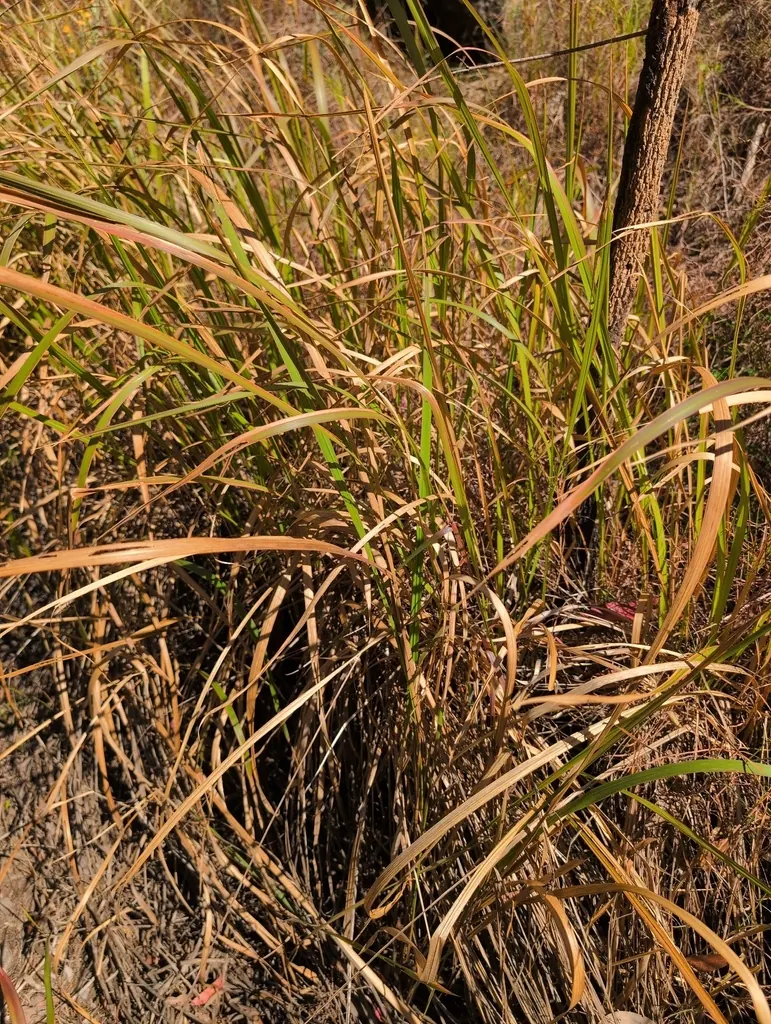
jikan is grass, and kakarr is 'grass; blanket to lie on, not to put over you', which says what grass was for first[1]. Blady grass, Imperata cylindrica, is the tall, sharp-edged, rhizome-forming grass of damp flats and creek margins, 'regarded as an excellent plant for thatching the roofs of traditional homes throughout south-east Asia', and in North Queensland the thatch of the beehive hut, the fibre of Cape Bedford dilly bags, the weave of the fish-fence wings, and the toy spears of small boys[2][3][4][5][6]. The dictionary's grass words cover the rest of the grass toolkit: mawu 'a coarse grass used in the making of dilly bags', bilanji 'grass used to make dilly bags', balji the 'ladies' dilly bag, made from grass', wuju 'sponge made from grass, used as a sop for eating honey or soup', duburan the directional sign of 'grass twisted to point the way', warrbi 'house made of grass', duli 'burnt patch of grass' and jumul-jumul 'the grass seeds that get stuck in clothes, which come during the wet season'[1].
Hann River Cape York
Possum People's country on the upper river and Thaypan (Kuku Thaypan) country downstream: stringybark and bloodwood woodland and a spring-fed sandy river that runs north-east from the Great Dividing Range, past the Peninsula Developmental Road, into Rinyirru (Lakefield) and the North Kennedy. Not Kuku Yalanji country: the Kuku Yalanji words on this page are the dictionary's, not the Hann's own languages. Place guide
Blady grass is barely on the record around the Hann: the Atlas of Living Australia holds just 2 records, from 1970 and 2023, in a box of about 90 × 85 km around the middle Hann, Laura and western Rinyirru, against 10 of black speargrass and 18 of kangaroo grass[17]. The Hann's woodland has 'a ground cover of coarse grasses such as speargrass'[18]. Kuku Thaypan Elders call the grasses together Kwern, and read them as the calendar for burning[19].
Where the grasses are here
Along the Hann the trees are stringybark, bloodwood, Moreton Bay ash and ironbark 'with a ground cover of coarse grasses such as speargrass'[18]. Open grassy plains, Kwern, are one of the nine kinds of country the Kuku Thaypan Elders name[19]. Blady grass wants damp ground; with only two Atlas records near the river, the grasses that matter here are the speargrasses, cockatoo grass and kangaroo grass[17][19].
Grass and the year here
Kuku Thaypan Elders read the grass to time their fires. In the early dry, which on the south-eastern side of Cape York is 'usually in April or May', 'Kwern umbayal Tall Spear grass (Heteropogan triticius) seed stalks begin to fall down and native grass seed begin to be knocked off the plants by the rain, making them ready for fire, smoke and germination'[19]. In their calendar the cockatoo grass, Kwern yulan, has 'finished flowering and fruiting' before the burns begin, and black speargrass is seeding as the grasses cure[19]. Messmate country is ready to burn 'when Eriachne sp is setting seed and bark has shed'[19]. After the wet, the giant speargrass's 'root base is a vital source of nutritious moisture'[19]. See hunting with fire.
How people used grass here
Kuku Thaypan Elders. Cockatoo or sugarbag grass, Kwern Yulan, 'was used in medicines and its root base was used as a mop in the collection of sugarbag or native honey'[19]. See native bees.
Princess Charlotte Bay hinterland and the Palmer, c. 1900. A duck hunter covered 'his head with a bundle of long grass, tied about near to its extremities into something like a horse-collar', and stalked through the water looking 'like a tussock of grass floating down the stream'[5].
Morehead and Musgrave rivers, c. 1900. For spinning human-hair twine, the spindle was 'about 8 in. long, and made from a piece of grass-stem'[7].
On country today
The upper Hann is the Possum People's country[20] and the middle and lower Hann are Thaypan country, both determined in November 2023[21]. Where the Thaypan rights are non-exclusive, they include the right to light fires 'for cultural, spiritual or domestic purposes including cooking, but not for the purpose of hunting or clearing vegetation'[21].
Language
Kuku Thaypan (Awu Alaya) words recorded with the Elders: Kwern grasses in general; Kwern umbayal giant spear grass (Heteropogon triticeus); Kwern Yulan cockatoo or sugarbag grass (Alloteropsis semialata); Che giuill wild rice (Oryza); chigaru reed grass[19]. These are Kuku Thaypan, not Kuku Yalanji.
Upper Mitchell Western Yalanji
Western Yalanji country west of the Great Dividing Range: dry open woodland cut by the sandy, paperbark-lined upper Mitchell River, around Karma Waters and Mount Carbine. Place guide
At Karma Waters the recorded grasses are black speargrass and kangaroo grass; blady grass is not in the 30 km records, and the methods here work with whatever long grass the flats give[22][9][10].
The grasses on the record here
Black speargrass (Heteropogon contortus) and kangaroo grass (Themeda triandra) are the recorded grasses of the Karma Waters woodland, the ones under the ironbarks and bloodwoods, with their twisted awns and their seed that the finches and the fires live on; the woodland page has them[22][9][10][11].
Where the grasses grow here
Within 30 km of Karma Waters the Atlas records black speargrass and kangaroo grass, the grasses of the dry ironbark and bloodwood woodland on sand, and no blady grass; if it is here it is on the wetter ground by the river and the soaks[22][11].
On country today
Whether blady grass grows on the Karma Waters flats, and what the Western Yalanji call the speargrass and the kangaroo grass, is for the contribution box below[22].
Eastern coast Eastern Kuku Yalanji
Eastern Kuku Yalanji country: rainforest, beaches, mangroves, reef and the short steep rivers from the Daintree to the Bloomfield and the Annan.
On the Bloomfield, grass was the everyday stuff of camp: hut covering, mattresses, sponges, climbing ropes, tinder, bead necklaces and path signs[8].
Grass at Bloomfield
Anderson: huts 'covered with whatever they could get nearest at hand, either the leaves of the Fan Palm, Lawyer Palms, grass or bark'; 'bunches of long bush grass served as mattresses on hard ground'; a 'grass sponge' swirled the Barringtonia fish poison into the water; 'when the nests were high in the tree, grass ropes were made for climbing'; the fire-drill's ember 'caught alight with the addition of dry grass and wood particles'; zamia flour was separated 'with a small grass brush'; 'necklaces of grass-bugles' were worn; and the path signs, duburan, ranged 'from a knotted tussock of grass with the tips pointing in the desired direction, a single stem of grass woven into the branches of a shrub, a number of straws or a palm leaf tied to a tree (all with their butts as pointers), to rather complicated little devices tied to sticks pushed into the ground'[8].
Everywhere
Names
jikan 'grass'; kakarr 'grass; blanket to lie on, not to put over you; also used as year, i.e. kararr jambul "two years"'; kararr 'a blanket, sheet, or grass bedding spread out to lie on'; kumul 'species of grass'; mawu 'a coarse grass used in the making of dilly bags'; bilanji 'grass used to make dilly bags'; balji 'ladie's dilly bag, made from grass or black palm'; wuju 'sponge made from grass'; duburan 'directional sign ... as a heap of stones or grass twisted to point the way; ring of soft materials to put on women's [heads] for carrying things'; warrbi 'house made of grass, "beehive house"'; duli 'burnt patch of grass'; jumul-jumul the clinging grass seeds of the wet; ngalku 'bush fire'[1]. Roth's Cape Bedford (Guugu Yimithirr) word dirnbur was both the blady grass and the dilly-bag made from it, 'the name of the plant itself'[4][7]. The Bloomfield bag grass that Roth and Anderson name is not blady grass but Lomandra (then Xerotes), mau-u, which the dilly bags page covers[7][8].
Blady grass, speargrass, kangaroo grass
Blady grass, Imperata cylindrica, 'is a species of perennial rhizomatous grass'. It 'grows from 0.2–3 m tall, its stalk is firm and has nodes covered with long white hairs. Each clump that grows shares an extensive rhizome network'; 'the leaves are about 2 cm wide in average and 12–80 centimetres in length near the base of the plant and narrow to a sharp point at the top; the margins are finely toothed and are embedded with sharp silica crystals'; the seed heads are narrow white plumes. 'It spreads both through small seeds, which are easily carried by the wind, and rhizomes'. It 'is a pyrophyte. It is highly flammable, even when still apparently green, particularly in tropical climates'[2]. The blade is the 'blade' of the name; Roth knew it as Imperata arundinacea, 'Blady Grass'[4].
Black speargrass (Heteropogon contortus) and kangaroo grass (Themeda triandra) are the grasses of the dry inland woodland under the ironbarks and bloodwoods, with their twisted awns and their seed that the finches and the fires live on; the woodland page has them[9][10][11].
Grass in Roth's North Queensland. The thatch of the beehive hut was 'bark, blady-grass, lawyer-vine, cycad- or palm-leaf according to the local vegetation', and on the lower Tully the grass was laid 'two and a half to three feet long' in handfuls, butts down then butts up, fixed with a spiral of split cane[3]. At Cape Bedford 'the long leaves, dried in the sun, are put into fresh water, and split. These lengths are made up into dilly-bags, which are called dirnbur', and the sieve-baskets were 'woven from twine derived from Haemodorum coccineum, Spinifex hirsutus, Imperata arundinacea ("Blady Grass"), etc.'[4]. In the eel-trap fences of the coast, sticks were 'driven in vertically, and plenty of big blady-grass intertwined, so as to prevent the fish passing through anywhere, except into the trap', and the flood-time net wings were 'short thin stakes intertwined with blady grass'[5]. Small boys' 'toy spears are thus made from light thin withes or else from grasses, reeds, and rushes, e.g., Andropogon, Imperata'[6].
Which grass for which job
- Blady grass: wide flat blades, white plumes, damp flats; thatch, bag fibre, fish fences[2][4][5].
- Speargrass: tall, with the black twisted awns that drill into socks and skin in the late dry; the fire grass of the woodland; its stems are sucked for sweet sap in the Northern Territory[9].
- Kangaroo grass: the rusty-headed tussock grass; seed ground for bread and stems twisted for string elsewhere in Australia[10].
- Lomandra (mau-u), a grass-like lily: the Bloomfield bag grass; see dilly bags[7][8].
- Reeds of the river bed (Phragmites): the reed-spear shafts of the Mitchell, 'cut green, and stored in large quantities', straightened in the fire[12].
- Spinifex (Triodia) on the stoniest ground, the resin grass; see beeswax and gums[4].
Signs
- A knotted tussock with its tips pointing, a stem woven into a shrub, straws tied to a tree: duburan, a message on the path, saying who went where and how many, or where the water or the food is[8][1].
- Burnt patches (duli) and green pick: the managed woodland, and where the wallabies will be[1][11].
- Flattened grass beds and grass bundles in a half-ring: a camp[3][8].
- Round woven grass nests with a tube entrance high in a gum: the black-throated finch[13].
- Seeds in your socks in the wet: jumul-jumul[1].
Where the grasses grow
Blady grass wants moisture: damp flats, creek margins, the edges of swamps, and it holds ground with its rhizome mat, which is why it is planted 'for ground cover and soil stabilization' elsewhere[2]. The Tully, the Bloomfield and Cape Bedford, where Roth saw it used, are wet coastal country[4][3].
Grass, fire and seed
The grass is the fuel and the feed of the whole woodland: kangaroo grass and speargrass feed the wallabies and the finches, carry the dry-season burns and come back green behind them[10][9][11]. Blady grass is the extreme case, 'highly flammable, even when still apparently green', and it is the rhizome that survives the fire and the dense mat and the chemicals it releases that let it 'outcompete' other plants[2]. The fire-drive and the cultural burn are grass management; the dictionary's duli and ngalku are the vocabulary of it[1][14].
Seasons
Thatch and bag grass are cut long in the late wet and early dry, when the blades are full length; bedding grass whenever the camp moves; the seeds that stick in clothes come 'during the wet season'; the burns run from the early dry as the grass cures, 'every 2–5 years' in the ironbark-bloodwood woodland[3][1][11][14]. See the year on country.
Uses
- Thatch for the beehive hut, laid from the top down in handfuls fixed with cane[3].
- Dilly bags and sieve-baskets from sun-dried, soaked, split blades (Cape Bedford)[4].
- Fish-fence wings of stakes with blady grass woven through[5].
- Bedding: kararr, bunches of long grass as a mattress[1][8].
- Windbreaks of grass bundles round the sleeping place[3].
- Sponges (wuju) for honey and soup, and for swirling fish poison[1][8].
- Grass ropes for climbing to high bee nests[8].
- Tinder for the fire-drill[8].
- A brush for sorting zamia flour[8].
- Signs on the path, duburan[8][1].
- Head rings of grass for carrying, the Cape Bedford mordi[15][1].
- Toy spears for boys[6].
- Necklaces of grass-stem bugles[8].
- Seed of other grasses ground for bread in the west[12].
Grass work
Thatching a hut (lower Tully method, Roth)[3]: cut blady grass two and a half to three feet long; lay handfuls butts-down against the frame all round, then a layer butts-up, and tie both on with a split cane run round the hut; then single rows, each tied with cane, spiralling up; cap the top with teatree bark or palm leaves; weigh it with logs. Put on plenty: the rain is kept out by the quantity, not the arrangement[3]. The frame is on the huts page.
A grass dilly bag (Cape Bedford, Roth)[4]: dry the long blades in the sun; soak them in fresh water; split them into strands; work them up on the bag's mesh. The mesh patterns are on the dilly bags page.
A fish-fence wing[5]: drive thin stakes in a V from the trap's mouth and weave big blady grass through them so nothing passes except into the trap; see fish traps.
A grass sponge (wuju)[1][8]: pull two or three handfuls, take off the roots, rub the grass hard between the hands until it is a soft pad; sop honey or soup with it, or wrap the mashed fish-poison seed in it and swirl it under water.
A bed: a shallow hollow in the sand, bunches of long grass laid thick, a paperbark sheet over you in the cold; see bark blankets[8].
A sign: knot a tussock with its tips pointing the way you went, or weave a stem into a shrub, butt as the pointer[8].
Safety
- Blady grass cuts: the blade edges carry silica crystals[2].
- It burns green; a grass fire in cured speargrass in the late dry moves faster than a person; permits apply[2][11][16].
- Dry grass bedding and a fire are a hut fire; see huts[3].
- Never a hand into long grass you cannot see into; see snakes[11].
On Country today
Grass is the one material that is always there and always free, and most of what this page lists can be tried on a river camp in an afternoon: a sponge, a bed, a sign on the path, a windbreak[8][1]. What each people calls its grasses, and which grass it used for what, is for the contribution box below.
Language
jikan 'grass'; kakarr 'grass; blanket to lie on'; kararr 'grass bedding spread out to lie on'; kumul 'species of grass'; mawu, bilanji dilly-bag grasses; balji grass dilly bag; wuju 'sponge made from grass'; duburan 'directional sign'; warrbi 'house made of grass'; duli 'burnt patch of grass'; ngalku 'bush fire'; jumul-jumul grass seeds in clothes[1].
References
- Hershberger, H. D. & Hershberger, R. (1982). Kuku-Yalanji Dictionary. Work Papers of SIL-AAB, Series B, Volume 7. With Toby Bloomfield, Roy Friday, Billy Roberts, Hector and Doris Sykes, Joe Walker and others. www.sil.org/resources/archives/18038
- Wikipedia. Imperata cylindrica (blady grass, cogongrass): description, fire ecology and uses. en.wikipedia.org/wiki/Imperata_cylindrica
- Roth, W. E. (1910). North Queensland Ethnography, Bulletin No. 16: Huts and shelters. Records of the Australian Museum 8(1): 55–66. — Sect. 11, ridge-pole huts archive.org/details/records-australian-museum-8-055-066
- Roth, W. E. (1904). North Queensland Ethnography, Bulletin No. 7: Domestic implements, arts, and manufactures. Brisbane: Government Printer. — Sect. 10 'Fire-tongs' archive.org/details/northqueensland00landgoog
- Roth, W. E. (1901). North Queensland Ethnography, Bulletin No. 3: Food — its search, capture, and preparation. Brisbane: Government Printer. Bloomfield River information from the Hislops. — Sect. 6 'Cooking'; plant list ('Castanospermum australe', 'Dioscorea sativa', 'Elettaria Scottiana', 'Nymphaea') archive.org/details/northqueensland00landgoog
- Roth, W. E. (1902). North Queensland Ethnography, Bulletin No. 4: Games, sports and amusements. Brisbane: Government Printer. — Sect. 4 'Realistic games (animals)' archive.org/details/northqueensland00landgoog
- Roth, W. E. (1901). North Queensland Ethnography, Bulletin No. 1: String, and other forms of strand: basketry-, woven bag-, and net-work. Brisbane: Government Printer. — Sects. 1–9: animal and vegetable string, plant list ('Ficus', 'Hibiscus', 'Panicum trachyrachis', 'Sterculia quadrifida'), manufacture of fibre-twine, knots, colouring; sect. 22 hour-glass nets archive.org/details/northqueensland00landgoog
- Anderson, C. (1996). Traditional material culture of the Kuku-Yalanji of Bloomfield River, North Queensland. Records of the South Australian Museum 29(1): 63–83. Based on fieldwork at Wujal Wujal in the late 1970s and early 1980s. — Hunting (spears, spear-throwers, harpoons); fishing (stupefacients); manufacturing (gums and resins); post-contact bush component archive.org/details/RecordsSouthAus29Sout
- Wikipedia. Heteropogon contortus (black speargrass). en.wikipedia.org/wiki/Heteropogon_contortus
- Wikipedia. Themeda triandra (kangaroo grass). en.wikipedia.org/wiki/Themeda_triandra
- Queensland Herbarium, Regional Ecosystem 9.11.26 (Einasleigh Uplands): Eucalyptus leptophleba and/or E. cullenii and/or Corymbia clarksoniana +/- E. platyphylla woodland on undulating terrain to rolling hills. Fire management guidelines. Queensland Government Regional Ecosystem Description Database. apps.des.qld.gov.au/regional-ecosystems/details/?re=9.11.26
- Palmer, E. (1883). On plants used by the natives of North Queensland, Flinders and Mitchell Rivers, for food, medicine, &c., &c. Journal and Proceedings of the Royal Society of New South Wales 17: 93–113. Palmer's Mitchell River names come from the lower and middle Mitchell, not from Kuku Yalanji speakers. archive.org/details/journalandproce16walegoog
- Wikipedia. Black-throated finch. en.wikipedia.org/wiki/Black-throated_finch
- Queensland Parks and Wildlife Service (2013). Planned Burn Guidelines: Cape York Peninsula Bioregion of Queensland. Department of National Parks, Recreation, Sport and Racing. — 'Fire in the monsoonal tropics of the Cape York Peninsula bioregion'; ch. 1–2 season guidance (storm burns) parks.desi.qld.gov.au/__data/assets/pdf_file/0019/151480/pbg-cape-york.pdf
- Roth, W. E. (1910). North Queensland Ethnography, Bulletin No. 14: Transport and Trade. Records of the Australian Museum 8(1). — Sects. 14–15, dug-out canoes from the Flinders Group to Cape Grafton archive.org/details/biostor-52863
- Queensland Fire Department. Fire permits: lighting fires in Queensland. fire.qld.gov.au/safety-education/using-fire-outdoors/lighting-fires-in-queensland
- Atlas of Living Australia. Occurrence records of Imperata cylindrica (2 records, 1970 and 2023), Heteropogon contortus (10 records, 1970–2026) and Themeda triandra (18 records, 1961–2019) in a box of about 90 × 85 km around the middle Hann River, Laura and western Rinyirru (lat −15.6 to −14.8, long 143.5 to 144.3), queried 28 October 2026. biocache.ala.org.au/occurrences/search?q=genus%3AImperata&fq=decimalLatitude%3A%5B-15.6%20TO%20-14.8%5D&fq=decimalLongitude%3A%5B143.5%20TO%20144.3%5D
- Wikipedia. Hann River (Queensland) (accessed 28 October 2026). en.wikipedia.org/wiki/Hann_River_(Queensland)
- Standley, P.-M. (2019). The importance of campfires to effective conservation. PhD thesis, James Cook University. Records the fire and country knowledge of Kuku Thaypan Elders Dr Tommy George and Dr George Musgrave. researchonline.jcu.edu.au/64274/
- Ross on behalf of the Cape York United #1 Claim Group v State of Queensland (No 21) (Possum determination) [2023] FCA 1316 (Federal Court of Australia, 2 November 2023). — Determination area (upper Hann and Kennedy rivers); prescribed body corporate; affidavit evidence on hunting and fishing www.judgments.fedcourt.gov.au/judgments/Judgments/fca/single/2023/2023fca1316
- Ross on behalf of the Cape York United #1 Claim Group v State of Queensland (No 20) (Thaypan determination) [2023] FCA 1315 (Federal Court of Australia, 2 November 2023). — Determination area and waters; prescribed body corporate (Awu-Laya Indigenous Corporation); affidavit evidence on hunting www.judgments.fedcourt.gov.au/judgments/Judgments/fca/single/2023/2023fca1315
- Atlas of Living Australia. Plant occurrence records within 30 km of the Karma Waters homestead (16.62°S, 144.60°E), queried 10 October 2026: 832 records of 266 species. biocache.ala.org.au/occurrences/search?q=kingdom:Plantae&lat=-16.62&lon=144.60&radius=30
From the community
Know this one? Add the words you use for it, what it is for, how it is done, a correction, or a photo from country. It shows here straight away with your name on it. Please keep anything restricted or sacred off the site.
Loading…