Mammals
Dingo and hunting dogs
murramu · murrumu · ngamu-murramu · kayaCanis familiaris (dingo)
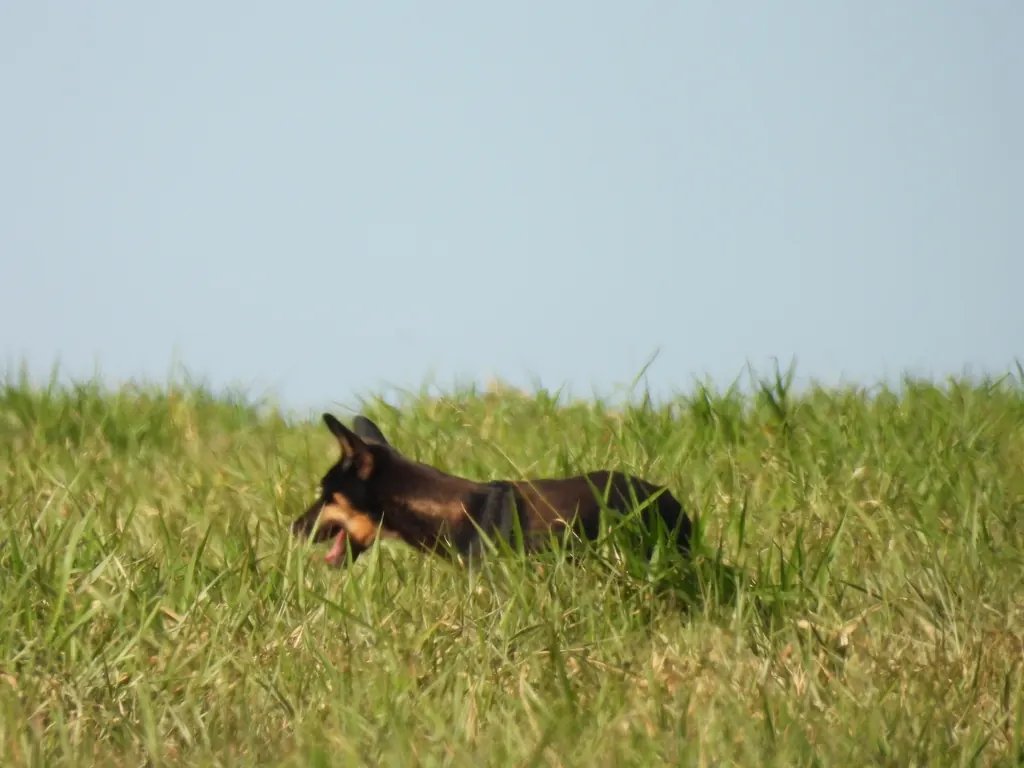
murramu, murrumu and ngamu-murramu are the dingo and kaya the dog, and the dictionary keeps the dog's working life in its words: majarr is 'lazy, no good for hunting or working, used to refer to both dogs and people', jurru-walay and mala-minya a good hunter, ngangkurr the bark[1]. The dingo 'is a medium-sized canine that possesses a lean, hardy body adapted for speed, agility, and stamina. Its three main coat colourations are light ginger or tan, black and tan, or creamy white'; 'the oldest remains of dingoes discovered in Australia are around 3,500 years old'[2]. Roth wrote in 1901 that 'dingoes are, on the whole, hunted rather for the sake of obtaining the pups than for the sake of food', and in 1902 that 'only in the case of the dingo does true domestication and training take place. The pups are caught young, brought into camp, and tied up by the leg until such time as they become reconciled to their surroundings'[3][4]. The dogs ran down kangaroos 'in rainy weather, and over boggy soil', went for the emu's neck, and hunted possums by night[3]. Today the dingo is 'the largest mammalian carnivore remaining in mainland Australia', and also a 'category 3, 4, 5 and 6 restricted invasive animal under the Biosecurity Act 2014'[5]. Where it may be baited, and where a dog may go, differs from place to place: see each place above.
Hann River Cape York
Possum People's country on the upper river and Thaypan (Kuku Thaypan) country downstream: stringybark and bloodwood woodland and a spring-fed sandy river that runs north-east from the Great Dividing Range, past the Peninsula Developmental Road, into Rinyirru (Lakefield) and the North Kennedy. Not Kuku Yalanji country: the Kuku Yalanji words on this page are the dictionary's, not the Hann's own languages. Place guide
The dingo lives along the Hann. The Atlas of Living Australia holds 20 records of Canis familiaris, from 1993 to 2026, most of them labelled dingo, in a box of about 90 × 85 km around the middle Hann, Laura and western Rinyirru[15]. The nearest old record of hunting with dogs is Roth's, from the Palmer, Musgrave and the country behind Princess Charlotte Bay[3]. Leave your own dog at home if you are going into Rinyirru: domestic animals are not permitted in the park[16].
What it hunts here
This country is full of the dingo's food. In Rinyirru 'agile wallabies are abundant'[17], and 'Feral pigs Sus scrofa occur in large numbers throughout the park'[18]. No study of what the Hann's dingoes eat was found; the general section above has its diet.
How people used dogs here
Roth, writing about 1900, recorded that 'On the Palmer, Musgrave, and back of Princess Charlotte Bay generally, in addition to occasionally hunting them with dogs, kangaroos are speared'[3]. That is the nearest published record to the Hann. Nothing published was found on how the Possum or Thaypan peoples raised or worked their dogs; Roth's general account of taming dingo pups is above.
Kuku Thaypan country has a Dog Story Dreaming, recorded by Standley with the Elders[19]. The story belongs to its custodians and is not retold here.
On country today
In Rinyirru (Lakefield) National Park 'Domestic animals are not permitted'[16]. In a protected area the dingo is 'a natural resource', and it 'can be controlled outside national parks and other protected areas'[5].
Native title. The upper Hann is the Possum People's country[20]. The middle and lower Hann are in the Thaypan determination of 2 November 2023, held by the Awu-Laya Indigenous Corporation[21]. Ask them before taking a dog onto their country to hunt.
Upper Mitchell Western Yalanji
Western Yalanji country west of the Great Dividing Range: dry open woodland cut by the sandy, paperbark-lined upper Mitchell River, around Karma Waters and Mount Carbine. Place guide
On Karma Waters the dingo hunts the wallaroos of the hills[7], and the station 'baits wild dogs twice a year'[12]. That is the first thing to know before bringing a dog onto this country.
Where they are here
Everywhere on the station, from the river to the ridges, with dens in the rock piles and hollow logs; the Atlas's records cluster on the roads and the river where people see them[22][2].
On country today
The dingoes howl from the Karma Waters ridges and the station baits them[12]. Ask the station where and when the baits are down before bringing a dog[12].
Eastern coast Eastern Kuku Yalanji
Eastern Kuku Yalanji country: rainforest, beaches, mangroves, reef and the short steep rivers from the Daintree to the Bloomfield and the Annan.
At the Bloomfield the dingo was the family's hunting dog: 'young boys at Bloomfield had dingo pups as pets while they were being trained for hunting ... women sometimes suckled the pups'[10].
Dogs in the Bloomfield camps
Anderson: the Bennett's tree-kangaroo 'was tracked by sight or with the use of dogs'[10]. Roth heard that on the Bloomfield, 'if the owner wants his dog to become an expert tip-top hunter, he will rub him over each morning with a piece of quartz-crystal'[23].
On country today
The camp dogs of the old Bloomfield camps are the pig dogs and the house dogs of today[10].
Everywhere
Names
murramu, murrumu, ngamu-murramu 'dingo'. kaya 'dog'; kayamuku 'felt hat (literally the back of a dog)'. ngangkurr 'bark, as of a dog', ngangkurri-l 'to bark'. majarr 'lazy, no good for hunting or working, used to refer to both dogs and people'. jurru-walay 'expert, good shooter or hunter', mala-minya 'good hunter', walay 'being good at working or getting food, as a good hunter'. mindil 'dog flea'. jindal 'to bite and leave a puncture mark, as a snake bite or some dog bites'[1]. In English, 'the name "dingo" comes from the Dharug language used by the Indigenous Australians of the Sydney area', and 'the dingo has different names in different Aboriginal Australian languages'; some peoples 'had different names' for camp dingoes and wild ones[2]. Roth recorded at Cape Bedford, north of Cooktown, that 'the name for a dingo signifies the offspring of a coward', and the dictionary's ngamu-murramu has the dictionary's word for 'mother' in it[3][1].
The dingo
'The dingo is a lineage of dog found in Australia. It is a medium-sized canine that possesses a lean, hardy body adapted for speed, agility, and stamina. Its three main coat colourations are light ginger or tan, black and tan, or creamy white. The skull is wedge-shaped and appears large in proportion to the body.' 'The dingo is closely related to the New Guinea singing dog: their lineage split early from the lineage that led to today's domestic dogs, and can be traced back through Maritime Southeast Asia to Asia. The oldest remains of dingoes discovered in Australia are around 3,500 years old'[2]. Queensland's biosecurity page says the same: 'thought to have arrived in Australia around 3,500–4,000 years ago', 'the largest mammalian carnivore remaining in mainland Australia, and fills an important ecological niche. Since early European settlement, the dingo has been regarded as a serious predator of domestic livestock'[5]. 'The term "wild dog" refers to purebred dingoes, dingo hybrids, and dogs that are not owned by a person'[6].
Camp dogs and hunting dogs, 1901–1902. 'Dingoes (Canis dingo) are, on the whole, hunted rather for the sake of obtaining the pups than for the sake of food—unless the natives are very hard pressed; the tracks of the pups are followed, and when run down are taken alive, to be subsequently tamed'[3]. 'Only in the case of the dingo does true domestication and training take place. The pups are caught young, brought into camp, and tied up by the leg until such time as they become reconciled to their surroundings. Sometimes a boy (on the Bloomfield) but more usually a gin is placed in charge of these animals: in the latter case it is a very common practice for her to suckle them if necessary. The aboriginals appear to be very fond of their dogs, share their food with them, often speak to them as if they were intelligent beings, and do not believe in "suling" them one onto the other: in the latter case, they will indulge in violent outbursts of anger even with their children — a most unusual occurrence — for attempting to do so'[4].
What the dogs hunted. Roth: 'Emus may also be hunted with dogs, the latter always making for the bird's neck'; kangaroos 'in rainy weather, and over boggy soil, they are run down with dogs'; on 'the Palmer, Musgrave, and back of Princess Charlotte Bay generally, in addition to occasionally hunting them with dogs, kangaroos are speared'; on the lower Tully wallabies 'also hunt them occasionally with dogs'; opossums 'can be hunted at night by sight, provided of course the moon is up, or by dogs'[3]. Roth's grammar notes carry the idea in a word: a 'kangaroo-dog', 'a dog for-kangaroos — for hunting them specially'[3].
Dingo or dog
- Dingo: ginger, black-and-tan or cream, white feet and tail-tip, a broad wedge head, erect ears, a bushy tail carried low; a howl, rarely a bark[2].
- Wild dog: under Queensland's definition any 'purebred dingoes, dingo hybrids, and dogs that are not owned by a person'; a brindle, piebald or heavy-headed animal is a hybrid or a stray[6].
- Pig dog gone bush: big, often brindle, collar marks; dangerous[6].
- Tracks: a dog's track shows claws and is narrower and longer than the quoll's or the cat's.
Signs
- Howling at dusk and before dawn, from the ridges[2].
- Tracks along the river sand and the station roads in the morning; the pups' small tracks near a den in the rocks[3].
- A kill: a wallaroo or calf opened at the belly; the kites above it[7].
- Scats of fur and bone on a track or a rise.
- The wallaroos bunched on the hill: 'groups of up to 30 that bunch together against people and dingoes'[7].
Where they are
The dingo's 'present distribution covers a variety of habitats', from the deserts to the tropical forests and wetlands of the north. 'Dens are mostly underground': in old burrows, in 'rock formations, under boulders in dry creeks' and in hollow logs[2].
The top predator
The dingo hunts the wallaroos and their joeys, the possums on the ground, the bandicoots, the goannas and the bustard's chicks, and takes calves, which is why it 'has been regarded as a serious predator of domestic livestock' since settlement[7][8][5]. It is also the one animal that hunts the feral pigs' piglets and the cats, and across northern Australia its absence is argued over for that reason[5]. The cane toad poisons it as it poisons the quoll and the goannas[9].
Seasons
Pups in the cool of the dry, when the old people followed their tracks; the dogs hunted best for people in the wet, when the ground was boggy and the kangaroos could be run down[3]. See the year on country.
Uses
- The hunting dog: raised from a den pup, fed from the camp's food, used for the emu's neck, the kangaroo in the wet, the possum at night and, at the Bloomfield, the tree-kangaroo in the scrub[3][4][10].
- A camp alarm against snakes, strangers and pigs.
- Meat only 'if the natives are very hard pressed'[3].
- Fur: Roth records animal-skin cloaks and rugs made 'from Paddymelon, or Opossum, occasionally from Dingo', in the south of the state[11].
Raising a hunting dog the old way
From Roth's and Anderson's accounts[3][4][10]:
- Find the den by following the pups' tracks in the cool season; take the pups young[3].
- Tie each pup by the leg in the camp until it settles, and put a boy or a woman in charge of it[4].
- Feed it from your own food and talk to it; the old people 'share their food with them, often speak to them as if they were intelligent beings'[4].
- Never set the dogs on each other; the old people punished even children for it[4].
- Take it out: on the wet-season ground after kangaroos, at night after possums, after an emu to seize the neck[3].
- A dog that will not work is majarr, and the word is used of people too[1].
Today, on a working station, add: keep your dog tied up or muzzled during the baiting rounds, carry it in the vehicle across baited country, and ask the station where and when the baits are down[12][6].
Safety and the law
- Baits. Queensland's wild dog control uses 1080 and PAPP poison baits, 'laid quickly by hand, vehicle or from air', and 'some local government agencies provide a baiting service'[6]. A working or pet dog that picks up a bait dies. The dingo 'can be controlled outside national parks and other protected areas' and 'is defined as both "wildlife" and "native wildlife" under the Nature Conservation Act 1992, and is a natural resource within protected areas such as national parks'[5].
- Traps. 'Only padded or offset laminated jawed traps are acceptable'; a dog in a trap is attended to quickly[6].
- A dingo or wild dog that follows you is testing; do not run, face it, make yourself big, keep children close.
- Brucellosis passes from feral pigs to pig dogs and from dogs to people; 'if your dog has been diagnosed with brucellosis' there are rules to follow, and pregnant women 'should avoid all contact with feral pigs, hunting activities and pig hunting dogs'[13].
- A dog bite that leaves a puncture, jindal, is washed and watched like a snake bite[1][14].
On Country today
The dictionary's three words for dingo and one for dog, and majarr for the dog that will not hunt, are the Kuku Yalanji side of it; the Western Yalanji words are for the contribution box below[1].
Where dogs may go and where baits are laid differs from place to place: see each place above.
Language
murramu, murrumu, ngamu-murramu 'dingo'; kaya 'dog'; ngangkurr 'bark'; majarr 'lazy, no good for hunting'; jurru-walay, mala-minya 'good hunter'; balbi 'hunt for, search for'; minya 'meat, animal'[1].
References
- Hershberger, H. D. & Hershberger, R. (1982). Kuku-Yalanji Dictionary. Work Papers of SIL-AAB, Series B, Volume 7. With Toby Bloomfield, Roy Friday, Billy Roberts, Hector and Doris Sykes, Joe Walker and others. www.sil.org/resources/archives/18038
- Wikipedia. Dingo. en.wikipedia.org/wiki/Dingo
- Roth, W. E. (1901). North Queensland Ethnography, Bulletin No. 3: Food — its search, capture, and preparation. Brisbane: Government Printer. Bloomfield River information from the Hislops. — Sect. 6 'Cooking'; plant list ('Castanospermum australe', 'Dioscorea sativa', 'Elettaria Scottiana', 'Nymphaea') archive.org/details/northqueensland00landgoog
- Roth, W. E. (1902). North Queensland Ethnography, Bulletin No. 4: Games, sports and amusements. Brisbane: Government Printer. — Sect. 4 'Realistic games (animals)' archive.org/details/northqueensland00landgoog
- Queensland Government (Business Queensland). Dingo: restricted invasive animal (accessed 10 October 2026). www.business.qld.gov.au/industries/farms-fishing-forestry/agriculture/biosecurity/animals/invasive/restricted/dingo
- Queensland Government (Business Queensland). Wild dog: restricted invasive animal (accessed 10 October 2026). www.business.qld.gov.au/industries/farms-fishing-forestry/agriculture/biosecurity/animals/invasive/restricted/wild-dog
- Wikipedia. Antilopine kangaroo (antilopine wallaroo). en.wikipedia.org/wiki/Antilopine_kangaroo
- Wikipedia. Common brushtail possum (Trichosurus vulpecula), including the northern subspecies' decline (von Takach et al. 2020). en.wikipedia.org/wiki/Common_brushtail_possum
- Wikipedia. Cane toads in Australia: effects on native predators (goannas, snakes, freshwater crocodiles) and on dogs. en.wikipedia.org/wiki/Cane_toads_in_Australia
- Anderson, C. (1996). Traditional material culture of the Kuku-Yalanji of Bloomfield River, North Queensland. Records of the South Australian Museum 29(1): 63–83. Based on fieldwork at Wujal Wujal in the late 1970s and early 1980s. — Hunting (spears, spear-throwers, harpoons); fishing (stupefacients); manufacturing (gums and resins); post-contact bush component archive.org/details/RecordsSouthAus29Sout
- Roth, W. E. (1904). North Queensland Ethnography, Bulletin No. 7: Domestic implements, arts, and manufactures. Brisbane: Government Printer. — Sect. 10 'Fire-tongs' archive.org/details/northqueensland00landgoog
- Karma Waters Station. Land management (web page, accessed 6 October 2026). www.karmawatersstation.com/land-management.html
- NSW Health. Brucellosis: fact sheet (accessed 10 October 2026). www.health.nsw.gov.au/Infectious/factsheets/Pages/brucellosis.aspx
- healthdirect Australia (Australian Government). Snake bites: symptoms, first aid and the pressure immobilisation bandage (accessed 10 October 2026). www.healthdirect.gov.au/snake-bites
- Atlas of Living Australia. Occurrence records of Canis familiaris (20 records, 1993–2026; 16 recorded as dingo) in a box of about 90 × 85 km around the middle Hann River, Laura and western Rinyirru (lat −15.6 to −14.8, long 143.5 to 144.3), queried 28 October 2026. biocache.ala.org.au/occurrences/search?q=taxon_name%3A%22Canis%20familiaris%22&fq=decimalLatitude%3A%5B-15.6%20TO%20-14.8%5D&fq=decimalLongitude%3A%5B143.5%20TO%20144.3%5D
- Queensland Parks and Wildlife Service. Visiting Rinyirru (Lakefield) National Park (CYPAL) safely (web page, last updated 1 June 2025; accessed 28 October 2026). parks.qld.gov.au/parks/rinyirru-lakefield/visiting-safely
- Queensland Parks and Wildlife Service. Nature, culture and history: Rinyirru (Lakefield) National Park (CYPAL) (web page, last updated 1 July 2024; accessed 28 October 2026). parks.qld.gov.au/parks/rinyirru-lakefield/about/culture
- Queensland Parks and Wildlife Service (2013). Rinyirru (Lakefield) Aggregation Management Statement 2013. parks.desi.qld.gov.au/__data/assets/pdf_file/0027/165771/rinyirru.pdf
- Standley, P.-M. (2019). The importance of campfires to effective conservation. PhD thesis, James Cook University. Records the fire and country knowledge of Kuku Thaypan Elders Dr Tommy George and Dr George Musgrave. researchonline.jcu.edu.au/64274/
- Ross on behalf of the Cape York United #1 Claim Group v State of Queensland (No 21) (Possum determination) [2023] FCA 1316 (Federal Court of Australia, 2 November 2023). — Determination area (upper Hann and Kennedy rivers); prescribed body corporate; affidavit evidence on hunting and fishing www.judgments.fedcourt.gov.au/judgments/Judgments/fca/single/2023/2023fca1316
- Ross on behalf of the Cape York United #1 Claim Group v State of Queensland (No 20) (Thaypan determination) [2023] FCA 1315 (Federal Court of Australia, 2 November 2023). — Determination area and waters; prescribed body corporate (Awu-Laya Indigenous Corporation); affidavit evidence on hunting www.judgments.fedcourt.gov.au/judgments/Judgments/fca/single/2023/2023fca1315
- Atlas of Living Australia. Occurrence records within 60 km of the Karma Waters homestead (16.62° S, 144.60° E), species counts for Animalia (accessed 10 October 2026). biocache.ala.org.au/occurrences/search?q=*:*&lat=-16.62&lon=144.60&radius=60
- Roth, W. E. (1903). North Queensland Ethnography, Bulletin No. 5: Superstition, magic, and medicine. Brisbane: Government Printer. — Sect. 111, charm for making dogs good hunters (Bloomfield) archive.org/details/northqueensland00landgoog
From the community
Know this one? Add the words you use for it, what it is for, how it is done, a correction, or a photo from country. It shows here straight away with your name on it. Please keep anything restricted or sacred off the site.
Loading…