Insects & honey
Termites and ant beds
jawurraji · kabay · jungu-jungu · jiljayAmitermes, Nasutitermes, Microcerotermes and Mastotermes termites
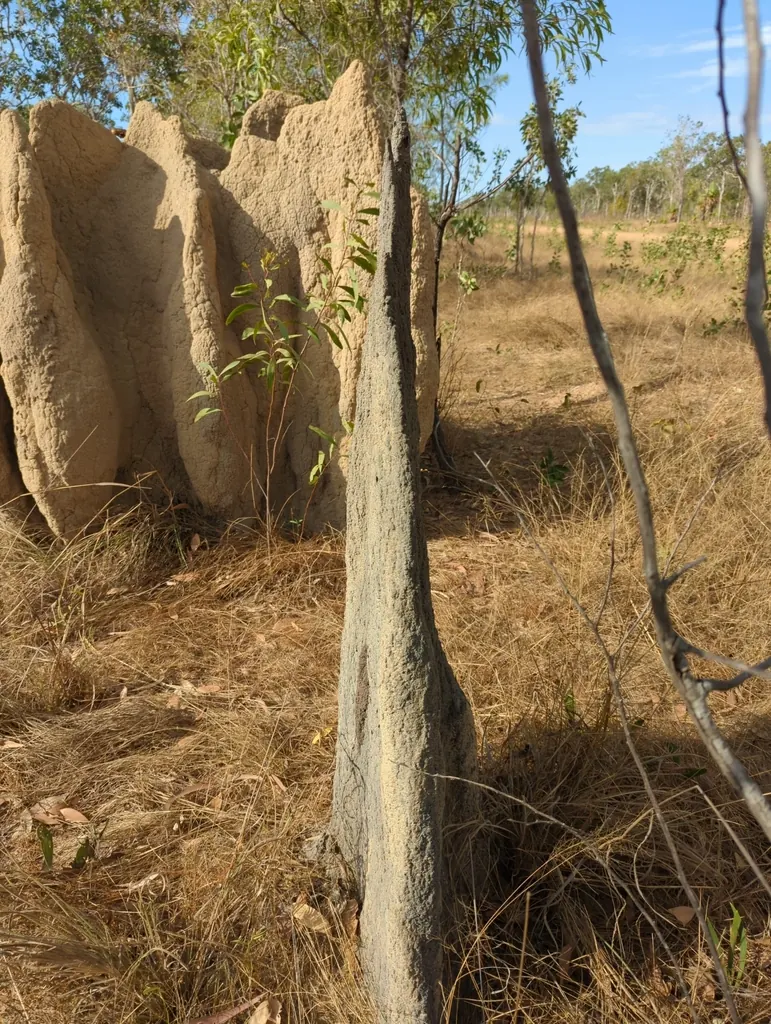
jawurraji is the 'large ant bed' and kabay the 'small ant bed', jungu-jungu the 'white ant eggs' and jiljay the 'grub found in antbed'[1]. The 'ant bed' is the termite mound, and the termites are not ants: 'termites were once classified in a separate order from cockroaches, but phylogenetic studies in the 21st century indicate that they evolved from cockroaches'; 'their colonies range in size from a few hundred individuals to enormous societies with several million'; 'they are important decomposers of decaying plant matter in the subtropical and tropical regions of the world', and 'many species are ecosystem engineers capable of altering many soil properties ... through the large mounds constructed by certain species'[2]. The slab mounds of the northern flats are built by grass-eating Amitermes, cousins of the Territory's magnetic termite, whose colony 'gather[s] the drying grass and other plant material to store as hay in chambers in the mound' through the dry[3]. The old people used the mound as an oven: Roth records 'ovens made of stones or pieces of ant-bed' wherever stones were short, and yams 'baked in a hot ant-bed covered with tea-tree bark and earth' on the Morehead River; the outer clay of the mound was eaten on the Bloomfield, 'used to "fill up" with when no other edible substance is available', and in the west the white ants themselves were eaten raw, swept off the legs as they ran up[4]. The mound is also the kookaburra's nest, the echidna's larder and the gecko's shelter[5][6][7].
Nothing is written for the Eastern coast on this page yet. What follows is true across the country.
Hann River Cape York
Possum People's country on the upper river and Thaypan (Kuku Thaypan) country downstream: stringybark and bloodwood woodland and a spring-fed sandy river that runs north-east from the Great Dividing Range, past the Peninsula Developmental Road, into Rinyirru (Lakefield) and the North Kennedy. Not Kuku Yalanji country: the Kuku Yalanji words on this page are the dictionary's, not the Hann's own languages. Place guide
Ant beds stand all through the Hann's woodland and grassy plains, and the Kuku Thaypan Elders used them: as earth ovens, as hiding places for a night fire, and as holders for marker sticks pointing the way to water[13]. On the Morehead River, whose upper reaches are Thaypan country[14], Roth recorded yams 'Baked in a hot ant-bed covered with tea-tree bark and earth'[4].
The mounds here
The Atlas of Living Australia holds 115 termite records, from 1913 to 2026, in a box of about 90 × 85 km around the middle Hann, Laura and western Rinyirru, among them 11 of the Cape York mound termite Amitermes laurensis (1982–2024)[15]. Standley writes that the grassy country of the Kuku Thaypan estate 'often contain[s] large termite mounds, both magnetic and rounded made by two different species of termite that consume large quantities of grass', and that termites are 'the dominant biomass and decomposer of savanna systems'[13].
What the termites do here
The termites hollow out the trees: the messmate stringybark 'is naturally hollowed by termites', and those hollow logs, sunk in the lagoons, became the people's fish traps and the turtles' shelter[13]. The ant beds of the tea-tree country are where the golden-shouldered parrot nests, and where its fledglings are taken by pied butcherbirds when the tea-tree thickens and gives them perches close by[13].
How the people of this country used them
Kuku Thaypan (Standley's work with the Elders)[13]:
- Ovens. 'Termite mounds were also used to make earth ovens.'
- A hidden fire. When you did not want to be found travelling, 'fires were also lit inside termite mounds at night so that others could not see your fire'.
- Markers. 'Magnetic termite nests were used to place marker sticks pointing in direction for water bodies/land marks', the termites building up over the stick to hold it in place. The markers are cultural property: leave them be.
The Morehead River (Roth, about 1900). Yams were cut in halves or quarters, washed, then 'Baked in a hot ant-bed covered with tea-tree bark and earth. Here it remains for about twenty minutes, when it becomes soft'. The mash was then squeezed through a grass dilly-bag into water and rinsed four or five times[4]. See earth oven.
The station years. Around 1908, at Old Laura homestead, 'The ground floor was made of ox blood clay from termite mounds', and the kitchen 'also had a dirt floor made from compacted termite mounds'[16].
On country today
Termite mounds 'hold spiritual significance' in Kuku Thaypan country, and some are story places[13]; those stories belong to their custodians. Standley warns that the navigation markers can be destroyed by fires that are too hot and too frequent, and that most land managers do not know they are there[13]. The upper Hann is the Possum People's country, and the middle and lower Hann are Thaypan country[17][14].
Upper Mitchell Western Yalanji
Western Yalanji country west of the Great Dividing Range: dry open woodland cut by the sandy, paperbark-lined upper Mitchell River, around Karma Waters and Mount Carbine. Place guide
On the Karma Waters flats the mounds are mostly the Cape York mound termite Amitermes laurensis, with thirty-one Atlas records within 60 km[9].
The mound-builders here
Karma Waters' species is A. laurensis, the Cape York magnetic termite, with thirty-one records within 60 km[9].
On country today
The slab mounds stand in their rows on every Karma Waters flat and the cathedral columns in the woodland; the station's posts and the homestead timbers are the giant northern termite's quarrel with the place[9][10].
Everywhere
Names
jawurraji 'large ant bed'; kabay 'small ant bed'; jungu-jungu 'white ant eggs'; jiljay 'grub found in antbed'; kawa 'little ants, white or black'; jabarrangkul 'black ant. Also their nest in rotten logs'[1]. Roth's Bloomfield name for the eaten mound clay was kappai[4]. 'Ant bed' and 'white ant' are the station English, and the dictionary follows it; the botanist's 'termite mound' is the same thing[2].
The termites and their mounds
'Termite colonies are commonly described as superorganisms due to the collective behaviors of the individuals which form a self-governing entity: the colony itself. Their colonies range in size from a few hundred individuals to enormous societies with several million individuals. Most species are rarely seen, having a cryptic life history where they remain hidden within the galleries and tunnels of their nests for most of their lives'; 'most termite colonies possess analogous "worker" and "soldier" castes'; 'most colonies begin from sexually mature individuals known as the "king" and "queen" that together form a lifelong monogamous pair'; in the tropics 'they are estimated to constitute 10% of the animal biomass in some regions'[2].
The mound-builders. The grass-eating mound termites of the north, Amitermes, build the slab and cone mounds of the flats. Of the Territory's magnetic termite: 'a large mound may house up to a million individual termites. Each is the nest of a colony ... and houses the queen, king, reproductives, soldiers and workers. The outer surface of the mound is hard and durable whereas the material separating the chambers and galleries inside is more papery'; 'the interior of the mound is kept at a relatively stable temperature and a high humidity. In the summer, when the land floods, the termites remain safely inside feeding on their stored food supplies. In the dry season, when the water drains away, the surrounding grass senesces and the termites gather the drying grass and other plant material to store as hay in chambers in the mound'[3]. The cathedral termites, Nasutitermes, three records, build the tall columns: 'constructed from mud, plant parts, and termite saliva and feces, the columns of the mound are extraordinarily tough'; 'construction of the hollow columns allows for internal circulation of air from the cooler soil at the base of the mound to the warmer top'; when the nest is breached 'nasute soldiers pour out', with 'an elongated, tubular snout' that squirts a sticky repellent, so that 'if a human were to stick their finger in the mound, it would be covered in the defensive fluid'[8][9].
The giant northern termite (Mastotermes darwiniensis), five records, 'the most primitive extant termite species'; 'contrary to common belief, this species does not form mounds as the nests are subterranean and inconspicuous'; it 'will eat introduced plants, damaged ivory and leather, and wood and debris, and in fact almost anything organic'; 'it becomes a major agricultural pest'; 'it has developed the ability to bore up into a living tree and ring bark it such that it dies and becomes the center of a colony'[10][9]. It and Coptotermes are the ones that eat the fence posts and the house.
Roth, 1901. Water-lily seeds are baked 'in "ovens" made of stones or pieces of ant-bed, covered with strips of tea-tree bark, over which ashes and sand are placed'; a rootstock is 'roasted on the ashes lying over heated ant-bed "chunks" or stones'; and of the cooking generally, 'ground-ovens with heated stones, or with chunks of ant-bed when the latter are not available'[4]. 'Clay from the ant-hills — the outside covering — is on the Bloomfield used to "fill up" with when no other edible substance is available. The women and piccaninnies seem always able to eat of this, even after a meal of things more nourishing: it requires no preparation, and is known as kappai'[4]. 'White ants, as well as green, are eaten in the Cloncurry and Boulia districts raw. The individual stands or stamps upon an ant-bed from which these creatures will run up his legs and thighs and get scraped or swept off as they come up and as quickly transferred to the mouth'[4]. And a Pennefather kangaroo hunter would 'paint himself completely over with yellow ochre ... and make himself resemble an ant-bed under the guise of which he can gradually approach to within a very short distance'[4].
Telling the mounds
- Slab mounds on the black-soil flats, aligned, in 'graveyard' groups: Amitermes, the grass-eaters[3].
- Tall rough columns to several metres: the cathedral termites[8].
- Round hard mounds at the base of trees and on the woodland floor: the wood-eating mound termites, Microcerotermes among them[9].
- A mound on a tree trunk with a hole in it: a kookaburra's nest in an arboreal termite nest[5].
- No mound, but mud tunnels up a living tree and a hollow ringbarked trunk: the giant northern termite[10].
- A meat-ant nest: a flat gravel disc with ants running on it, not a mound; see green ants.
Signs
- Mud tubes up a trunk or a fence post: termites working under cover[8].
- A mound dug open from one side with a long snout-hole: echidna; torn open with claws: goanna[6].
- Winged termites swarming at a light after the first storms: the flying reproductives.
- A kookaburra flying into a mound on a trunk[5].
- A python coiled at a mound on a warm night, waiting for the geckos[7].
Where they are
The mound termites on the grassy flats and the open woodland floor; the arboreal nests on the trunks; the giant northern termite underground in the woodland and round the homestead; all of them everywhere there is dead grass and wood[3][10][11].
The mound as a house
The termites are the woodland's recyclers, turning the dead grass and wood into soil and into a tenth of the animal weight of the country, and the mound is the woodland's apartment block[2]. The laughing kookaburra makes 'a hollow for a nest in an arboreal termite nest'; Bynoe's gecko shelters 'under all types of ground cover including ... termite mounds'; the echidna and the goanna dig the mounds for the termites and the eggs; the pythons hunt the geckos and rats that live in them; and the dictionary's jiljay grub lives in the ant bed[5][7][6][1]. The flying termites after the first storms feed every bird, frog and gecko on the river for a night.
Seasons
The mound termites cut and store hay through the dry and shelter from the flood in the wet; the reproductives fly with the first storms; the mounds are dug most in the late dry when other food is short[3]. See the year on country.
Uses
- Oven stones: chunks of mound heated in the fire where stone is short, for the earth oven[4].
- Hunger food: the outer clay of the mound, kappai, on the Bloomfield; and the white ants themselves, in the west[4].
- The grub of the ant bed, jiljay; see witchetty grub[1].
- A hunting disguise: the hunter painted as an ant bed[4].
- A sign of the ground: the slab mounds mark the black soil that floods, which is where the wild rice and the lilies are; see wild rice[3].
Using an ant bed
- Oven chunks: break lumps the size of a fist from a dead or abandoned mound, heat them in the fire as you would stones, and build the earth oven on them 'covered with tea-tree bark and earth'[4].
- Leave the live mounds on the flats; each is a colony of a million and a kookaburra's or gecko's house[3][5].
- Do not put a finger in a cathedral mound; the soldiers' glue is the answer[8].
- Watch the trees round the camp for mud tubes and a hollow ring; the giant northern termite kills living trees and the posts the camp stands on[10].
- The hunger food is recorded, not recommended; the old people ate the mound clay when there was nothing else[4].
Safety
- A mound is a snake's and a centipede's hiding place as well as a gecko's; see snakes and bites and stings[12].
- A tree ringbarked by termites drops without warning; see river red gum[10].
- Eating mound clay was a hunger food; it is not a food.
On Country today
The dictionary has the ant bed and its grub; the Western Yalanji words are for the contribution box below[1].
Language
jawurraji 'large ant bed'; kabay 'small ant bed'; jungu-jungu 'white ant eggs'; jiljay 'grub found in antbed'; kawa 'little ants'; jabarrangkul 'black ant, and its nest in rotten logs'; kurrma 'earth oven'; jangka 'stone'[1].
References
- Hershberger, H. D. & Hershberger, R. (1982). Kuku-Yalanji Dictionary. Work Papers of SIL-AAB, Series B, Volume 7. With Toby Bloomfield, Roy Friday, Billy Roberts, Hector and Doris Sykes, Joe Walker and others. www.sil.org/resources/archives/18038
- Wikipedia. Termite. en.wikipedia.org/wiki/Termite
- Wikipedia. Magnetic termite (Amitermes meridionalis). en.wikipedia.org/wiki/Amitermes_meridionalis
- Roth, W. E. (1901). North Queensland Ethnography, Bulletin No. 3: Food — its search, capture, and preparation. Brisbane: Government Printer. Bloomfield River information from the Hislops. — Sect. 6 'Cooking'; plant list ('Castanospermum australe', 'Dioscorea sativa', 'Elettaria Scottiana', 'Nymphaea') archive.org/details/northqueensland00landgoog
- Wikipedia. Laughing kookaburra (Dacelo novaeguineae). en.wikipedia.org/wiki/Laughing_kookaburra
- Wikipedia. Short-beaked echidna. en.wikipedia.org/wiki/Short-beaked_echidna
- Wikipedia. Bynoe's gecko (Heteronotia binoei). en.wikipedia.org/wiki/Bynoe%27s_gecko
- Wikipedia. Cathedral termite (Nasutitermes triodiae). en.wikipedia.org/wiki/Nasutitermes_triodiae
- Atlas of Living Australia. Occurrence records within 60 km of the Karma Waters homestead (16.62° S, 144.60° E), species counts for Animalia (accessed 10 October 2026). biocache.ala.org.au/occurrences/search?q=*:*&lat=-16.62&lon=144.60&radius=60
- Wikipedia. Giant northern termite (Mastotermes darwiniensis). en.wikipedia.org/wiki/Mastotermes_darwiniensis
- Queensland Herbarium, Regional Ecosystem 9.11.26 (Einasleigh Uplands): Eucalyptus leptophleba and/or E. cullenii and/or Corymbia clarksoniana +/- E. platyphylla woodland on undulating terrain to rolling hills. Fire management guidelines. Queensland Government Regional Ecosystem Description Database. apps.des.qld.gov.au/regional-ecosystems/details/?re=9.11.26
- healthdirect Australia (Australian Government). Snake bites: symptoms, first aid and the pressure immobilisation bandage (accessed 10 October 2026). www.healthdirect.gov.au/snake-bites
- Standley, P.-M. (2019). The importance of campfires to effective conservation. PhD thesis, James Cook University. Records the fire and country knowledge of Kuku Thaypan Elders Dr Tommy George and Dr George Musgrave. researchonline.jcu.edu.au/64274/
- Ross on behalf of the Cape York United #1 Claim Group v State of Queensland (No 20) (Thaypan determination) [2023] FCA 1315 (Federal Court of Australia, 2 November 2023). — Determination area and waters; prescribed body corporate (Awu-Laya Indigenous Corporation); affidavit evidence on hunting www.judgments.fedcourt.gov.au/judgments/Judgments/fca/single/2023/2023fca1315
- Atlas of Living Australia. Occurrence records of termites (115 records, 1913–2026, among them the Cape York mound termite Amitermes laurensis, 11 records, 1982–2024) in a box of about 90 × 85 km around the middle Hann River, Laura and western Rinyirru (lat −15.6 to −14.8, long 143.5 to 144.3), queried 28 October 2026. biocache.ala.org.au/occurrences/search?q=*%3A*&fq=decimalLatitude%3A%5B-15.6%20TO%20-14.8%5D&fq=decimalLongitude%3A%5B143.5%20TO%20144.3%5D
- Queensland Parks and Wildlife Service. Nature, culture and history: Rinyirru (Lakefield) National Park (CYPAL) (web page, last updated 1 July 2024; accessed 28 October 2026). parks.qld.gov.au/parks/rinyirru-lakefield/about/culture
- Ross on behalf of the Cape York United #1 Claim Group v State of Queensland (No 21) (Possum determination) [2023] FCA 1316 (Federal Court of Australia, 2 November 2023). — Determination area (upper Hann and Kennedy rivers); prescribed body corporate; affidavit evidence on hunting and fishing www.judgments.fedcourt.gov.au/judgments/Judgments/fca/single/2023/2023fca1316
From the community
Know this one? Add the words you use for it, what it is for, how it is done, a correction, or a photo from country. It shows here straight away with your name on it. Please keep anything restricted or sacred off the site.
Loading…