Birds
Eagles, kites and hawks
yalngkurr · wandi · kalin-kalin · jinabiju
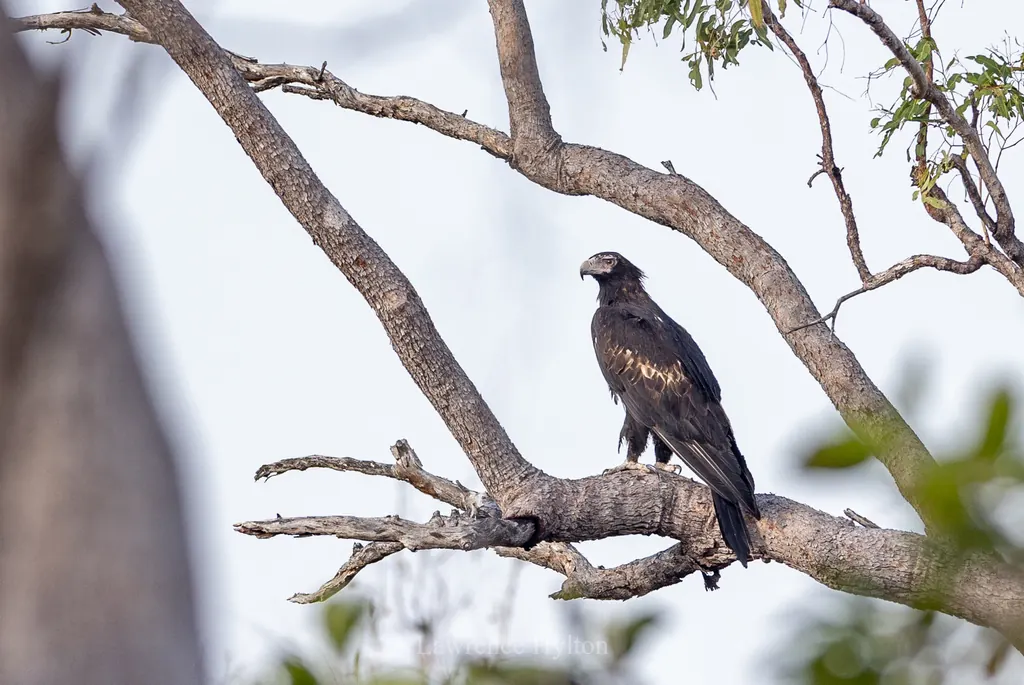
yalngkurr is the eagle hawk, the wedge-tailed eagle, and the dictionary says of it: 'Totem of all the Kuku-Yalanji people. It represents the country to which they belong'; the same word is glossed 'grey sea eagle'[1]. wandi is the 'fish hawk, brown hawk, red-backed sea eagle', the brahminy kite of the coast, 'one of the sacred birds'; kalin-kalin the kestrel; jinabiju the 'chicken hawk, goshawk'; muku a 'small hawk'[1]. The whistling kite, the black kite and the brown falcon are the three 'firehawks', birds that 'intentionally set or spread fires to catch prey', carrying burning sticks from a grass fire to unburnt grass, which the hunting with fire page takes up[2][3]. The wedge-tailed eagle is 'one of the world's most powerful avian predators', above all a mammal hunter that takes the young wallabies; the sea eagle takes the fish and the ducks of the pools; the kestrel hovers over the grass for mice and grasshoppers[4][5][6].
Nothing is written for the Eastern coast on this page yet. What follows is true across the country.
Hann River Cape York
Possum People's country on the upper river and Thaypan (Kuku Thaypan) country downstream: stringybark and bloodwood woodland and a spring-fed sandy river that runs north-east from the Great Dividing Range, past the Peninsula Developmental Road, into Rinyirru (Lakefield) and the North Kennedy. Not Kuku Yalanji country: the Kuku Yalanji words on this page are the dictionary's, not the Hann's own languages. Place guide
Every big bird of prey on this page lives over the Hann country. In a box of about 90 × 85 km around the middle Hann, Laura and western Rinyirru the Atlas of Living Australia holds 1,226 whistling kite records, 790 black kite, 390 wedge-tailed eagle, 317 white-bellied sea eagle, 235 brown falcon, 184 brown goshawk, 156 nankeen kestrel, 142 black-breasted buzzard and 124 brahminy kite records, from 1958 to 2026[17]. The Kuku Thaypan Elders know the brown falcon as the fire bird[18].
Names here
The Kuku Thaypan (Awu Alaya) names recorded with the Elders are Mey Arromi, the wedge-tailed eagle; Arrsteeyung, the whistling kite; Nhye arrayl, the brown falcon or 'fire bird'; and Arrumcom, the black kite[18]. These are Kuku Thaypan words, the language of the Hann country, not Kuku Yalanji ones.
Which ones are here
- The brahminy kite. The dictionary's wandi, the brahminy kite, is in the Hann records, 124 times in the Atlas box[17][1].
- The red goshawk. 77 Atlas records in the box, 1991–2025[17]. It is endangered, and Rinyirru names it among the park's threatened species[19][20]. Leave a goshawk's nest tree alone.
- The rest are the birds described above: the kites over the fires and the river, the eagle over the woodland, the sea eagle on the big holes, the kestrel and the falcon on the plains[17].
Fire birds here
The fire bird. Kuku Thaypan old people talked about the brown falcon as the fire bird: 'He picks up a burning stick from the fire, fly's away and drops it to make his own fire for hunting'[18]. Bruce Rigsby's notes of 2005 gave this to the whistling kite, and also mention 'sparrow hawks' or falcons; the Elders' fire research 'confirmed in the field that this behavior is characteristic of brown falcons'[18]. Kites do it too, as the general sections say[2].
Over the burns. On the open grassy plains, 'during a fire event, birds of prey flock to these areas to feast on the insects flying from the grass to escape the fire'[18].
On country today
The upper Hann is the Possum People's country and the middle and lower Hann are Thaypan country[21][22]. In Rinyirru the joint managers keep a list of known traditional totem species, and 'any activity involving these species is considered a significant activity and needs approval from the land trust'[20]. Which birds are totems, and their stories, belong to the Traditional Owners. No published record from this country describes taking birds of prey.
Upper Mitchell Western Yalanji
Western Yalanji country west of the Great Dividing Range: dry open woodland cut by the sandy, paperbark-lined upper Mitchell River, around Karma Waters and Mount Carbine. Place guide
Over Karma Waters the hawks are the commonest big birds in the sky: the black kite with fifty-two records within 30 km, the whistling kite forty-three, the kestrel thirty-nine, the brown falcon twenty, the wedge-tailed eagle sixteen, the white-bellied sea eagle nine, the brown goshawk nine, and the black-breasted buzzard three[23].
Names here
The brahminy kite, wandi, is a coastal bird and not in the Karma Waters records; its inland cousin the whistling kite is[1][23].
Which ones are here
The osprey, three records, is the river's other fish hawk[23]. The collared sparrowhawk has four records[23].
On country today
The kites and the kestrel are over Karma Waters every day of the dry, the eagle most days, and the firehawks are over every burn[23][2].
Everywhere
Names
yalngkurr 'eagle hawk. Totem of all the Kuku-Yalanji people. It represents the country to which they belong', and in another entry 'grey sea eagle'[1]. wandi 'fish hawk, brown hawk, red-backed sea eagle. One of the sacred birds', the brahminy kite[1]. kalin-kalin 'kestrel hawk'. jinabiju 'chicken hawk (goshawk)'. muku 'small hawk' (the same word is 'back'). The dictionary's notes on which birds are totems and sacred are given as they stand and not added to[1]. The brown falcon's species name 'berigora has Aboriginal origins'[3].
The birds of prey
Wedge-tailed eagle (Aquila audax, yalngkurr). 'The largest bird of prey in the continent of Australia'; 'some of their native continent's most generalised birds of prey. They reside in most habitats present in Australia'; 'one of the world's most powerful avian predators. Although a true generalist, which hunts a wide range of prey, including birds, reptiles, and' mammals, it is above all a mammal hunter[4]. 'Wedge-tailed eagles usually construct a large stick nest in an ample tree, normally the largest in a stand, and lay one to four eggs, though typically only two'; 'although historically heavily persecuted by humans through poisoning and shooting, mostly for alleged predation on sheep, wedge-tailed eagles have proved to be exceptionally resilient'[4].
White-bellied sea eagle (Icthyophaga leucogaster). 'A large diurnal bird of prey'; 'resident from India and Sri Lanka through Southeast Asia to Australia on coasts and major waterways, the white-bellied sea eagle breeds and hunts near water, and fish form around half of its diet'. 'A white head, rump and underparts, and dark or slate-grey back and wings. In flight, the black flight feathers on the wings are easily seen when the bird is viewed from below'; in a glide the wings 'rise from the body at an angle'[5].
Whistling kite (Haliastur sphenurus). 'A medium-sized diurnal raptor found throughout Australia'; 'one of three birds that intentionally sets or spreads fires to catch prey. The other two are the black kite and brown falcon'. '50 to 60 cm, with a wingspan between 123 and 146 cm'; 'adult birds are a pale buff on the head, breast and tail, with browner wings and black flight feathers'; 'a noisy species, calling regularly in flight and while perched ... a clear descending whistle, often followed by a rapid series of rising notes'[2].
Black kite (Milvus migrans). 'The black kite or fire kite', 'thought to be the world's most abundant species' of its family; dark, with a shallowly forked tail that it twists as a rudder, in loose flocks over the fires, the river and the rubbish[7].
Nankeen kestrel (Falco cenchroides, kalin-kalin). 'One of the smallest falcons, and unlike many, does not rely on speed to catch its prey. Instead, it simply perches in an exposed position, but it also has a distinctive technique of hovering over crop and grasslands'; 'a small, slim falcon 28 to 35 cm long with a wingspan of 66 to 78 cm', 'pale rufous upper-parts with contrasting black flight-feathers'; 'mosquito hawk, kestrel, windhover, hoverer' are its other names[6].
Brown falcon (F. berigora). 'Adults are usually 40 to 50 cm long. They are found in light and dark forms'; 'the falcons make a loud cackle call uttered frequently'; 'the brown falcon eats small mammals, including house mice ... small birds, lizards, snakes, and a variety of invertebrates, particularly caterpillars, grasshoppers, crickets, and beetles'; it nests 'usually in an old nest of a larger passerine or another hawk species'; and 'brown falcons and other Australian firehawks have been said to pick up sticks with flames and dropping them to spread fires and prey on escaping animals'[3].
Brown goshawk (Tachyspiza fasciata, jinabiju), with the smaller collared sparrowhawk. 'Its upperparts are grey with a chestnut collar; its underparts are mainly rufous, finely barred with white'; 'body length is 40–55 cm'; 'brown goshawks feed mainly on other medium-sized birds, while small mammals such as rats and rabbits are also taken. Brown goshawks often hunt near farmland or wetlands, where birds such as ducks, cockatoos and pigeons' gather; 'the main methods of catching prey are still-hunting, by which the goshawk waits on a hidden perch until prey comes within striking distance, and flying through undergrowth attempting to flush out small prey'[8].
Black-breasted buzzard (Hamirostra melanosternon). 'One of Australia's largest birds of prey and one of the world's largest kites'; 'from the underside, the mainly black colouring of the body and wings is contrasted by thick white panels near the end of the wings'; 'widely but sparsely distributed throughout northern and inland Australia'; famous for the way 'it uses a stone to crack an emu egg'[9].
Telling them in the air
- Wedge-tailed eagle: huge, dark, a long wedge tail, wings held in a shallow V, soaring high[4].
- Sea eagle: white below with black flight feathers, a short wedge tail, over the river[5].
- Whistling kite: pale buff head and body, long rounded tail, a drooping flight and the whistle[2].
- Black kite: dark, a forked tail that twists, in flocks[7].
- Kestrel: small, rufous, hovering[6].
- Brown falcon: a lazy flight, long legs, perched on fence posts, cackling[3].
- Goshawk and sparrowhawk: rounded wings, long barred tail, a dash through the trees after a pigeon[8].
- Buzzard: black with white 'windows' in the wings, a short tail, over open country[9].
- Crows fly straight and flap; the kites sail[10].
Signs
- Kites over a grass fire, and a kite carrying a burning stick[2].
- A kestrel hanging in the wind over the grass: mice there[6].
- A stick nest the size of a car bonnet in the biggest tree: the eagle[4].
- A sea eagle's plucking post on the bank, with fish bones and duck feathers[5].
- Every small bird silent and still: a goshawk through the trees[8].
- A broken emu or bustard egg with a stone beside it: the buzzard[9].
Where they are
The eagle over the woodland and the ridges, nesting in the tallest tree; the sea eagle and the osprey along the river; the kites over everything, the fires, the river and the camp; the kestrel and the brown falcon on the open flats and the fence lines; the goshawk in the trees by the water where the birds drink[4][5][6][8].
The top of the chain
The birds of prey are the end of the woodland's food chain and the beginning of its fires. The eagle takes the wallaby joeys, the goannas, the bustard chicks and the carrion; the sea eagle the fish, the ducks and the turtles; the kites whatever the fire flushes and whatever dies; the kestrel the mice and grasshoppers; the goshawk the pigeons and parrots; the buzzard the eggs[4][5][2][6][8][9]. The firehawks make the fire work for them, which the hunting with fire page says people watched and did too[2]. The cane toad kills the kites and the eagle that eat it dead on the road[11].
Seasons
The brown falcon breeds from June to November, the eagle and the kites through the dry on their stick nests; the kites gather over the early-dry burns and the late-dry fires, and over the shrinking pools where the fish die[3][2][12]. See the year on country.
Uses
- Fire-finding and fire-reading: where the kites circle, the fire is, and where it is going[2].
- Game-finding: the kestrel over the mice, the kites over the drive[6].
- Feathers: Roth's Tully girl 'decorated with eagle-hawk or cockatoo feathers in her hair'[13].
- A mark of country: the eagle hawk 'represents the country to which they belong'[1].
Reading the hawks
- Kites circling low and fast mean a fire front; kites drifting high mean carrion or a dead pool[2].
- Where the kestrel hovers, the grass has mice and grasshoppers, and so, later, the snakes[6].
- When the small birds go quiet, a goshawk is through; a minute later they start again[8].
- The eagle's nest tree is the biggest in the stand; leave it, and do not burn under it in the nesting season[4].
- A sea eagle working the pool is working the same fish you are[5].
Safety
- Native birds are protected wildlife in Queensland under the Nature Conservation Act 1992; native title holders hunting for personal, domestic or non-commercial communal needs are covered by section 211 of the Native Title Act 1993, recognised in the Western Yalanji determinations[14][15][16]. The eagle's long persecution 'for alleged predation on sheep' is a station history too[4].
- A kite that drops a burning stick in unburnt grass has started a fire; firehawks are one reason a cool burn runs away[2][12].
- Road-killed toads poison the kites that eat them; see frogs[11].
On Country today
The dictionary's word for the eagle hawk carries more than a name, and this page leaves it in the dictionary's words[1].
Language
yalngkurr 'eagle hawk; grey sea eagle'; wandi 'fish hawk, red-backed sea eagle'; kalin-kalin 'kestrel hawk'; jinabiju 'chicken hawk, goshawk'; muku 'small hawk'; ngalku 'bush fire'; duli 'burnt patch of grass'[1].
References
- Hershberger, H. D. & Hershberger, R. (1982). Kuku-Yalanji Dictionary. Work Papers of SIL-AAB, Series B, Volume 7. With Toby Bloomfield, Roy Friday, Billy Roberts, Hector and Doris Sykes, Joe Walker and others. www.sil.org/resources/archives/18038
- Wikipedia. Whistling kite (Haliastur sphenurus). en.wikipedia.org/wiki/Whistling_kite
- Wikipedia. Brown falcon (Falco berigora). en.wikipedia.org/wiki/Brown_falcon
- Wikipedia. Wedge-tailed eagle. en.wikipedia.org/wiki/Wedge-tailed_eagle
- Wikipedia. White-bellied sea eagle (Icthyophaga leucogaster). en.wikipedia.org/wiki/White-bellied_sea_eagle
- Wikipedia. Nankeen kestrel (Falco cenchroides). en.wikipedia.org/wiki/Nankeen_kestrel
- Wikipedia. Black kite (Milvus migrans). en.wikipedia.org/wiki/Black_kite
- Wikipedia. Brown goshawk (Tachyspiza fasciata). en.wikipedia.org/wiki/Brown_goshawk
- Wikipedia. Black-breasted buzzard (Hamirostra melanosternon). en.wikipedia.org/wiki/Black-breasted_buzzard
- Wikipedia. Torresian crow (Corvus orru). en.wikipedia.org/wiki/Torresian_crow
- Wikipedia. Cane toads in Australia: effects on native predators (goannas, snakes, freshwater crocodiles) and on dogs. en.wikipedia.org/wiki/Cane_toads_in_Australia
- Queensland Parks and Wildlife Service (2013). Planned Burn Guidelines: Cape York Peninsula Bioregion of Queensland. Department of National Parks, Recreation, Sport and Racing. — 'Fire in the monsoonal tropics of the Cape York Peninsula bioregion'; ch. 1–2 season guidance (storm burns) parks.desi.qld.gov.au/__data/assets/pdf_file/0019/151480/pbg-cape-york.pdf
- Roth, W. E. (1903). North Queensland Ethnography, Bulletin No. 5: Superstition, magic, and medicine. Brisbane: Government Printer. — Medicine, 'Erythrophloeum laboucherii' (Pennefather River) archive.org/details/northqueensland00landgoog
- Queensland Government, State of the Environment. Nature Conservation Act 1992. www.stateoftheenvironment.des.qld.gov.au/biodiversity/management-responses/legislation/nature-conservation-act-1992
- Australian Law Reform Commission. Review of the Native Title Act 1993 (DP 82), ch. 8: Relevant provisions in the Native Title Act (s 211). www.alrc.gov.au/publication/review-of-the-native-title-act-1993-dp-82/8-the-nature-and-content-of-native-title/relevant-provisions-in-the-native-title-act/
- Western Yalanji Aboriginal Corporation & CRC for Developing Northern Australia (2020). Western Yalanji Land Use and Economic Diversification Plan. CC BY 4.0. — Native Title Determinations 1–4 (pp. 13–18); ‘Fire Management and Carbon Farming’ (pp. 32–33); ‘Pastoralists’ crcna.com.au/wp-content/uploads/2024/05/westernyalanjilanduseplan_nov2020.pdf
- Atlas of Living Australia. Occurrence records of Accipitridae and Falconidae, among them Haliastur sphenurus (1,226 records), Milvus migrans (790), Aquila audax (390), Haliaeetus leucogaster (317), Falco berigora (235), Accipiter fasciatus (184), Falco cenchroides (156), Hamirostra melanosternon (142), Haliastur indus (124) and Erythrotriorchis radiatus (77), 1958–2026 in a box of about 90 × 85 km around the middle Hann River, Laura and western Rinyirru (lat −15.6 to −14.8, long 143.5 to 144.3), queried 28 October 2026. biocache.ala.org.au/occurrences/search?q=family%3AAccipitridae&fq=decimalLatitude%3A%5B-15.6%20TO%20-14.8%5D&fq=decimalLongitude%3A%5B143.5%20TO%20144.3%5D
- Standley, P.-M. (2019). The importance of campfires to effective conservation. PhD thesis, James Cook University. Records the fire and country knowledge of Kuku Thaypan Elders Dr Tommy George and Dr George Musgrave. researchonline.jcu.edu.au/64274/
- Queensland Parks and Wildlife Service. Nature, culture and history: Rinyirru (Lakefield) National Park (CYPAL) (web page, last updated 1 July 2024; accessed 28 October 2026). parks.qld.gov.au/parks/rinyirru-lakefield/about/culture
- Queensland Parks and Wildlife Service (2013). Rinyirru (Lakefield) Aggregation Management Statement 2013. parks.desi.qld.gov.au/__data/assets/pdf_file/0027/165771/rinyirru.pdf
- Ross on behalf of the Cape York United #1 Claim Group v State of Queensland (No 21) (Possum determination) [2023] FCA 1316 (Federal Court of Australia, 2 November 2023). — Determination area (upper Hann and Kennedy rivers); prescribed body corporate; affidavit evidence on hunting and fishing www.judgments.fedcourt.gov.au/judgments/Judgments/fca/single/2023/2023fca1316
- Ross on behalf of the Cape York United #1 Claim Group v State of Queensland (No 20) (Thaypan determination) [2023] FCA 1315 (Federal Court of Australia, 2 November 2023). — Determination area and waters; prescribed body corporate (Awu-Laya Indigenous Corporation); affidavit evidence on hunting www.judgments.fedcourt.gov.au/judgments/Judgments/fca/single/2023/2023fca1315
- Atlas of Living Australia. Bird (Aves) occurrence records within 30 km of the Karma Waters homestead (16.62° S, 144.60° E), species counts (accessed 10 October 2026). biocache.ala.org.au/occurrences/search?q=*:*&lat=-16.62&lon=144.60&radius=30&fq=class:Aves
From the community
Know this one? Add the words you use for it, what it is for, how it is done, a correction, or a photo from country. It shows here straight away with your name on it. Please keep anything restricted or sacred off the site.
Loading…