Mammals
Flying foxes and bats
kambi · mali · jibulPteropus scapulatus (little red flying fox); Pteropus alecto; Pteropus conspicillatus; and the cave and hollow bats
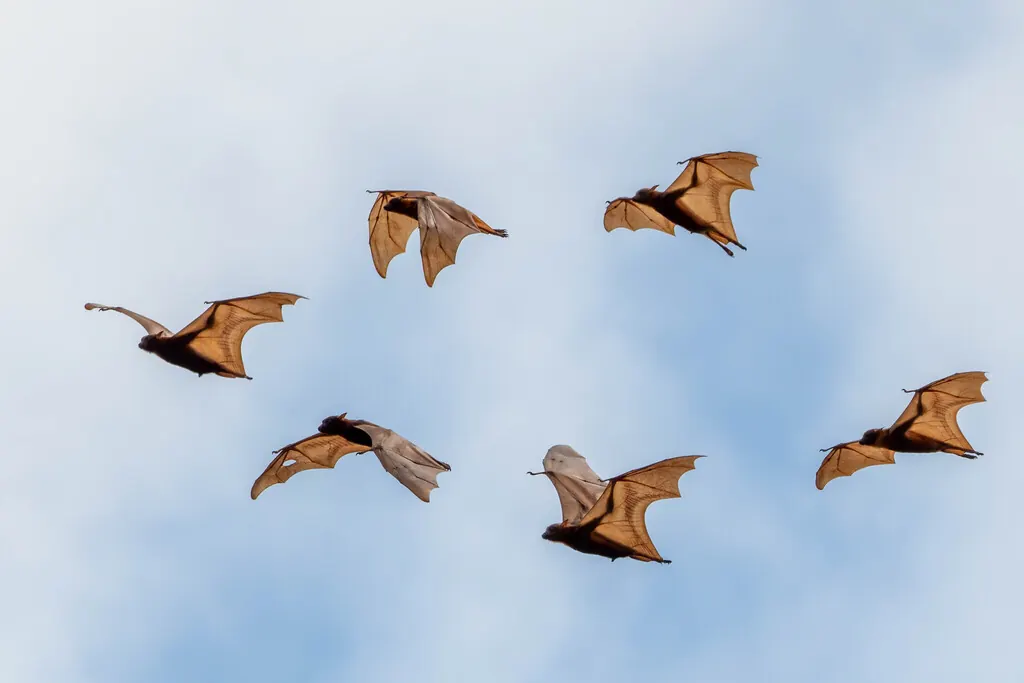
kambi is the flying fox, mali 'species of small bat' and jibul 'species of large bat'[1]. Inland, the flying fox is the little red flying fox, the smallest and most inland of the mainland flying foxes, which 'camps and flies to the tropical to temperate regions that provide them with an annual source of nectar', lives on the blossom of the gums and bloodwoods and the paperbarks, and drinks on the wing by 'skimming a stream's surface to gather it onto their fur'[2]. The small bats are the woodland's night insect-eaters, roosting in caves, rock crevices and hollows and hunting the air over the pools; the flying foxes are its night pollinators, and 'their colonies are recognised as important contributors to woodland ecology'[3][2]. Roth's Tully people knocked flying foxes 'over when on the wing, with a long stick held by the hunter hidden up in a tree'[4]. Today the first rule of bats is a health rule: 'any bat in Australia could potentially carry' the bat lyssavirus, and no bat, alive or dead, is handled barehanded[5].
Nothing is written for the Eastern coast on this page yet. What follows is true across the country.
Hann River Cape York
Possum People's country on the upper river and Thaypan (Kuku Thaypan) country downstream: stringybark and bloodwood woodland and a spring-fed sandy river that runs north-east from the Great Dividing Range, past the Peninsula Developmental Road, into Rinyirru (Lakefield) and the North Kennedy. Not Kuku Yalanji country: the Kuku Yalanji words on this page are the dictionary's, not the Hann's own languages. Place guide
Flying foxes and small bats live in the Hann's country, and the people of this country eat flying fox: a Kuku Warra man of Laura told the Federal Court of 'hunting, cooking and eating different types of turtle, as well as flying fox' (the Court's summary of his evidence)[16]. The Atlas of Living Australia holds more little red flying fox records than any other bat here[17].
Which bats live here
The Atlas of Living Australia holds 33 bat records, from 1948 to 2025, in a box of about 90 × 85 km around the middle Hann, Laura and western Rinyirru[17]:
- Little red flying fox, 11 records (1948–2025);
- Black flying fox, 3 records (2011);
- Ghost bat, 6 records (1979–2020);
- the common sheath-tailed bat (4), the hoary wattled bat (3), the yellow-bellied sheath-tailed bat (2) and four other small bats with one record each.
No spectacled flying fox is recorded in the box. Few people survey bats here, so the list is short, not complete. In the Kuku Thaypan Elders' account of the sandridge country, the 'Species of significance include gliders, quolls, rodents, wallaroos and rock wallabies, micro-bats and flying foxes'[18].
How the people of this country used them
Kuku Warra (Laura). Joseph Lee Cheu's evidence covered 'hunting, cooking and eating different types of turtle, as well as flying fox'[16]. The published judgment does not give his methods.
No published record describes how flying foxes were hunted on the Hann itself; the general sections above have Roth's Tully method, from far to the south.
On country today
The upper Hann is the Possum People's country, and the middle and lower Hann are in the Thaypan native title determination of November 2023[19][20]. Kuku Warra people hold customary rights with the Thaypan over the land between the North Kennedy and the Hann[16]. The health rule above applies to everyone: never handle a bat barehanded.
Upper Mitchell Western Yalanji
Western Yalanji country west of the Great Dividing Range: dry open woodland cut by the sandy, paperbark-lined upper Mitchell River, around Karma Waters and Mount Carbine. Place guide
Within 60 km of Karma Waters the Atlas has twenty-eight records of the little red flying fox, eight of the spectacled flying fox of the rainforest and four of the big black flying fox of the coast, and the small bats outnumber them all: the little bent-wing bat with thirty-six, the horseshoe bat with thirty-four, the eastern cave bat with twenty-two, the Australasian bent-wing with twenty-one, and thirteen of the ghost bat, 'the only Australian bat that preys on large vertebrates'[11][10].
The other bats here
Besides the bats above, the hoary wattled bat, the diadem and dusky leaf-nosed bats, two long-eared bats and the sheath-tailed bats make up the rest of the list[11]. Within 30 km of the homestead the eastern cave bat is the most-recorded bat, and the little red flying fox has one record[21].
On country today
The little reds come through Karma Waters with the blossom in their tens of thousands and are gone a month later; the cave bats are in every gorge and old working of the Hodgkinson goldfield country round the station[2][11][22]. Whether the flying fox was a Western Yalanji food, and what the two bat words name, is for the contribution box below[1]. Native title holders hunting for personal, domestic or non-commercial communal needs are covered by section 211, recognised in the Western Yalanji determinations[23].
Everywhere
Names
kambi 'flying fox' (the same word is also glossed 'clothing'). mali 'species of small bat'. jibul 'species of large bat'[1]. The dictionary names no more bats than that, and the Atlas has a dozen kinds here, so the two small-bat words cover a lot; which bat is mali and which jibul is for the contribution box below.
The flying foxes and bats
Little red flying fox (Pteropus scapulatus, kambi). 'A megachiropteran bat native to northern and eastern Australia. The species weighs about half a kilogram ... and is the smallest species of Pteropus in mainland Australia'; 'frugivorous bats with simple dog-like heads, often found roosting closely together in large numbers. The characteristic absence of a tail distinguishes these "flying-foxes" from other bats in Australia'; 'a measured weight range of 300 to 600 grams'; 'the bare legs, reddish fur colour, and the paler near-transparent wings distinguish it' from the grey-headed and the black[2]. 'The largest range of all the species, extending further inland than the others of the family', it 'will also decamp and roam widely to increase their food availability. The primary source of food for this species is obtained from Eucalyptus and Corymbia blossoms. Their diet consists of nectar and pollen of these eucalypts and is responsible for the much of their pollination, the irregular flowering periods induce the camps to forage in new areas. The nectar of Melaleuca species is also favoured'. 'Camps may become large groups of tens of thousands, with records of some colonies of over one hundred thousand individuals. This species gives birth 6 months later than the other mainland flying fox species, in April and May, this may be to avoid exposing a newborn to the high temperatures of the northern austral summer'[2].
Black flying fox (P. alecto). 'Short, black hair with a contrasting reddish-brown mantle, and a mean forearm length of 164 mm and a mean weight of 710 g. It is one of the largest bat species in the world, and has a wingspan of more than 1 metre.' 'During the day, individuals reside in large roosts (colonies or "camps") consisting of hundreds to tens of thousands of individuals. They sometimes share their roosts with ... the little red flying fox. They roost in mangroves, paperbark swamps, patches of rainforest'. 'A single young is born, and carried by its mother for the first month of life'; they 'eat pollen and nectar from native eucalyptus, lilypillies, paperbark, and turpentine trees' and have 'been known to travel up to 50 km a night in search of food'; 'these animals begin to die once temperatures reach above 40°C'[6].
Spectacled flying fox (P. conspicillatus), the rainforest's bat. 'A large spectacled flying fox has pale yellow or straw-colored fur around its eyes'; 'forest dwellers and rainforests are their preferred habitat'; the diet 'is rainforest fruits, riparian zone flowers, and flowers from Myrtaceae (primarily Eucalyptus and Syzygium species) and fruits from the Moraceae (figs)'. 'In February 2019, the Australian government upgraded the threatened status from vulnerable to endangered, after almost a third of the bat population died in a severe heatwave in Queensland in late 2018.' 'Spectacled flying foxes skim over the surface of water to drink and are sometimes eaten by crocodiles'[7].
The small bats. The smaller horseshoe bat (Rhinolophus megaphyllus), 'a combined head and body length of 44–53 millimetres ... The mass is in a range of 7 to 13 grams', with 'a distinctively shaped nose-leaf'; 'they have a fluttery motion in flight as the wing shape allows them to make slow and agile manoeuvres while foraging within the forest. Insects are gleaned close to surfaces at all levels of the forest canopy'; the diet is 'mostly consisting of Lepidoptera and Coleoptera', moths and beetles; 'rather than clinging to walls while at their roost, R. megaphyllus hang from the ceiling of caves. The individuals roost apart from their neighbours and may cloak their body with the wings'[3]. The two bent-wing bats (Miniopterus australis and M. orianae) are cave bats, and the eastern cave bat (Vespadelus troughtoni) roosts in the rock as its name says[8][9].
Ghost bat (Macroderma gigas). 'The only Australian bat that preys on large vertebrates – birds, reptiles and other mammals – which they detect using acute sight and hearing, combined with echolocation, while waiting in ambush at a perch. The wing membrane and bare skin is pale in colour, their fur is light or dark grey'; 'a larger species of microchiropterans (microbats) and the largest in Australia, the size is comparable to the megabat species'; 'since when its recorded range has significantly contracted'[10].
Roth, 1901. 'Flying foxes (Pteropus funereus), on the lower Tully River, are knocked over when on the wing, with a long stick held by the hunter hidden up in a tree on the same lines adopted in the case of the Torres Strait pigeon'[4]. That Tully method was the east coast's; no account of how Kuku Yalanji people took the flying fox is in the sources used here.
Telling them
- Little red flying fox: small, reddish, bare legs, wings you can see the light through, in enormous noisy camps that come and go with the blossom[2].
- Black flying fox: much bigger, black with a reddish collar, a wingspan over a metre[6].
- Spectacled flying fox: straw-coloured rings round the eyes, in the rainforest to the east[7].
- A bat with a tail: a small insect bat, not a flying fox[2].
- Horseshoe and leaf-nosed bats: a fleshy nose-leaf, hanging free from a cave roof, wrapped in their wings[3].
- Ghost bat: pale, huge ears joined at the base, a big-eyed face, and feathers or bones under its feeding perch[10].
- Night birds: an owlet-nightjar or a frogmouth flies with a bird's silhouette; a bat flickers.
Signs
- A camp: trees along a creek or a paperbark swamp screaming by day, with a sweet strong smell and the ground white beneath[6].
- A tree in blossom roaring at night: flying foxes feeding[2].
- Chewed spat-out fruit and blossom under figs and gums in the morning[7].
- Skimming over the pool at dusk: flying foxes drinking, and the crocodile waiting under them[2][7].
- A cave or mine with a smell of ammonia and guano on the floor: a bat roost; stay out of it[3].
- Bird and bat remains under a rock overhang: a ghost bat's perch[10].
Where they live
The flying foxes camp in the river's paperbarks and scrub and fly out to whatever is flowering in the woodland, the little red 'at the coast and further inland', the spectacled in the rainforest, the black in the mangroves and paperbark swamps of the coast[2][7][6]. The small bats roost in the caves and crevices of the gorges and old mine workings and in hollows, and hunt over the pools and through the trees[3][11].
The night shift
The flying foxes are the night half of the woodland's blossom economy: by day the lorikeets and honeyeaters and the native bees work the gum and bloodwood flowers, and by night the little reds do, carrying pollen for kilometres between trees 'responsible for the much of their pollination'[2]. The spectacled flying fox spreads the figs and rainforest fruit the same way[7]. The small bats take the moths and beetles that the swifts and bee-eaters took by day, 'gleaned close to surfaces at all levels of the forest canopy', and the ghost bat takes the small bats, the mice and the birds[3][10]. Over the pool at dusk the flying foxes drink by skimming and the freshwater crocodile takes them[7]. In the hollows the small bats share with the possums, the parrots and the carpet python, which eats them[12]. Heat kills them: the black flying fox dies above 40°C and a third of the spectacled flying foxes died in one 2018 heatwave, which is why the little red times its births for April and May[6][7][2].
Seasons
The little red camps arrive with the blossom and leave with it, 'the irregular flowering periods induce the camps to forage in new areas'; their young are born in April and May as the cold comes on; the spectacled flying fox gives birth from October to December[2][7]. See the year on country.
Uses
- Meat, on the east coast, knocked from the evening flight[4].
- A sign of where the blossom is, and so of where the honey and the lorikeets will be[2].
- Pollination of the trees whose blossom makes the sugarbag; the flying foxes keep the woodland flowering[2].
- Insect control over the camp at night, by the small bats[3].
Living with the bats
- Find the camp by the noise and the smell by day; sit downwind at dusk to watch the fly-out, which goes the way of the flowering trees[2].
- Do not touch a bat, alive, hurt or dead, even a baby on the ground; call a wildlife rescuer, who is vaccinated and trained[5].
- Old method, for the record: Roth's Tully hunter hid in a tree on the flight line at dusk with a long stick and knocked the flying foxes down as they passed[4]. The health rule above comes first today.
- Leave the caves alone; a disturbed bat colony abandons its young, and a cave of bats is a cave of bat virus and dust[3][5].
- Keep the big flowering trees along the creek; the camp is as much a part of the river as the pool[2].
Safety
- Bat lyssavirus. 'In Australia, evidence of ABLV infection has been found in species of flying foxes/fruit bats and insect-eating microbats. Any bat in Australia could potentially carry ABLV. The behaviour or appearance of a bat is not a true guide as to whether it is carrying the virus.' It is spread 'through bites or scratches, or by being exposed to infected animals' saliva through the eyes, nose or mouth'; 'the early symptoms are flu-like ... The illness progresses rapidly to paralysis, delirium, convulsions and death'; 'there is no available treatment for rabies or ABLV once symptoms have started.' 'The best protection ... is to avoid handling any bat'; 'if you are bitten or scratched by a bat' wash the wound thoroughly and get medical help the same day, because 'rabies infection can be prevented following an exposure through proper wound care' and post-exposure vaccination[5].
- Native animals are protected wildlife in Queensland under the Nature Conservation Act 1992; native title holders hunting for personal, domestic or non-commercial communal needs are covered by section 211 of the Native Title Act 1993[13][14]; see each place above for whose country it is. The spectacled flying fox is nationally endangered[7].
- A dusk pool full of skimming flying foxes is a pool the crocodile is working; see Crocwise[7][15].
Language
kambi 'flying fox'; mali 'species of small bat'; jibul 'species of large bat'; minya 'meat, animal'; ngalku 'bush fire'[1].
References
- Hershberger, H. D. & Hershberger, R. (1982). Kuku-Yalanji Dictionary. Work Papers of SIL-AAB, Series B, Volume 7. With Toby Bloomfield, Roy Friday, Billy Roberts, Hector and Doris Sykes, Joe Walker and others. www.sil.org/resources/archives/18038
- Wikipedia. Little red flying fox. en.wikipedia.org/wiki/Little_red_flying_fox
- Wikipedia. Smaller horseshoe bat (Rhinolophus megaphyllus). en.wikipedia.org/wiki/Eastern_horseshoe_bat
- Roth, W. E. (1901). North Queensland Ethnography, Bulletin No. 3: Food — its search, capture, and preparation. Brisbane: Government Printer. Bloomfield River information from the Hislops. — Sect. 6 'Cooking'; plant list ('Castanospermum australe', 'Dioscorea sativa', 'Elettaria Scottiana', 'Nymphaea') archive.org/details/northqueensland00landgoog
- NSW Health. Rabies and Australian bat lyssavirus infection: fact sheet (accessed 10 October 2026). www.health.nsw.gov.au/Infectious/factsheets/Pages/rabies-australian-bat-lyssavirus-infection.aspx
- Wikipedia. Black flying fox (Pteropus alecto). en.wikipedia.org/wiki/Black_flying_fox
- Wikipedia. Spectacled flying fox (Pteropus conspicillatus). en.wikipedia.org/wiki/Spectacled_flying_fox
- Wikipedia. Little bent-wing bat (Miniopterus australis). en.wikipedia.org/wiki/Little_bent-wing_bat
- Wikipedia. Australasian bent-wing bat (Miniopterus orianae). en.wikipedia.org/wiki/Miniopterus_orianae
- Wikipedia. Ghost bat (Macroderma gigas). en.wikipedia.org/wiki/Ghost_bat
- Atlas of Living Australia. Occurrence records within 60 km of the Karma Waters homestead (16.62° S, 144.60° E), species counts for Animalia (accessed 10 October 2026). biocache.ala.org.au/occurrences/search?q=*:*&lat=-16.62&lon=144.60&radius=60
- Wikipedia. Morelia spilota (carpet python). en.wikipedia.org/wiki/Morelia_spilota
- Queensland Government, State of the Environment. Nature Conservation Act 1992. www.stateoftheenvironment.des.qld.gov.au/biodiversity/management-responses/legislation/nature-conservation-act-1992
- Australian Law Reform Commission. Review of the Native Title Act 1993 (DP 82), ch. 8: Relevant provisions in the Native Title Act (s 211). www.alrc.gov.au/publication/review-of-the-native-title-act-1993-dp-82/8-the-nature-and-content-of-native-title/relevant-provisions-in-the-native-title-act/
- Queensland Government. Be Crocwise top tips; Be Crocwise in Croc Country (web pages, accessed 5 October 2026). www.qld.gov.au/environment/plants-animals/animals/living-with/crocodiles/becrocwise/be-crocwise-top-tips
- Ross on behalf of the Cape York United #1 Claim Group v State of Queensland (No 19) (Kuku Warra determination) [2023] FCA 1314 (Federal Court of Australia, 2 November 2023). www.judgments.fedcourt.gov.au/judgments/Judgments/fca/single/2023/2023fca1314
- Atlas of Living Australia. Occurrence records of bats, order Chiroptera (33 records, 1948–2025): little red flying fox Pteropus scapulatus 11 (1948–2025), black flying fox P. alecto 3 (2011), ghost bat Macroderma gigas 6 (1979–2020), common sheath-tailed bat Taphozous australis 4, hoary wattled bat Chalinolobus nigrogriseus 3, yellow-bellied sheath-tailed bat Saccolaimus flaviventris 2, and single records of four more in a box of about 90 × 85 km around the middle Hann River, Laura and western Rinyirru (lat −15.6 to −14.8, long 143.5 to 144.3), queried 28 October 2026. biocache.ala.org.au/occurrences/search?q=*%3A*&fq=decimalLatitude%3A%5B-15.6%20TO%20-14.8%5D&fq=decimalLongitude%3A%5B143.5%20TO%20144.3%5D
- Standley, P.-M. (2019). The importance of campfires to effective conservation. PhD thesis, James Cook University. Records the fire and country knowledge of Kuku Thaypan Elders Dr Tommy George and Dr George Musgrave. researchonline.jcu.edu.au/64274/
- Ross on behalf of the Cape York United #1 Claim Group v State of Queensland (No 21) (Possum determination) [2023] FCA 1316 (Federal Court of Australia, 2 November 2023). — Determination area (upper Hann and Kennedy rivers); prescribed body corporate; affidavit evidence on hunting and fishing www.judgments.fedcourt.gov.au/judgments/Judgments/fca/single/2023/2023fca1316
- Ross on behalf of the Cape York United #1 Claim Group v State of Queensland (No 20) (Thaypan determination) [2023] FCA 1315 (Federal Court of Australia, 2 November 2023). — Determination area and waters; prescribed body corporate (Awu-Laya Indigenous Corporation); affidavit evidence on hunting www.judgments.fedcourt.gov.au/judgments/Judgments/fca/single/2023/2023fca1315
- Atlas of Living Australia. All occurrence records within 30 km of the Karma Waters homestead (16.618° S, 144.605° E), species facet, queried 5 October 2026 (4,053 records; 601 species). biocache.ala.org.au/occurrences/search?q=*:*&lat=-16.6179&lon=144.6047&radius=30
- Karma Waters Station. About: location, native title (web page, accessed 5 October 2026). www.karmawatersstation.com/about.html
- Western Yalanji Aboriginal Corporation & CRC for Developing Northern Australia (2020). Western Yalanji Land Use and Economic Diversification Plan. CC BY 4.0. — Native Title Determinations 1–4 (pp. 13–18); ‘Fire Management and Carbon Farming’ (pp. 32–33); ‘Pastoralists’ crcna.com.au/wp-content/uploads/2024/05/westernyalanjilanduseplan_nov2020.pdf
From the community
Know this one? Add the words you use for it, what it is for, how it is done, a correction, or a photo from country. It shows here straight away with your name on it. Please keep anything restricted or sacred off the site.
Loading…