Insects & honey
Green ants
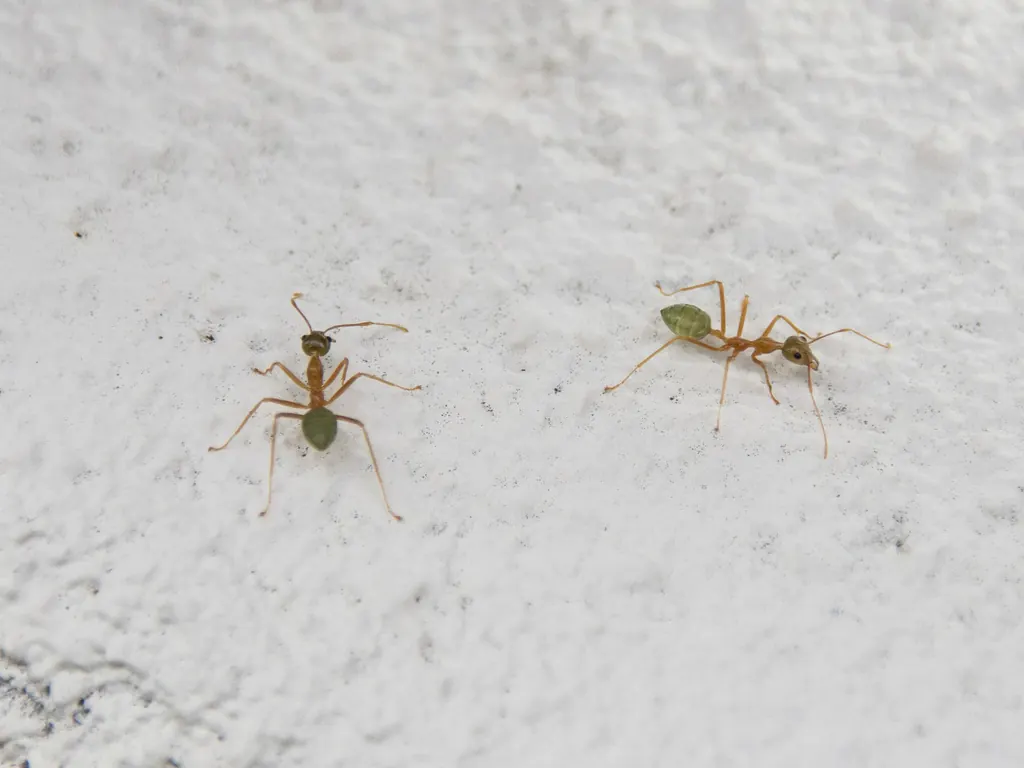
The green ant is three things in the dictionary: munjurr, the ant; nyirran, 'the big green ant that is eaten, comes in December–January'; and yangka, the medicine, 'used as a medicine for the common cold and other chest complaints. They can be crushed and the odour inhaled to cure headache; or the eggs, larvae, and pupae from the nests can be mixed with salt water and taken'[1]. Roth watched the same thing done: 'green ants, as well as their larvae, are eaten as food both by men and women, and at Princess Charlotte Bay, Cooktown, Bloomfield, etc., are in addition used as medicine (e.g., in diarrhoea, headache, etc.)'; on the Bloomfield 'the nests are pulled down and their contents shaken into a piece of bark or large leaf', kneaded, squeezed into a trough of water 'which makes the water look as if milk had been added to it', and the liquid 'sopped up by means of chewed grass, while the remains of the ants and eggs are eaten'[2]. The ant itself, Oecophylla smaragdina, is the weaver ant of the tropics, which builds its nests by pulling leaves together in living chains and gluing them with the silk of its own larvae, farms scale insects for honeydew, and bites[3].
Hann River Cape York
Possum People's country on the upper river and Thaypan (Kuku Thaypan) country downstream: stringybark and bloodwood woodland and a spring-fed sandy river that runs north-east from the Great Dividing Range, past the Peninsula Developmental Road, into Rinyirru (Lakefield) and the North Kennedy. Not Kuku Yalanji country: the Kuku Yalanji words on this page are the dictionary's, not the Hann's own languages. Place guide
Green ants live in the Hann country: the Atlas of Living Australia holds 14 records of Oecophylla smaragdina from 1980 to 2022 around the middle Hann, Laura and western Rinyirru[4]. Roth saw green-ant nests eaten at Princess Charlotte Bay, and a Kuku Warra man from the Laura side told the Federal Court in 2023 how the nest is crushed in water for a headache[2][5].
Where they are here
The Atlas of Living Australia holds 14 green-ant records from a box of about 90 × 85 km around the middle Hann, Laura and western Rinyirru, from 1980 to 2022[4]. That is a thin record for a common ant, so treat it as 'they live here', not as a map. Look for the leaf nests in the trees along the river, 'especially in tree canopies linked by lianas'[3].
How the people of this country used them
Princess Charlotte Bay, c. 1900. Roth: green ants 'at Princess Charlotte Bay, Cooktown, Bloomfield, etc., are in addition used as medicine (e.g., in diarrhoea, headache, etc.). At Princess Charlotte Bay and Cooktown, I have seen the nest cut down and opened on a piece of stone or rock whence the green ants scatter about in all directions, leaving the white larvae behind.' The larvae were rolled into a ball between the hands and swallowed[2].
Kuku Warra (Laura and the Palmer side), 2023. 'With green ants, you crush the nest, mix it with water and it cures a headache too. If you catch the ants at the right time of the year they have white eggs, and when you crush the eggs with water, it makes a milky drink'[5]. He does not say which time of year; on the coast the dictionary gives December–January for the big eating ant[1]. See bush medicine.
Nothing about green ants is published from the Thaypan or Possum evidence for the Hann itself.
On country today
The upper Hann is the Possum People's country and the middle and lower Hann are Thaypan country; Laura and the Deighton River side are Kuku Warra country; all three were determined on 2 November 2023[6][7][5]. Taking a nest for food or medicine is part of native title for personal, domestic and non-commercial communal needs[8].
Upper Mitchell Western Yalanji
Western Yalanji country west of the Great Dividing Range: dry open woodland cut by the sandy, paperbark-lined upper Mitchell River, around Karma Waters and Mount Carbine. Place guide
Green ants are in the river trees at Karma Waters: the Atlas holds ten records within 60 km of the homestead[9].
Where they are here
Ten records within 60 km of the Karma Waters homestead, in the river trees[9]. The method in the general section works here as anywhere: a nest, a sheet of bark, a trough of water, a grass sponge[2].
Eastern coast Eastern Kuku Yalanji
Eastern Kuku Yalanji country: rainforest, beaches, mangroves, reef and the short steep rivers from the Daintree to the Bloomfield and the Annan.
On the Bloomfield green ants were food and medicine both. Roth's Bloomfield informant described the milky drink of squeezed nests, and the moth chrysalis in the nests, bi-i bi-i, was 'a great delicacy'[2].
Gathered here in the 1970s
Anderson lists 'insects such as green ants and their eggs' among the gathered foods at Bloomfield in the 1970s[10].
Everywhere
Names
munjurr 'green ant'. nyirran 'the big green ant that is eaten, comes in December–January'. yangka 'green ant. These are used as a medicine for the common cold and other chest complaints. They can be crushed and the odour inhaled to cure headache; or the eggs, larvae, and pupae from the nests can be mixed with salt water and taken'. kurrmaja 'larvae of green ants'. kalbal 'the mixture made from green ant larvae/pupae and eggs eaten for chest sickness and the common cold'[1]. The other ants: karrkil 'red jumper ant. Some people have gotten sick and vomited after being bitten by them'; ngalmnbu 'jumper ant'; kira-kira 'black ant'; jabarrangkul 'black ant. Also their nest in rotten logs'; kawa 'little ants, white or black'; muyu-muyu 'small red ant'; jingka-jingka 'honey ant, the abdomen enlarges after eating'; jungu-jungu 'white ant eggs'; jawurraji 'large ant bed'; kabay 'small ant bed'[1]. Roth's Bloomfield name for the moth chrysalis found in the nests was bi-i bi-i, and the Cooktown name ged-ya[2].
The ant and the nest
'Oecophylla smaragdina (common names include Asian weaver ant, weaver ant, green ant, green tree ant, and orange gaster) is a species of arboreal ant found in tropical Asia and Australia. These ants form colonies with multiple nests in trees, each nest being made of leaves stitched together using' the silk of their larvae. 'Workers and major workers are mostly coloured orange. Workers are 5–7 mm long; they look after larvae and farm scale bugs for honeydew. Major workers are 8–10 mm long, with long, strong legs and large mandibles. They forage, assemble, and expand the nest. Queens are typically 20–25 mm long, and normally greenish-brown', which gives the species its name[3].
'Weaver ants when constructing their leaf nests show multiphase team coordination. Workers initially spread across tree branches and pull independently on leaf edges. When one ant successfully bends a leaf segment, nearby workers stop and join to pull in unison. For leaves too wide for a single ant's span or when linking separate leaves, workers form bridges, with ants climbing onto the backs of their chain mates and pulling backward to create mechanical leverage to bring the leaf edges together.' 'The ants also attend aphids, scale insects and other homopterans to feed on the honeydew they produce, especially in tree canopies linked by lianas. For this purpose, they drive away other ant species'. 'Weaver ants can bite humans when disturbed'[3].
Elsewhere in their range the same ants are food and medicine: 'the larvae and pupae are collected and processed into bird food and fish bait in Indonesia, are used in Chinese and Indian traditional medicine, and consumed as a delicacy in Thailand', where their taste is 'variously described as creamy, sour, and lemony'; 'in some parts of India, the adult ants are used in traditional medicine as a remedy for rheumatism'[3].
Roth's account, 1901. 'Green ants, as well as their larvae, are eaten as food both by men and women, and at Princess Charlotte Bay, Cooktown, Bloomfield, etc., are in addition used as medicine (e.g., in diarrhoea, headache, etc.). At Princess Charlotte Bay and Cooktown, I have seen the nest cut down and opened on a piece of stone or rock whence the green ants scatter about in all directions, leaving the white larvae behind. Any remaining ants are removed by putting the fingers into it, letting them crawl up the arm, and rubbing them briskly off. The white larvae are then collected into more or less of a ball, rubbed a bit between the flats of the hand, and swallowed. If in large quantity, and a "big feed" wanted, the larvae from two or three nests are collected into one big ball, crumpled over with leaves, washed in water, and then eaten. The "washed" water may be also drunk. At Cape Bedford, ashes are put into the water when the ants are kneaded. On the Bloomfield (E. Hislop), the nests are pulled down and their contents shaken into a piece of bark or large leaf, and are slightly kneaded so as to prevent the grown ants getting away. The mass of squashed ants and eggs is then squeezed into a trough containing water, which makes the water look as if milk had been added to it. This liquid is sopped up by means of chewed grass, while the remains of the ants and eggs are eaten. Saltwater is preferred to fresh to mix the ants up in, and the nests are considered more palatable when there is a preponderance of eggs over ants. The "queens" are eaten without being squashed. It is interesting to note that on the Bloomfield, as well as at Cooktown, etc., the chrysalis of a lepidopteron is found in the green-ant nests. The Bloomfield blacks, who call it bi-i bi-i, consider it a great delicacy, while the Cooktown natives, who speak of it as ged-ya, break it up in water, drink the mixture, and say it is very good for bad constipation. The lower Tully River natives utilise the green ants mainly as food, but also as medicine. The insects, the young larvae at least, are either squashed up in water and drunk or else rolled up, in the dry, in "wild-ginger" leaves and baked'[2].
Green ant, jumper ant, meat ant
- Green ant: orange-green, long-legged, in the trees, in leaf nests, in chains; a sharp bite and a squirt of acid that stings in the bite; eaten[3].
- Jumper ants (karrkil, ngalmnbu): big, red or black, jumping, on the ground, with a sting that has made people 'sick and vomited'; not eaten[1].
- Meat ants and the ant beds (jawurraji, kabay): the mound-builders of the woodland, the echidna's food and the ant-bed of the earth oven[1][2].
- Honey ant (jingka-jingka): 'the abdomen enlarges after eating'[1].
- White ants (termites): not ants; their eggs are jungu-jungu and their mounds the oven stones[1].
Signs
- Leaf nests the size of a fist to a football, green leaves pulled together and stitched with white silk, several in one tree, on the river gums, the figs and the paperbarks[3].
- Ant highways along the branches and the lianas, and ants on the scale insects[3].
- A nest heavy with white: eggs and larvae, the eating stage; 'the nests are considered more palatable when there is a preponderance of eggs over ants'[2].
- December and January: the big eating ant's season[1].
- A smell of sour lemon on the fingers after handling the nest: the formic acid[3].
Where they are
In the trees along the river and the moister woodland, 'especially in tree canopies linked by lianas', from the coast to the upper Mitchell[3]. The waterhole page's river trees are where to look; the place sections above say what is on the record locally.
The ant in the tree
The green ants run the canopy they live in: they drive other ants out, farm the scale insects for honeydew, kill the caterpillars and the small things that eat leaves, and are hunted in turn by the jumping spiders that mimic their smell and by the birds[3]. A moth lays its eggs in their nests, and its chrysalis was the Bloomfield delicacy bi-i bi-i[2]. The echidna cannot reach them; the witchetty grub page has the other insects that were eaten, and the native bees the other sweet thing in the trees.
Seasons
'The big green ant that is eaten, comes in December–January', the build-up and the first storms, when the nests are full of eggs and larvae[1]. The medicine was taken whenever a cold or a headache came, and the nests are there all year[1][2]. See the year on country.
Uses
- Food: the larvae, pupae and eggs rolled into a ball and swallowed; the whole nest squeezed into water and the milky water sopped up with chewed grass (wuju); the larvae baked in wild-ginger leaves on the Tully; the queens eaten whole[2][1].
- Medicine for colds and chest complaints: kalbal, the eggs, larvae and pupae mixed with salt water and drunk; for headache, the ants crushed and the smell inhaled; for diarrhoea, in Roth's note[1][2].
- The moth chrysalis from the nests: a delicacy at Bloomfield, a cure for constipation at Cooktown[2].
- Bait and bird food elsewhere in their range[3].
Taking a green-ant nest
From Roth's Bloomfield and Cooktown accounts and the dictionary[2][1]:
- Choose a nest heavy with white, eggs and larvae rather than ants, in the eating season[2].
- Cut or pull the nest down quickly into a sheet of bark or a big leaf; the ants bite and spray, so be quick and brush them off up the arm 'briskly'[2][3].
- For a snack: open the nest on a rock, let the ants scatter, collect the white larvae into a ball, rub it between the palms, and swallow it[2].
- For a feed: larvae from two or three nests into one ball, wrapped in leaves and washed in water; drink the water too[2].
- The Bloomfield way: knead the whole contents lightly so the ants cannot escape, squeeze the mass into a trough of water, salt water for choice, until it is milky; sop it up with a grass sponge (wuju) and eat what is left[2][1].
- For a cold: eggs, larvae and pupae in salt water, drunk, kalbal; for a headache, crush ants and breathe the smell[1].
- Baked: roll the larvae in wild-ginger leaves and bake them in the ashes, the Tully method[2].
Safety
- Green ants bite and spray formic acid; a nest dropped on the head is a bad minute. Eyes shut, work fast[3].
- The red jumper ant karrkil is the one that has made people 'sick and vomited'; it is not the green ant and is not eaten[1].
- Anyone who reacts to insect stings should treat ant medicine with care.
- Take a nest or two from a tree, not all of them; the colony is many nests[3].
On Country today
The method is as Roth saw it and the dictionary records it: a nest, a sheet of bark, a trough of water, a grass sponge; the medicine for a cold is the same recipe[2][1]. It is the easiest of the old foods to try and one of the sharpest-tasting.
Language
munjurr 'green ant'; nyirran the big eating ant of December–January; yangka green ant as medicine; kurrmaja 'larvae of green ants'; kalbal the cold medicine; karrkil 'red jumper ant'; ngalmnbu 'jumper ant'; kira-kira 'black ant'; jabarrangkul black ant and its log nest; kawa 'little ants'; muyu-muyu 'small red ant'; jingka-jingka 'honey ant'; jungu-jungu 'white ant eggs'; jawurraji, kabay ant beds; wuju 'sponge made from grass'[1].
References
- Hershberger, H. D. & Hershberger, R. (1982). Kuku-Yalanji Dictionary. Work Papers of SIL-AAB, Series B, Volume 7. With Toby Bloomfield, Roy Friday, Billy Roberts, Hector and Doris Sykes, Joe Walker and others. www.sil.org/resources/archives/18038
- Roth, W. E. (1901). North Queensland Ethnography, Bulletin No. 3: Food — its search, capture, and preparation. Brisbane: Government Printer. Bloomfield River information from the Hislops. — Sect. 6 'Cooking'; plant list ('Castanospermum australe', 'Dioscorea sativa', 'Elettaria Scottiana', 'Nymphaea') archive.org/details/northqueensland00landgoog
- Wikipedia. Oecophylla smaragdina (green tree ant, weaver ant). en.wikipedia.org/wiki/Oecophylla_smaragdina
- Atlas of Living Australia. Occurrence records of Oecophylla smaragdina (14 records, 1980–2022) in a box of about 90 × 85 km around the middle Hann River, Laura and western Rinyirru (lat −15.6 to −14.8, long 143.5 to 144.3), queried 28 October 2026. biocache.ala.org.au/occurrences/search?q=genus%3AOecophylla&fq=decimalLatitude%3A%5B-15.6%20TO%20-14.8%5D&fq=decimalLongitude%3A%5B143.5%20TO%20144.3%5D
- Ross on behalf of the Cape York United #1 Claim Group v State of Queensland (No 19) (Kuku Warra determination) [2023] FCA 1314 (Federal Court of Australia, 2 November 2023). www.judgments.fedcourt.gov.au/judgments/Judgments/fca/single/2023/2023fca1314
- Ross on behalf of the Cape York United #1 Claim Group v State of Queensland (No 21) (Possum determination) [2023] FCA 1316 (Federal Court of Australia, 2 November 2023). — Determination area (upper Hann and Kennedy rivers); prescribed body corporate; affidavit evidence on hunting and fishing www.judgments.fedcourt.gov.au/judgments/Judgments/fca/single/2023/2023fca1316
- Ross on behalf of the Cape York United #1 Claim Group v State of Queensland (No 20) (Thaypan determination) [2023] FCA 1315 (Federal Court of Australia, 2 November 2023). — Determination area and waters; prescribed body corporate (Awu-Laya Indigenous Corporation); affidavit evidence on hunting www.judgments.fedcourt.gov.au/judgments/Judgments/fca/single/2023/2023fca1315
- Native Title Act 1993 (Cth), section 211: preservation of certain native title rights and interests (hunting, fishing and gathering for personal, domestic or non-commercial communal needs). www.legislation.gov.au/C2004A04665/latest/text
- Atlas of Living Australia. Occurrence records within 60 km of the Karma Waters homestead (16.62° S, 144.60° E), species counts for Animalia (accessed 10 October 2026). biocache.ala.org.au/occurrences/search?q=*:*&lat=-16.62&lon=144.60&radius=60
- Anderson, C. (1996). Traditional material culture of the Kuku-Yalanji of Bloomfield River, North Queensland. Records of the South Australian Museum 29(1): 63–83. Based on fieldwork at Wujal Wujal in the late 1970s and early 1980s. — Hunting (spears, spear-throwers, harpoons); fishing (stupefacients); manufacturing (gums and resins); post-contact bush component archive.org/details/RecordsSouthAus29Sout
From the community
Know this one? Add the words you use for it, what it is for, how it is done, a correction, or a photo from country. It shows here straight away with your name on it. Please keep anything restricted or sacred off the site.
Loading…