Birds
Kookaburras and kingfishers
wakuka · kururrungka · milman · yindili · dabuy
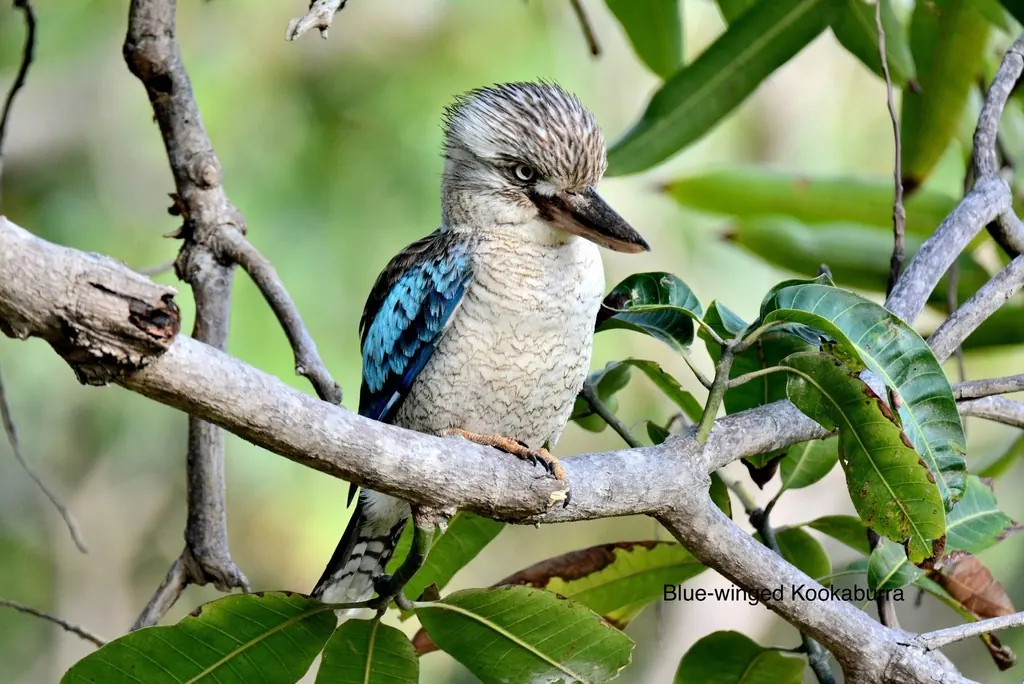
wakuka is the kookaburra and kururrungka the 'bronze wing kookaburra', the blue-winged kookaburra of the north; milman the azure kingfisher of the river, yindili the forest kingfisher of the woodland, jiwal-jiwal a 'kingfisher, white tailed', and dabuy a 'small brownish kingfisher', of which the dictionary says 'when this bird starts singing you know you will get company, that someone is travelling'[1]. The kookaburras are the woodland's snake-and-lizard hawks, waiting 'perched on a branch until it sees an animal on the ground and then flies down and pounces on its prey', 'lizards, insects, worms, snakes, mice'; the forest kingfisher does the same on a smaller scale, 'bugs, beetles, grasshoppers ... small fish, frogs and tadpoles, lizards, and snakes'; and the azure kingfisher on its low branch over the pool means fish and shrimps in the shallows under it[2][3][4]. The laughing kookaburra digs its nest into a termite nest in a tree, the red-backed kingfisher into a creek bank[2][5].
Nothing is written for the Eastern coast on this page yet. What follows is true across the country.
Hann River Cape York
Possum People's country on the upper river and Thaypan (Kuku Thaypan) country downstream: stringybark and bloodwood woodland and a spring-fed sandy river that runs north-east from the Great Dividing Range, past the Peninsula Developmental Road, into Rinyirru (Lakefield) and the North Kennedy. Not Kuku Yalanji country: the Kuku Yalanji words on this page are the dictionary's, not the Hann's own languages. Place guide
Kookaburras and kingfishers are everywhere on the Hann. The Atlas of Living Australia holds 3,395 records of them (1976–2026) in a box of about 90 × 85 km around the middle Hann, Laura and western Rinyirru, most of them the blue-winged kookaburra (1,294) and the laughing kookaburra (1,017): both kookaburras live here together[14]. Along the Hann the country is 'stringybark, bloodwood, Moreton Bay ash and ironbark' woodland[15], their kind of country.
Which ones live here
After the two kookaburras come the forest kingfisher (675 records), the sacred kingfisher (215), the azure kingfisher of the river (151) and the red-backed kingfisher of the dry country (34). The little kingfisher (4 records, 2003–2023), the buff-breasted paradise-kingfisher (2, 1990) and single yellow-billed and collared kingfishers have also been logged[14]. The box takes in far more country than the Hann, so read the counts as 'lives in this country', not as a map.
Their year here
The Hann never stops running, so its holes keep fish and shrimps through the late dry[16], and the azure kingfisher keeps to them. In the wet (December to March) the plains flood and food is everywhere[17], the season when the blue-winged kookaburra eats more frogs and lizards (see above). By October 'the land is brown and parched'[17]: the dry-country birds' time.
People and these birds here
No published Possum, Thaypan, Kuku Warra or Lama Lama record describes using or hunting kookaburras or kingfishers. The Kuku Thaypan names below show they are known birds of this country; what they mean in story or law is for the Traditional Owners to tell.
Language
In Kuku Thaypan (Awu Alaya), the language of the Thaypan people of the middle and lower Hann, the blue-winged kookaburra is arrolmba, possibly a word shared with Olkola[18], and the sacred kingfisher arodha[19].
Upper Mitchell Western Yalanji
Western Yalanji country west of the Great Dividing Range: dry open woodland cut by the sandy, paperbark-lined upper Mitchell River, around Karma Waters and Mount Carbine. Place guide
Both kookaburras are at Karma Waters, the blue-winged with thirty-three records and the laughing with twenty-seven, and four kingfishers with them: the forest, nineteen, the azure, eleven, the sacred, eight, and the red-backed, nine[20].
On country today
Both kookaburras laugh at Karma Waters, and the forest kingfisher is on every second dead branch in the dry; the dictionary's six names are a field guide waiting for the Western Yalanji to say which is which[20][1]. Here the native title rights that section 211 protects (see Safety above) are those recognised in the Western Yalanji determinations[21].
Everywhere
Names
wakuka 'kookaburra' (the same word is also glossed 'species of crow'). kururrungka 'bronze wing kookaburra', which can only be the blue-winged kookaburra, the north's kookaburra with blue in the wing[1][6]. milman 'azure kingfisher'. yindili 'forest kingfisher'. jiwal-jiwal 'kingfisher, white tailed'. dabuy 'small brownish kingfisher ... When this bird starts singing you know you will get company, that someone is travelling', and in another entry 'spirit'[1].
The kookaburras and kingfishers
Blue-winged kookaburra (Dacelo leachii, kururrungka). 'A large species of kingfisher native to northern Australia and southern New Guinea. Measuring around 40 cm, it is slightly smaller than the more familiar laughing kookaburra. It has cream-coloured upper- and underparts barred with brownish markings. It has blue wings and brown shoulders and blue rump. It is sexually dimorphic, with a blue tail in the male', a barred rufous tail in the female, and 'striking white eyes'; 'their call has been described as a maniacal cackling or barking'[6]. The woodland page has its diet by season: more insects, lizards and frogs in the wet, more crayfish and scorpions in the dry; and its enemies, the red goshawk, the rufous owl, and at the nest pythons, quolls and goannas[6].
Laughing kookaburra (Dacelo novaeguineae, wakuka). 'A large kingfisher with a whitish head and a brown eye-stripe. The upperparts are mostly dark brown but there is a mottled light-blue patch on the wing'; 'a predator of a wide variety of small animals, the laughing kookaburra typically waits perched on a branch until it sees an animal on the ground and then flies down and pounces on its prey. Its diet includes lizards, insects, worms, snakes, mice'; it makes 'a hollow for a nest in an arboreal termite nest'[2].
Forest kingfisher (Todiramphus macleayii, yindili). 'Predominantly a blue and white bird', '21.5–25.5 cm in length', 'blue wings, head and tail with white breast, abdomen and nape ... a black band stretching from the bill, through the eyes to the ear coverts'. 'The forest kingfisher hunts invertebrates, such as bugs, beetles, grasshoppers, spiders, dragonflies, cicadas, ants, adult and larval butterflies, and worms, as well as small fish, frogs and tadpoles, lizards, and snakes. The forest kingfisher watches from a high perch, dives to the ground or water to seize its prey (sally-pouncing), then returns directly to the perch'[3].
Sacred kingfisher (T. sanctus), 'a medium-sized woodland kingfisher that inhabits mangroves, woodlands, forests and river valleys', 'mostly blue-green to turquoise above with white underparts and collar feathers, a black mask and buff lores'[7]. Red-backed kingfisher (T. pyrrhopygius), 'a predominantly blue-green and white bird with a chestnut rump', 20–24 cm; 'the call is a descending, mournful whistle "kee-ip", repeated every few seconds in a long series from a tree-top'; 'the breeding season is August to February ... although birds may not breed in times of drought. The nest is a burrow 0.5–1.25 m into the top third section of a steep sloping bank overlooking a dry creek-bed or dam'[5].
Azure kingfisher (Ceyx azureus, milman): the small deep-blue and orange kingfisher of the river's low branches, which dives for small fish and shrimps and nests in a tunnel in the bank; the waterhole page reads it as a sign of what is in the shallows below its perch[4].
Telling them
- Blue-winged kookaburra: pale head with streaks, white eye, blue wings, no dark eye-stripe; a bark and cackle[6].
- Laughing kookaburra: brown eye-stripe, dark eye, only a patch of blue on the wing; the laugh[2].
- Forest kingfisher: blue and white with a black mask and a white spot before the eye, on a high perch in the woodland[3].
- Sacred kingfisher: greener, buff below, a buff spot before the eye[7].
- Red-backed kingfisher: a chestnut rump and a streaked crown, on a dead tree-top over dry country, whistling[5].
- Azure kingfisher: tiny, deep blue above and orange below, on a stick a hand above the water[4].
- Rainbow bee-eater: also a bright, perching, sallying bird over the river, but green and gold with a long tail wire[8].
Signs
- The laugh at dawn and dusk marks the kookaburra family's territory[2].
- A hole dug into a termite nest on a tree trunk: a kookaburra's nest[2].
- A burrow high in a creek bank over a dry bed: the red-backed kingfisher[5].
- An azure kingfisher on a low branch: fish and shrimps in the shallows beneath[4].
- Crayfish and prawn shells under a perch; see waterhole[4].
- The small brown kingfisher singing: company coming, the dictionary says[1].
Where they live
The kookaburras and the forest and sacred kingfishers in the woodland and the river trees, on high perches over open ground; the red-backed kingfisher in the driest country with a bank to burrow in; the azure kingfisher only over the water[6][3][5][4].
The watchers on the branch
The kookaburras and kingfishers hunt by sitting still and dropping: a snake, a skink, a mouse, a grasshopper, a frog, a prawn, each taken from a perch and beaten on the branch[2][3]. The kookaburra is the one bird that eats the small snakes in numbers, and the cane toad is now a hazard to it as to the goannas[2][9]. Their nests in the termite nests and the banks are raided by the pythons, the goannas and the quoll, and the birds themselves by the goshawk and the owls[6]. Their calls are the woodland's clock: the laugh at first light and last, and the red-backed kingfisher's whistle through the heat of a dry-season day[2][5].
Seasons
Kookaburras nest from September; the red-backed kingfisher from August to February 'often with a double brood', and not at all in a drought; the blue-winged kookaburra's diet turns from the wet's frogs and lizards to the dry's crayfish and scorpions[6][5]. See the year on country.
Uses
Reading the kookaburras
- A kookaburra or a butcherbird scolding one spot on the ground is a snake or a goanna; look before you walk there[2].
- Follow the azure kingfisher to the shallows with bait in them[4].
- When the small brown kingfisher sings, put the billy on; someone is coming[1].
- Leave the termite-nest hollows on the trunks; they are nests[2].
- The kookaburras were not a hunted bird in any of the sources used here; the small birds of the east coast were taken as eggs and fledglings rather than adults[10].
Safety
- Native birds are protected wildlife in Queensland under the Nature Conservation Act 1992; native title holders hunting for personal, domestic or non-commercial communal needs are covered by section 211 of the Native Title Act 1993[11][12].
- A kookaburra at the camp table will take meat from a plate and a finger with it.
- A bird scolding on the ground is a snake warning; see snakes[13].
On Country today
The dictionary's six names are a field guide waiting for speakers to say which bird is which[1]. The contribution box below is for that. Native title holders' rights differ from place to place: see each place above.
Language
wakuka 'kookaburra'; kururrungka 'bronze wing kookaburra'; milman 'azure kingfisher'; yindili 'forest kingfisher'; jiwal-jiwal 'kingfisher, white tailed'; dabuy the small brown kingfisher of visitors; dikal 'bird'[1].
References
- Hershberger, H. D. & Hershberger, R. (1982). Kuku-Yalanji Dictionary. Work Papers of SIL-AAB, Series B, Volume 7. With Toby Bloomfield, Roy Friday, Billy Roberts, Hector and Doris Sykes, Joe Walker and others. www.sil.org/resources/archives/18038
- Wikipedia. Laughing kookaburra (Dacelo novaeguineae). en.wikipedia.org/wiki/Laughing_kookaburra
- Wikipedia. Forest kingfisher (Todiramphus macleayii). en.wikipedia.org/wiki/Forest_kingfisher
- Wikipedia. Azure kingfisher (Ceyx azureus). en.wikipedia.org/wiki/Azure_kingfisher
- Wikipedia. Red-backed kingfisher (Todiramphus pyrrhopygius). en.wikipedia.org/wiki/Red-backed_kingfisher
- Wikipedia. Blue-winged kookaburra. en.wikipedia.org/wiki/Blue-winged_kookaburra
- Wikipedia. Sacred kingfisher (Todiramphus sanctus). en.wikipedia.org/wiki/Sacred_kingfisher
- Wikipedia. Rainbow bee-eater (Merops ornatus). en.wikipedia.org/wiki/Rainbow_bee-eater
- Wikipedia. Cane toads in Australia: effects on native predators (goannas, snakes, freshwater crocodiles) and on dogs. en.wikipedia.org/wiki/Cane_toads_in_Australia
- Roth, W. E. (1901). North Queensland Ethnography, Bulletin No. 3: Food — its search, capture, and preparation. Brisbane: Government Printer. Bloomfield River information from the Hislops. — Sect. 6 'Cooking'; plant list ('Castanospermum australe', 'Dioscorea sativa', 'Elettaria Scottiana', 'Nymphaea') archive.org/details/northqueensland00landgoog
- Queensland Government, State of the Environment. Nature Conservation Act 1992. www.stateoftheenvironment.des.qld.gov.au/biodiversity/management-responses/legislation/nature-conservation-act-1992
- Australian Law Reform Commission. Review of the Native Title Act 1993 (DP 82), ch. 8: Relevant provisions in the Native Title Act (s 211). www.alrc.gov.au/publication/review-of-the-native-title-act-1993-dp-82/8-the-nature-and-content-of-native-title/relevant-provisions-in-the-native-title-act/
- healthdirect Australia (Australian Government). Snake bites: symptoms, first aid and the pressure immobilisation bandage (accessed 10 October 2026). www.healthdirect.gov.au/snake-bites
- Atlas of Living Australia. Occurrence records for kookaburras and kingfishers (Alcedinidae) in a box of about 90 × 85 km around the middle Hann, Laura and western Rinyirru (latitude 15.6–14.8° S, longitude 143.5–144.3° E), holding 3,395 records (1976–2026): blue-winged kookaburra 1,294, laughing kookaburra 1,017, forest kingfisher 675, sacred kingfisher 215, azure kingfisher 151, red-backed kingfisher 34, little kingfisher 4, buff-breasted paradise-kingfisher 2 (1990), and single records of the yellow-billed and collared kingfishers (biocache query, accessed 28 October 2026). biocache-ws.ala.org.au/ws/occurrences/search
- Wikipedia. Hann River (Queensland) (accessed 28 October 2026). en.wikipedia.org/wiki/Hann_River_(Queensland)
- Bureau of Meteorology, Water Data Online. Station 105001B, Hann River at Sandy Creek: daily and monthly mean discharge 1968–2026 (recent data provisional), retrieved 28 October 2026. No day of zero mean flow in 20,711 days of record; mean flow highest in February–March, lowest in September–November. www.bom.gov.au/waterdata/
- Queensland Parks and Wildlife Service. Nature, culture and history: Rinyirru (Lakefield) National Park (CYPAL) (web page, last updated 1 July 2024; accessed 28 October 2026). parks.qld.gov.au/parks/rinyirru-lakefield/about/culture
- Hunter-Gatherer Language Database (University of Texas at Austin). Lexical feature 'blue-winged kookaburra': Kuku-Thaypan (accessed 28 October 2026). huntergatherer.la.utexas.edu/lexical/feature/256
- Hunter-Gatherer Language Database (University of Texas at Austin). Lexical feature 'sacred kingfisher': Kuku-Thaypan (accessed 28 October 2026). huntergatherer.la.utexas.edu/lexical/feature/324
- Atlas of Living Australia. Bird (Aves) occurrence records within 30 km of the Karma Waters homestead (16.62° S, 144.60° E), species counts (accessed 10 October 2026). biocache.ala.org.au/occurrences/search?q=*:*&lat=-16.62&lon=144.60&radius=30&fq=class:Aves
- Western Yalanji Aboriginal Corporation & CRC for Developing Northern Australia (2020). Western Yalanji Land Use and Economic Diversification Plan. CC BY 4.0. — Native Title Determinations 1–4 (pp. 13–18); ‘Fire Management and Carbon Farming’ (pp. 32–33); ‘Pastoralists’ crcna.com.au/wp-content/uploads/2024/05/westernyalanjilanduseplan_nov2020.pdf
From the community
Know this one? Add the words you use for it, what it is for, how it is done, a correction, or a photo from country. It shows here straight away with your name on it. Please keep anything restricted or sacred off the site.
Loading…