Trees
Cotton tree (wawuburra) and the kapok bushes
wawuburraBombax ceiba var. leiocarpum; also Cochlospermum and Gossypium australe
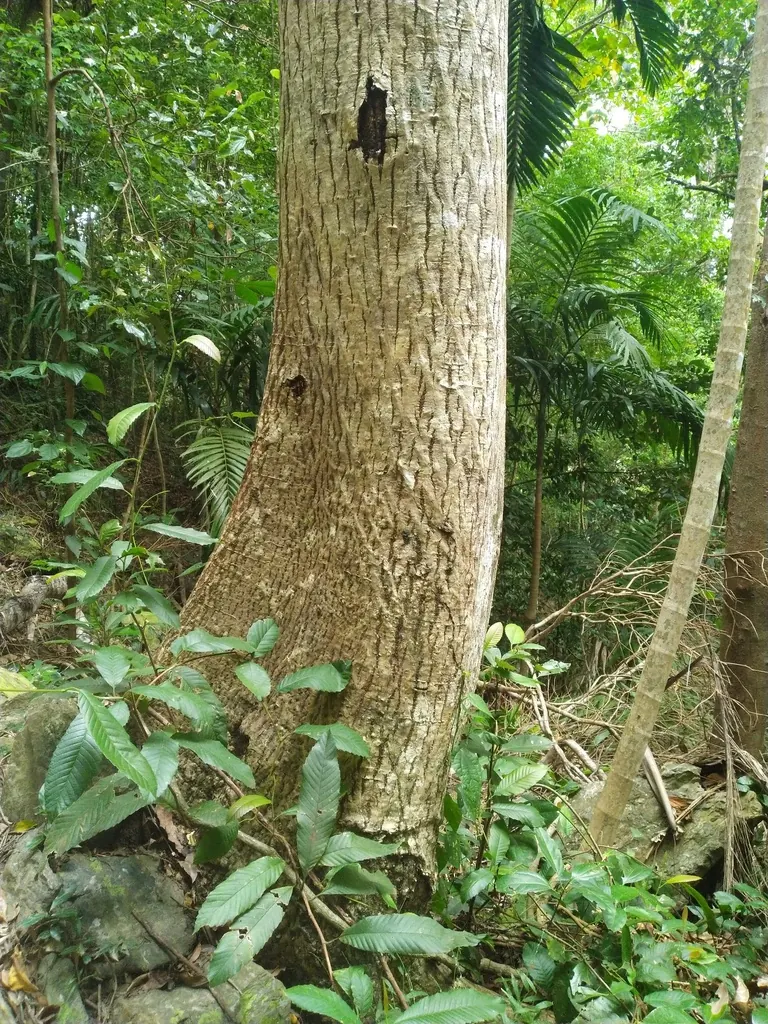
wawuburra is the cotton tree, and the dictionary gives it two jobs: 'Canoes were made out of these and the candlenut tree, bilar. When it blooms (big red flowers) it signals the start of the scrub hen egg season'[1]. It is the red silk-cotton tree, Bombax ceiba, a tall straight tree of the monsoon forest and river banks that drops every leaf in the dry and then covers itself in cup-shaped red flowers, 'when most other forms of vegetation in the community are looking rather drab and forlorn', before splitting its capsules to let out the cream kapok[2][3]. Its cousins are the kapok bush Cochlospermum, which flowers yellow on bare rocky ridges in the dry and whose roots Palmer saw roasted on the Mitchell in 1883, and the native cotton Gossypium australe of sandy ground[4][5][6].
Hann River Cape York
Possum People's country on the upper river and Thaypan (Kuku Thaypan) country downstream: stringybark and bloodwood woodland and a spring-fed sandy river that runs north-east from the Great Dividing Range, past the Peninsula Developmental Road, into Rinyirru (Lakefield) and the North Kennedy. Not Kuku Yalanji country: the Kuku Yalanji words on this page are the dictionary's, not the Hann's own languages. Place guide
On the Hann, the tree the Kuku Thaypan Elders call the cotton tree is the yellow-flowered kapok tree, Cochlospermum gillivraei, not the red Bombax of the coast[11]. The Atlas of Living Australia holds 8 records of it, from 1970 to 2021, in a box of about 90 × 85 km around the middle Hann, Laura and western Rinyirru, and only one unconfirmed Bombax (2024, not identified to species)[12].
The cotton tree here
In the Elders' words, recorded by Standley: 'This tree grows in sand ridges and rocky areas. It has a spectacular habitat and a bright yellow flower. When the fruits are forming and maturing the tree losses most of its leaves'[11]. No native cotton (Gossypium australe) is recorded in the Hann box; the only cotton records there are introduced cottons, from 1998–1999[12].
Its year here
It flowers from June to October, through the dry, on bare branches[11]: yellow on the stony ridges when the country is brown.
How the people of this country used it
String. The Kuku Thaypan Elders, whose country takes in the middle and lower Hann[13], recorded that 'the bark of the tree was used to make string'[11]. Their table gives no language name for it. Eating the roots of the kapok bush is recorded elsewhere (see the general sections), but not for this country.
Upper Mitchell Western Yalanji
Western Yalanji country west of the Great Dividing Range: dry open woodland cut by the sandy, paperbark-lined upper Mitchell River, around Karma Waters and Mount Carbine. Place guide
At Karma Waters the cotton tree itself is not in the records; what is there is its cousins: the kapok bush Cochlospermum, which flowers yellow on the bare rocky ridges in the dry, and the native cotton Gossypium australe, recorded on the sandy ground near the watercourses[14][4][6]. Its roots are a wet-season food that Palmer recorded on the Mitchell in 1883[4][5].
Which ones grow here
The one recorded within 30 km of Karma Waters is Cochlospermum gregorii, the kapok bush of the dry northern savanna, the same kind of plant[14].
Safety here
On country today
Gathering on native title country is protected by section 211 of the Native Title Act 1993, as recognised for Western Yalanji country[10][16].
Eastern coast Eastern Kuku Yalanji
Eastern Kuku Yalanji country: rainforest, beaches, mangroves, reef and the short steep rivers from the Daintree to the Bloomfield and the Annan.
On the Bloomfield it was one of the three favourite hulls for the outrigger canoe, and on the Endeavour River Roth found the same tree in the dug-outs[9][7]. The bush cotton had one more use at Bloomfield: tied as a streamer to a bee, it hummed loudly enough to follow to the hive[9].
How people used it here
- Canoe hulls. 'A "cotton tree" (probably Bombax malabaricum)' was among the three timbers 'most favoured on the Bloomfield coast' for the dug-out; Roth found Bombax hulls on the Endeavour[9][7].
- Bee-tracking. 'Idriess describes how Aborigines at China Camp attached a "streamer" of bush cotton to a bee's body. This streamer made a loud hum as the bee flew and it was easy to then track it to the hive'[9].
Following a bee with a streamer
From Idriess, at China Camp on the Bloomfield[9]:
- Catch a sugarbag bee at a flower or a water-hole.
- Tie a wisp of bush cotton, kapok or native-cotton lint, to its body.
- Let it go; the streamer 'made a loud hum as the bee flew', and it flies home.
- Follow the hum to the tree, then see native bees for getting the sugarbag out.
Everywhere
Names
wawuburra 'cottontree'[1]. Its partners in the dictionary: bilar, the candlenut, the other canoe tree; and ngakun, the flame tree, which also 'signals the time when the scrub hen eggs are in season'[1]. Roth's Endeavour River (Guugu Yimithirr) name for the Bombax was nanggarbura[7]. Palmer's Mitchell River name for the kapok bush was Kurrutcha, from a language he does not name[5]. The dictionary has no separate word on record for the kapok bush or for native cotton.
The tree, and its cousins
The cotton tree, Bombax ceiba var. leiocarpum, the 'northern cottonwood' or 'red silk-cotton tree'. 'This Asian tropical tree has a straight tall trunk and its leaves are deciduous in winter. Red flowers with 5 petals appear in the spring before the new foliage. It produces a capsule which, when ripe, contains white fibres like cotton'[3]. It grows to about 20 m; 'the trunk and limb bear numerous conical spines particularly when young, but get eroded when older'; the leaves are palmate, five or six leaflets from one point on a long stalk[3]. The flowers are 'usually produced when the tree is leafless', with a corolla 6–8 cm long, densely hairy outside, the stamens fused into a central column; the capsules, about 10 cm, are 'densely packed with large quantities of cream fibrous material which resembles cotton wool and surrounds the seed, but is not really attached to the seed'[2]. In Australia it is 'widespread in WA, NT, CYP and NEQ', from sea level to about 300 m, 'usually grows in monsoon forest' and along rivers; 'flowers are produced in the dry season when the tree is completely leafless'[2]. The kapok is an 'inferior grade' of the commercial fibre, and the tree is the food plant of the common aeroplane butterfly's caterpillars[2].
The kapok bushes, Cochlospermum. The one in the rainforest key, C. gillivraei, is 'usually a small, short-boled tree', deciduous and 'leafless for a period between July and October', with deeply lobed leaves 'radiating like the blades of a windmill', flowers 7–10 cm across 'usually produced when the tree is leafless', petals marked inside with pink-red spots, and inflated capsules 6–9.5 cm long that fall apart at maturity to let out the silky seed hairs; it 'usually grows in rocky situations in open forest' and 'adds a considerable amount of colour to an environment which is often bereft of colour or green leaves'[4]. Palmer's Kurrutcha of the Mitchell, 'a peculiar thorny tree, with large palmatifid leaf, growing in a cluster or crown near the top', with a spiny stem, 10 to 12 feet high 'on the banks of the Mitchell in good soil', with a disagreeable smell, is named by him as a Cochlospermum, though his spiny stem and river-bank habit read like the cotton tree itself; either way, 'the roots of the young trees, which are long and thick, are roasted, when the skin peels off, leaving the edible part white and delicate and well-flavoured'[5].
Native cotton, Gossypium australe, 'an endemic woody shrub, related to cotton', across northern Australia, grows on sandy ground near watercourses; it is a true cotton, with a small boll of lint[6].
Cotton tree, kapok bush, flame tree
- Cotton tree (Bombax): a tall tree, spiny when young, red flowers on bare branches, big kapok capsules; river and monsoon forest[2][3].
- Kapok bush (Cochlospermum): a small crooked tree of the rocky ridges, yellow flowers on bare branches, windmill leaves, kapok capsules[4].
- Flame tree (ngakun), the dictionary's other egg-season tree, which also flowers red on bare wood; the dictionary gives it a yam's name too[1].
- Native cotton (Gossypium): a shrub, not a tree, grey-leaved, with a pink hibiscus flower and a small cotton boll[6].
- Coral tree (Erythrina): King's 1819 canoe timber at the Bloomfield, another soft-wooded, spiny, red-flowered tree of the coast, and the shield wood of the Mitchell[8][5].
Signs
- Red flowers on a leafless tree by a coastal river in the dry: the cotton tree, and the start of the scrub-hen egg season[1][2].
- Yellow flowers on bare crooked trees on a stony ridge from July to October: the kapok bush[4].
- Kapok drifting and split capsules under the tree in the late dry[2][4].
- Conical spines on a straight young trunk[3].
- A bee with a hum louder than a bee has a streamer on it; see below[9].
Where they grow
The cotton tree is a coastal tree: monsoon forest and river banks from sea level to 300 m on the Peninsula and the north-east[2]. The kapok bush takes the rocky open forest[4]; native cotton the sandy ground near the watercourses[6]; and Palmer's Kurrutcha grew 'on the banks of the Mitchell in good soil'[5]. Each place below says which of them grows there.
The calendar tree
The cotton tree flowers in the dry when it has no leaves, which is why it is such a clear signal: 'when it blooms (big red flowers) it signals the start of the scrub hen egg season', and the flame tree says the same thing[1][2]. The seasons page puts the dictionary's flowering signs in order. Its nectar feeds the honeyeaters and lorikeets of a leafless forest; its leaves feed the aeroplane butterfly; its kapok carries the seed on the wind[2]. As a canoe tree it stood beside the red cedar and the candlenut, soft, light, straight timbers that a stone axe could fell and fire could hollow[9].
Seasons
Leafless and flowering in the dry; the kapok bush bare between July and October; capsules opening in the late dry; the egg season of the mound-builders, which the flowers announce, from September[2][4][1]. Kapok-bush roots were dug 'in the wet season, when excavation is easier'[4]. Canoe timber was felled after the first storms with the other big timber work[9]. See the year on country.
Uses
- Canoe hulls on the coast, and bee-tracking with a cotton streamer: see the eastern coast below.
- A calendar. The red flowering marks the scrub-hen egg season[1].
- Kapok-bush roots roasted: Palmer on the Mitchell, and the rainforest key's note that 'Aboriginal people dig up the roots of small plants of this species. They are baked in ashes and hammered to soften them before being consumed'[5][4].
- Kapok. In India and Nepal the fibre is carded, spun and stuffed into pillows; no Kuku Yalanji use of the fibre is on record[3].
Using the cotton trees
Kapok-bush roots[5][4]: in the wet, when the ground is soft, dig the long thick roots of small young plants; roast them in the ashes until the skin peels; hammer them soft; the inside is 'white and delicate and well-flavoured'.
Safety
- Young cotton trees are armed with conical spines[3].
- Roots are taken only from small young plants, which kills them; take a few[4].
- Kapok bushes differ from place to place, and Palmer's root may have been yet another plant by his description. The method is the same; the plant should be checked[4][5].
On Country today
The cotton tree still flowers on the coastal rivers every dry season and still says what it said: eggs[2]. Gathering on native title country is protected by section 211 of the Native Title Act 1993[10].
Language
wawuburra 'cottontree'; bilar 'candle nut tree'; ngakun 'flame tree; species of yam'; nganjirr 'grass tree'; nganyin 'sugar bag'; dabu, kuja the bees[1].
References
- Hershberger, H. D. & Hershberger, R. (1982). Kuku-Yalanji Dictionary. Work Papers of SIL-AAB, Series B, Volume 7. With Toby Bloomfield, Roy Friday, Billy Roberts, Hector and Doris Sykes, Joe Walker and others. www.sil.org/resources/archives/18038
- Australian Tropical Rainforest Plants (RFK8), Bombax ceiba var. leiocarpum (northern cottonwood, red silk-cotton tree). CSIRO / Lucidcentral. apps.lucidcentral.org/rainforest/text/entities/bombax_ceiba_var._leiocarpum.htm
- Wikipedia. Bombax ceiba (cotton tree, red silk-cotton). en.wikipedia.org/wiki/Bombax_ceiba
- Australian Tropical Rainforest Plants (RFK8), Cochlospermum gillivraei (kapok tree, kapok bush), citing Kenneally et al. (1995) for Aboriginal use. CSIRO / Lucidcentral. apps.lucidcentral.org/rainforest/text/entities/cochlospermum_gillivraei.htm
- Palmer, E. (1883). On plants used by the natives of North Queensland, Flinders and Mitchell Rivers, for food, medicine, &c., &c. Journal and Proceedings of the Royal Society of New South Wales 17: 93–113. Palmer's Mitchell River names come from the lower and middle Mitchell, not from Kuku Yalanji speakers. archive.org/details/journalandproce16walegoog
- Wikipedia. Gossypium australe (native cotton). en.wikipedia.org/wiki/Gossypium_australe
- Roth, W. E. (1910). North Queensland Ethnography, Bulletin No. 14: Transport and Trade. Records of the Australian Museum 8(1). — Sects. 14–15, dug-out canoes from the Flinders Group to Cape Grafton archive.org/details/biostor-52863
- King, P. P. (1827). Narrative of a Survey of the Intertropical and Western Coasts of Australia, performed between the years 1818 and 1822. London: John Murray. Vol. 1: Blomfield's Rivulet (the Bloomfield River), 26 June 1819, and Endeavour River, July 1819; Vol. 2: Trinity Bay, June 1821. www.gutenberg.org/ebooks/11203
- Anderson, C. (1996). Traditional material culture of the Kuku-Yalanji of Bloomfield River, North Queensland. Records of the South Australian Museum 29(1): 63–83. Based on fieldwork at Wujal Wujal in the late 1970s and early 1980s. — Hunting (spears, spear-throwers, harpoons); fishing (stupefacients); manufacturing (gums and resins); post-contact bush component archive.org/details/RecordsSouthAus29Sout
- Australian Law Reform Commission. Review of the Native Title Act 1993 (DP 82), ch. 8: Relevant provisions in the Native Title Act (s 211). www.alrc.gov.au/publication/review-of-the-native-title-act-1993-dp-82/8-the-nature-and-content-of-native-title/relevant-provisions-in-the-native-title-act/
- Standley, P.-M. (2019). The importance of campfires to effective conservation. PhD thesis, James Cook University. Records the fire and country knowledge of Kuku Thaypan Elders Dr Tommy George and Dr George Musgrave. — Table 8.7, 'Plants and their uses as recorded by the Kuku Thaypan elders', pp. 335–338 (Cotton Tree, Cochlospermum gillivraei) researchonline.jcu.edu.au/64274/
- Atlas of Living Australia. Plant occurrence records in a box of about 90 × 85 km around the middle Hann River, Laura and western Rinyirru (lat −15.6 to −14.8, long 143.5 to 144.3), queried 28 October 2026: Cochlospermum gillivraei 8 records (1970–2021); Bombax 1 record (2024, iNaturalist, not identified to species); Gossypium 3 records (1998–1999), all introduced cottons (G. hirsutum, G. barbadense). biocache.ala.org.au/occurrences/search?q=genus%3ACochlospermum
- Ross on behalf of the Cape York United #1 Claim Group v State of Queensland (No 20) (Thaypan determination) [2023] FCA 1315 (Federal Court of Australia, 2 November 2023). — Determination area and waters; prescribed body corporate (Awu-Laya Indigenous Corporation); affidavit evidence on hunting www.judgments.fedcourt.gov.au/judgments/Judgments/fca/single/2023/2023fca1315
- Atlas of Living Australia. Plant occurrence records within 30 km of the Karma Waters homestead (16.62°S, 144.60°E), queried 10 October 2026: 832 records of 266 species. biocache.ala.org.au/occurrences/search?q=kingdom:Plantae&lat=-16.62&lon=144.60&radius=30
- Karma Waters Station. About: location, native title (web page, accessed 5 October 2026). www.karmawatersstation.com/about.html
- Western Yalanji Aboriginal Corporation & CRC for Developing Northern Australia (2020). Western Yalanji Land Use and Economic Diversification Plan. CC BY 4.0. — Native Title Determinations 1–4 (pp. 13–18); ‘Fire Management and Carbon Farming’ (pp. 32–33); ‘Pastoralists’ crcna.com.au/wp-content/uploads/2024/05/westernyalanjilanduseplan_nov2020.pdf
From the community
Know this one? Add the words you use for it, what it is for, how it is done, a correction, or a photo from country. It shows here straight away with your name on it. Please keep anything restricted or sacred off the site.
Loading…