Mammals
Possums and gliders
yawa · balaTrichosurus vulpecula; Pseudocheirus peregrinus; Petaurus spp.
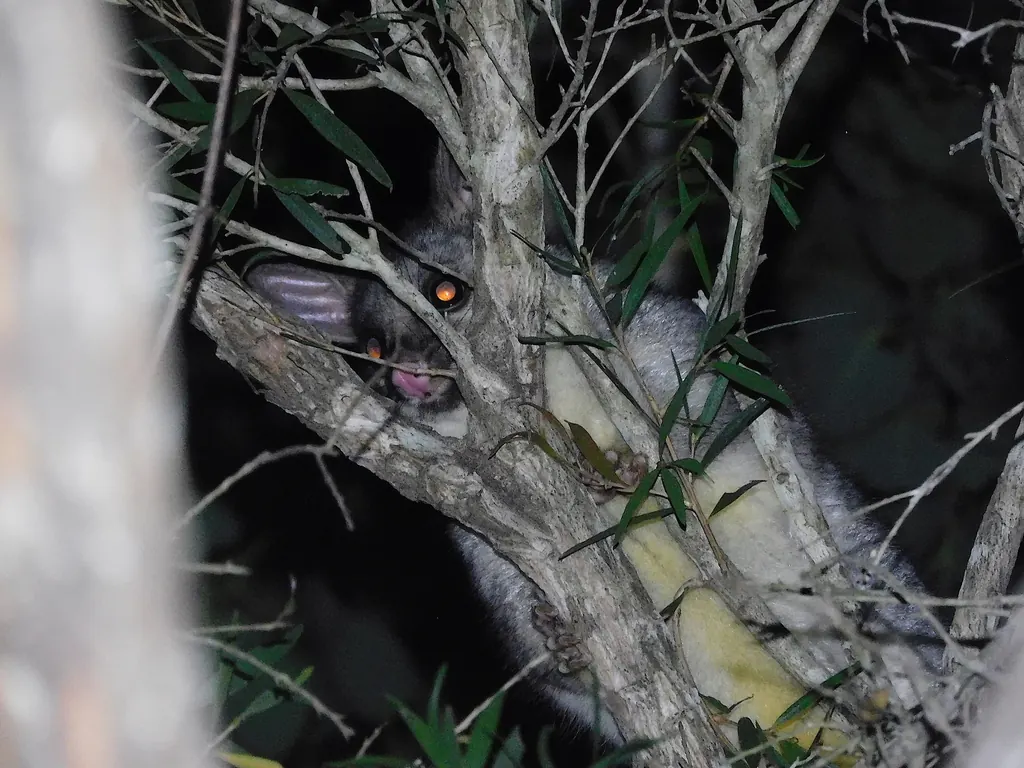
yawa is the possum and bala the 'feathertail glider or sugar glider', the small animals of the night in the hollows of the woodland[1]. The possum of the Mitchell is the common brushtail, Trichosurus vulpecula, 'a nocturnal, semiarboreal marsupial', 32–58 cm in the body with a tail of 24–40 cm, 1.2–4.5 kg, with a prehensile tail and a diet of eucalypt leaves, flowers, fruit and the odd insect, which dens by day 'in natural places such as tree hollows and caves, but also use spaces in the roofs of houses'[2]. Roth's hunting note is the plainest on these pages: possums 'can be hunted at night by sight, provided of course the moon is up, or by dogs: during the day-time, the freshly-made claw-marks are looked for on the tree-butts in the hollow trunk or branch of which the animal is camping'[3]. Its fur was spun into twine on the middle Palmer, and its skin cloaks were a lost art by 1910[4][5]. Across the north the northern brushtail is in retreat 'towards areas of higher rainfall, lower fire frequency, and higher vegetation cover'[2].
Nothing is written for the Eastern coast on this page yet. What follows is true across the country.
Hann River Cape York
Possum People's country on the upper river and Thaypan (Kuku Thaypan) country downstream: stringybark and bloodwood woodland and a spring-fed sandy river that runs north-east from the Great Dividing Range, past the Peninsula Developmental Road, into Rinyirru (Lakefield) and the North Kennedy. Not Kuku Yalanji country: the Kuku Yalanji words on this page are the dictionary's, not the Hann's own languages. Place guide
The upper Hann is the country of the Possum People, whose native title the Federal Court recognised in November 2023[16]; the name is theirs, and what it holds belongs to them. Kuku Thaypan, the language of the middle and lower Hann, calls the brushtail possum Nye Looun, also written Neh Looun[17]. The Elders count it among the animals 'once known to have existed in higher numbers' in their country[17].
Which possums live here
In a box of about 90 × 85 km around the middle Hann, Laura and western Rinyirru, the Atlas of Living Australia holds only 3 records of the common brushtail (1993–2017), 7 of Krefft's glider (1993–2024) and 3 of the squirrel glider (1995–2002), and none of the ringtail[18]. In Kuku Thaypan country the boxwood woodland, Ku arronga, provides 'nesting hollows for a range of animals such as the common brush tail possum'[17].
The possum year here
The Elders burn for possums. 'In Boxwood communities' possum breeding season and tree flowering times are considered before burning', and 'it is important to protect developing boxwood flowers through cool burns in the early dry season as they are an important food resource for possums'[17]. Bloodwoods 'were burnt to produce new shoots for possums at important times of year in their breeding cycles, the result not only that possums were fat but populations were sufficiently healthy to breed productively'. Their calendar marks autumn with 'Healthy Possums'[17].
How the people of this country dealt with them
Reading the bloodwood. A young bloodwood leaf, broken across, tells whether the possums are fat: 'If the gum appears between the broken leaf then the possums were to be fat at that time'; the gum is expected 'in the June - July months of the year'. Elder Dr George Musgrave Snr, 2003: 'Bloodwood tell you the fat that possum. You go out and find a minya you kill him they all fat'[17].
Law. 'In Kuku Thaypan law possums were not killed in front of other possums they were taken away so that their kin could not hear their passing. This also acted to ensure that there was on going trust between humans and possums'[17].
On country today
The upper Hann's native title is held by the Possum Aboriginal Corporation, and the Thaypan country downstream by the Awu-Laya Indigenous Corporation[16][19]. Native title holders may hunt for personal, domestic and non-commercial communal needs without a licence[20]; everyone else needs the Traditional Owners' permission to be on their country.
Language
Kuku Thaypan (Awu Alaya): Nye Looun, Neh Looun 'common brushtail possum'[17]. This is not a Kuku Yalanji word; the dictionary's is yawa.
Upper Mitchell Western Yalanji
Western Yalanji country west of the Great Dividing Range: dry open woodland cut by the sandy, paperbark-lined upper Mitchell River, around Karma Waters and Mount Carbine. Place guide
Within 60 km of Karma Waters the Atlas has the brushtail twenty-four times, the ringtail six, the yellow-bellied glider thirty-two, the sugar glider sixteen, Krefft's glider eight and the squirrel glider six; Roth's spotted 'opossum', the quoll, has twenty-five[6].
Where they live here
On Karma Waters the possums' country is the river's paperbark and gum fringe and the old hollow-bearing trees of the woodland, the ironbarks and bloodwoods that the fire has spared[8].
Hollow trees here
Cutting a hollow tree on the station is a matter for the lessee's permission and kills a hollow it took a century to make[21][8].
On country today
Possums are in the Karma Waters river trees and roofs, and fewer in the burnt woodland than they were; the four gliders are the sign that the old trees are still there[6][2]. The Western Yalanji names for the ringtail and the big glider, if they differ from yawa and bala, are for the contribution box below[1].
Everywhere
Names
yawa 'possum'; bala 'feathertail glider or sugar glider'[1]. Roth's Koko-minni of the middle Palmer called possum-hair and kangaroo-hair twine alike alnjo[4]. The brushtail's scientific name is 'from the Greek for "furry tailed" and the Latin for "little fox"'; the northern form is the subspecies arnhemensis and the Cape York form eburacensis[2].
The possums and gliders
Common brushtail possum. 'A nocturnal, semiarboreal marsupial'. 'Like most possums, the common brushtail possum is nocturnal. It is mainly a folivore, but has been known to eat small mammals such as rats. In most Australian habitats, eucalyptus leaves are a significant part of the diet, but rarely the sole item eaten. Its tail is prehensile and naked on its lower underside.' 'The common brushtail possum has a head and body length of 32–58 cm with a tail length of 24–40 cm. It weighs 1.2–4.5 kg. Males are generally larger than females.' 'It prefers Eucalyptus leaves, but also eats flowers, shoots, fruits, and seeds. It may also consume animal matter such as insects'. 'It has a mostly solitary lifestyle, and individuals keep their distance with scent markings (urinating) and vocalisations. They usually make their dens in natural places such as tree hollows and caves, but also use spaces in the roofs of houses.' 'The common brushtail possum can breed at any time of the year, but breeding tends to peak in spring, from September to November, and in autumn, from March to May'[2].
'The northern subspecies of the common brushtail possum has declined substantially, with one study in Australia's Northern Territory finding a 22% reduction in the extent of occurrence ... Analysis of contemporary occurrence points suggested that the species is contracting towards areas of higher rainfall, lower fire frequency, and higher vegetation cover'[2].
Ringtail and gliders. The common ringtail possum, smaller, grey, with a white-tipped tail carried in a coil; the yellow-bellied glider, the biggest glider, which cuts V-shaped notches in gum bark for the sap; the sugar glider, Krefft's glider and the squirrel glider, the small bala that sail between the trees after blossom, sap and insects[6][1].
Roth's hunting note. 'Opossums can be hunted at night by sight, provided of course the moon is up, or by dogs: during the day-time, the freshly-made claw-marks are looked for on the tree-butts in the hollow trunk or branch of which the animal is camping. In the Rockhampton district it would appear that in the absence of claw-marks, the presence of mosquitoes flying in and out of a hole is a very likely indication of an opossum or native bear in an otherwise unsuspected tree. The ring-tailed spotted opossum, black with white spots, is tracked not only by its claw-marks, but also by its scent, which is as strong-smelling as a pole-cat's'; that last is the quoll[3].
Possum, glider, quoll, flying fox
- Brushtail: big, grey to copper, a black bushy tail, pink nose, in the hollows and the roofs; a growl and a hiss at night[2].
- Ringtail: smaller, with a thin white-tipped tail held coiled; a drey of leaves or a hollow[6].
- Gliders: a membrane from wrist to ankle, a flat furred tail; the yellow-bellied glider is possum-sized and loud, the sugar and squirrel gliders a hand long[6].
- Northern quoll: Roth's 'ring-tailed spotted opossum', black-brown with white spots, a hunter not a leaf-eater, and smelling 'as strong as a pole-cat's'[3].
- Flying foxes: in the blossom at night too, but hanging, and on wings[7].
Signs
- Fresh claw marks on the butt and trunk of a hollow tree, which is Roth's sign and the one that still works[3].
- Mosquitoes going in and out of a hole in a tree by day, Roth's Rockhampton sign[3].
- Droppings at the base of a den tree, and the smell of urine on the trunk: 'scent markings'[2].
- V-cut notches bleeding sap on a gum: the yellow-bellied glider[6].
- Eye-shine and a growl in the torch at night; a crash in the camp roof[2].
Where they live
'A variety of habitats, such as forests, semi-arid areas and even cultivated or urban areas', but 'mostly a forest inhabiting species', and in the north retreating to wetter, denser, less-burnt country[2]. The gliders need the same hollows and the blossom[6].
The hollow's night shift
The possums and gliders are the hollow-tree animals, and the hollows are made over a century by kino, termites and fire in the old bloodwoods and ironbarks; cut the old trees or burn them hot and the possums go with them, which is what the northern decline shows[2][8]. At night they eat leaf, blossom, fruit and sap; the carpet python eats them in the hollows, the owls and the quoll hunt them, and the dingo takes them on the ground[2][9]. A camp with a roof and food is a possum's den and larder, as Roth's note and every station kitchen knows[2].
Seasons
Breeding peaks in spring, September to November, and in autumn, March to May; the young ride the mother's back through the dry[2]. The moonlit nights of the dry are the hunting nights, and the fire season is the possum's hazard[3][10]. See the year on country.
Uses
- Meat, hunted by moonlight or dogs at night, or dug out of the hollow by day[3].
- Twine from 'the soft down from the belly of the animal', spun with a spindle on the thigh on the middle Palmer, for apron-belts and waist-belts; in the west the possum-string was 'both greased and raddled', the grease to keep the vermin off[4].
- Skin cloaks in the south, thirty or forty skins sewn with sinew; 'now a lost art in Queensland' by 1910[5].
- Trade: 'opossum-string armlets' were among the goods that came into the Cape Grafton trade from the south[11].
Finding a possum
From Roth[3]:
- By day, walk the hollow trees and look for 'the freshly-made claw-marks ... on the tree-butts'; fresh scratches with the bark still bright mean the hollow above is in use.
- Check for mosquitoes going in and out of a hole in a tree with no claw marks[3].
- By night, with the moon up, by sight along the river trees and the blossom; or with dogs[3].
- Getting it out of a hollow: the axe and the climbing method on the native bees page were the same for possums; the Bloomfield people cut steps in trees to climb them[12].
- Cook it whole on the coals or in the earth oven, fur singed off first[12].
- Keep the belly fur if you want twine; see string and twine[4].
Safety
- Possums and gliders are protected wildlife in Queensland; native title holders hunting for personal, domestic or non-commercial communal needs are covered by section 211 of the Native Title Act 1993[13][14][15].
- The northern brushtail is in decline; a hollow tree with a possum in it is worth more standing[2].
- A cornered brushtail bites and claws hard.
Language
yawa 'possum'; bala 'feathertail glider or sugar glider'; the night words are on the woodland page[1].
References
- Hershberger, H. D. & Hershberger, R. (1982). Kuku-Yalanji Dictionary. Work Papers of SIL-AAB, Series B, Volume 7. With Toby Bloomfield, Roy Friday, Billy Roberts, Hector and Doris Sykes, Joe Walker and others. www.sil.org/resources/archives/18038
- Wikipedia. Common brushtail possum (Trichosurus vulpecula), including the northern subspecies' decline (von Takach et al. 2020). en.wikipedia.org/wiki/Common_brushtail_possum
- Roth, W. E. (1901). North Queensland Ethnography, Bulletin No. 3: Food — its search, capture, and preparation. Brisbane: Government Printer. Bloomfield River information from the Hislops. — Sect. 6 'Cooking'; plant list ('Castanospermum australe', 'Dioscorea sativa', 'Elettaria Scottiana', 'Nymphaea') archive.org/details/northqueensland00landgoog
- Roth, W. E. (1901). North Queensland Ethnography, Bulletin No. 1: String, and other forms of strand: basketry-, woven bag-, and net-work. Brisbane: Government Printer. — Sects. 1–9: animal and vegetable string, plant list ('Ficus', 'Hibiscus', 'Panicum trachyrachis', 'Sterculia quadrifida'), manufacture of fibre-twine, knots, colouring; sect. 22 hour-glass nets archive.org/details/northqueensland00landgoog
- Roth, W. E. (1910). North Queensland Ethnography, Bulletin No. 15: Decoration, deformation, and clothing. Records of the Australian Museum 8(1). — Sect. 56, bark blankets (Atherton) archive.org/details/biostor-52864
- Atlas of Living Australia. Occurrence records within 60 km of the Karma Waters homestead (16.62° S, 144.60° E), species counts for Animalia (accessed 10 October 2026). biocache.ala.org.au/occurrences/search?q=*:*&lat=-16.62&lon=144.60&radius=60
- Wikipedia. Little red flying fox. en.wikipedia.org/wiki/Little_red_flying_fox
- Queensland Herbarium, Regional Ecosystem 9.11.26 (Einasleigh Uplands): Eucalyptus leptophleba and/or E. cullenii and/or Corymbia clarksoniana +/- E. platyphylla woodland on undulating terrain to rolling hills. Fire management guidelines. Queensland Government Regional Ecosystem Description Database. apps.des.qld.gov.au/regional-ecosystems/details/?re=9.11.26
- Wikipedia. Morelia spilota (carpet python). en.wikipedia.org/wiki/Morelia_spilota
- Queensland Parks and Wildlife Service (2013). Planned Burn Guidelines: Cape York Peninsula Bioregion of Queensland. Department of National Parks, Recreation, Sport and Racing. — 'Fire in the monsoonal tropics of the Cape York Peninsula bioregion'; ch. 1–2 season guidance (storm burns) parks.desi.qld.gov.au/__data/assets/pdf_file/0019/151480/pbg-cape-york.pdf
- Roth, W. E. (1910). North Queensland Ethnography, Bulletin No. 14: Transport and Trade. Records of the Australian Museum 8(1). — Sects. 14–15, dug-out canoes from the Flinders Group to Cape Grafton archive.org/details/biostor-52863
- Anderson, C. (1996). Traditional material culture of the Kuku-Yalanji of Bloomfield River, North Queensland. Records of the South Australian Museum 29(1): 63–83. Based on fieldwork at Wujal Wujal in the late 1970s and early 1980s. — Hunting (spears, spear-throwers, harpoons); fishing (stupefacients); manufacturing (gums and resins); post-contact bush component archive.org/details/RecordsSouthAus29Sout
- Queensland Government, State of the Environment. Nature Conservation Act 1992. www.stateoftheenvironment.des.qld.gov.au/biodiversity/management-responses/legislation/nature-conservation-act-1992
- Australian Law Reform Commission. Review of the Native Title Act 1993 (DP 82), ch. 8: Relevant provisions in the Native Title Act (s 211). www.alrc.gov.au/publication/review-of-the-native-title-act-1993-dp-82/8-the-nature-and-content-of-native-title/relevant-provisions-in-the-native-title-act/
- Western Yalanji Aboriginal Corporation & CRC for Developing Northern Australia (2020). Western Yalanji Land Use and Economic Diversification Plan. CC BY 4.0. — Native Title Determinations 1–4 (pp. 13–18); ‘Fire Management and Carbon Farming’ (pp. 32–33); ‘Pastoralists’ crcna.com.au/wp-content/uploads/2024/05/westernyalanjilanduseplan_nov2020.pdf
- Ross on behalf of the Cape York United #1 Claim Group v State of Queensland (No 21) (Possum determination) [2023] FCA 1316 (Federal Court of Australia, 2 November 2023). — Determination area (upper Hann and Kennedy rivers); prescribed body corporate; affidavit evidence on hunting and fishing www.judgments.fedcourt.gov.au/judgments/Judgments/fca/single/2023/2023fca1316
- Standley, P.-M. (2019). The importance of campfires to effective conservation. PhD thesis, James Cook University. Records the fire and country knowledge of Kuku Thaypan Elders Dr Tommy George and Dr George Musgrave. researchonline.jcu.edu.au/64274/
- Atlas of Living Australia. Occurrence records of possums and gliders: common brushtail possum Trichosurus vulpecula (3 records, 1993–2017), Krefft's glider Petaurus notatus (7, 1993–2024) and squirrel glider Petaurus norfolcensis (3, 1995–2002); no ringtail possum records in a box of about 90 × 85 km around the middle Hann River, Laura and western Rinyirru (lat −15.6 to −14.8, long 143.5 to 144.3), queried 28 October 2026. biocache.ala.org.au/occurrences/search?q=*:*&fq=decimalLatitude:%5B-15.6%20TO%20-14.8%5D&fq=decimalLongitude:%5B143.5%20TO%20144.3%5D
- Ross on behalf of the Cape York United #1 Claim Group v State of Queensland (No 20) (Thaypan determination) [2023] FCA 1315 (Federal Court of Australia, 2 November 2023). — Determination area and waters; prescribed body corporate (Awu-Laya Indigenous Corporation); affidavit evidence on hunting www.judgments.fedcourt.gov.au/judgments/Judgments/fca/single/2023/2023fca1315
- Native Title Act 1993 (Cth), section 211: preservation of certain native title rights and interests (hunting, fishing and gathering for personal, domestic or non-commercial communal needs). www.legislation.gov.au/C2004A04665/latest/text
- Karma Waters Station. About: location, native title (web page, accessed 5 October 2026). www.karmawatersstation.com/about.html
From the community
Know this one? Add the words you use for it, what it is for, how it is done, a correction, or a photo from country. It shows here straight away with your name on it. Please keep anything restricted or sacred off the site.
Loading…