Trees
Mangroves
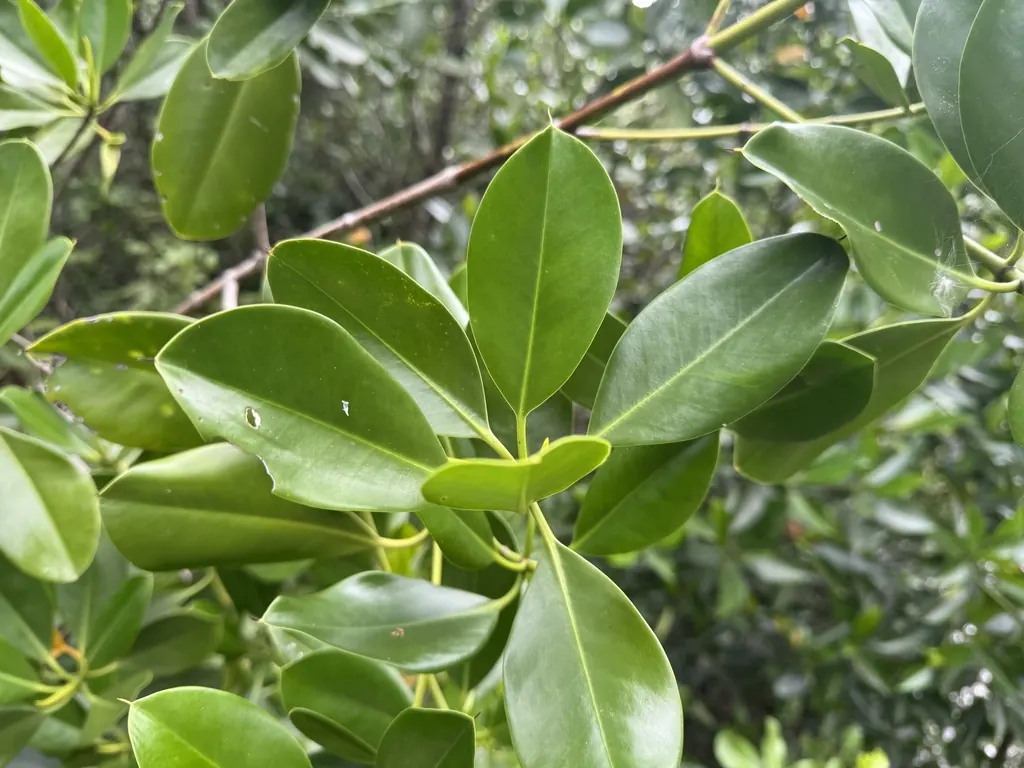
The dictionary has a mangrove for every use and no botany: kajul, 'a long thin fruit which must be soaked in water to make it edible'; kakaji, 'a short thin fruit which becomes edible by leaching out the poison'; marril, 'with apple-like seed only much bigger. The wood is hard and is good for making oars'; miyilabu, 'a poisonous sap which makes people blind'; kurubarr and kurunkal 'with a long round seed'; and mangkurru, the English word borrowed[1]. Those are, in order, the orange mangrove whose green propagules are 'eaten after scraping, washing, drying and cooking to remove tannins' across the north, the cannonball mangrove Xylocarpus that Anderson's informants made paddles from, and the blind-your-eye mangrove Excoecaria whose latex 'can cause temporary blindness' and whose smoke Kuku Yalanji said does the same[2][3][4]. Mangroves are the trees of the tidal mud, and the crabs, oysters and young fish of the coast live among their roots[3].
Hann River Cape York
Possum People's country on the upper river and Thaypan (Kuku Thaypan) country downstream: stringybark and bloodwood woodland and a spring-fed sandy river that runs north-east from the Great Dividing Range, past the Peninsula Developmental Road, into Rinyirru (Lakefield) and the North Kennedy. Not Kuku Yalanji country: the Kuku Yalanji words on this page are the dictionary's, not the Hann's own languages. Place guide
Mangroves do not grow on the Hann. It is a fresh-water river from its springs to where it joins the North Kennedy[16]. The mangroves of its country are far downstream, where the Kennedy and the Normanby reach the sea: 'Salt flats and fringing mangroves are common in the tidal zones around Princess Charlotte Bay'[17].
What you will see instead here
The Atlas of Living Australia holds no mangrove records in a box of about 90 × 85 km around the middle Hann, Laura and western Rinyirru; its one Excoecaria is Excoecaria parvifolia, an inland species, from 1970[18]. The 'mangrove' of the inland waterholes is the freshwater mangrove (Barringtonia acutangula), a different tree: Rinyirru lists it among the riverine plants of its deep waterholes with 'paperbarks, weeping tea trees and corypha palms'[17], and Kuku Thaypan Elders' country notes record it as common in perennial swamps[19]. It is on the fish poison plants page.
Where the mangroves are in this country
Down on the coast, 'Mangrove forest dominates the coastal flats and saltpans in the northern coastal sections' of Rinyirru, and low mangrove forest grows around Princess Charlotte Bay, including Excoecaria agallocha and Aegiceras corniculatum scrub[20]. Rinyirru's Traditional Owners are the Lama Lama and Kuku Thaypan peoples[17], and Kuku Thaypan Elders record that heath and mangroves occur on their boundary with the Lama Lama at Low Lake[19].
How people used them here
No published record from the Possum, Thaypan or Kuku Warra peoples of the Hann describes using mangroves, and none was found for the Lama Lama coast; Roth's mangrove-food records come from Cape Bedford, Cooktown and the Pennefather, not from Princess Charlotte Bay[8]. See the general sections for how mangroves were used elsewhere.
Language
Kuku Thaypan (Awu Alaya) names the river mangrove (Aegiceras corniculatum) angganh[21].
Upper Mitchell Western Yalanji
Western Yalanji country west of the Great Dividing Range: dry open woodland cut by the sandy, paperbark-lined upper Mitchell River, around Karma Waters and Mount Carbine. Place guide
The mangroves are the sea country of the Eastern Kuku Yalanji, the Bloomfield and Daintree coast; that is a long way from Karma Waters on the upper Mitchell, and they matter here because the words, the trade and the tools reach inland. On the Mitchell the nearest mangroves are at its mouth, two hundred kilometres downstream; the river's 'freshwater mangrove' is a different tree, on the fish poison plants page.
Where they grow here
On the Mitchell the mangroves are at its mouth on the Gulf, Kokoberra and Yir Yoront country[5].
Eastern coast Eastern Kuku Yalanji
Eastern Kuku Yalanji country: rainforest, beaches, mangroves, reef and the short steep rivers from the Daintree to the Bloomfield and the Annan.
The mangroves are the Bloomfield's larder and hardware store: the mud crab, the oysters on the roots, the mangrove worm in the dead trunks, the stingray on the flats, the harpoon shaft of Rhizophora, and the canoe hull of the milky mangrove on the Endeavour[3][5].
Where they grow here
On the Bloomfield they are the 'mangrove areas at the mouth and on the several islands in the Bloomfield River'[3].
On country today
The Eastern Kuku Yalanji's plan for their country names the mangroves and mudflats as breeding areas to protect, and the rangers at Wujal Wujal patrol them[10][22].
Everywhere
Names
mangkurru 'mangrove (english loan word)'. kajul 'species of mangrove. A long thin fruit which must be soaked in water to make it edible'. kakaji 'species of mangrove with a short thin fruit which becomes edible by leaching out the poison'. marril 'species of mangrove, with apple-like seed only much bigger. The wood is hard and is good for making oars'. miyilabu 'species of mangrove. It has a poisonous sap which makes people blind'. kurubarr and kurunkal 'species of mangrove with a long round seed'. walbul-walbul is, among other things, 'species of mangrove, long round seed'[1]. Roth's Endeavour River canoe timbers include the 'milky mangrove' Excoecaria agallocha and Sonneratia, and the Bloomfield turtle-harpoon shaft was the mangrove Rhizophora apiculata[5][3].
The mangroves and their uses
Red or spotted mangrove (Rhizophora stylosa): 'a small to medium-sized evergreen tree ... up to 15 metres tall', on stilt roots, with dark bark and pear-shaped fruit that sprouts on the tree[6]. Its straight poles were the Bloomfield harpoon shaft, 'up to three metres long made from the mangrove Rhizophora apiculata'[3].
Grey mangrove (Avicennia marina): 'a shrub or tree to a height of 3 to 10 m, or up to 14 metres in tropical regions', with 'smooth light-grey bark made up of thin, stiff, brittle flakes' and thick leaves 'silvery-white, or grey' beneath, standing in a field of pencil roots; 'a pioneer in muddy soil'[7].
Orange mangrove (Bruguiera gymnorhiza), kajul or kakaji: 'a mangrove tree that grows usually to 7–20 metres high', 'found on the seaward side of mangrove swamps, often in the company of Rhizophora'. 'The fruit (propagule/hypocotyl) is reported as being eaten after scraping/grating, washing, drying and cooking to remove tannins'; 'the green propagules/hypocotyls are also eaten by many indigenous groups in northern Australia. For example, on northwestern Cape York Peninsula, in the Weipa region, Thaynakwithi people' eat them. 'The wood is widely used, including for firewood, building construction ... canoe parts, fishing stakes, spears'[2]. The dictionary's two leached mangrove fruits are on the leaching page, with Roth's sand-basin method[1][8].
Yellow mangrove (Ceriops tagal): 'a medium-sized tree growing to a height of 25 metres', buttressed, with 'silvery-grey to orangish-brown' bark and glossy yellowish leaves; 'favoured as firewood, being second only to Rhizophora', and 'its bark and sap yield red and black dyes' and tannin[9].
Blind-your-eye or milky mangrove (Excoecaria agallocha), miyilabu: 'The milky latex of Excoecaria agallocha is very poisonous and powerfully irritant ... Contact with skin causes irritation and rapid blistering; slight contact with eyes can cause temporary blindness, hence the common names that refer to blindness. Even the generic name is from the Latin for "blinder"'. 'Burning the wood can release toxic fumes in the smoke leading to eye irritation'; 'even dried and powdered leaves retain the poison and can kill fish quickly'[4]. Anderson: 'a mangrove species, Excoecaria agallocha, produces a smoke which is said by Kuku-Yalanji to produce blindness'[3]. Roth found its light wood in the Endeavour River dug-outs[5].
Cannonball mangrove (Xylocarpus granatum), marril: the paddle wood, 'paddles were made from Xylocarpus granatum', with the big round fruit the dictionary describes as an apple-like seed 'only much bigger'[3][1].
The mangrove's animals. The mud crab, the mangrove worm in the dead logs, the oysters on the roots and rocks, the mullet and bream and barramundi of the creeks, the stingrays on the flats, and the saltwater crocodile; the Traditional Owners' plan calls the mangrove and mudflat areas 'very important breeding areas' for fish and shellfish[3][10]. The mud crab page has the flats.
Telling the mangroves apart
- Stilt roots arching from the trunk: red mangrove[6].
- Pencil roots standing up out of the mud in a field, pale flaky bark, silver leaf undersides: grey mangrove[7].
- Knee roots looping out of the mud, big leaves, a long cigar propagule: orange mangrove, the food one[2].
- Buttresses and yellow-green glossy leaves: yellow mangrove, the firewood[9].
- Milky sap when a leaf is broken, and leaves that turn red before they fall: blind-your-eye; never into the eyes, never on the fire[4].
- A fruit like a cannonball hanging from a smooth-barked tree: cannonball mangrove, the oar wood[1].
- The inland rivers' 'freshwater mangrove' is Barringtonia, a fish-poison tree, not one of these[3].
Signs
- Mud-crab holes under the roots at low tide; see mud crab[3].
- Oysters cemented on the roots and the rocks at the creek mouths[11].
- Dead mangrove trunks soft with worm: the mangrove worm[3].
- A slide and a drag on the mud bank: the crocodile[12].
- Propagules sprouting on the tree and washed up along the strand[6][2].
Where they grow
The tidal creeks and river mouths of the coast: the grey mangrove furthest up the creeks and furthest south, the red mangrove and the orange mangrove toward the sea[7][2].
The nursery
The mangroves hold the mud, feed the creeks with leaf fall, and shelter the young of the fish, the crabs and the prawns; the Traditional Owners' plan names them 'very important breeding areas'[10]. Everything on this coast's food pages comes through them: the mud crab, the oysters, the stingrays, the barramundi and mullet of the creeks, the sea turtle that eats mangrove fruit, and the saltwater crocodile that eats everything else[13][3].
Seasons
The mangrove flats were worked at low tide (ngajal) through the year; mullet ran into the creeks in the late dry; the mangrove fruits were leached when gathered; harpoon shafts and canoe timber were cut with the other timber after the storms[1][3]. See the year on country.
Uses
- Food: orange-mangrove propagules leached and cooked (kajul, kakaji); mangrove worms; and everything that lives among the roots[2][1][3].
- Harpoon shafts of Rhizophora 'up to three metres long'[3].
- Paddles of cannonball mangrove, marril[3][1].
- Canoe hulls of milky mangrove and Sonneratia on the Endeavour[5].
- Firewood: yellow and red mangrove, never blind-your-eye[9][3].
- Dye and tannin from yellow-mangrove bark[9].
- Fish poison: the blind-your-eye's leaves 'can kill fish quickly'; see fish poison plants[4].
Leaching mangrove fruit
From the dictionary, Roth and the Cape York record[1][8][2]:
- Gather the green propagules of the orange mangrove, the long cigar-shaped sprouts, from the tree or the strand[2].
- Scrape or grate them, and wash in changes of water, or soak them in a basin dug in the sand by the swamp, as Roth saw along the coast, 'to leach out the poison'[2][8][1].
- Dry and cook them; the tannins are what the washing removes[2].
- The leaching page has the general method and the sand-basin.
Safety
- Blind-your-eye mangrove: no sap in the eyes, no leaves rubbed on skin, no wood on the cooking fire[4][3].
- Mangrove creeks are the saltwater crocodile's; Be Crocwise[12].
- Mangroves are protected marine plants in Queensland under the Fisheries Act 1994; cutting them needs a permit, and the Traditional Owners' plan and the Marine Park rules apply on sea country[14][10][15].
- Oyster shell cuts; boots on the flats.
On Country today
The dictionary's six mangroves are the useful ones; which botanical trees they are, beyond the three matched here, is for the people who use them[1]. Mangroves are protected marine plants in Queensland (see Safety)[14].
Language
mangkurru 'mangrove'; kajul, kakaji mangroves with leached fruit; marril the oar-wood mangrove; miyilabu the blinding mangrove; kurubarr, kurunkal mangroves with a long round seed; ngajal 'low tide'; bilngkumu 'salt water crocodile'; nganjamu 'worm'[1].
References
- Hershberger, H. D. & Hershberger, R. (1982). Kuku-Yalanji Dictionary. Work Papers of SIL-AAB, Series B, Volume 7. With Toby Bloomfield, Roy Friday, Billy Roberts, Hector and Doris Sykes, Joe Walker and others. www.sil.org/resources/archives/18038
- Wikipedia. Bruguiera gymnorhiza (large-leafed orange mangrove), including its use as food on Cape York Peninsula. en.wikipedia.org/wiki/Bruguiera_gymnorrhiza
- Anderson, C. (1996). Traditional material culture of the Kuku-Yalanji of Bloomfield River, North Queensland. Records of the South Australian Museum 29(1): 63–83. Based on fieldwork at Wujal Wujal in the late 1970s and early 1980s. — Hunting (spears, spear-throwers, harpoons); fishing (stupefacients); manufacturing (gums and resins); post-contact bush component archive.org/details/RecordsSouthAus29Sout
- Wikipedia. Excoecaria agallocha (blind-your-eye mangrove, milky mangrove). en.wikipedia.org/wiki/Excoecaria_agallocha
- Roth, W. E. (1910). North Queensland Ethnography, Bulletin No. 14: Transport and Trade. Records of the Australian Museum 8(1). — Sects. 14–15, dug-out canoes from the Flinders Group to Cape Grafton archive.org/details/biostor-52863
- Wikipedia. Rhizophora stylosa (spotted or red mangrove). en.wikipedia.org/wiki/Rhizophora_stylosa
- Wikipedia. Avicennia marina (grey mangrove). en.wikipedia.org/wiki/Avicennia_marina
- Roth, W. E. (1901). North Queensland Ethnography, Bulletin No. 3: Food — its search, capture, and preparation. Brisbane: Government Printer. Bloomfield River information from the Hislops. — Sect. 6 'Cooking'; plant list ('Castanospermum australe', 'Dioscorea sativa', 'Elettaria Scottiana', 'Nymphaea') archive.org/details/northqueensland00landgoog
- Wikipedia. Ceriops tagal (yellow mangrove). en.wikipedia.org/wiki/Ceriops_tagal
- Yalanjiwarra People & Jabalbina Yalanji Aboriginal Corporation (2016). Nganjinanga Bubu, Nganjinanga Jalun, Nganjinanga Bama Plan: Our Land, Our Sea, Our People Plan 2016–2021. Eastern Kuku Yalanji Indigenous Protected Area Management Plan, Stage 3. Mossman: Jabalbina. — Sections 4, 7.9 (Wrong fishing and sea hunting), 7.10 and Action 9.2 www.wettropicsplan.org.au/wp-content/uploads/2019/09/Eastern-Kuku-Yalanji-Indgenous-Protected-Area-Management-Plan-Stage-3-Yalanjiwarra-Land-and-Sea-Country.pdf
- Wikipedia. Saccostrea cucullata (hooded or rock oyster). en.wikipedia.org/wiki/Saccostrea_cucullata
- Queensland Government. Be Crocwise top tips; Be Crocwise in Croc Country (web pages, accessed 5 October 2026). www.qld.gov.au/environment/plants-animals/animals/living-with/crocodiles/becrocwise/be-crocwise-top-tips
- Great Barrier Reef Marine Park Authority. Marine turtles (web page, accessed 5 October 2026). www2.gbrmpa.gov.au/learn/animals/marine-turtles
- Fisheries Act 1994 (Qld), current as at 27 April 2026: s 14 (defence for Aboriginal peoples and Torres Strait Islander peoples). www.legislation.qld.gov.au/view/html/inforce/current/act-1994-037
- Great Barrier Reef Marine Park Authority. Traditional use of the Marine Park; Traditional Use of Marine Resources Agreements (web pages, accessed 5 October 2026). www2.gbrmpa.gov.au/learn/traditional-owners/traditional-use-marine-resources-agreements
- Wikipedia. Hann River (Queensland) (accessed 28 October 2026). en.wikipedia.org/wiki/Hann_River_(Queensland)
- Queensland Parks and Wildlife Service. Nature, culture and history: Rinyirru (Lakefield) National Park (CYPAL) (web page, last updated 1 July 2024; accessed 28 October 2026). parks.qld.gov.au/parks/rinyirru-lakefield/about/culture
- Atlas of Living Australia. Occurrence records for mangrove genera (Rhizophora, Avicennia, Bruguiera, Ceriops, Sonneratia, Aegiceras, Lumnitzera and Excoecaria) in a box of about 90 × 85 km around the middle Hann, Laura and western Rinyirru (latitude 15.6–14.8° S, longitude 143.5–144.3° E), holding no mangrove records; the only Excoecaria record is one of the inland species Excoecaria parvifolia (1970) (biocache query, accessed 28 October 2026). biocache-ws.ala.org.au/ws/occurrences/search
- Standley, P.-M. (2019). The importance of campfires to effective conservation. PhD thesis, James Cook University. Records the fire and country knowledge of Kuku Thaypan Elders Dr Tommy George and Dr George Musgrave. researchonline.jcu.edu.au/64274/
- Queensland Parks and Wildlife Service (2013). Rinyirru (Lakefield) Aggregation Management Statement 2013. parks.desi.qld.gov.au/__data/assets/pdf_file/0027/165771/rinyirru.pdf
- Hunter-Gatherer Language Database (University of Texas at Austin). Lexical feature 'river mangrove': Kuku-Thaypan (accessed 28 October 2026). huntergatherer.la.utexas.edu/lexical/feature/322
- Australian Geographic (29 September 2021). Daintree handed back to Traditional Owners. www.australiangeographic.com.au/news/2021/09/daintree-handed-back-to-traditional-owners/
From the community
Know this one? Add the words you use for it, what it is for, how it is done, a correction, or a photo from country. It shows here straight away with your name on it. Please keep anything restricted or sacred off the site.
Loading…